


See the Whole Play

August 19, 2014

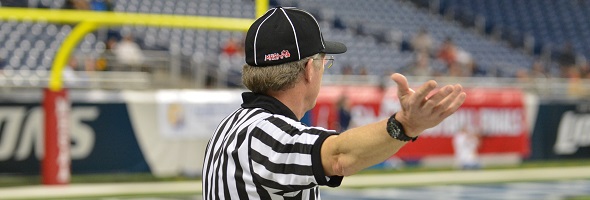
“What I Learned from That Play” was the name given to a session at the National Association of Sports Officials (NASO) Summit in Albuquerque last month. Several prominent officials talked about tough calls they made. One official was telling us of an error made, the other of a correct call; but the message was the same from both: “See the whole play.”

One official described an apparent touchdown reception where the focus of the officials was intent upon whether or not the receiver had a foot inbounds and maintained possession of the ball. Both occurred, but all the officials missed the fact that the receiver’s foot had brushed the pylon at the goal line, which made the pass incomplete regardless of what followed. “In focusing so intently on two key aspects of the play, we missed a detail that overruled the other two.”

“To make the right call we have to avoid narrow focus and be aware of all details,” this college official opined.

The other official described a play in which the quarterback rolled to his left to throw a pass while linemen provided protection. There was a near chop block by the left guard and running back, near hold by the right tackle, and a center/guard double team that had to be observed closely. But there were no penalties called, correctly according to the video the audience was shown.

The play ended with the quarterback heaving a forward pass just as he was being tackled. The referee called him down by contact, before the pass; and the video showed that call to also be correct.

The referee said: “If the officials had fixated on the double team, or the potential hold or the possible chop block, the crew may have missed that the quarterback was down by contact for a seven-yard loss.”

Each official was speaking of the importance of seeing the whole play – all of the key factors. Staying open to all the details.

Game officials must do this over the span of a few seconds or less, but countless times over the course of a contest. Administrators have the luxury of minutes, days, weeks or longer to get it right.

Here are a few more pearls of wisdom from the nation’s leading gathering of sports officials, these from Barry Mano, NASO president:

  • “Incorrect no-calls are easier to explain than incorrect calls.”
  • “Officials are to enforce, not appease.”
  • “In spite of their criticisms, there is no sensible parent who would want their child to participate without officials.”
Law and Order

June 9, 2017

I have no knowledge of the rumored wrongdoing associated with the athletic department at Baylor University except what I’ve read in leaks and news reports for well over a year. One thing I’ve noticed is the different approach the NCAA is taking now compared to its high-profile involvement when the scandalous wrongdoing at Penn State began to surface just a few years ago.

In both situations, we are not talking about violations of rules directly related to the conduct of an intercollegiate athletic program. Apparently in both cases, there are crimes involved, for which society has a system to adjudicate guilt and, if found, to assess penalties.

In the earlier case, the NCAA jumped ahead of the judicial system to find guilt, and it vaulted over its own Handbook to fix penalties. Some of those penalties have since been modified or vacated. They were based on public opinion more than the published policies and procedures for governing NCAA operations.

Perhaps the NCAA’s lower profile now indicates it has learned from its earlier overreach that, however heinous the behavior, some things are beyond the authority and regulatory responsibility of a voluntary, nonprofit athletic association – no matter how powerful it may seem.

While I’m not aware of anything remotely resembling these situations in Michigan high schools, it is not infrequent that the Michigan High School Athletic Association is asked by a well-intentioned person to terminate the athletic eligibility of a student who has broken a public law but not a published rule of his or her local school or the MHSAA. We can’t.

The MHSAA does not have rules that duplicate society’s laws or seek to exceed them. Even with a budget 1,000 times that of the MHSAA, the NCAA has discovered it doesn’t have policies and procedures to do so consistently or well.

We already know that the MHSAA must allow local schools, law enforcement agencies and courts to deal with transgressions away from school sports. Our job is to stay focused on sports and a sub-set of issues that address participant eligibility and safety as well as competitive equity between contestants.

The MHSAA is an organization that cares about young people but recognizes its limitations, both legal and practical. The MHSAA has neither the legal authority nor the resources to be involved in regulating young people and coaches for all things, at all times and in all places. In the area of sports, and especially within the limits of the season and the boundaries of the field of play, the MHSAA does have a role, and it’s to help provide an environment that is sportsmanlike, healthy and consistent with the educational mission of schools.