


See the Whole Play

August 19, 2014

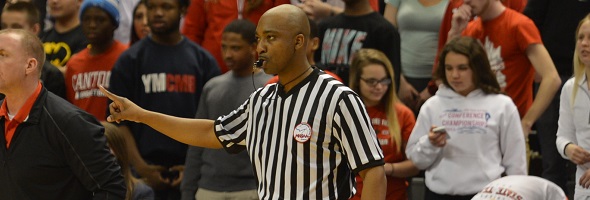
“What I Learned from That Play” was the name given to a session at the National Association of Sports Officials (NASO) Summit in Albuquerque last month. Several prominent officials talked about tough calls they made. One official was telling us of an error made, the other of a correct call; but the message was the same from both: “See the whole play.”

One official described an apparent touchdown reception where the focus of the officials was intent upon whether or not the receiver had a foot inbounds and maintained possession of the ball. Both occurred, but all the officials missed the fact that the receiver’s foot had brushed the pylon at the goal line, which made the pass incomplete regardless of what followed. “In focusing so intently on two key aspects of the play, we missed a detail that overruled the other two.”

“To make the right call we have to avoid narrow focus and be aware of all details,” this college official opined.

The other official described a play in which the quarterback rolled to his left to throw a pass while linemen provided protection. There was a near chop block by the left guard and running back, near hold by the right tackle, and a center/guard double team that had to be observed closely. But there were no penalties called, correctly according to the video the audience was shown.

The play ended with the quarterback heaving a forward pass just as he was being tackled. The referee called him down by contact, before the pass; and the video showed that call to also be correct.

The referee said: “If the officials had fixated on the double team, or the potential hold or the possible chop block, the crew may have missed that the quarterback was down by contact for a seven-yard loss.”

Each official was speaking of the importance of seeing the whole play – all of the key factors. Staying open to all the details.

Game officials must do this over the span of a few seconds or less, but countless times over the course of a contest. Administrators have the luxury of minutes, days, weeks or longer to get it right.

Here are a few more pearls of wisdom from the nation’s leading gathering of sports officials, these from Barry Mano, NASO president:

  • “Incorrect no-calls are easier to explain than incorrect calls.”
  • “Officials are to enforce, not appease.”
  • “In spite of their criticisms, there is no sensible parent who would want their child to participate without officials.”
Inside Information

September 25, 2015

The source you choose selects your news.

If your source is Fox News, you will get different stories than from ABC, CBS and NBC, and different slants on the same stories.

If your source is publicly supported radio, the news stories will be different than on commercial radio stations; and if you choose Public Radio International, you will hear some topics that are much more frequently and deeply covered than by National Public Radio.

PRI is, for example, where I was following the crisis of refugees fleeing from Northern Africa to Europe long before that story became headlines for other news sources. Did you know, for example, that there are more displaced people in the world today than at any time except World War II?

Similarly, if I were to listen only to coaches of one sport or another, I’m likely to learn about issues that affect that sport, but not much about issues that affect other sports, or affect schools as a whole. Our sources must include input from all sports. 

Our sources must also include the perspective of principals who deal with academics more than athletics and who are as attentive to the essential needs of harassed, homeless, displaced and disabled students as they are to the athletic desires of gifted and talented students.

And our sources must include the even broader perspective of superintendents who are fighting for the financial life of their districts. Sometimes that means they are throwing open the doors of their schools and recruiting students from far and wide to replace the dwindling school age children of their local population.

Ours is an association of schools. Not an association of football coaches, or of all coaches. Ours is an association of schools whose directions are determined by blending top-down with in-the-trenches views.

From our vantage point at the Michigan High School Athletic Association we do not learn about everything happening in our state’s secondary schools. But from the myriad calls, emails and letters we receive and the many meetings we have with administrators, coaches, officials and students, we know much more than those who are on the outside looking in.