


Sportsmanship and Success in Soccer
August 16, 2012
Ralph Polson, president of the National Soccer Coaches Association of America (NSCAA), reports in the July/August 2012 Soccer Journal that there is a strong statistical link between sportsmanship and success in intercollegiate soccer. He cites the work of Tim Lenahan, head men’s coach at Northwestern University, who compiled total fouls, yellow cards and red cards for the 2011 season to create a “Fair Play Rating” (FPR).
Polson reports that 12 of the 20 teams with the top FPR made the NCAA tournament, while only one of the teams in the bottom 20 did. Of course, this is a statistical link, not necessarily cause and effect. But here’s how Mr. Polson concludes his column:
“How should we interpret this data? One direction is toward more disciplined teams. It seems to me the more a culture of sportsmanship and fair play is established, the more likely any team is to demonstrate the consistency needed for success. The data suggests those teams without entrenched standards, with respect to on-field behavior, should anticipate a higher likelihood of failure in today’s highly competitive environment.
“Play within the spirit of the game and more than just a win may be gained; play against the spirit of the game and much more than just a game may be lost.”
Dr. Brian Crossman, chair of the NSCAA Ethics Committee, contributes this to the discussion in the same issue of Soccer Journal:
“A five year study from 2007 to 2011 of almost 4,700 intercollegiate soccer matches in which only one player was red-carded during the match showed a strong likelihood that the player’s team would lose. Teams that had one player red-carded lost 67 percent of the matches, tied 10 percent of the matches and won 23 percent of the matches. In other words, a team that had a player red-carded at any time during the match was three times more likely to lose the match than win it. Taking steps to encourage clean and fair play, and thus to reduce the likelihood of having players ejected, will pay dividends in sportsmanship and should improve your team’s won-loss record.”
For more, go to www.nscaa.com.
BOTF Semifinalists: Accept the Challenge
January 16, 2018
By Geoff Kimmerly
Second Half editor
The bigger battle is coming. Contenders now must prove they are up to the challenge.
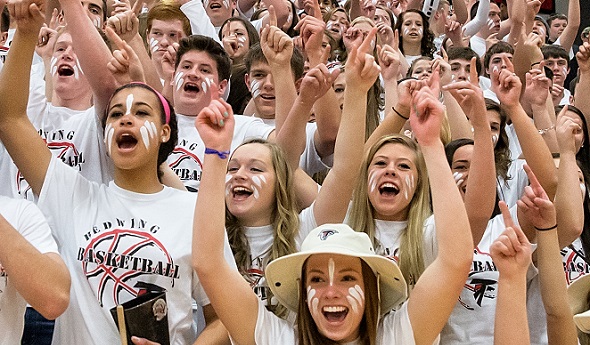
Nine student cheering sections from MHSAA member schools have been selected to continue on in this year’s “Battle of the Fans VII” contest by taking part in an inaugural “Challenge Round” as they vie for this year’s championship recognizing the top section in our state.
This year’s nine semifinalists are Cedar Springs, Petoskey and Traverse City West from Class A, Boyne City, Buchanan and Charlotte from Class B, and Munising, Negaunee and Pellston from Class C/D.
Battle of the Fans, organized by MHSAA staff and its 16-member Student Advisory Council, was revamped this year to allow for more schools to remain in title contention past the application round. As in past years, schools again were invited throughout the fall to submit short videos, via YouTube, of their cheering sections in action, with the deadline Jan. 13. However, instead of then choosing five finalists as in past years, the Advisory Council selected nine semifinalists to accomplish a list of tasks showing off their sections over the next 12 days – and the Council will then select three finalists for MHSAA visits.
This year’s winner will be announced Feb. 23 and recognized March 23 at the Breslin Center.
Semifinalists are required to complete 10 challenges via their social media channels by 11 p.m. Jan. 27. Five mandatory challenges focus on contest criteria: positive sportsmanship, student body participation, school spirit, originality of cheers, organization of the group, student section leadership and overall fun.
Five elective challenges (taken from a list of 15 opportunities) will allow semifinalists more opportunities to show the unique characteristics that make their sections elite. Click for descriptions of all 20 challenges.
“Our Student Advisory Council wanted to keep more of these great student sections involved in Battle of the Fans longer, and also make sure our best sections were showing their best on more than just the days they applied and we visited,” said Andy Frushour, MHSAA director of brand management and advisor to the Student Advisory Council. “The ‘Challenge Round’ sets up a true competition as these nine schools watch and try to outdo each other’s best work over the next 12 days. We’re excited to watch them step up their games to answer the competition.”
Below is a playlist of all 19 application videos. Click to see each individually.
A total of 19 schools applied for this year’s contest – seven from Class A schools, six from Class B, four from Class C and two from Class D. Three semifinalists each were selected from the Class A, Class B and Class C/D applicants.
The Student Advisory Council will select the finalists for announcement Jan. 29 on Second Half. MHSAA staff and Student Advisory Council members will visit all three finalists for home basketball games during the second half of this regular season, with coverage and video from those visits and the announcement of the winner all to be published on Second Half.
The winner will be selected by another Advisory Council vote based in part on activity on the MHSAA’s social media sites. All social media postings regarding Battle of the Fans VII should include the hashtag #BOTF. The MHSAA will share semifinalists’ challenge posts over the next two weeks on its Facebook, Twitter and Instagram sites and Snapchat feed. The MHSAA also will post from the three finalists visits on those channels.
This year’s applicants brought the total number of schools that have entered the contest at least once to 91, with Ann Arbor Gabriel Richard – a finalist in 2013 – the only school to apply all seven years.
Among semifinalists, Buchanan and Traverse City West both have applied five times and Petoskey has applied four. Charlotte has applied three times, and Boyne City, Cedar Springs and Munising all have applied twice. Negaunee and Pellston were two of six first-time applicants, as were Coldwater, Elkton-Pigeon-Bay Port Laker, Essexville Garber and Mason.
Buchanan was named BOTF champion in 2013, and Traverse City West earned the title in 2016. Boyne City, Charlotte, Munising and Petoskey also have been selected as finalists in the past.
The contest is sponsored in part by the United Dairy Industry of Michigan, which promotes Michigan's locally-produced dairy products and nutrition education. Rules plus links to past years’ coverage of the contest can be found on the MHSAA website.
The Student Advisory Council is made up of eight seniors and eight juniors who each serve two-year terms. The Council acts as the voice of Michigan's student-athletes; it serves as a student sounding board for the MHSAA's Representative Council, assists in planning Sportsmanship Summits, Captains Clinics and other student leadership events; participates in a yearly focus group about the state of high school sports for Michigan State University's Institute for the Study of Youth Sports and assists with medal ceremonies at MHSAA championship events.
PHOTO: St. Johns fans cheer on their boys basketball team during the 2015 Battle of the Fans finalists tour.