


Sportsmanship and Success in Soccer
August 16, 2012
Ralph Polson, president of the National Soccer Coaches Association of America (NSCAA), reports in the July/August 2012 Soccer Journal that there is a strong statistical link between sportsmanship and success in intercollegiate soccer. He cites the work of Tim Lenahan, head men’s coach at Northwestern University, who compiled total fouls, yellow cards and red cards for the 2011 season to create a “Fair Play Rating” (FPR).
Polson reports that 12 of the 20 teams with the top FPR made the NCAA tournament, while only one of the teams in the bottom 20 did. Of course, this is a statistical link, not necessarily cause and effect. But here’s how Mr. Polson concludes his column:
“How should we interpret this data? One direction is toward more disciplined teams. It seems to me the more a culture of sportsmanship and fair play is established, the more likely any team is to demonstrate the consistency needed for success. The data suggests those teams without entrenched standards, with respect to on-field behavior, should anticipate a higher likelihood of failure in today’s highly competitive environment.
“Play within the spirit of the game and more than just a win may be gained; play against the spirit of the game and much more than just a game may be lost.”
Dr. Brian Crossman, chair of the NSCAA Ethics Committee, contributes this to the discussion in the same issue of Soccer Journal:
“A five year study from 2007 to 2011 of almost 4,700 intercollegiate soccer matches in which only one player was red-carded during the match showed a strong likelihood that the player’s team would lose. Teams that had one player red-carded lost 67 percent of the matches, tied 10 percent of the matches and won 23 percent of the matches. In other words, a team that had a player red-carded at any time during the match was three times more likely to lose the match than win it. Taking steps to encourage clean and fair play, and thus to reduce the likelihood of having players ejected, will pay dividends in sportsmanship and should improve your team’s won-loss record.”
For more, go to www.nscaa.com.
Sportsmanship Salutes: EGR & Pellston
September 27, 2017
By Geoff Kimmerly
Second Half editor
We love telling stories of our athletes and coaches showing good sportsmanship, often sacrificing for others especially in moments when victory appears within grasp.
The East Grand Rapids boys soccer and Pellston girls cross country teams provided us examples again earlier this month of how doing the right thing – regardless of the scoreboard – always leaves the lasting impression.
He shoots, both teams score
On Sept. 12, East Grand Rapids’ boys soccer team trailed Grand Rapids Christian 2-1. The victor would gain a significant upper hand in the Ottawa-Kent Conference Gold race. And these are also two of the best teams in the state; EGR is ranked No. 10 in Division 2 this week, and the Eagles are No. 4.
During the 66th minute, Grand Rapids Christian fired a shot at the East Grand Rapids goal, to the lower corner of the net. The ball continued through and past the goal – apparently missing it completely since the net did not catch the ball.
The two officials closest to the play, unable to rule for certain if the ball traveled inside or outside the goal post, were not going to count a goal. But Pioneers coach A.J. Dufendach saw from his perspective that the Eagles’ shot did indeed score – and he made sure to confirm it to the trailing official, who also believed the ball had crossed inside the post. Only then did the officials award Grand Rapids Christian a goal to make the score 3-1.
With three minutes to play, East Grand Rapids did score a second goal, but the game ended with the Eagles winning 3-2 – although Dufendach and his assistants also showed championship character despite the loss on the scoreboard, as detailed both by the head official in his report to the MHSAA and East Grand Rapids’ opponent.
“In a world where doing whatever it takes to win is the norm, we want to thank EGR for leading with honor and integrity,” Grand Rapids Christian posted as part of its online “Eagle Sport Report.” “Well done coach. You set an unforgettable example of what is most important in educational athletics. Thank you for taking this rivalry to a new level.”
Most memorable finish
The Petoskey News-Review called it “the finish of the day,” and that’s tough to argue.
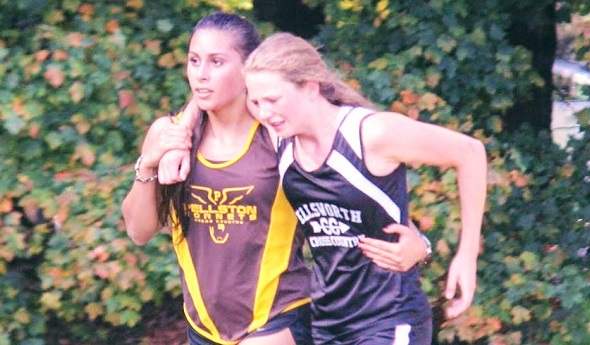
During Ellsworth’s House on the Hill cross country event Sept. 16, Pellston lead runner Alice Principi gave up a probable top-10 finish in the Class D race to assist Ellsworth freshman Judith Veldbloom, who was struggling to finish and went to the ground during the final stretch.
Principi, who would go on to finish 11th as her team took second, gathered Veldbloom up and then stayed with her across the finish line.
“Alice sacrificed some time and places to help a struggling competitor at the end of the race,” Pellston coach Chelsey Hermann told the News-Review. “It was an incredible demonstration of sportsmanship and shows just the kind of person she is.”
Ellsworth athletic director Brian Certa, in a letter to the MHSAA, echoed the appreciation: “What a tremendous example and witness to all who watched,” he wrote.
PHOTO: Pellston’s Alice Principi, left, assists Ellsworth runner Judith Veldbloom during the House on the Hill Invitational. (Photo courtesy of Ellsworth’s athletic department.)