


Sportsmanship and Success in Soccer
August 16, 2012
Ralph Polson, president of the National Soccer Coaches Association of America (NSCAA), reports in the July/August 2012 Soccer Journal that there is a strong statistical link between sportsmanship and success in intercollegiate soccer. He cites the work of Tim Lenahan, head men’s coach at Northwestern University, who compiled total fouls, yellow cards and red cards for the 2011 season to create a “Fair Play Rating” (FPR).
Polson reports that 12 of the 20 teams with the top FPR made the NCAA tournament, while only one of the teams in the bottom 20 did. Of course, this is a statistical link, not necessarily cause and effect. But here’s how Mr. Polson concludes his column:
“How should we interpret this data? One direction is toward more disciplined teams. It seems to me the more a culture of sportsmanship and fair play is established, the more likely any team is to demonstrate the consistency needed for success. The data suggests those teams without entrenched standards, with respect to on-field behavior, should anticipate a higher likelihood of failure in today’s highly competitive environment.
“Play within the spirit of the game and more than just a win may be gained; play against the spirit of the game and much more than just a game may be lost.”
Dr. Brian Crossman, chair of the NSCAA Ethics Committee, contributes this to the discussion in the same issue of Soccer Journal:
“A five year study from 2007 to 2011 of almost 4,700 intercollegiate soccer matches in which only one player was red-carded during the match showed a strong likelihood that the player’s team would lose. Teams that had one player red-carded lost 67 percent of the matches, tied 10 percent of the matches and won 23 percent of the matches. In other words, a team that had a player red-carded at any time during the match was three times more likely to lose the match than win it. Taking steps to encourage clean and fair play, and thus to reduce the likelihood of having players ejected, will pay dividends in sportsmanship and should improve your team’s won-loss record.”
For more, go to www.nscaa.com.
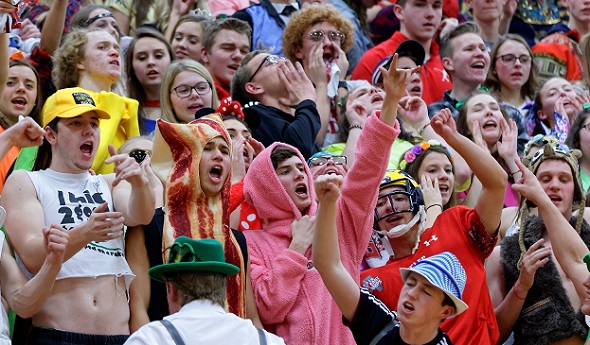
And the 2017 BOTF Winner is ...
February 17, 2017
By Geoff Kimmerly
Second Half editor
When Shafer Webb and his classmates were middle schoolers, they watched the high school student section turn into a party at every Frankenmuth home game.
 Webb's older brother Brennan led the 2012 section that won the inaugural MHSAA Battle of the Fans. And, of course, older brother told younger that no student section would ever measure up to the original champion.
Shafer, and about 300 of his friends, took that as a challenge – and have responded by earning a second championship banner as the first two-time winner in BOTF history.
"It shows we had good leadership this year, and it sets the standard for next year," Shafer Webb said. "It helps we won; now we have something tangible to show how good we were, and hopefully that will inspire them to continue next year."
Frankenmuth will accept its Battle of the Fans VI championship banner during halftime of the Class B Girls Basketball Final on March 18 at Michigan State University’s Breslin Center. The other four finalists also have been invited to Breslin to be honored for this season’s achievement.
Frankenmuth was chosen based on a vote by the MHSAA’s 16-member Student Advisory Council influenced by public vote on the MHSAA’s Facebook, Twitter and Instagram sites. A total of 20,125 social media votes were received, with those results then equated against a school’s enrollment.
The Council based its vote on the following criteria: positive sportsmanship, student body participation, school spirit, originality of cheers, organization of the group, section leadership and overall fun.
Boyne City totaled the most public social media support, finishing first across all four ways votes were accepted (Facebook likes and shares, Twitter re-tweets and Instagram likes) – despite being the smallest school among our finalists. Votes were scaled to take into account a school’s size – although Traverse City West received the most social media votes total, Boyne City’s when compared to its student enrollment pushed the Rambler Rowdies to the top of the list. Frankenmuth finished second in the social media voting.
Other numbers to consider from this season's contest: The application videos have been watched more than 16,600 times, and the MHSAA-produced videos from our tour stops have nearly 5,700 views. The stories on the five finalists plus Tuesday’s explanation of how to vote had been viewed 10,270 times as of 8:30 this morning. The five Snapchat stories covering our visits were viewed nearly 13,000 times combined.
We were excited at the beginning of this Battle of the Fans because we received our most entries since the first BOTF in 2012, and our most first-time entries ever (of course not counting that first contest). That means the spirit of Battle of the Fans is thriving in a number of communities, while also catching on in more every year. This year’s finalists no doubt will inspire student leaders at more schools to create championship-caliber student sections – and below is why we were inspired during our five BOTF tour stops.
Now See This Award: Boyne City
What we saw: The “Rambler Rowdies” burst on the scene for Battle of the Fans VI with a hype machine that would be the envy of many organizations. It didn’t take us long after entering the school to find messaging advertising the night’s theme (Fright Night) and activities, and the in-house television promos were especially impressive. Of course, our visit was on Friday, Jan. 13, which made the horror film-style night a perfect choice. And the Rowdies played it well, filling the stands for a makeshift graveyard of living fans, opening the festivities with students rushing in screaming from all corners of the gym and putting together some fun props (including an impressive surf board) with a consistent message of “R.I.P. Bad Sportsmanship.”
Why we’re fans: As people who focus on promoting the benefits of high school sports on a daily basis, we were immediately impressed with Boyne City’s marketing work. But we also were impressed quickly with how the section draws from all different communities within the school, not just athletes, and with one of the leaders not involved in sports at all but instead part of the band and theater cast. Boyne City also was our smallest finalist this season, but packed in enough fans to at least feel comparable in section size to the other four – all while being our first stop and having to set the tone for this year’s tour. The Rowdies set it well.
Be the Change Award: Charlotte
What we saw: We returned to Charlotte for the second straight year and anticipate it won’t be our last BOTF trip to see the “Flight Club,” which is anything but a one-hit wonder. You want something built? Call the Orioles, who have the best props we’ve seen/heard about over our six years on tour. We didn’t see the “bird cage” used before football games but were intrigued by the description; we did see the two giant tifos and wonder why more schools aren’t making the same to drape over their student sections. The Flight Club also came up with a sharp idea of posting their “pilots” with megaphones on raised platforms at each side of the section so they can lead cheers and be seen and heard by all of their classmates – another great idea from a group that literally has built from nothing one of the strongest student section programs in the state in just two years.
Why we’re fans: The Flight Club is having a lot of fun, and we loved hearing the stories – whether they were telling us about the mostly-failed slip-n-slide at a football game or the much more popular “highlight” games where the section attended events for every sport, including bowling. In a short time, they’ve created a lot of memories – one that sticks out is how the driver for a spirit bus during football season took a 10-minute detour after an away game to allow the students to hang out a little bit longer. As a whole, the last two years in Charlotte have been a fun trip. And we're sure the Flight Club will continue to thrive.
Draw the Blueprint Award: Petoskey
What we saw: The “Blue Crew” returned as one of the north’s best-known student sections by following a blueprint – pun only slightly intended – that any school could follow. After becoming a finalist for the first Battle of the Fans in 2012, the Blue Crew dwindled especially the last few years and into this past fall. But following a few proven steps, the Crew returned to its former height. First, student leaders attend an MHSAA Sportsmanship Summit in November. Then, on the way home, they started a section Twitter feed so they could communicate with classmates en masse. They set expectations, like featuring girls basketball games just as much as boys and letting students sit based on when they showed up to games, not their seniority. And with a leadership group including students from multiple classes, they ensured there will be student section veterans to pick up the reins again after these seniors graduate.
Why we’re fans: For starters, we love a good comeback story. We’re also a big fan of sections cheering on more than the boys basketball team; we always hear that they do, but we saw it with our own eyes as the Blue Crew began filling during the girls varsity basketball game (played before boys on this night) during our trip, despite the fact junior varsity and freshman teams also were playing at other locations and it was a Wednesday. We also try to emphasize every year that the best student sections are those who remember they’re at games to cheer for their classmates – not become the event themselves. The Blue Crew was all in, cheering on both the girls and boys varsities against Sault Ste. Marie, starting early and taking their fever to the final buzzer. Most of all, the Crew showed there’s a plan for any school that would like to accomplish the same – and we’ll surely be using Petoskey as an example in years to come.
Legacy Award: Traverse City West
What we saw: With three BOTF finals appearances, Traverse City West – our 2016 champion – has entered something of an unofficial ring of honor as one of the student sections that always will be in the mix to win this contest any year it applies. The setup of a Student Senate running the show is proven and provides West an opportunity to affect student life at its school to a degree others could emulate. The Bleacher Creatures built a sizable section for our visit despite not having school that day, and with it put on display some of the same great traditions we’ve come to enjoy during past visits. This section was around long before Battle of the Fans, and would be just as great even if it wasn’t competing regularly to be known as best in the land.
Why we’re fans: It’s hard to watch the Creatures do their thing and not think it would be fun to be a part. Ask Petoskey – watching West at a game last season helped motivate the Blue Crew to get back in the game this winter. The Creatures are loud, they’re together, the chants and cheers they do are all their own, and their most notable traditions also include the “Bucket Brigade” leaders who stand at the front and bequeath the honor from year to year. What we’ve noticed especially the last two years is how much West students love their school and community – and no wonder there’s a sense of pride that continues to get passed down to those who will fill the bleachers next.
Battle of the Fans champion: Frankenmuth
What we saw: In some ways, what we saw resembled a lot of what we saw on our first BOTF visit ever in 2012 – a few hundred students making up at least half (or more) of the student body dressed up in sometimes ridiculous costumes putting on a dance party and singing along. Section leaders have played on successful teams in other sports, and it was obvious their competitiveness boiled over into this contest. But as much as Frankenmuth enjoys the thrill of the fight, cheerers simply were having fun – from the costumes to the songs, to the original cheers and well-placed side shows. Be it the fullback taking an imaginary football handoff and diving in to knock down 270 people, or the “fake” wrestling match complete with good guys and bad guys, foreign objects and a championship belt, we saw some things we hadn’t seen before – and will be laughing about for years to come.
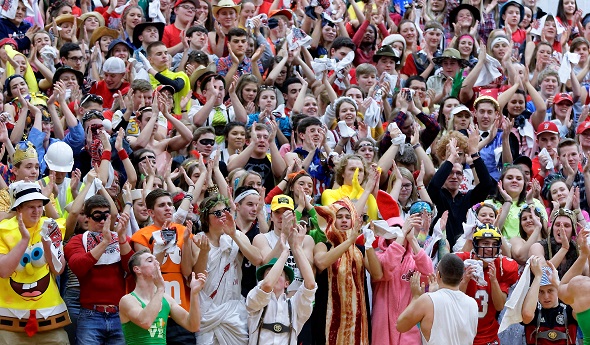 Why we’re fans: At the end of the day, Battle of the Fans is about a few things – bringing together a large group of the student body and drawing that crew from all grades and social groups, cheering classmates the right way with sportsmanship, and having the kind of fun that would make someone on the other side of the gym wish he or she could be a part. This year, Frankenmuth is that section – be it for the student from a rival school who shows up and always seems to know the theme of the night, or the parents across the floor during our visit who also got into “Costume Night’ and showed up in half-German and half-basketball garb. Frankenmuth’s student section no doubt riles up fans from opposing sides – but from a wider view, it’s a good bet those across the floor would love to join in, or hopefully start the same success story at their schools.
"It shows we give our student athletes a lot of support, and certainly we encourage kids that it's OK to be different," Webb said.
"I think it would be a lot more fun that whoever we're playing had just as good a student section as us. ... Hopefully this encourages other student bodies to participate in something like this at the other schools around us."
The Battle of the Fans is sponsored in part by the United Dairy Industry of Michigan.
Check out below our stories and videos behind the finalists. Also, click to see student-produced videos from all sections that entered the contest. (Photos by Chip DeGrace.)
Boyne City
Read all about it: 5 Ways Boyne City's Ramblers Get Rowdy
Charlotte
Read all about it: 5 Ways Charlotte's Fight Club Soars
Frankenmuth
Read all about it: 5 Ways Frankenmuth is Flying High
Petoskey
Read all about it: 5 Ways the Blue Crew Has Us 'Believin'
Traverse City West
Read all about it: 5 Ways West's Creatures Continue to Crush