


Sportsmanship and Success in Soccer
August 16, 2012
Ralph Polson, president of the National Soccer Coaches Association of America (NSCAA), reports in the July/August 2012 Soccer Journal that there is a strong statistical link between sportsmanship and success in intercollegiate soccer. He cites the work of Tim Lenahan, head men’s coach at Northwestern University, who compiled total fouls, yellow cards and red cards for the 2011 season to create a “Fair Play Rating” (FPR).
Polson reports that 12 of the 20 teams with the top FPR made the NCAA tournament, while only one of the teams in the bottom 20 did. Of course, this is a statistical link, not necessarily cause and effect. But here’s how Mr. Polson concludes his column:
“How should we interpret this data? One direction is toward more disciplined teams. It seems to me the more a culture of sportsmanship and fair play is established, the more likely any team is to demonstrate the consistency needed for success. The data suggests those teams without entrenched standards, with respect to on-field behavior, should anticipate a higher likelihood of failure in today’s highly competitive environment.
“Play within the spirit of the game and more than just a win may be gained; play against the spirit of the game and much more than just a game may be lost.”
Dr. Brian Crossman, chair of the NSCAA Ethics Committee, contributes this to the discussion in the same issue of Soccer Journal:
“A five year study from 2007 to 2011 of almost 4,700 intercollegiate soccer matches in which only one player was red-carded during the match showed a strong likelihood that the player’s team would lose. Teams that had one player red-carded lost 67 percent of the matches, tied 10 percent of the matches and won 23 percent of the matches. In other words, a team that had a player red-carded at any time during the match was three times more likely to lose the match than win it. Taking steps to encourage clean and fair play, and thus to reduce the likelihood of having players ejected, will pay dividends in sportsmanship and should improve your team’s won-loss record.”
For more, go to www.nscaa.com.
BOTF V: What You Taught Us
February 17, 2016
By Geoff Kimmerly
Second Half editor
We’ve completed our Battle of the Fans statewide tour for 2016, and hopefully you’ve kept up with our visits and learned why our five finalists are candidates to be known as the state’s top high school student section.
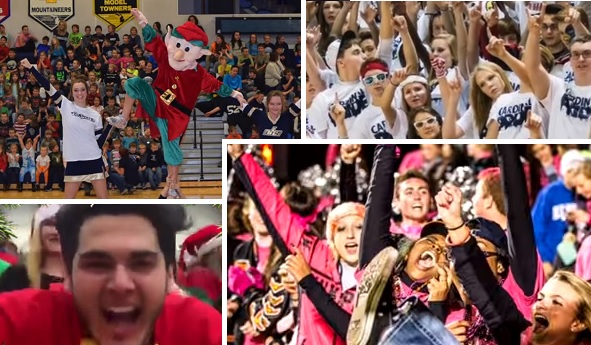
 But we appreciate as well the great student sections that entered the contest and weren’t chosen this time for the finalists tour. We try to teach sportsmanship and the best way to support your local teams – but all of our applicants taught us something again this winter.
Here’s a look at what we learned from the 17 student sections who didn’t make the BOTF Finals, but should be celebrated as well:
Tradition never graduates
Ann Arbor Gabriel Richard’s video took us through five years of its student section. The Fighting Irish were a BOTF finalist in 2013, and the section brings a strong effort every year although a new class of students joins each fall and a veteran group of leaders graduate each spring. Longevity and doing it right earns a lot of respect – not only from us, but surely in the community as well as the section has become such a prominent and positive part of student life at the school.
Get inspired
The Saginaw Michigan Lutheran Seminary student section was represented in a local contest last year by a photo of a few students sitting in the bleachers. Things had to change. Driven by the student council and a league Sportsmanship Summit, the Superfans were born – in fact, superfan became a verb to mean taking part. They’re off to a great start.
Wyoming Godwin Heights’ “Fred’s Fanatic Fans” also got their start this year as part of the Promote Enthusiastic Price (P.E.P.) Club, which was created to cheer on the school’s teams and “build the right climate.” We couldn’t have described the right goal better ourselves.
St. Johns was a finalist in 2015 even as leaders were still working to sway the entire student body toward a new, positive way of thinking and cheering. That movement continued to pay off this year; the Redwings were back, bigger and better, and we were glad to see it.
Be proud
Big Rapids has a few more than 600 students, but we could count at least 150 making up a rowdy crowd at a number of events used in the application video. Everything we could see pointed toward what has to be a blast in the stands.
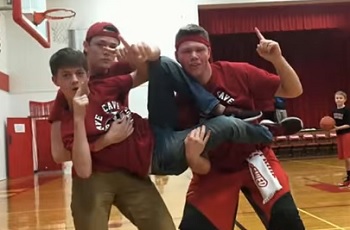 Fulton literally spelled out its drive on the screen: “Small Town, Small Teams, Big Hearts, Big Dreams.” The school has 200 students – and like finalist Munising, showed it can be done, filling the stands for a variety of games used in the video.
Manton’s Ranger Rowdies may number no more than 280 students, but they certainly bring the noise, literally, which was immediately obvious. Most of the student body had to be in attendance for the games they filmed.
Follow the leaders
Similar to finalist Traverse City West, Detroit U-D Jesuit’s section is driven by its student government. A student senate committee is dedicated to making the section (and whoever came up with the wrecking ball deserves a few more votes in the next election).
We know about the strength of Dowagiac’s leadership firsthand after awarding the section the BOTF 2015 championship. They had a lot of leaders showing the way last year, and that appeared to be true again – a favorite part was a line of students arm-in-arm in the front row, facing the rest of the section during a back-and-forth cheer. And the The Attack's chant shown below always will be a favorite.
Be creative
Tawas’ Brave Cave is full of ideas, starting with in-game interviews of students during an application “broadcast” by TSPN (Tawas Sports Programming Network). Tawas Proud, indeed, and for good reason.
Even if the “D” was upside-down at first on the line of placards spelling out the school’s name in the back row (which was funny), Wayland brought plenty to join the discussion of possible finalists. The “Den” was filled with costumes, signs, and just a lot of material that surely makes for a fun night.
For starters, Pontiac Notre Dame’s name – Irish Thunder – just sounds powerful. It was hard to tell what was going on as part of the “Whistle Cheer,” but it looked pretty wild, especially in front of what appeared to be a giant pep rally crowd (See below).
Involve everyone
Walled Lake Western’s video included interviews with parents and basketball players as well, and one of the athletes said something that especially stuck out: “They cheer the other team and us on.” That’s taking inclusion to another level, and we applaud it.
Utica Ford’s leaders spoke during its application about how the student section was like something bigger than the school itself – something they all have together. And that’s a great thing. (The student section flag was a cool touch as well.)
Holland’s Dutch Nation leaders take getting everyone involved to the highest level, incorporating the pep band and cheerleaders during games and the athletic director and many others at the school behind the scenes. As one said, “We work to spread participation not only for the students, but the whole community.”
Imlay City’s Spartan Nation made shirts like many student sections, but didn’t reserve them for high school students alone – they made them for elementary and middle schoolers and sold to the greater community as well in an effort to get everyone together. (And bringing in Santa Claus for a Christmas-themed game for the younger kids was a neat idea too.)
Ending on one last strong note, we hope Norway is just beginning its BOTF quest. #UKNIGHTED might be the best campaign of BOTF V. They’re “all knights and all united,” and set a great example of getting a community together.
Click to watch all 22 application videos for this year's Battle of the Fans V.