


Sportsmanship and Success in Soccer
August 16, 2012
Ralph Polson, president of the National Soccer Coaches Association of America (NSCAA), reports in the July/August 2012 Soccer Journal that there is a strong statistical link between sportsmanship and success in intercollegiate soccer. He cites the work of Tim Lenahan, head men’s coach at Northwestern University, who compiled total fouls, yellow cards and red cards for the 2011 season to create a “Fair Play Rating” (FPR).
Polson reports that 12 of the 20 teams with the top FPR made the NCAA tournament, while only one of the teams in the bottom 20 did. Of course, this is a statistical link, not necessarily cause and effect. But here’s how Mr. Polson concludes his column:
“How should we interpret this data? One direction is toward more disciplined teams. It seems to me the more a culture of sportsmanship and fair play is established, the more likely any team is to demonstrate the consistency needed for success. The data suggests those teams without entrenched standards, with respect to on-field behavior, should anticipate a higher likelihood of failure in today’s highly competitive environment.
“Play within the spirit of the game and more than just a win may be gained; play against the spirit of the game and much more than just a game may be lost.”
Dr. Brian Crossman, chair of the NSCAA Ethics Committee, contributes this to the discussion in the same issue of Soccer Journal:
“A five year study from 2007 to 2011 of almost 4,700 intercollegiate soccer matches in which only one player was red-carded during the match showed a strong likelihood that the player’s team would lose. Teams that had one player red-carded lost 67 percent of the matches, tied 10 percent of the matches and won 23 percent of the matches. In other words, a team that had a player red-carded at any time during the match was three times more likely to lose the match than win it. Taking steps to encourage clean and fair play, and thus to reduce the likelihood of having players ejected, will pay dividends in sportsmanship and should improve your team’s won-loss record.”
For more, go to www.nscaa.com.
Student Leadership Plays Vital Role
By
Rob Kaminski
MHSAA benchmarks editor
September 26, 2014
By Rob Kaminski
MHSAA benchmarks editor
Fred Smith had a plan. Josh Money had no idea what it was, only that he was to report to the Buchanan High School athletic director’s office in the morning.
In the fall of 2012, Smith was observing a student section of somewhere between a dozen and 20 kids during a volleyball game. At times the line between rooting for his school was crossed into the area of rooting against the opponents; nothing unruly, but not the behavior Smith would prefer to see in his gym.
“I asked one of the students, Josh Money, to come see me the next day,” Smith recalls. “I said, ‘You’re not in trouble. I just want to meet with you about something.’”
Smith prepped for the meeting by queuing up the MHSAA Battle of the Fans video from the previous winter, in which Frankenmuth prevailed in a contest to reward the state’s most innovative and entertaining student rooting section, that above all else did so with the highest degree of sportsmanship on display.
“I asked Josh, ‘Why can’t we do this?’” Smith recalled.
The meeting supplied the impetus for a full-court press to turn around the culture at the small school in southwestern Michigan. By the time the 2013 Battle of the Fans contest was underway just a few short months later, Money was one of the leaders of the section that would become the competition’s next winner.
“I was fortunate. You know the old saying, ‘You can lead a horse to water, but you can’t make them drink?’ Well, I led them to the water, and they drank,” Smith said.
The Buchanan story is just one of many in which solid student leadership can assist not only an athletic program, but also boost the morale of a school and its community.
The first stop on trek to the oasis was to one of the MHSAA’s Sportsmanship Summits, this one in Kalamazoo, where eight students gleaned valuable insight to creating positive, enthusiastic settings at their athletic events.
Instrumental in guiding the students was student council advisor and social studies teacher Stacey Carlin, along with fellow staff members Rachel Carlson, Jessica Cornelius and Lisa Holok.
“It takes a dedicated staff to get behind the effort,” Smith said, pointing out that principal Sharon Steinke allowed the student council to hold school-wide “prep rallies” to allow “The Herd’s” leaders to practice routines and give classmates instructions.
“We have good student leaders and a good teaching staff involved to lead the way, and now it’s become a culture; it’s a culture change,” Smith said. “We have sections for the middle schools and elementary schools at the games, and we are proud to include these kids because that’s where we leave our legacy. We include all grade levels.”
At the root of school sports lies the most precious commodity: students. Involving them in decision-making processes and thrusting them into supervised leadership roles can strengthen the health of the overall program.
In recent years, the MHSAA has put increased emphasis on the promotion of such peer-to-peer educational gatherings.
“Throughout its history, the MHSAA has done a tremendous job working directly with coaches, administrators and officials to make school sports a valuable part of the high school student experience,” said Andy Frushour, director of brand management, who also coordinates student programs for the Association. “While students have always benefitted from those efforts, there were few initiatives involving student-athletes directly.”
That has changed over the last decade.
While the MHSAA Scholar-Athlete program just last year enjoyed its 25th anniversary, and the Women In Sports Leadership Conference has long led the nation in its realm, the MHSAA has introduced several student-based programs recently with the expectation that each will be just as successful as those endeavors.
Eight years ago, the MHSAA formed a 16-member Student Advisory Council, which meets several times annually with MHSAA staff, and serves as a student sounding board for the MHSAA’s Representative Council.
The group also assists in the planning of MHSAA Sportsmanship Summits (held regionally every other year) and Captains Clinics which take place annually in six to 12 locations in Michigan.
“All of these student-training programs, delivered directly to students, make up the overall MHSAA student leadership program,” Frushour said. “To have the voices of our students heard is invaluable in the development of targeted plans for the growth and preservation of school sports. Having students deliver our message to their classmates only helps to strengthen our product.”
Pete Ryan, athletic director for Saginaw Township Community Schools, is involved with two Captains Clinics for the Saginaw Valley Association each year, and understands the importance of student-led messages.
“Peer leadership works well when it is leadership and guidance, and not simply telling others how they have to do it,” Ryan said. “Setting the example is a priority, and exemplifying behaviors that correspond to leadership plays a role.”
The Captains Clinics are geared to accommodate 100-150 students per session, and the benefits can be felt conference-wide.
“Our main goal is to learn and understand that all team members can affect the focus of ‘team’ in many different ways. We ask our students who have attended the Captains Clinics to take back one or two things and re-teach their teammates,” said Jim Conway, Mount Pleasant High School athletic director and an active leader in the annual series.
“Peer learning is wonderful when taught using positive measures. Set examples, be early, respect all teammates, take care of yourself off the field. Also, there is strength in numbers. Student-to-student clearly out-numbers coach-to-student ratio.”
Ryan has noticed a change in environment during contests with some traditional rivals, adding that social media can play a productive role today.
“The Captains Clinics have helped break down barriers between rival schools because there is name and face recognition now,” he says. “We have tried to use social media in a positive manner to invite schools for a tailgate or to create a friendly competition. It can become a negative tool when taunting comes into play. The Captains Clinics provide a great forum to educate our leaders about using social media in a constructive manner.”
“Constructive” is the key word. Properly supervised, social media can be a big help in getting positive messages out.
 “Continued education toward social media is at the forefront of what we need to be discussing,” Conway said. “As the high school climate grows, students must understand how powerful social media has become. Captains Clinics teach that no reaction is the only reaction.”
The SAC is using technology to roll out an online Captains Course in the coming months, modifying the printed publication Captains 101 which was published by members of the 2009, 2010 and 2011 Councils.
Under the guidance of Frushour, with current SAC members Connor Thomas (Marlette) and Caycee Turczyn (Lapeer) leading the charge, the new format will prove a valuable resource for captains statewide.
As one would expect, having been selected following a thorough process which includes recommendations, minimum GPAs, and a Q & A form, SAC members are enthusiastic, and they revel in their opportunity to make a difference through communication with MHSAA staff and participation in the summits and clinics.
One of the many benefits is bringing students from diverse backgrounds and large and small communities together.
“I love sports and anything to do with sports,” said Jonathan Perry, SAC member from McBain Northern Michigan Christian. “I hopefully will make my career in sports, for example as an athletic director, and I thought this would be a great learning step. I also wanted to experience high school sports from a different perspective, because I only have a small-school perspective. It’s fun learning about all different school sizes, areas and sports that other SAC members participate in.”
Eliza Beird is also from a small school, Holland Black River. For her, the SAC appointment provided more than the opportunity to play a sport.
“I wanted to do something more with sports besides just participating,” she said. “I was motivated to apply for the SAC because I knew that it would give me an opportunity to expand the role that sports played in my life. Not only would I learn more about the rules and regulations of high school sports, but I would also get the chance to share other’s ideas and visions about high school athletics – along with my own – with the entire state.”
The ability to share ideas with local groups and spread them statewide is one of the foundations on which school sports is built, particularly in Michigan. The MHSAA preaches local leadership and local competition. When the proper messages and behaviors are cultivated in towns, cities and communities around the state, then statewide missions can be achieved.
Today’s students are impacting the culture more than ever simply because communication lines are more open than ever. More two-way streets are in place to provide opportunities for student input, with Captains Clinics and Sportsmanship Summits chief among those avenues.
“Training is priority one,” says Ryan. “We need more time to teach them the value in leadership and then we need more opportunities to do it. The Captains Clinics are great resources for training. There is a need for these clinics, and I would like to see more available.”
Student role models can be pivotal not only on athletic teams, but in classrooms and hallways.
“I’ve found that being a teenager in high school is tough. It’s every girl’s dream to be in the ‘popular group,’ and when you’re not, it makes those four years even harder,” says SAC member Emily Starck of Remus Chippewa Hills. “When it comes to being a leader, it isn’t necessarily about having the title of captain on your team, being president of student council or the latest trendsetter. It’s more about leading by example, and obeying the simple concept of treating others the way you want to be treated, whether that is helping an opponent up on the court or making a conscious effort to smile and say hello to everyone you see in the halls.”
It’s that type of behavior and those types of students which make the job as a high school administrator, teacher and coach so rewarding. Not to mention, it can make the job easier.
“Student leadership benefits the coaches because they can rely on those students to assist with team issues,” said Ryan. “It helps from an administrative standpoint because you know those leaders are buying into the program and will encourage others to do the same. I’ve also seen students set the tone by speaking at parent meetings. They can have a real impact on explaining expectations of the team and school to parents.”
Ah, the parent component. School sports are quite different in nature and purpose from community-based programs, which range from all-star travel teams to recreation leagues run by groups of parents. In most cases, winning and playing time supersede all other goals.
Educational, interscholastic athletics differ. Allowing students to help carry the mission only makes sense. MHSAA Sportsmanship Summits offer a major delivery vehicle.
In the instance relayed from Buchanan at the outset of this article, the Summits can make all the difference. SAC members are heavily involved and interested in the potential of this fall’s sportsmanship efforts.
“My goals for the Sportsmanship Summits this year is to get all of the students in my session to open up and talk about what is good, and bad, sportsmanship,” said Thomas. “Also, I hope to gain personal knowledge, as well as having the other students gain knowledge, that we can bring to our own schools.”
Each Summit has approximately 250 participants who are led through a series of breakout sessions designed to get students talking about sportsmanship in their communities, as well as coming up with solutions to curb bad sportsmanship at school. One of the breakouts is developed and delivered by SAC members. A final session focuses on creating a school sportsmanship action plan.
“I hope we get kids to think more about sportsmanship at the Summits,” Perry said. “Get them thinking more about sportsmanship and letting them figure some of it out on their own, and cause them to talk about it with others. If a person at a Summit talks to five other people who were not at the Summit, we still affect six people. We can have a huge impact on people’s perspective of sportsmanship.”
It’s that “pay it forward” method that bodes well for future grades across the state in general, and perhaps even within the SAC more specifically.
“I hope that other student-athletes are inspired,” added Beird. “I hope we can help motivate them to go and make a change in their school. I also think it would be pretty cool if someone wanted to apply for the SAC after attending one of the Summits.”
The MHSAA is proud of its recent boom in student programming, and plans for the future include greater student content in the highly successful Coaches Advancement Program, and possibly a statewide Captains Summer Camp, potentially drawing 200-300 students to one of Michigan’s picturesque lakeside settings.
Of course, a little outside assistance is always welcome, especially when the helping hand has the same goals in mind. Enter the Michigan State University Institute for the Study of Youth Sports (ISYS). The group helps to facilitate the MHSAA Captains Clinics, and SAC members also participate in a yearly focus group about the state of high schools sports for the ISYS.
ISYS staff member Scott Westfall works diligently with Frushour at the MHSAA in creating a comprehensive program for captains.
“Adults often say and do the right things, thus, their leadership is often viewed as obligatory behavior,” Wesftall said. “However, student-led leadership is much more influential. This power is rooted in the peer-to peer relationships and mutual empathy. Student-athletes are often very close in age, so that leadership is often held with higher validity because the student leader is most likely experiencing many of the same adversities and temptations as the peers on his or her team.”
That’s not just clinician-speak. Several SAC members are living those situations each day and relate similar scenarios.
 “In the hallway and on the field, students will see and be directly influenced by peers around them. Other students may be more likely to copy the actions of those in student leadership,” said Beird. “Because these actions are not being suggested by an authoritative figure, students are less likely to resist these ways and more likely to repeat them. Their peers are leading the way.”
“Whether its student council or pep club, working with other leaders teaches one to step out of their comfort zone in order to get tasks accomplished,” said Turczyn. “For example, the SAC has taught me to voice my opinions while also taking into consideration the opinions of others, whether we are in agreement or not.”
There are also instances when a school’s best leaders are roaming the grounds and nobody– not even themselves – realize the potential within them. Such was the case for Karen Leinaar, when lightning struck at two different schools.
Leinaar, current Bear Lake and former Benzie Central athletic director, recalls the stories of Travis Clous (Benzie, 2012) and Emileigh Ferguson (Bear Lake, 2014), a pair of typical high school students who emerged as unexpected leaders through their experiences with the SAC.
“Travis was a kid who you thought was kind of a cut-up or class clown type; there was always that smile on his face,” Leinaar recalled. “But, you could tell there was more to him. He organized a cross country function, and from there would ask questions about my job, about the Representative Council and what it did. He applied for a spot on the SAC, and it completely changed him. He began to understand that your voice can be heard if you back it up with rationale. That young man discovered that he was someone people would listen to.
“Emileigh was a decent student and good athlete,” Leinaar said. “She was taller and bigger than most of her classmates, always in front of the line, but unfortunately sometimes for girls, that’s enough. She was a follower, and didn’t always follow the right people. After serving on the SAC, she was able to make good decisions, she was accountable and had a voice. She tried to show people the right way to do things, and if they didn’t, she stayed the course. She was no longer a follower.”
The two are now enrolled at Hope College, walking testimonials that dedicated student programs provide useful skill sets for those putting on a cap and gown each spring.
Maybe someday they’ll join Andria Baker, a charter SAC member from Constantine in 2007, who teaches and coaches in the St. Joseph school system after a year in Alma where she coached volleyball, basketball and track & field.
“On the SAC, I was able to connect with other students who shared similar beliefs with me, and also those who challenged my way of thinking. Being challenged and having to defend what you feel is important and was a tremendous skill to learn,” Baker said.
College-bound former SAC member Coby Ryan also feels well equipped for the next stage of his life.
“Student leadership in high school prepared me quite well for the next chapter in my life,” Ryan said. “It taught me how to communicate with my peers, and it was vital for me to be able to handle the responsibilities given to me in high school. Learning how to act in pressure situations and think on my feet has helped me in the present.”
In Baker’s case, she finds herself in a familiar setting now as an adult, but her role changes ever so slightly as she attempts to pass on the values that launched her career to current students.
“Leadership is something that never stops. As a student-athlete in high school and college, I shared my leadership through my passion of sports and competition,” Baker explains. “However, I was a unique leader playing-wise because I wasn’t always on the court; I wasn't the best player on the team, but I understood the importance of being a team player and every teammate is valuable and important.
“Transitioning that to my life as a professional has been different because I am now showing the athletes and students I work with how to be the next generation of leaders. I have to not only lead by example, but train them how to behave and act on and off the court. I have had many conversations with athletes about not being afraid of the leadership role. Although it is a big role, it will benefit them for the rest of their lives.”
Leadership can also be contagious. The key is harnessing what’s intrinsically good in people and finding a way to bring it to the surface.
Smith mentioned the cultural change at Buchanan, where staff and students have built on the Battle of the Fans momentum.
“Our cheering sections weren’t always the model, and at times had a reputation as not the most sportsmanlike,” Smith said. “But the Battle of the Fans experience has carried over to other areas of sportsmanship and behavior.”
Last year, Buchanan was named one of the five nicest schools in America by Mean Stinks, for its anti-bullying efforts and “ganging up for good.” Part of the honor included a pizza party, courtesy of the sponsors for the Mean Stinks campaign.
“You ever see 300 pizzas brought in from local pizza place?” Smith asked. “It’s quite a sight.”
So, too, are the images of hundreds of students gathered at Sportsmanship Summits, Captains Clinics, and cheering sections on a nightly basis. The MHSAA invites you to come out and have a look.
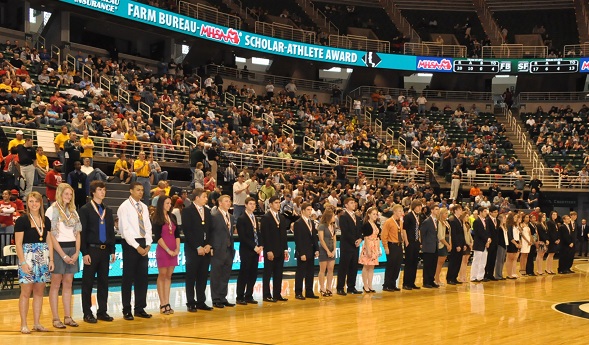
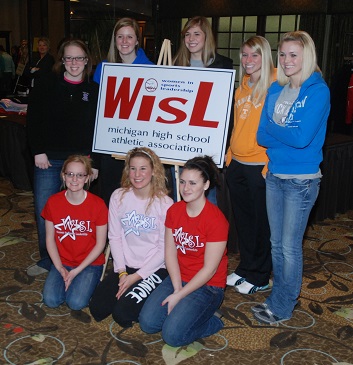
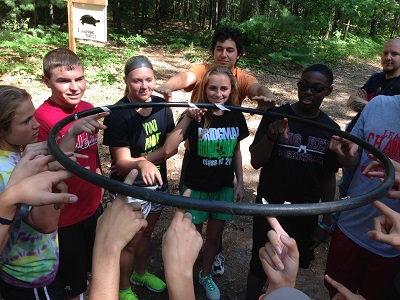
PHOTOS: (Top) Honorees are recognized with their Farm Bureau/MHSAA Scholar-Athlete Awards in March at the Breslin Center. (Middle) Attendees posefor a souvenir photo at a recent Women in Sports Leadership conference. (Below) Members of the 2014-15 Student Advisory Council participate in a leadership exercise this summer.
Leadership Opportunities Abound for 2014-15
SCHOLAR-ATHLETE AWARD APPLICATIONS
In 2014-15 we celebrate the 26th anniversary of the Farm Bureau Insurance sponsored MHSAA Scholar-Athlete Award. In 2014-15, 32 $1,000 scholarships will again be awarded from a pool of the best and brightest high school seniors. Eligibility requirements and applications can be found at MHSAA.com on the “Students” page. Applications are due to the MHSAA on Dec. 5.
SPORTSMANSHIP SUMMITS
This fall the MHSAA’s series of Sportsmanship Summits returns with four regional clinics spread across the state. These day-long summits will cover sportsmanship topics from a variety of perspectives, including from the viewpoints of athletes, coaches, officials and administrators. Most importantly, though, the summits will focus on sportsmanship in student cheering sections. School groups will review what makes great student sections tick, and then develop plans on how to make its own student section more loud, organized, positive and fun. This year’s Summits are as follows: Gaylord, Nov. 3; Saginaw, Nov. 5; Grand Rapids, Nov. 10; Warren, Nov. 12.
BATTLE OF THE FANS
The fourth annual MHSAA Battle of the Fans competition will take place again during the winter season. The contest, organized by the MHSAA Student Advisory Council, seeks to find the loudest, most organized, most fun and most positive student cheering section in the state. Students should begin filming their student sections this fall in preparation for the video deadline in early January. Beaverton High School is the defending champion, while Buchanan won in 2012-13 and Frankenmuth in 2011-12. More details are available at http://www.mhsaa.com/BOTF.
STUDENT LEADERSHIP GRANTS
The MHSAA has earmarked $20,000 to help students become better leaders. This fund originated from a gift to the MHSAA from student leadership training leader, the former W.B.A. Ruster Foundation. Scholarships are available to students to attend existing student leadership camps, and schools can receive grant money to create student leadership programs in their communities. Funding is available NOW. There is no deadline – applications are accepted, and money is distributed, year-round. Visit the “Students” page at MHSAA.com.
CAPTAINS CLINICS
The purpose of the MHSAA Captains Clinic series is to give basic leadership training to both current and future team captains. The training session is only four-and-a-half hours long, so there’s no way these students can learn everything they need to become effective team leaders. Instead, we use this time as an opportunity to give the students the basics of being a team captain – we answer the question, “I was named a team captain, now what am I supposed to do?” We walk through the role of a team captain, we discuss common team problems, and we finish the day by making a “To Do” guide for all of each school’s team captains. Several clinics will take place in the coming year, and the MHSAA would love to come to your league. If you can get your entire league on board, guarantee 100-150 participants, and suggest a good location (preferably a school on a professional development day), the MHSAA will do the rest. The Association will coordinate the registration process, negotiate with facilities if necessary, provide the curriculum and supplies, work with the caterers and bring facilitators to the clinic. Contact Andy Frushour to learn more about the Captains clinic program – [email protected].