

Calumet Invite Produces Northern Stars
September 18, 2013
By Geoff Kimmerly
Second Half editor
The Calumet Invitational dates back roughly 30 years as an annual staple of the cross country schedule for schools at the northernmost tip of Michigan's Upper Peninsula.
A creative move by the Copper Kings last year added some statewide prestige to the event.
 Last week, for the second season, Calumet ran the series of races at Keweenaw Mountain Lodge, a resort near Copper Harbor and the northern bank of the Keweenaw Peninsula.
Calumet is the northernmost high school in Michigan. And moving this race another 35 miles northeast more or less guaranteed it's the northernmost event run in the state.
"We figured it was pretty safe. We're the northernmost school in the state, and you can only go four more miles and you're in Lake Superior," Calumet athletic director Sean Jacques said. "Nobody else is going to do anything more north than that."
A total of 10 schools were represented this fall in the races for boys and girls varsity, junior varsity and middle schoolers.
Jacques said the event formerly was run at a golf course in Calumet. But a few years ago, Calumet graduate and former Copper Kings cross country runner Dan Harri moved home from Florida to become general manager at the Mountain Lodge (he's also a renowned chef and has owned restaurants in Miami with Hall of Fame Dolphins coach Don Shula).
Harri had asked a few times about bringing a cross country or golf event to the lodge. Jacques told him last year they'd give it a try, so Harri set up a course that includes golf course, a couple of bridges, trails and finishes with a climb on the No. 1 fairway. It also provides various points for fans to watch runners go by, not always available on other courses.
"We were looking for a little bit of a change, and it's a beautiful course," Jacques said. "We thought if people were willing to make the extra drive, it would be really nice."
Calumet won the boys race this season, just ahead of runner-up Houghton. Houghton's girls were victorious, followed by the host Copper Kings.
Click to read more about this year's event from the Houghton Mining Gazette.
Michigan's claim to an NFL evolution
As part of its NFL preview this month, Sports Illustrated reported on one of the most significant developments for offenses over the last few decades – the silent snap count, which is used regularly by visiting teams because offensive linemen can’t hear the quarterback calling for the ball over the clamor of the home crowd.
And the article explained that the silent snap count might’ve gotten its start at one of Michigan’s smallest high schools – Flint’s Michigan School for the Deaf.
Offensive linemen during the 1980s were feasted on by pass rushers like Lawrence Taylor and Bruce Smith, who built record sack totals by blasting past blockers who seemed a step slow. Turns out, that was true. Defensive players were getting an edge by attacking as soon as they saw the ball move. But blockers (especially offensive tackles), focused instead on the defensive ends and linebackers lined up across from them, and didn’t have the luxury of watching the ball – and since they also couldn’t hear the snap count, started each play a step behind.
Enter the silent count. The quarterback signals to the center that he is ready to receive the ball (with a pat on the back, by raising a foot, etc.). The center then raises his head, and after a predetermined count of at least one second snaps the ball without a sound. This means an offensive tackle doesn’t have to listen for a snap count – he just counts after seeing the center get set.
The SI report recognized longtime offensive line coach Howard Mudd as the guru of the silent snap count. But Mudd recalled a conversation he’d had while working for the Seattle Seahawks with another coach, the late Andy MacDonald, who also had coached early in his career at a school for the deaf in Michigan.
The article doesn’t mention Michigan School for the Deaf by name. But it seems to make sense that the Tartars were the first to use the now-revolutionary count. MacDonald – who played at Central Michigan University and went on to coach at Michigan State and four other colleges and also for the Buffalo Bills – grew up in Flint and attended Flint Northern before playing for the Chippewas from 1950-53. The historical web site Michigan-football.com has results for Flint’s Michigan School for the Deaf dating to 1950, making it a decent assumption that MacDonald might’ve gotten in a little early coaching experience at the school down the road from his home.
Click for the SI story and go to page 4 for the mention of Michigan’s school.
Michigan mourns trooper, running standout
The law enforcement community is mourning the death of Michigan State Police trooper Paul Butterfield, who was shot Sept. 9 during a traffic stop in Mason County. He also was a well-known distance runner during the 1980s and the MHSAA Class A cross country champion running for Bridgeport in 1987.
According to a Ludington Daily News report, Butterfield continued running after high school at the University of Tennessee, and also competed at the 1989 Pan American Junior Games in Argentina.
Butterfield was stationed in Hart after previously serving in Manistee, and lived in Mason County. He also had served in the U.S. Army. Click to read more from the Ludington Daily News.
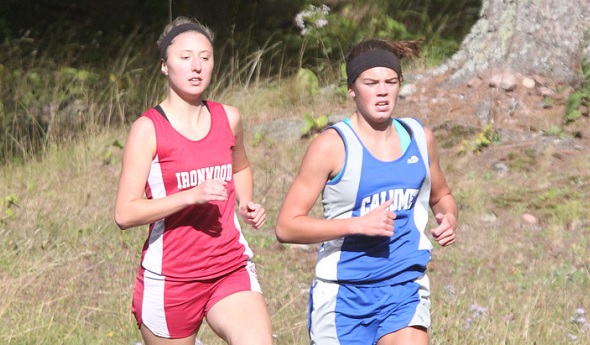
PHOTO: Calumet's Chelsea Jacques (right) won this season's Calumet Invitational with a time of 21:08.06, just ahead of Ironwood's Jessica Gering at 21:46.16. (Photo courtesy of Calumet athletic department.)
Century of School Sports: Good Sports Are Winners Then, Now & Always
By
Geoff Kimmerly
MHSAA.com senior editor
November 12, 2024
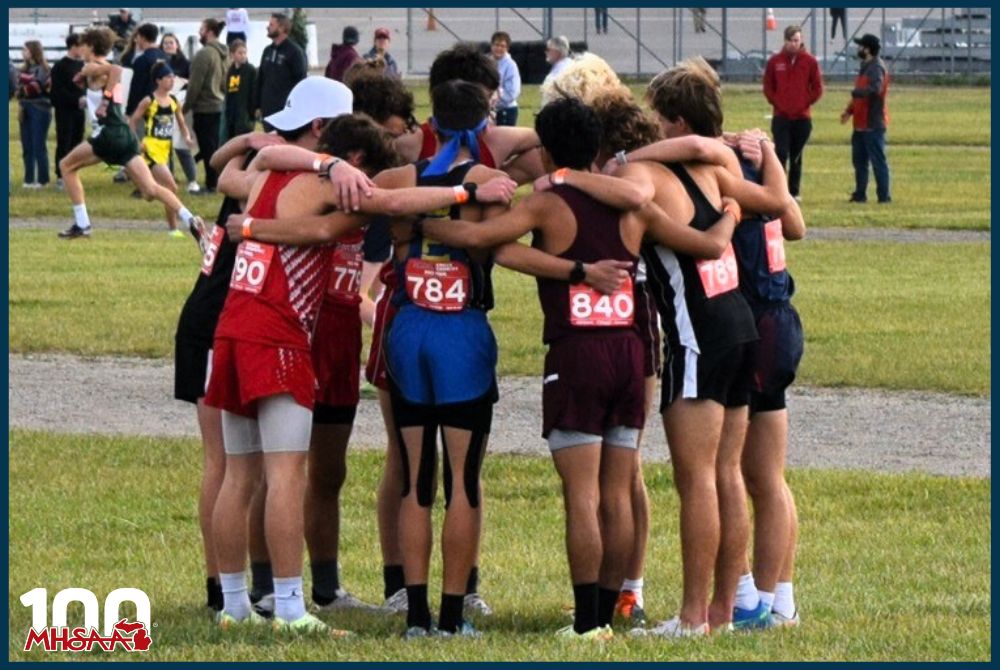
The above photo came to us two years ago this fall, from a now-retired athletic director, who was especially taken by these 10 runners from eight schools huddling together before their races during the 2022 Lower Peninsula Boys Cross Country Finals at Michigan International Speedway.
Representing Bloomingdale, Bridgman, Centreville, Coloma, Constantine, Parchment, Schoolcraft and Watervliet, these racers had competed against each other all season, and for some several seasons. But during these moments before what would be the most high-profile event of their athletic careers, they joined together for support, motivation and camaraderie.
Sportsmanship is one of the MHSAA’s core values – the “4 S’s” – of educational athletics. It has served as part of the bedrock of this organization from its beginning 100 years ago, and should remain so as long as school sports are considered a valued part of the educational experience.
Two weeks ago, we covered in this #MHSAA100 space the history of the MHSAA Sportsmanship Summit – first conducted in 1997 – and our latest statewide tour concludes Thursday in Grand Rapids. But those sessions welcoming student leaders every year are just one of many efforts the MHSAA has made to continue teaching sportsmanship through athletics over the last century.
An essay, “Athletics – Why and How” by Grand Rapids Union athletic director John Truesdale, was included with the November 1925 edition of the Bulletin of the Michigan High School Athletic Association and addresses how the creation of the MHSAA from its predecessor organization played a part in immediately improving sportsmanship in school sports during that first year:
“Because of (the creation and fulltime nature of the MHSAA), the standards of sportsmanship are more nearly approached. Bickerings have been reduced to a minimum. Better understanding exists between schools. The conducting of games has become the exhibition not only of skill, strength and wisdom, but of sportsmanship, obedience to accepted rules, and consideration of those who for the moment are in the position of enemies, although friendly.
“In fact, athletics in Michigan are in position now to accomplish the purpose for which they were designed – the building of character. … It is entirely reasonable that each, the player and spectator, emerges from a contest a better citizen because of his experiences.”
High Schools change over entire student bodies every four years. Freshman eventually become seniors, and when they leave take their parents and others who have spent a portion of time in the school sports space, to be replaced by the next classes of athletes and families playing, cheering and altogether carrying forward our time-cherished activities.
And as such, the lessons of sportsmanship are constantly in need of renewal.
After both arrived during the mid 1980s, retired MHSAA Executive Director John E. “Jack” Roberts and retired Communications Director John Johnson embarked on a mission to transform sportsmanship in Michigan school sports – and in doing so, made the MHSAA a national leader in that work, which continues today.
These MHSAA sportsmanship campaigns from the last 30 years should ring at least a few bells for those who have spent time around our games:
“Good Sports are Winners” – Beginning in 1989 and over the following two decades, the MHSAA (and with help from the Michigan Interscholastic Athletic Administrators Association and multiple sponsors) annually distributed 100+ page sportsmanship kits to member schools which included materials to assist in promoting good sportsmanship, including letters to be sent out to various stakeholders, public address announcements for events and other content for programs and publications.
An awards program celebrated teams best displaying these ideals from every season – Fall, Winter and Spring – with those winners receiving recognition across statewide media and MHSAA publications through the conclusion of this campaign during the 2010-11 school year.
“What Kids Wish Their Parents Knew About Sportsmanship” – This six-minute video produced for the start of the 1999-2000 school year featured students addressing adult behavior at their events. The video was designed to be shown as preseason meetings, booster clubs, school board meetings and similar athletic department or school gatherings.
“Battle of the Fans” Fast forward to 2012. The MHSAA’s Student Advisory Council, in an effort to affect sportsmanship especially among peers, created a statewide competition to promote positive cheering from the growing number of student sections across the state.
The “Battle of the Fans” continued for 10 years (skipping 2021 due to COVID-19 precautions) and annually recognized not only a champion but additional finalists with banners during the Basketball Finals at Breslin Center. The contest was almost entirely video and social media-driven, and during later years of the competition included multiple rounds that required sections to complete challenges to advance.
The BOTF program also was recognized nationally and copied by other states after seeing what Michigan’s student leaders were capable of influencing.
And that work continues.
The following was created this summer by the Student Advisory Council based on 10 pages of notes from their experiences at 2023 Sportsmanship Summits.
One of the most revealing truths in studying the 100-year history of the MHSAA is that many issues of the day then and now are remarkably similar. It’s not that there haven’t been improvements along the way. But rather, the process of educational athletics is ongoing as generations of students take their turns and continue on – and the work to keep sportsmanship at the heart of competition remains of great importance.
To that end, let’s allow Truesdale to close this latest history lesson.
“Let us then, in this year of 1925, demonstrate to the people as a whole that victory is not all we seek.
“Let each of us, whether superintendent, principal, coach, player or spectator, emphasize the point that to win is welcome, that to demonstrate superiority is one goal we are after. But let us not lose sight of the fact that the means employed are of great consequence, and that the results we seek are not championships alone but victory of the player and the team and the school over the temptations of unfair tactics.
“Championships will be forgotten but character is lasting.”
Previous "Century of School Sports" Spotlights
Nov. 5: MHSAA's Home Sweet Home - Read
Oct. 29: MHSAA Summits Draw Thousands to Promote Sportsmanship - Read
Oct. 23: Cross Country Finals Among MHSAA's Longest Running - Read
Oct. 15: State's Storytellers Share Fall Memories - Read
Oct. 8: Guided by 4 S's of Educational Athletics - Read
Oct. 1: Michigan Sends 10 to National Hall of Fame - Read
Sept. 25: MHSAA Record Books Filled with 1000s of Achievements - Read
Sept. 18: Why Does the MHSAA Have These Rules? - Read
Sept. 10: Special Medals, Patches to Commemorate Special Year - Read
Sept. 4: Fall to Finish with 50th Football Championships - Read
Aug. 28: Let the Celebration Begin - Read
PHOTO A group of Southwestern Athletic Conference runners huddle up before their races at the 2022 Lower Peninsula Boys Cross Country Finals at Michigan International Speedway, including Bloomingdale’s Jaden Barnes and Joe Stocchiero, Bridgman’s Andrew Mabry and John Sanderson, Centreville’s Logan Weis, Coloma’s Boden Genovese, Constantine’s Ethan Glick, Parchment’s William Winter, Schoolcraft’s Dante Pilot and Watervliet’s Daniel Mandujano. (Photo by Alan Bobalik/Bloomingdale cross country.)