

Casting Lines for Future Tournaments
August 12, 2016
By Jack Roberts
MHSAA Executive Director
The MHSAA is best known to the public for the tournaments it conducts to conclude the fall, winter and spring seasons each school year.
These tournaments, the first and largest program of the MHSAA, have survived the Vietnam War, the Korean conflict and two World Wars. They have survived the technology bubble, the housing collapse, the energy crisis and the Great Depression.
MHSAA tournaments existed at the dawn of aviation and at the time of our nation’s lunar landing. Popes, presidents and governors have changed and changed again and again, and MHSAA tournaments roll on year after year.
But the sense of tradition and permanence and inevitability of MHSAA tournaments doesn’t dissuade us from asking questions about our tournaments, even some of the most basic questions. Here are two.
Question #1
I have long been and will always be an advocate for a Ryder Cup format for the MHSAA Golf Finals, and a team tennis approach to the MHSAA Tennis Finals; but 90 years of tradition is hard to overcome. Might this be a more exciting format? Could it be co-ed? Could it reverse the decline in boys tennis participation, and increase girls golf participation? Wouldn’t it be fun to try?
Periodically, the International Olympic Committee requires each of the designated Olympic sports to defend its status, to state its case why the sport should remain a part of the Olympic program. Then, after a series or votes that retain one sport at a time, the IOC drops the sport that makes the weakest case. It does so to make room for one of the previously unlisted sports that makes the best case for inclusion.
This would appear to keep the existing Olympic sports on their toes, and to keep the Olympic movement fresh and reflective of modern trends in sports.
While I would not enjoy the controversy, I can see the potential for some positive results if the MHSAA were to invoke the same policy for determining the 14 tournaments it will provide for girls and the 14 for boys.
This might cause us to consider more deeply what a high school sport should look like, or at least what an MHSAA tournament sport should stand for.
On the one hand, we might be inclined to drop tournaments for those sports that involve mostly non-faculty coaches and non-school venues, or require cooperative programs to generate enough participants to support a team, or resort almost entirely to non-school funding, or cater to individuals more than teams.
Or perhaps this process would cause policymakers to forget traditional thinking and ask: “In this day and age, should we shake off traditional notions of sport and consider more where modern kids are coming from?” That might mean fewer team sports and more individual sports, more “extreme” sports like snowboarding and skateboarding, and more lifetime sports, meaning not just golf and tennis and running sports, but also fishing and even shooting sports.
Currently, MHSAA policy states that the MHSAA will consider sponsorship of a tournament series for any sport which 64 member schools conduct on an interscholastic basis as a result of action by the governing boards of those schools.
Should the only question be how many schools sponsor a sport, or must an activity also have certain qualities and/or avoid certain “defects?” What should an MHSAA tournament sport look like and stand for?
Question #2
Bristling from criticism that his association is a money-grabbing exploiter of children, my counterpart in another state said, “If we were running our programs just to make money, we would do very many things very differently.” I knew exactly what he meant.
Because we care about the health and welfare of students, because we mean what we say that the athletic program needs to maximize the ways it enhances the school experience while minimizing academic conflicts, and because we try to model our claim that no sport is a minor sport when it comes to its potential to teach young people life lessons, we operate our programs in ways that make promoters, marketers and business entrepreneurs laugh, cry or cringe.
If money were the only object, we would seed and select sites to assure the teams that attracted the most spectators had the best chance to advance in our tournaments, regardless of the travel for any team or its fan base. If money were the only object, we would never schedule two tournaments to overlap and compete for public attention, much less tolerate three or four overlapping events. If money were the only object, we would allow signage like NASCAR events and promotions like minor league baseball games.
Those approaches to event sponsorship may not be all wrong; they’re just not all right for us. And we will live with the consequences of our belief system.
During a typical school year, more than 20 percent of the MHSAA’s 2,097 District, Regional and Final tournaments lose money. Not a single site in golf, skiing or tennis makes a single penny. In no sport did every District, Regional and Final site have revenue in excess of direct expenses.
In fact, in only three sports – boys and girls basketball and football – is revenue so much greater than direct expenses overall that it helps to pay for all the other tournaments in which the MHSAA invests.
That’s right: invests. When we present our budget to our board, we talk about the MHSAA’s investment in providing tournament opportunities in all those sports and all those places that cannot sustain the cost of those events on their own. How much is this investment worth to students, schools and society?
These two are core questions that require our focus far in advance of talk about scheduling, site selection, seeding and the myriad matters that too often hijack our time and attention.
Byiringiro's Journey Now Includes Arrival Among State's Diving Champions
By
Steve Vedder
Special for MHSAA.com
March 20, 2025
KENTWOOD – Fidele Byiringiro remembers lounging in a middle school lunchroom shooting the breeze with friends and discussing the range of topics that interest most teenage boys.
Stuff about the toughest class in school. A favorite teacher. Who had a couple extra bucks they could blow. Maybe a serious conversation of who the cutest girl at Valleywood Middle School happened to be.
But when a few of Byiringiro's buddies began extolling the virtues of being on the school’s swimming & diving team, they might as well have been talking about what it’s like to live on Mars.
Born in a Rwandan refugee camp in the Republic of the Congo, Byiringiro said water was thought of more as a critical life-saver than something associated with sports. Still, talk of diving’s somersaults, twists and flips intrigued Byiringiro, who at the time had designs on becoming a professional soccer player.
"I heard about it at a lunch table, and I said, 'I can do that,'" he said.
So Byiringiro, whose parents escaped the horrors of the Rwandan genocide which by several estimates claimed nearly 1 million lives in 1994, decided to follow up on this diving idea. He joined the Kentwood Middle School swim team as an eighth grader and quickly became hooked on the sport.
"I just liked flipping," Byiringiro recalled of why he opted to dive. "I'd do it in my free time after practices. I just kept doing flips."
And how's this for a flip: Five years later, Byiringiro has gone from complete novice to just the second boys diving Finals champion during the 50-plus year history of East Kentwood High School, and the first since 1997.
As he climbed the Holland Aquatic Center podium at Saturday’s MHSAA Lower Peninsula Division 1 meet to receive his first-place medal, Byiringiro capped a story few athletes in any sport can match.
His parents and siblings had fled Rwanda to the refugee camp, where his mother worked as a nurse and his father repairing water distribution facilities. Byiringiro was born in the camp, and with the help of Christian organizations, eventually immigrated with the family to Philadelphia in 2015. The family wound up in Grand Rapids, and Byiringiro entered school in the Kentwood system and was encouraged by friends to join the swim team.
Since he had never been around lakes or pools in Rwanda, adapting to water wasn't exactly a stroll in the park. But guided by his fascination with turning flips, he eventually became good enough to place in a couple middle school events.
At first, Byiringiro by his own admission wasn't very good. But he stuck with it, eventually getting hooked up with Falcons diving coach Eric Gale as a freshman. While Gale could plainly see Byiringiro was raw, he also believed that with a little teaching, dedication and experience-building – both mentally and physically – there might be something there.
 "Things like a half-somersault and maybe adding a twist," Gale said of his first impressions of Byiringiro.
So Byiringiro began to get serious about the sport and slowly improved. He scored at the conference meet as a freshman, qualified for the MHSAA Finals but didn't place as a sophomore, and last year took eighth in Division 1 while placing fourth in the conference.
Nice credentials to be sure, but nothing yet to indicate visions of a state title.
Even the start of his senior year wasn't enough for Byiringiro to become a household name among state divers. It wasn't until he swept the conference meet and finished first at his Regional qualifier at the end of the season that the first tepid thoughts of a Finals title emerged. Byiringiro said the difference between his first 3½ varsity seasons and the final couple of weeks before the LPD1 championship meet can be summed up in a single word.
"It was mental," he said. "Coach has told us never go into a meet focused on winning. Go in and just do what you're capable of. At the conference meet I learned how to believe in myself and what confidence can do for you. It begins with confidence."
So true, Gale said.
"I saw at least a year earlier that the talent was there and that he wanted to get better," said Gale, East Kentwood's diving coach for 37 years and still the school's record holder in the 6 and 11-dive events.
"I would see greatness every day, and I just kept harping to him to be more consistent."
Right up until the Finals meet, there were doubts Byiringiro would pull off his rags-to-riches story. But a late conversation with legendary Falcons swim coach Jock Ambrose boosted his confidence level. He said Ambrose talked about being surrounded by greatness, and while athletes are constantly plagued with the "what if" question, Ambrose stressed "why not?"
"He said there was no reason not to do my best," Byiringiro said. "It kind of woke me up."
Based on season finishes, Byiringiro was the 34th of 36 divers to participate in Friday's prelims. He had an outstanding prelim with 321 points which seeded him first going into the final rounds. With three dives to go Saturday, the title was Byiringiro's to lose.
He proceeded to nail a front one-and-a-half twist, an inward one-and-a-half and finished off his day with an inward two-and-a-half. He won the meet with a 448.80.
"I knew I wasn't favored to win," he said, "but I knew anything could happen."
Like many athletes who compete individually at a high level, Byiringiro said he was flooded with emotion as he stood on the Holland podium. He flashed for a second on how far he'd come from a Rwandan refugee camp, an unlikely original attraction to diving, putting in hours of hard work and ultimately walking away with the top prize in high school diving.
His reaction was predictable.
"I was probably more relieved than happy, but I definitely was happy. Things all went blurry," he said. "It took a couple days to sink in."
There could be a couple chapters left in Byiringiro's story. He wants to dive in college and schools such as Oakland University, Grand Valley State University, Davenport University and Kalamazoo College have recruited him.
Gale said any of those schools would be getting a diver who works diligently to improve his craft. That attitude, Gale said, should lead to additional success at the next level.
"He got a late start to diving, so he really hasn't bloomed yet," Gale said. "Each year he's gotten better, and we're just now seeing what he can do. With good coaching, he could really blossom."
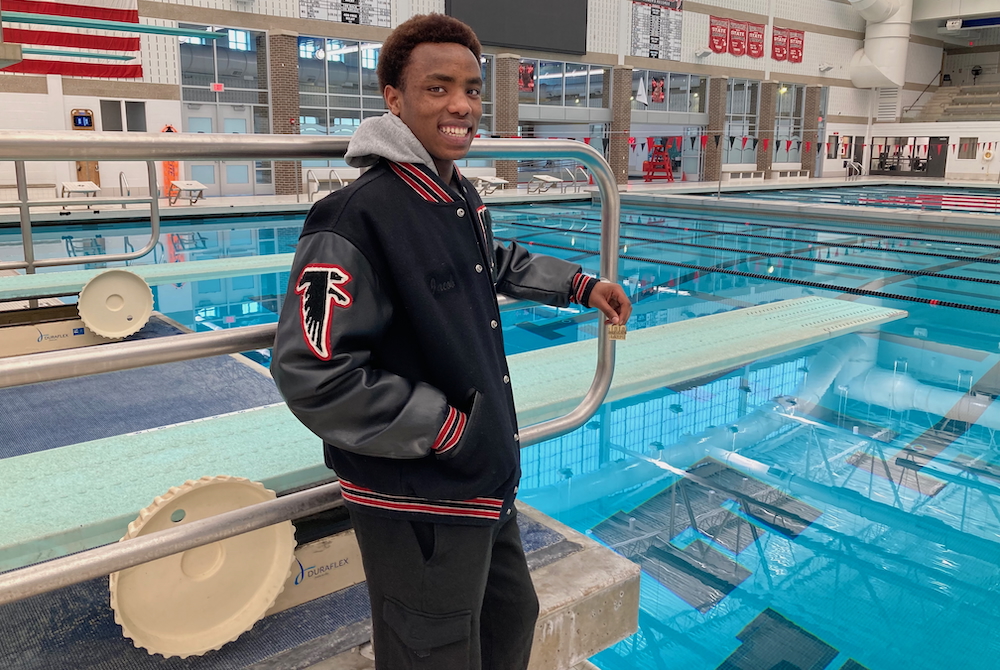
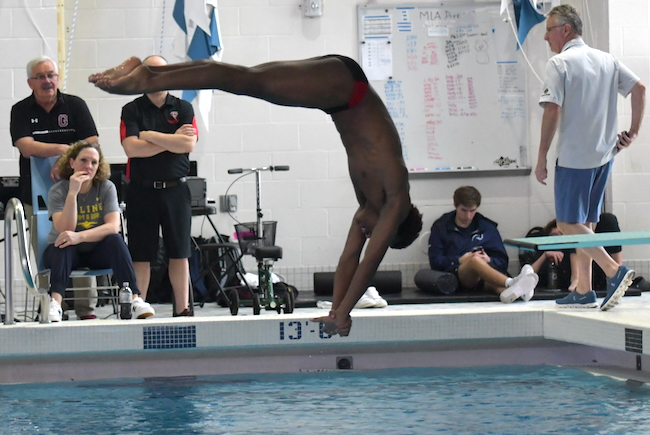
PHOTOS (Top) East Kentwood’s Fidele Byiringiro stands for a photo recently at his school’s pool. (Middle) Byiringiro dives during last weekend’s Lower Peninsula Division 1 Finals at Holland Aquatic Center. (Click for more Finals photos from High School Sports Scene.)