

Casting Lines for Future Tournaments
August 12, 2016
By Jack Roberts
MHSAA Executive Director
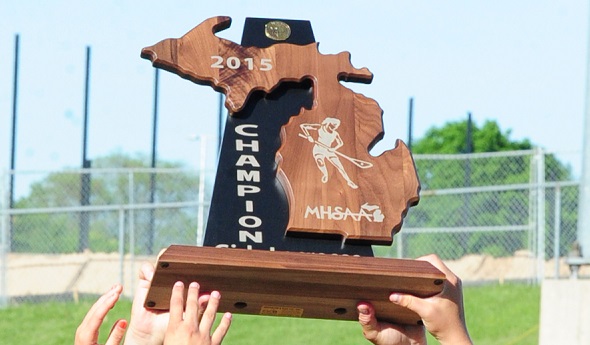
The MHSAA is best known to the public for the tournaments it conducts to conclude the fall, winter and spring seasons each school year.
These tournaments, the first and largest program of the MHSAA, have survived the Vietnam War, the Korean conflict and two World Wars. They have survived the technology bubble, the housing collapse, the energy crisis and the Great Depression.
MHSAA tournaments existed at the dawn of aviation and at the time of our nation’s lunar landing. Popes, presidents and governors have changed and changed again and again, and MHSAA tournaments roll on year after year.
But the sense of tradition and permanence and inevitability of MHSAA tournaments doesn’t dissuade us from asking questions about our tournaments, even some of the most basic questions. Here are two.
Question #1
I have long been and will always be an advocate for a Ryder Cup format for the MHSAA Golf Finals, and a team tennis approach to the MHSAA Tennis Finals; but 90 years of tradition is hard to overcome. Might this be a more exciting format? Could it be co-ed? Could it reverse the decline in boys tennis participation, and increase girls golf participation? Wouldn’t it be fun to try?
Periodically, the International Olympic Committee requires each of the designated Olympic sports to defend its status, to state its case why the sport should remain a part of the Olympic program. Then, after a series or votes that retain one sport at a time, the IOC drops the sport that makes the weakest case. It does so to make room for one of the previously unlisted sports that makes the best case for inclusion.
This would appear to keep the existing Olympic sports on their toes, and to keep the Olympic movement fresh and reflective of modern trends in sports.
While I would not enjoy the controversy, I can see the potential for some positive results if the MHSAA were to invoke the same policy for determining the 14 tournaments it will provide for girls and the 14 for boys.
This might cause us to consider more deeply what a high school sport should look like, or at least what an MHSAA tournament sport should stand for.
On the one hand, we might be inclined to drop tournaments for those sports that involve mostly non-faculty coaches and non-school venues, or require cooperative programs to generate enough participants to support a team, or resort almost entirely to non-school funding, or cater to individuals more than teams.
Or perhaps this process would cause policymakers to forget traditional thinking and ask: “In this day and age, should we shake off traditional notions of sport and consider more where modern kids are coming from?” That might mean fewer team sports and more individual sports, more “extreme” sports like snowboarding and skateboarding, and more lifetime sports, meaning not just golf and tennis and running sports, but also fishing and even shooting sports.
Currently, MHSAA policy states that the MHSAA will consider sponsorship of a tournament series for any sport which 64 member schools conduct on an interscholastic basis as a result of action by the governing boards of those schools.
Should the only question be how many schools sponsor a sport, or must an activity also have certain qualities and/or avoid certain “defects?” What should an MHSAA tournament sport look like and stand for?
Question #2
Bristling from criticism that his association is a money-grabbing exploiter of children, my counterpart in another state said, “If we were running our programs just to make money, we would do very many things very differently.” I knew exactly what he meant.
Because we care about the health and welfare of students, because we mean what we say that the athletic program needs to maximize the ways it enhances the school experience while minimizing academic conflicts, and because we try to model our claim that no sport is a minor sport when it comes to its potential to teach young people life lessons, we operate our programs in ways that make promoters, marketers and business entrepreneurs laugh, cry or cringe.
If money were the only object, we would seed and select sites to assure the teams that attracted the most spectators had the best chance to advance in our tournaments, regardless of the travel for any team or its fan base. If money were the only object, we would never schedule two tournaments to overlap and compete for public attention, much less tolerate three or four overlapping events. If money were the only object, we would allow signage like NASCAR events and promotions like minor league baseball games.
Those approaches to event sponsorship may not be all wrong; they’re just not all right for us. And we will live with the consequences of our belief system.
During a typical school year, more than 20 percent of the MHSAA’s 2,097 District, Regional and Final tournaments lose money. Not a single site in golf, skiing or tennis makes a single penny. In no sport did every District, Regional and Final site have revenue in excess of direct expenses.
In fact, in only three sports – boys and girls basketball and football – is revenue so much greater than direct expenses overall that it helps to pay for all the other tournaments in which the MHSAA invests.
That’s right: invests. When we present our budget to our board, we talk about the MHSAA’s investment in providing tournament opportunities in all those sports and all those places that cannot sustain the cost of those events on their own. How much is this investment worth to students, schools and society?
These two are core questions that require our focus far in advance of talk about scheduling, site selection, seeding and the myriad matters that too often hijack our time and attention.
1st & Goal: 2026 Week 2 Preview
By
Geoff Kimmerly
MHSAA.com senior editor
September 3, 2026
If you’re traveling for the long weekend and see stadium lights shining in the distance, you might want to make a quick stop and check out one of these matchups.
 Nearly 80 percent of this weekend’s games will be played Thursday, although those waiting for Friday won’t miss out as there are plenty of opportunities that night as well to see high-profile nonleague clashes or conference openers that could eventually determine championships.
Staying close to home? Tune in to the NFHS Network for the majority of games across the state, and follow the MHSAA Scores page for results as they’re submitted.
Bay & Thumb
Almont (1-0) at Armada (1-0) – Thursday
Almont has continued to set the standard in the Blue Water Area Conference with three straight league championships. The Raiders’ most recent league loss came in 2022 – to Armada, which has finished second once and third in the league twice over that stretch. Both opened this season with wins over 2025 playoff teams, Armada over St. Clair Shores Lakeview and Almont over Marysville.
Keep an eye on these THURSDAY Saginaw Swan Valley (1-0) at Freeland (0-1), Lapeer (0-1) at Goodrich (1-0), Saginaw Heritage (0-1) at Midland Dow (1-0), Marysville (0-1) at Port Huron (1-0).
Greater Detroit
Detroit Martin Luther King (1-0) at Orchard Lake St. Mary’s (1-0) – Friday
This power pair is facing off for the first time since 2006, and theirs will certainly be one of the most discussed games statewide this weekend. St. Mary’s is coming off winning last season’s Division 2 championship and opened with a 35-27 win over Muskegon Mona Shores, while King reached the Division 3 Regional Finals last fall and began this one by downing annual Ohio contender Toledo Whitmer.
Keep an eye on these THURSDAY Howell (1-0) at Belleville (0-1), Rochester Adams (0-1) at Rochester (1-0), Clarkston (1-0) at Rochester Hills Stoney Creek (1-0). FRIDAY Davison (1-0) at Detroit Catholic Central (1-0).
Mid-Michigan
DeWitt (1-0) at Mason (1-0) – Thursday
This has developed into one of the most intriguing rivalries in the Lansing area, with both teams playing at Ford Field over the last three seasons – with 2023 also when these two started their current series. DeWitt has a 2-1 edge and won last year’s matchup 44-37 – the Panthers’ closest game during a run to the Division 3 championship – but Mason has brought back nearly its entire starting lineup this fall.
Keep an eye on these THURSDAY Fenton (0-1) at Haslett (0-1), Durand (1-0) at New Lothrop (1-0), Lansing Sexton (1-0) at Portland (1-0), Hastings (0-1) at Williamston (1-0).
Northern Lower Peninsula
Ogemaw Heights (1-0) at Traverse City St. Francis (1-0) – Friday
Ogemaw Heights made its first run to the Semifinals last season since 2009, and its only loss of the regular season came 42-32 to St. Francis in Week 2. The Falcons opened last week with an impressive win over Freeland, and the Gladiators downed Elk Rapids. This matchup is joined on St. Francis’ schedule by three games against teams that finished last season at Ford Field.
Keep an eye on these THURSDAY Escanaba (0-1) at Gaylord (1-0), East Jordan (0-1) at Oscoda (0-1). FRIDAY Boyne City (0-1) at Charlevoix (1-0), Grand Rapids Christian (0-1) at Traverse City West (0-1).
Southeast & Border
Pewamo-Westphalia (1-0) at Ottawa Lake Whiteford (0-1) – Friday
These two small-school powers are playing for the first time, but it might not be the last time this season as both stand to be in the Division 7 playoff chase in two months. Whiteford also played a first-time opponent last week, falling to Monroe St. Mary Catholic Central 37-28, while the Pirates are also coming off a tough opener after having outlasted North Muskegon 17-9.
Keep an eye on these THURSDAY Monroe Jefferson (1-0) at Carleton Airport (0-1), Brooklyn Columbia Central (1-0) at Michigan Center (1-0), Union City (1-0) at Reading (1-0). FRIDAY Flat Rock (0-1) at Monroe St. Mary Catholic Central (1-0).
Southwest Corridor
Cedar Springs (0-1) at Battle Creek Harper Creek (1-0) – Friday
Harper Creek hasn’t received enough attention for its run over the last three seasons, which has included two straight Interstate 8 Athletic Conference titles and a combined 22-6 record. The Beavers opened this campaign with a fourth-straight win (and third-straight shutout) of rival Battle Creek Lakeview and now will have a chance to avenge last fall’s lone regular-season loss. Cedar Springs won that Week 2 matchup 30-20 and is seeking to bounce back after falling to Zeeland West last week.
Keep an eye on these THURSDAY Grand Rapids Forest Hills Central (0-1) at Portage Central (0-1), Lansing Everett (0-1) at Battle Creek Central (1-0). FRIDAY Stevensville Lakeshore (1-0) at Niles (0-1), Lowell (0-1) at St. Joseph (1-0).
Upper Peninsula
Menominee (1-0) at Marquette (1-0) – Thursday
These former Great Northern Conference rivals are meeting for the first time since 2022, the last season of football for that league. The Sentinels have won four of their last five matchups, but both have found success since their last time facing off. Over the last three seasons, Menominee has played at Ford Field twice – winning last year’s Division 7 title – and Marquette has reached the Division 3 playoffs twice and opened with a close but impressive loss last week to Negaunee.
Keep an eye on these THURSDAY Ishpeming Westwood (0-1) at Calumet (1-0), Houghton (0-1) at Kingsford (1-0). FRIDAY Gladstone (1-0) at Negaunee (1-0), North Muskegon (0-1) vs. Iron Mountain (1-0) at Petoskey.
West Michigan
East Kentwood (1-0) at Byron Center (1-0) – Thursday
Rare are the days when Muskegon/Rockford isn’t be the default “game of the week” in West Michigan. But don’t look past this matchup this time. East Kentwood is coming off a run to the Division 1 Semifinals last season, which included a 43-14 win over 2024 Division 2 runner-up Byron Center in Week 2. The Bulldogs emerged from an 0-2 start last season, including that defeat by the Falcons, to go 7-2 the rest of the way, and they’ve already avenged the first of last year’s losses by downing Hudsonville 41-20 last week.
Keep an eye on these THURSDAY Grand Rapids South Christian (1-0) at East Grand Rapids (1-0), Detroit Cass Tech (1-0) at Grandville (1-0). FRIDAY Muskegon (0-1) at Rockford (0-1), Midland (1-0) at Zeeland West (1-0).
8-Player
Portland St. Patrick at Blanchard Montabella – Friday
There may not be a team in MHSAA 8-player football history that scheduled a tougher slate to start the season than Montabella, which avenged last fall’s Division 1 championship game loss with a 62-12 win over Martin last week and now gets the reigning Division 2 champion Shamrocks. St. Patrick handed the Mustangs their only regular-season defeat a year ago, 42-16, in Week 9 on the way to a perfect run, and even had a few more days to prepare this time with its Week 1 opponent Wyoming Tri-unity Christian canceling its season.
Keep an eye on these THURSDAY Merrill (1-0) at Morrice (1-0), Central Lake (1-0) at Gaylord St. Mary (1-0), Britton Deerfield (1-0) at Climax-Scotts (1-0). FRIDAY Pickford (1-0) at Rudyard (1-0).
MHSAA.com's weekly “1st & Goal” previews and reviews are powered by MI Student Aid, a division within the Department of Lifelong Education, Advancement, and Potential (MiLEAP). MI Student Aid encourages students to pursue postsecondary education by providing access to student financial resources and information. MI Student Aid administers the state’s scholarship and grant programs that help make college Accessible, Affordable and Attainable for you. Click to connect with MI Student Aid and find more information on Facebook and Twitter @mistudentaid.
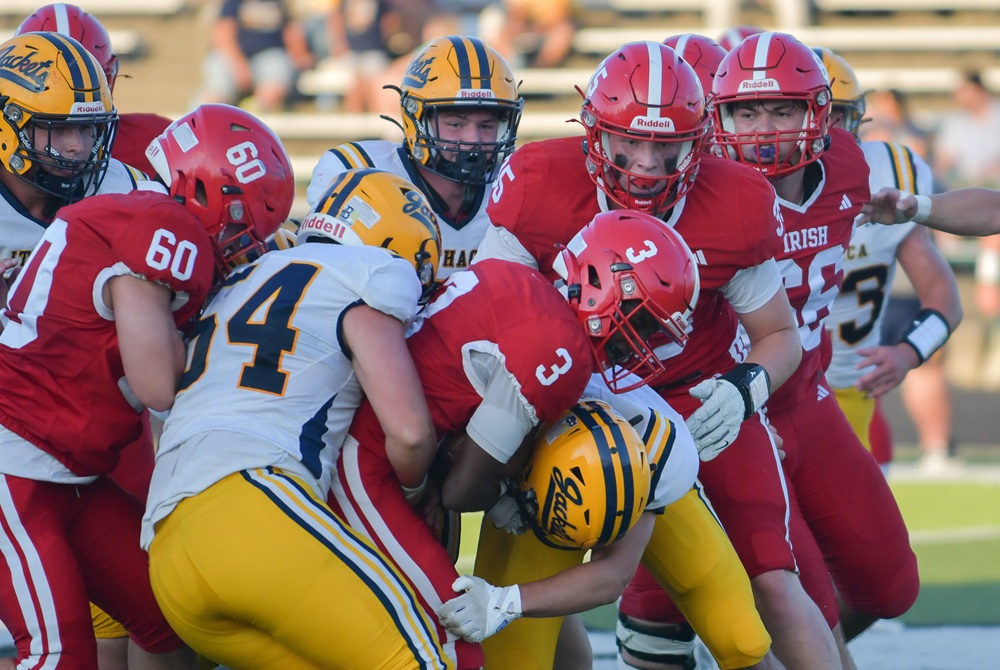
PHOTO Ithaca defenders wrap up a Mount Pleasant Sacred Heart ball carrier during their 48-6 Week 1 win. (Click for more from High School Sports Scene.)