
Casting Lines for Future Tournaments
August 12, 2016
By Jack Roberts
MHSAA Executive Director
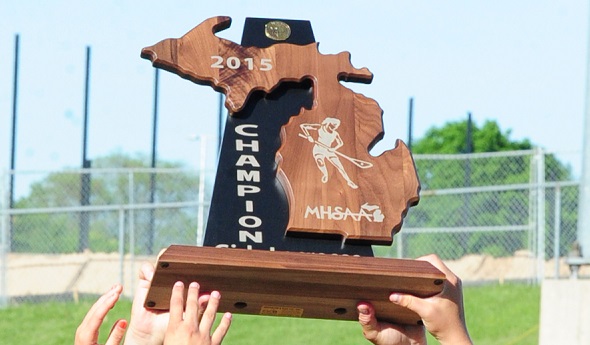
The MHSAA is best known to the public for the tournaments it conducts to conclude the fall, winter and spring seasons each school year.
These tournaments, the first and largest program of the MHSAA, have survived the Vietnam War, the Korean conflict and two World Wars. They have survived the technology bubble, the housing collapse, the energy crisis and the Great Depression.
MHSAA tournaments existed at the dawn of aviation and at the time of our nation’s lunar landing. Popes, presidents and governors have changed and changed again and again, and MHSAA tournaments roll on year after year.
But the sense of tradition and permanence and inevitability of MHSAA tournaments doesn’t dissuade us from asking questions about our tournaments, even some of the most basic questions. Here are two.
Question #1
I have long been and will always be an advocate for a Ryder Cup format for the MHSAA Golf Finals, and a team tennis approach to the MHSAA Tennis Finals; but 90 years of tradition is hard to overcome. Might this be a more exciting format? Could it be co-ed? Could it reverse the decline in boys tennis participation, and increase girls golf participation? Wouldn’t it be fun to try?
Periodically, the International Olympic Committee requires each of the designated Olympic sports to defend its status, to state its case why the sport should remain a part of the Olympic program. Then, after a series or votes that retain one sport at a time, the IOC drops the sport that makes the weakest case. It does so to make room for one of the previously unlisted sports that makes the best case for inclusion.
This would appear to keep the existing Olympic sports on their toes, and to keep the Olympic movement fresh and reflective of modern trends in sports.
While I would not enjoy the controversy, I can see the potential for some positive results if the MHSAA were to invoke the same policy for determining the 14 tournaments it will provide for girls and the 14 for boys.
This might cause us to consider more deeply what a high school sport should look like, or at least what an MHSAA tournament sport should stand for.
On the one hand, we might be inclined to drop tournaments for those sports that involve mostly non-faculty coaches and non-school venues, or require cooperative programs to generate enough participants to support a team, or resort almost entirely to non-school funding, or cater to individuals more than teams.
Or perhaps this process would cause policymakers to forget traditional thinking and ask: “In this day and age, should we shake off traditional notions of sport and consider more where modern kids are coming from?” That might mean fewer team sports and more individual sports, more “extreme” sports like snowboarding and skateboarding, and more lifetime sports, meaning not just golf and tennis and running sports, but also fishing and even shooting sports.
Currently, MHSAA policy states that the MHSAA will consider sponsorship of a tournament series for any sport which 64 member schools conduct on an interscholastic basis as a result of action by the governing boards of those schools.
Should the only question be how many schools sponsor a sport, or must an activity also have certain qualities and/or avoid certain “defects?” What should an MHSAA tournament sport look like and stand for?
Question #2
Bristling from criticism that his association is a money-grabbing exploiter of children, my counterpart in another state said, “If we were running our programs just to make money, we would do very many things very differently.” I knew exactly what he meant.
Because we care about the health and welfare of students, because we mean what we say that the athletic program needs to maximize the ways it enhances the school experience while minimizing academic conflicts, and because we try to model our claim that no sport is a minor sport when it comes to its potential to teach young people life lessons, we operate our programs in ways that make promoters, marketers and business entrepreneurs laugh, cry or cringe.
If money were the only object, we would seed and select sites to assure the teams that attracted the most spectators had the best chance to advance in our tournaments, regardless of the travel for any team or its fan base. If money were the only object, we would never schedule two tournaments to overlap and compete for public attention, much less tolerate three or four overlapping events. If money were the only object, we would allow signage like NASCAR events and promotions like minor league baseball games.
Those approaches to event sponsorship may not be all wrong; they’re just not all right for us. And we will live with the consequences of our belief system.
During a typical school year, more than 20 percent of the MHSAA’s 2,097 District, Regional and Final tournaments lose money. Not a single site in golf, skiing or tennis makes a single penny. In no sport did every District, Regional and Final site have revenue in excess of direct expenses.
In fact, in only three sports – boys and girls basketball and football – is revenue so much greater than direct expenses overall that it helps to pay for all the other tournaments in which the MHSAA invests.
That’s right: invests. When we present our budget to our board, we talk about the MHSAA’s investment in providing tournament opportunities in all those sports and all those places that cannot sustain the cost of those events on their own. How much is this investment worth to students, schools and society?
These two are core questions that require our focus far in advance of talk about scheduling, site selection, seeding and the myriad matters that too often hijack our time and attention.

Past Wildcats Bringing Valuable Experiences Home as Three Rivers' New Hoops Coaches
By
Scott Hassinger
Special for MHSAA.com
December 2, 2025
THREE RIVERS – Basketball has always been a passion for rookie Three Rivers coaches Drew Bosma and Michael Morrison.
The two former Wildcats aim to bring that same level of energy they exhibited during their playing careers as they embark on their first varsity coaching stints.
Both Bosma and Morrison have brought along a few familiar faces as they begin working to rebuild Three Rivers' strong basketball tradition.
Bosma, a 2009 graduate, replaced long-time mentor Brian Burg as the Wildcats' varsity boys coach, while Morrison has taken the reins of the girls program from Carley Shoesmith.
As a student-athlete at Three Rivers, Bosma excelled in football, basketball, baseball and track & field. He continued his playing career at Alma College and Liberty University before returning home and completing his undergraduate studies in psychology through online courses.
"My psychology background has been useful in my coaching career. The kids you work with have so many different issues they encounter than when I was in school," said Bosma, who is employed in the RV Industry at Grand Design in Elkhart, Ind.
Bosma's early shift works out perfectly with his coaching duties. After 11 seasons as Three Rivers’ JV boys coach, he spent the last two as a varsity assistant at Portage Northern. His immediate goal is to renew enthusiasm within the program.
"My experience with Three Rivers basketball as a player was a very good one. I want to build the culture to the point where people want to be here, the effort isn't questioned and (we) have kids who enjoy the game," Bosma said. "I've had a lot of good mentors in this game. Now that I'm a head coach, I want our players to be able to step onto the court and play freely. Yelling after every mistake they make isn't going to teach them anything. They are going to make mistakes in life, and they have to understand it’s ok to mess up and learn from those mistakes.”
Bosma's additional goals this season are simple ones.
"I want our kids to make it known that we have competed hard in every game with a no-quit attitude. It's a coach’s dream to win every game, but I want to make sure these kids are becoming better people as well as basketball players," Bosma said.
Long-range goals include increasing interest among students to try out for the team. He and his staff have organized the Three Rivers NextGen Boys' Basketball Program for students in kindergarten through eighth grade that will begin in January and focus on building skills and nurturing players who may fill the ranks down the road.
Bosma's coaching philosophy includes being tough on his players while showing that he truly cares about their well-being.
"As a coach I'm going to be hard on you, but these guys know that it’s out of love and concern for them,” he said. “They understand that anything I say to them is meant truthfully, and it comes from the heart. I want them to know they can come and talk to me. I want them to return 10-12 years later and notice the same type of feeling in this program. All of my coaches are either former teammates of mine or guys who played for me.”
Tirrell Hausmanis, a former hoops star at Three Rivers, serves as Bosma's varsity assistant. Brenden Brown is the Wildcats' junior varsity mentor, and alumnus Thomas O'Dell is the freshman coach.
"Having Three Rivers alumni on our coaching staff teaches these kids how important basketball is to our community," Bosma said.
Offensively, Bosma expects the Wildcats to be able to stay in space and use their long wing players and better shooters to their advantage. Among the top returners are junior point guard Brayden Carpenter, 6-foot-6 senior forward Zander Barth (who is committed to Central Michigan for football), and senior forward Carter Langston.
Carpenter averaged 13 points per game as a sophomore, as Three Rivers finished 7-15.
"You can tell there's a different attitude under the new coaching staff. There are lot of guys now who want to put in the extra time and energy to get better,” Carpenter said. “Our communication on the court has improved, and Coach Bosma's system allows us to play freely without worrying about the consequences of making a mistake.”
Three Rivers looks to be more adaptable at the defensive end.
"Defensively I want to change things up all the time. We don't want to just sit back in one zone or play man-to-man, but rather press whenever we can,” Bosma said. “We have a group that has improved its basketball IQ, which allows us to do so much more as coaches. We have good team camaraderie and kids who are going to play for each other. These guys are more excited about getting the win rather than what shows up in the box score.”
Bosma has seven seniors on his roster, but Three Rivers still is a fairly young team in terms of experience.
"We have long and athletic kids and guys who could be pretty good once they build their confidence level. We have great guards and kids who like to defend. Defense has become somewhat of a lost art in high school basketball. We have the tools though to be a successful basketball team," Bosma said.
Morrison, a 2003 Three Rivers graduate who played football, basketball and baseball for the Wildcats, has taken the reins of the girls program. After high school, Morrison attended Ferris State University where he graduated with a psychology degree as well. He is employed as a probation officer for the state.
Morrison has extensive experience coaching basketball. He started out coaching travel basketball in Paw Paw while also coaching high school teams at Kalamazoo Loy Norrix, Vicksburg and Three Rivers, including the last five years as the JV boys coach under Burg. He also served as an assistant men's coach at Glen Oaks Community College under Mike Elliott.
"Working under Mike taught me so much more about basketball and has made me an even better coach. That time was very beneficial," Morrison said.
Morrison's immediate goal is to provide stability in the girls program.
"These girls have had several coaches in the last few years. I want to provide some stability and help the program grow from the lower levels,” he said. “Obviously you want to win championships, but right now we have to start with attainable goals like finishing over .500, which we haven't done in a while.”
Other goals that Morrison feels are within Three Rivers’ grasp are finishing in the top half of the Wolverine Conference and competing for a District title. The Wildcats were 8-14 last season and tied for sixth in the league.
His philosophy centers around pace and space.
"I want to get up and down the floor and defend. We want to execute an offense in the halfcourt, but also get up and down the floor and get some fastbreaks when we can. We spent the first couple weeks of practice working on executing things the right way," Morrison said.
Senior guard Dani Glass, a second-team all-Wolverine Conference pick last season, returns for her fourth varsity season. Glass, who averaged 12 points per game as a junior, has committed to play at Kalamazoo Valley Community College.
"Dani makes us go and is our catalyst for everything we do offensively. We expect more from her this season as she gets ready for the next level," Morrison said.
Sophomore post player Braylee Burg will be another key component for the Wildcats, along with senior defensive specialist Jersey Roehrs.
"I feel I help my team most with my ability to box out and create a lane for my guards along with providing rebounding. I want to work on finishing stronger at the rim this year,” Burg said. “Our coaching staff has us doing fun drills that are getting us ready for the season. We want to get the ball down the floor more effectively and set up our offense."
Morrison is most excited about his team's work ethic.
"We are very excited about this team's potential and are really leaning heavily on our seniors to give us a big great burst of energy and bring everyone else along,” Morrison said. “People are going to see a very well-disciplined group that works hard and together as a team. We are working extremely hard on our communication and shooting as well."
Parker Ellifritz, who ranks among Three Rivers’ all-time leading scorers, serves as Morrison's varsity assistant. Olivia Hancock, whose played on the 2016 Class B championship team at Marshall during her prep days, fills the role of junior varsity coach with Payge Ellifritz, Parker's sister, serving as her assistant.
Scott Hassinger is a contributing sportswriter for Leader Publications and previously served as the sports editor for the Three Rivers Commercial-News from 1994-2022. He can be reached at [email protected] with story ideas for Berrien, Cass, St. Joseph and Branch counties.
PHOTOS (Top) Above, the Three Rivers boys basketball coaching staff, from left to right: junior varsity coach Brenden Brown, head varsity coach Drew Bosma, varsity assistant Tirrell Hausmanis and freshman coach Thomas O'Dell. Below, the girls basketball coaching staff, also from left to right: varsity assistant Parker Ellifritz, head varsity coach Michael Morrison and junior varsity coach Olivia Hancock. (Middle) Junior point guard Brayden Carpenter (0) returns for his second varsity season at Three Rivers. (Below) Senior Braylee Burg (52) returns for her second varsity season for Three Rivers. (Photos by Scott Hassinger.)