

Casting Lines for Future Tournaments
August 12, 2016
By Jack Roberts
MHSAA Executive Director
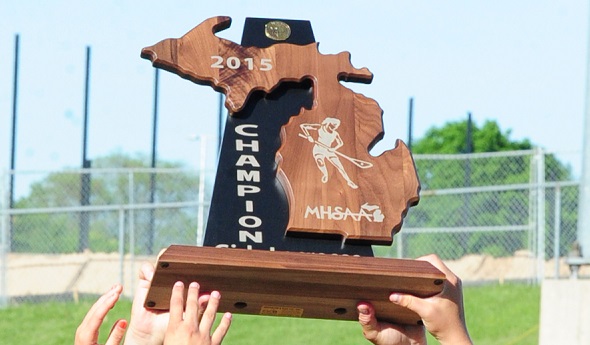
The MHSAA is best known to the public for the tournaments it conducts to conclude the fall, winter and spring seasons each school year.
These tournaments, the first and largest program of the MHSAA, have survived the Vietnam War, the Korean conflict and two World Wars. They have survived the technology bubble, the housing collapse, the energy crisis and the Great Depression.
MHSAA tournaments existed at the dawn of aviation and at the time of our nation’s lunar landing. Popes, presidents and governors have changed and changed again and again, and MHSAA tournaments roll on year after year.
But the sense of tradition and permanence and inevitability of MHSAA tournaments doesn’t dissuade us from asking questions about our tournaments, even some of the most basic questions. Here are two.
Question #1
I have long been and will always be an advocate for a Ryder Cup format for the MHSAA Golf Finals, and a team tennis approach to the MHSAA Tennis Finals; but 90 years of tradition is hard to overcome. Might this be a more exciting format? Could it be co-ed? Could it reverse the decline in boys tennis participation, and increase girls golf participation? Wouldn’t it be fun to try?
Periodically, the International Olympic Committee requires each of the designated Olympic sports to defend its status, to state its case why the sport should remain a part of the Olympic program. Then, after a series or votes that retain one sport at a time, the IOC drops the sport that makes the weakest case. It does so to make room for one of the previously unlisted sports that makes the best case for inclusion.
This would appear to keep the existing Olympic sports on their toes, and to keep the Olympic movement fresh and reflective of modern trends in sports.
While I would not enjoy the controversy, I can see the potential for some positive results if the MHSAA were to invoke the same policy for determining the 14 tournaments it will provide for girls and the 14 for boys.
This might cause us to consider more deeply what a high school sport should look like, or at least what an MHSAA tournament sport should stand for.
On the one hand, we might be inclined to drop tournaments for those sports that involve mostly non-faculty coaches and non-school venues, or require cooperative programs to generate enough participants to support a team, or resort almost entirely to non-school funding, or cater to individuals more than teams.
Or perhaps this process would cause policymakers to forget traditional thinking and ask: “In this day and age, should we shake off traditional notions of sport and consider more where modern kids are coming from?” That might mean fewer team sports and more individual sports, more “extreme” sports like snowboarding and skateboarding, and more lifetime sports, meaning not just golf and tennis and running sports, but also fishing and even shooting sports.
Currently, MHSAA policy states that the MHSAA will consider sponsorship of a tournament series for any sport which 64 member schools conduct on an interscholastic basis as a result of action by the governing boards of those schools.
Should the only question be how many schools sponsor a sport, or must an activity also have certain qualities and/or avoid certain “defects?” What should an MHSAA tournament sport look like and stand for?
Question #2
Bristling from criticism that his association is a money-grabbing exploiter of children, my counterpart in another state said, “If we were running our programs just to make money, we would do very many things very differently.” I knew exactly what he meant.
Because we care about the health and welfare of students, because we mean what we say that the athletic program needs to maximize the ways it enhances the school experience while minimizing academic conflicts, and because we try to model our claim that no sport is a minor sport when it comes to its potential to teach young people life lessons, we operate our programs in ways that make promoters, marketers and business entrepreneurs laugh, cry or cringe.
If money were the only object, we would seed and select sites to assure the teams that attracted the most spectators had the best chance to advance in our tournaments, regardless of the travel for any team or its fan base. If money were the only object, we would never schedule two tournaments to overlap and compete for public attention, much less tolerate three or four overlapping events. If money were the only object, we would allow signage like NASCAR events and promotions like minor league baseball games.
Those approaches to event sponsorship may not be all wrong; they’re just not all right for us. And we will live with the consequences of our belief system.
During a typical school year, more than 20 percent of the MHSAA’s 2,097 District, Regional and Final tournaments lose money. Not a single site in golf, skiing or tennis makes a single penny. In no sport did every District, Regional and Final site have revenue in excess of direct expenses.
In fact, in only three sports – boys and girls basketball and football – is revenue so much greater than direct expenses overall that it helps to pay for all the other tournaments in which the MHSAA invests.
That’s right: invests. When we present our budget to our board, we talk about the MHSAA’s investment in providing tournament opportunities in all those sports and all those places that cannot sustain the cost of those events on their own. How much is this investment worth to students, schools and society?
These two are core questions that require our focus far in advance of talk about scheduling, site selection, seeding and the myriad matters that too often hijack our time and attention.
Champion Coaches - Including Local Legends - Unite to Restore Ravenna Glory
By
Scott DeCamp
Special for MHSAA.com
October 8, 2026
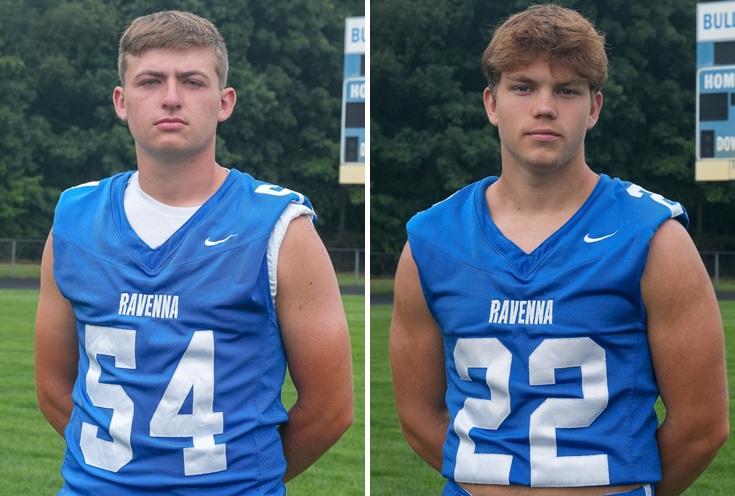
RAVENNA – Whether they want to or not, Ravenna seniors Joel Kantola and Colton Rolison hear about the glory days of Bulldogs football from their fathers.
 Kantola’s dad, Brandon, watches old games from the 1994 season when he was a two-way starter on Ravenna’s first MHSAA Finals championship team.
“He can’t remember very well, but he’ll see a play and he’s like, ‘Oh, I remember doing that play!’” Joel Kantola said. “It’s one of the best things to hear something (from that era). He loves it, too.”
Rolison’s dad, Willy, shares memorable stories from back in the day when he was a dynamic running back on the Bulldogs’ 1997 Class C title squad.
“It’s just insane that he still has all these stories that I’ve never heard. He’s still bringing them up, new ones every day,” Colton Rolison said with a smile.
Three decades have passed since the 1990s heyday of Ravenna football, when the Bulldogs won three of their program’s four Finals titles. But in the small town located on the eastern edge of Muskegon County, the band is back together, one might say.
Steve Czerwon was hired in March as Ravenna’s head football coach, coming from a highly successful 13-year tenure at his Muskegon Catholic Central alma mater where he guided the Crusaders to Division 8 championships all of his first four seasons (2013-16).
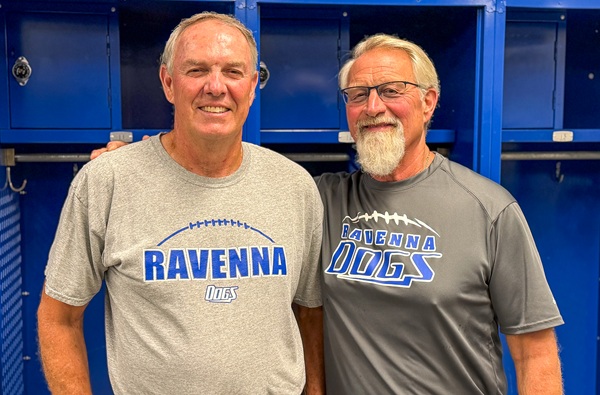
One of Czerwon’s first orders of business in Ravenna was securing the commitments of legendary coaches Dusty Fairfield and Randy Helsen – architects of the Bulldogs’ championship teams in 1994, 1996, 1997 and 2003 – to bring their wisdom and serve as a link from the storied era to this current one.
They agreed, others from the old guard hopped aboard, and a couple more experienced coaches joined Czerwon’s staff. Now, entering the final third of the 2026 regular season, the Bulldogs appear to have regained a little traction despite coming off three straight losing campaigns.
Ravenna carries a 5-1 overall record and five-game winning streak into this Friday’s West Michigan Conference Rivers home game against Hesperia.
Next week, Ravenna plays at North Muskegon with at least a share of the WMC Rivers title on the line. Should the Bulldogs win this Friday, they’ll take on the Norsemen for the outright league championship.
Since the WMC expanded and split into two divisions in 2022, North Muskegon has not lost a Rivers football game. Meanwhile, Ravenna has not won a conference title since sharing one with two teams in 2001.
In their football history, the Bulldogs have as many Finals titles as they do conference championships (four), illustrating the enduring strength of the West Michigan Conference.
This pack is hungry to etch its own history: Winning a conference title and making a run in the Division 7 playoffs. But, as Helsen laid out, there’s a price to pay.
“Steve addressed the fact (with the players),” Helsen recalled. “‘You wanted these guys to come back and you wanted what they had in the ’80s through the ’90s into the 2000s, and what it’s going to take is every effort you’ve got and even take it up from where you are. If you want to leave a legacy, that’s what you have to do. These guys (have) a legacy.’”
When Helsen says “these guys,” he’s referring to Fairfield and himself, but also other connections from the days of Ravenna football prominence.
In 20 seasons as Ravenna’s head coach covering two stints – the second ending in 2010 – Fairfield sported a 164-55 record. He’s a Michigan High School Football Coaches Association Hall of Famer.
Helsen served as Ravenna’s defensive coordinator for all of those seasons, and then some. He and Fairfield are both Ravenna Athletic Hall of Famers, their plaques side-by-side on the wall of the high school’s athletic wing.
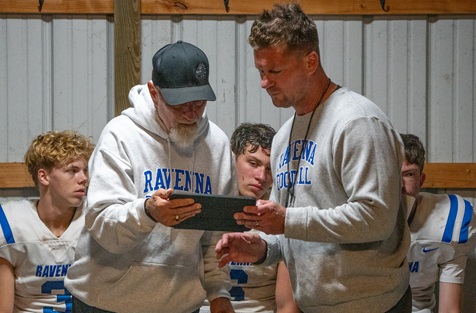
Fairfield and Helsen are both retired and they’re volunteer assistants on Czerwon’s staff. They are not at every practice, but they fill critical roles: The former works with the secondary and quarterbacks, plus he’s on the headset in the press box on game days, while the latter coaches defensive linemen.
“They have so much knowledge, and I think it really does connect the past to the current,” said Czerwon, who did his student teaching at Ravenna in the early 2000s and was a member of the Bulldogs coaching staff during their most recent state title season in 2003. “A lot of kids here, they heard from their uncles and their fathers about some really good teams that Ravenna had in the ’90s and early 2000s, and those guys are the actual link.
“I talk to Dusty daily, and he just reinforces the importance of relationships you have with the kids,” Czerwon added. “He’s second to none at that, and it reinforces to me the importance of that.”
Geoff Nelson, who was a starting lineman on Ravenna’s 1994 team, coaches the offensive line. Neil Sladick, who helped the Bulldogs win Finals titles in 1996 and 1997, works with linebackers. Mark Jacobs, who starred on Ravenna’s first Finals group in 1988, helps coach defensive backs.
Canaan Groff is Ravenna’s defensive coordinator, and Nate Smith specializes in offense. Both bring experience to the table, including as head coaches. Czerwon, Groff, Sladick, and Smith all work in Ravenna school buildings, which is an advantage for coaches.
“I think that we’re bringing back a lot of accountability. I think we don’t settle,” Nelson said about Ravenna’s coaching staff. “This has been a great group. We had to break a lot of bad habits, but they’re starting to form new habits and starting to go in the right direction.”
Ravenna got a reality check to start the season in a 33-7 loss to Division 8 top-ranked Beal City, a perennial small-school power. Czerwon admitted he may have asked too much of his players right away in terms of new schemes and such.
Since then, the Bulldogs have exhibited gradual improvement, including winning a couple of one-point games, and now they’re starting to establish an identity of physical football. That was at its peak in last week’s 28-0 win at Mason County Central, which by the way is coached by Ravenna alumnus David Smith, a former Bulldogs head coach who was a member of Class C championship teams in 1994 and 1996.
Things are moving in the right direction for Ravenna.
“There hasn’t really been a lot of drama or anything like that. We love each other. That wins games,” said Rolison, a linebacker who suffered a fractured collarbone in Week 3. Chances of a return this season are up in the air, he said.
“(The coaches have all) worked together before and nobody motivates like Dusty Fairfield – there’s not a single person out there who does,” Rolison added. “Coach Randy Helsen, he knows his stuff. He knows more than I probably ever will about football.”
According to Helsen, getting to know young people at the ground level is Fairfield’s specialty: Types of music they like, their hunting spots, etc.
In terms of accountability, everybody is responsible for that.
“We get after them if they’re not getting it done,” Helsen said. “Kids that were not getting after it five, six weeks ago and kind of rolling their eyes at me when I’m coaching them on scout defense, they’re now in the starting lineup. I said, ‘You’re getting coached by a guy that coached defense here for 27 years. I’m giving you the same coaching that our all-staters and all-conference players got.’”
Fairfield’s goal in returning was to help lay building blocks for current and future success. He believes the overall health of football in Ravenna is strong considering participation numbers from high school to youth levels, especially at a time when similarly small communities across the state are canceling varsity seasons or not fielding enough players to form junior varsity squads.
“It’s been a good experience, and it’s made me realize, you know, what we did in the past really meant something, and it made me realize how hard we worked because I’m totally invested in the team right now. It is fun with the camaraderie with not just the boys but also the coaches,” Fairfield said.
“You know, it’s my last hurrah where I get to experience what I did for a living for over 30 years. I get to experience it one more time before I, you know, go off into the sunset,” he added with a chuckle.
For families such as the Kantolas and Rolisons, things are coming full circle – and they could not be more excited. Brandon Kantola is enjoying his son’s senior season while also reminiscing about the good ol’ days.
“I think he was invested back then,” said Joel Kantola, Ravenna’s starting center, “but he’s more excited for us than I think he was back then.”

Scott DeCamp has worked more than 25 years in sports media, including 21 at MLive Media Group as a reporter and editor. He is founder and owner of DeCamp Creative Solutions. Email him at [email protected] with story ideas for Lake, Mason, Mecosta, Muskegon, Newaygo, Oceana, and Oceola counties.
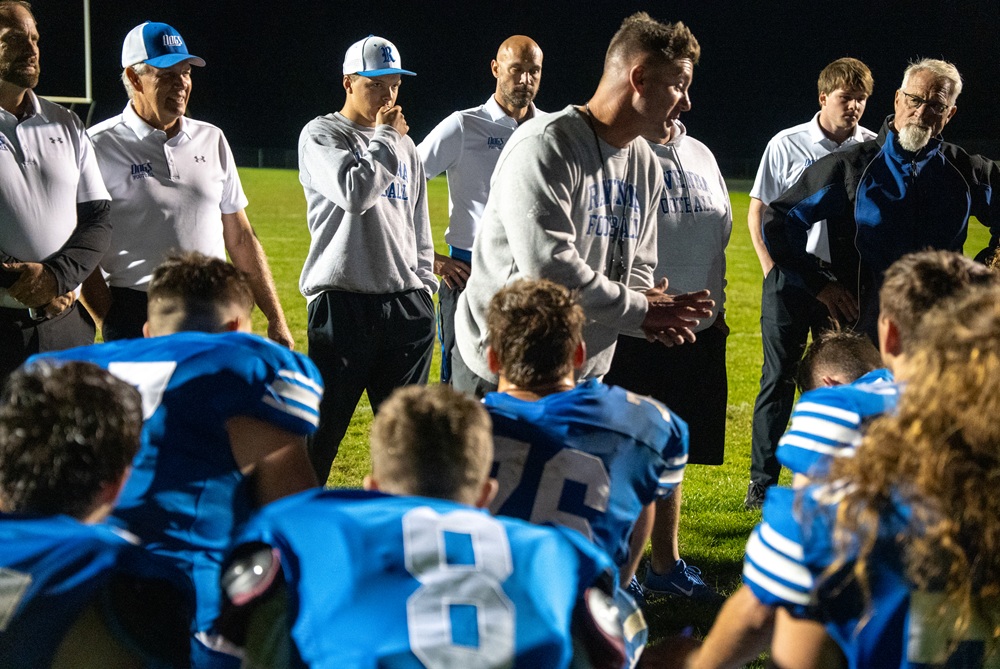
PHOTOS (Top) Ravenna head coach Steve Czerwon addresses the team following a 28-14 victory over Shelby on Sept. 25. (2) Ravenna assistant coaches Randy Helsen, left, and Dusty Fairfield are pictured in the Bulldogs' locker room in August. (3) Joel Kantola, left, is a senior center for the Ravenna football team, and Colton Rolison is a senior linebacker. (4) Fairfield, left, and Czerwon look at an iPad during halftime of a 28-0 victory over Mason County Central on Friday. (Photos by Scott DeCamp.)