

Casting Lines for Future Tournaments
August 12, 2016
By Jack Roberts
MHSAA Executive Director
The MHSAA is best known to the public for the tournaments it conducts to conclude the fall, winter and spring seasons each school year.
These tournaments, the first and largest program of the MHSAA, have survived the Vietnam War, the Korean conflict and two World Wars. They have survived the technology bubble, the housing collapse, the energy crisis and the Great Depression.
MHSAA tournaments existed at the dawn of aviation and at the time of our nation’s lunar landing. Popes, presidents and governors have changed and changed again and again, and MHSAA tournaments roll on year after year.
But the sense of tradition and permanence and inevitability of MHSAA tournaments doesn’t dissuade us from asking questions about our tournaments, even some of the most basic questions. Here are two.
Question #1
I have long been and will always be an advocate for a Ryder Cup format for the MHSAA Golf Finals, and a team tennis approach to the MHSAA Tennis Finals; but 90 years of tradition is hard to overcome. Might this be a more exciting format? Could it be co-ed? Could it reverse the decline in boys tennis participation, and increase girls golf participation? Wouldn’t it be fun to try?
Periodically, the International Olympic Committee requires each of the designated Olympic sports to defend its status, to state its case why the sport should remain a part of the Olympic program. Then, after a series or votes that retain one sport at a time, the IOC drops the sport that makes the weakest case. It does so to make room for one of the previously unlisted sports that makes the best case for inclusion.
This would appear to keep the existing Olympic sports on their toes, and to keep the Olympic movement fresh and reflective of modern trends in sports.
While I would not enjoy the controversy, I can see the potential for some positive results if the MHSAA were to invoke the same policy for determining the 14 tournaments it will provide for girls and the 14 for boys.
This might cause us to consider more deeply what a high school sport should look like, or at least what an MHSAA tournament sport should stand for.
On the one hand, we might be inclined to drop tournaments for those sports that involve mostly non-faculty coaches and non-school venues, or require cooperative programs to generate enough participants to support a team, or resort almost entirely to non-school funding, or cater to individuals more than teams.
Or perhaps this process would cause policymakers to forget traditional thinking and ask: “In this day and age, should we shake off traditional notions of sport and consider more where modern kids are coming from?” That might mean fewer team sports and more individual sports, more “extreme” sports like snowboarding and skateboarding, and more lifetime sports, meaning not just golf and tennis and running sports, but also fishing and even shooting sports.
Currently, MHSAA policy states that the MHSAA will consider sponsorship of a tournament series for any sport which 64 member schools conduct on an interscholastic basis as a result of action by the governing boards of those schools.
Should the only question be how many schools sponsor a sport, or must an activity also have certain qualities and/or avoid certain “defects?” What should an MHSAA tournament sport look like and stand for?
Question #2
Bristling from criticism that his association is a money-grabbing exploiter of children, my counterpart in another state said, “If we were running our programs just to make money, we would do very many things very differently.” I knew exactly what he meant.
Because we care about the health and welfare of students, because we mean what we say that the athletic program needs to maximize the ways it enhances the school experience while minimizing academic conflicts, and because we try to model our claim that no sport is a minor sport when it comes to its potential to teach young people life lessons, we operate our programs in ways that make promoters, marketers and business entrepreneurs laugh, cry or cringe.
If money were the only object, we would seed and select sites to assure the teams that attracted the most spectators had the best chance to advance in our tournaments, regardless of the travel for any team or its fan base. If money were the only object, we would never schedule two tournaments to overlap and compete for public attention, much less tolerate three or four overlapping events. If money were the only object, we would allow signage like NASCAR events and promotions like minor league baseball games.
Those approaches to event sponsorship may not be all wrong; they’re just not all right for us. And we will live with the consequences of our belief system.
During a typical school year, more than 20 percent of the MHSAA’s 2,097 District, Regional and Final tournaments lose money. Not a single site in golf, skiing or tennis makes a single penny. In no sport did every District, Regional and Final site have revenue in excess of direct expenses.
In fact, in only three sports – boys and girls basketball and football – is revenue so much greater than direct expenses overall that it helps to pay for all the other tournaments in which the MHSAA invests.
That’s right: invests. When we present our budget to our board, we talk about the MHSAA’s investment in providing tournament opportunities in all those sports and all those places that cannot sustain the cost of those events on their own. How much is this investment worth to students, schools and society?
These two are core questions that require our focus far in advance of talk about scheduling, site selection, seeding and the myriad matters that too often hijack our time and attention.
Century of School Sports: State's Storytellers Share Fall Memories
By
Geoff Kimmerly
MHSAA.com senior editor
October 15, 2024
The story of school sports always has been, and remains, one of its most valuable commodities – a collection of memories tying together generations who have learned, competed and endured with their classmates, representing their communities over the 100-year history of the Michigan High School Athletic Association.
High School sports in Michigan have had the great benefit of being featured prevalently in the state’s media going back to their start – first in the local newspaper, then over the local radio airwaves, followed by local TV stations and now joined by an online presence allowing anyone from anywhere to keep up with their favorite school team.
Once per season – Fall, Winter and Spring – during this 2024-25 “Century of School Sports” celebration, we’ll feature memories from several of our state’s storytellers who have played major roles in getting out the good word on school sports. Below is our first edition, taken from a survey of more than 20 media members past and present along with our longtime MHSAA historian and staff communications specialist.
Dad Role Provides Perspective for Role as Storyteller
Jack Doles, WOOD TV (Grand Rapids)
I have been covering high school sports in the state of Michigan since 1987. I have seen some of the most incredible games played at the Silverdome and Ford Field in the MHSAA football state championships. Nothing will top watching my son Tommy win a state championship with Grand Rapids Christian in 2012. They beat Orchard Lake St. Mary's in overtime 40-37. Drake Harris, who would go on to play football at the University of Michigan, had a game for the ages.
But the thing I'll never forget was interviewing my son afterward. I could hardly get the questions out. I wasn't the reporter for that game; that wouldn't be right. Still, I came away from that championship run with a different perspective. I saw first-hand how a school community rallies around a team. It gave me a better understanding of how we should try and cover teams and tournaments.
Sexton Takes Lansing on Unforgettable Ride
Brian Calloway, Lansing State Journal
One of the best things about high school sports is seeing teams take communities on special rides and to places they have never been before. I have seen it plenty with football teams I have covered, like Mason and Corunna last season making their historic runs to Ford Field. But the instance that stands out the most is when Lansing Sexton reached the Division 4 state championship game in 2014 under Dan Boggan. The trip ended with a 28-27 loss to Grand Rapids South Christian, but the experience marked a major moment for the Lansing School District, which has produced plenty of football talent over the years but never had any of its schools get to a football state final.
Livonia Schools Set Stage as 1st Class A Boys Soccer Finalists
 Brad Emons, Detroit Free Press (formerly of Observer & Eccentric newspapers)
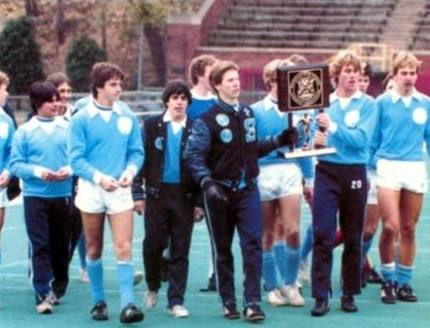
The first MHSAA Class A boys soccer championship game, on Nov. 6, 1982, ironically featured two Livonia schools, Stevenson vs. Churchill, at Flint’s Atwood Stadium.
Stevenson, coached by Pete Scerri and led by prolific goal scorer Gary Mexicotte, earned a 4-1 victory over the Chargers.
Reese Refuses to Let Championship Party End
Rob Kaminski, MHSAA communications coordinator since 1999
In a sport that has seen a host of repeat champions and schools with numerous Finals appearances, it’s a school that had only one shot at the Finals and made the most of it against long odds that comes to mind: The 2021 Reese Rockets.
The Rockets, in fact, had only reached the MHSAA Semifinals one other time (2010), and coach Angie Compton’s team was facing a tall task being asked to dethrone two-time defending champion Monroe St. Mary Catholic Central in the Division 3 championship match. SMCC was making its 11th Finals appearance. Before reaching the Final, however, Reese was extended to four sets in a thrilling 25-20, 25-18, 23-25, 28-26 victory over Muskegon Western Michigan Christian.
Facing the perennial power Kestrels the next day, Compton’s team appeared to be running on empty as SMCC took the first two sets, 25-18, 25-19. Unfazed, and actually singing and dancing to music blaring over the public address system during each break in the action, Reese pounded out a 25-25 win in set 3 and put the champs on the ropes with a 25-21 win in set 4 to tie the match, 2-2.
The Rockets would have to battle back from one last deficit, trailing in the see-saw fifth set, 9-7, before capping the Cinderella season on the second championship point of the night as senior Maddi Osantowski and junior Abby Karst combined for a block for a 16-14 victory. Osantowski finished with 34 kills and totaled 110 attack attempts while setter Aydan Dalak had 42 assists.
Muskegon Reminds Us that It’s Never ‘Game Over’
Ron Pesch, MHSAA historian
Part of a rare double bill hosted at MSU's Spartan Stadium, the 2008 Muskegon-Davison Division 2 Semifinal provided countless Big Reds fans with the opportunity to depart early. And many did.
Everything that could go wrong did go wrong for unbeaten, top-ranked, and heavily-favored Muskegon. Turnover after turnover – six in total, including two muffed punts – aligned with a stellar performance by Davison's sophomore quarterback, Jake Thompson, and an opportunistic Cardinals squad. Davison led 21-13 at the half, 35-13 with 4:45 to play in the third quarter, and 35-19 with under five minutes remaining when a blown defensive assignment allowed Muskegon to cut the margin to 35-25 on a 77-yard TD pass. But a failed 2-point conversion meant the Big Reds still needed two scores.
For several in the press box, as well as the great majority in the stands, it was game over. However, in a game filled with life lessons, Muskegon's recovery of a pair of onside kicks – with touchdowns to follow – made the Big Reds’ eventual 38-35 victory the most improbable of improbable comebacks in MHSAA playoff history. It's still stunning to watch.
Good-bye to Legendary Program, Legendary Coach
Brad Emons, Detroit Free Press (formerly of Observer & Eccentric newspapers)
In the final year of Farmington Hills Harrison before it closed its doors, the state’s all-time winningest coach with a career record of 443-112-1 saw his team surrender a 14-7 fourth-quarter lead and fall in a Division 4 Regional Final at home to Chelsea, 21-14, on Nov. 11, 2018.
Afterward, legendary Harrison coach John Herrington addressed the media and said, “The only thing I thought about was Don Meredith and Monday Night Football. He used to say, ‘Turn out the lights, the party is over.’ I guess that’s my quote.” Herrington finished his career at Harrison with 34 playoff appearances, 13 state titles and five runner-up finishes from 1970-2018.
Mercy Completes Miracle at Calihan Hall
Mick McCabe, Detroit Free Press since 1970
(From its start as an MHSAA-sponsored sport in 1973 through 2006, girls basketball was played during the fall.)
On Dec. 11, 1982, the Flint Northern girls basketball team was well on its way to making MHSAA history. After three quarters the Vikings, who were attempting to become the first girls team to win five consecutive state championships, led upstart Farmington Hills Mercy by 19 points.
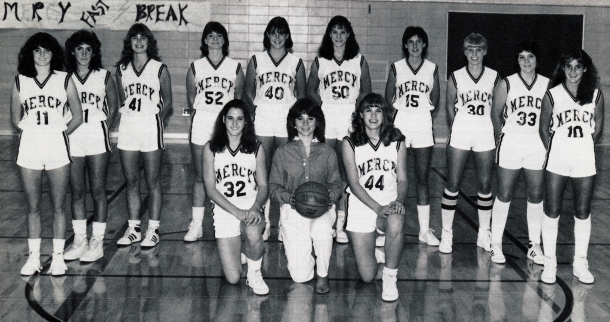
With less than seven minutes remaining the lead was 18 points, and Mercy was in trouble. Left with no alternative, Mercy applied a full-court trapping press and suddenly Northern began turning the ball over like crazy. The Marlins got within five when sophomore Amy DeMattia (13 points, 10 rebounds) scored three straight baskets to give Mercy the lead while Northern, which had 31 turnovers, responded with four consecutive turnovers. Sophomore Annette Ruggiero came up with a key steal and hit a free throw for a two-point lead and then another sophomore, Mary Rosowski, nailed a clutch free throw with 11 seconds left to seal the deal – a 61-58 win over the Vikings.
Junior Sarah Basford led Mercy with 20 points. Mercy started one senior, one junior and three sophomores, and the Marlins may have been too naive to realize they were supposed to be intimidated by Northern. After the final buzzer sounded, Mercy coach Larry Baker looked like he was in a daze as he wandered around the court repeating: “I don’t believe it ... I don’t believe it.” Neither did anyone else.
Grand Ledge Refuses to Lose in 1st Football Finals Trip
Tim Staudt, WILX (Lansing), in 53rd year of broadcasting
(Trailing 14-7 against Utica Eisenhower with less than a minute to play in the 2000 Division 1 football championship game, Grand Ledge scored 12 unanswered points – beginning with a 5-yard touchdown run by Matt Bohnet with 53 seconds to play, followed by an onside kick recovered by the Comets’ Collin O’Keefe, which led to a 45-yard game-winning scoring pass from Bohnet to Tim George with 22 seconds remaining. The 19-14 win gave Grand Ledge its first football Finals championship, notable as well as the team was coached by Pat O’Keefe, who at one time had the record for most baseball coaching wins in state history and remains second on that list.)
One of the most remarkable comebacks in state finals football history was when Grand Ledge came back to defeat Utica Eisenhower at the Silverdome, rallying to win the Division 1 state championship under coach Pat O’Keefe in 2000.
Even for Those Disappointed, 8-Player Final Tremendous
Greg Miller, formerly of 9&10 News (Cadillac)
I had the misfortune of covering a great deal of sad state championship games where our local team would fall to a team from downstate. Few were more heartbreaking than the 2012 8-Player Football Final (the second year a state championship was awarded in 8-player football) at Greenville High School's beautiful football stadium.
The Bellaire Eagles had a 6-0 halftime lead but fell behind when Deckerville scored twice in the third quarter. The Eagles would try to rally in the fourth quarter, and eventually hit a massive touchdown pass with less than a minute to play to pull within a 2-point conversion of tying the game and likely sending it to overtime. Alas, the 2-point try failed, and the subsequent onside kick was unlucky as well.
As a bit of an introduction to a new brand of football that allowed so many small schools across the state to keep playing the game, it was a tremendous game – even if the team I was there to cover came up two points short.
Power of DeYoung’s 42 Resonates for Mourning Champion
Jack Doles, WOOD TV (Grand Rapids)
Back in 2002, the South Christian Sailors had a fantastic team. They were very talented and tight knit. During the playoffs, in the week of the Semifinals, one of their teammates, Derek DeYoung was killed in a car accident. At the urging of his father, a pastor, the Sailors decided to continue to play.
Derek wore number 42, and they scored 42 points in a win over Caro in the Semifinal. After the game, both teams and fans gathered together on the field and took a knee and prayed.
The Sailors then had to go to a funeral for their friend and teammate, and then prepare for a state championship game. Instead of being distracted, they came out focused and on a mission. Derek's brother wore his jersey with the #42 and led the Sailors onto the field. They hammered Riverview and won the state championship. Late in the game, they kicked a field goal that would give them 42 points. There wasn't a dry eye in the house. Another incredible memory from covering high school sports.
Previous "Century of School Sports" Spotlights
Oct. 8: Guided by 4 S's of Educational Athletics - Read
Oct. 1: Michigan Sends 10 to National Hall of Fame - Read
Sept. 25: MHSAA Record Books Filled with 1000s of Achievements - Read
Sept. 18: Why Does the MHSAA Have These Rules? - Read
Sept. 10: Special Medals, Patches to Commemorate Special Year - Read
Sept. 4: Fall to Finish with 50th Football Championships - Read
Aug. 28: Let the Celebration Begin - Read
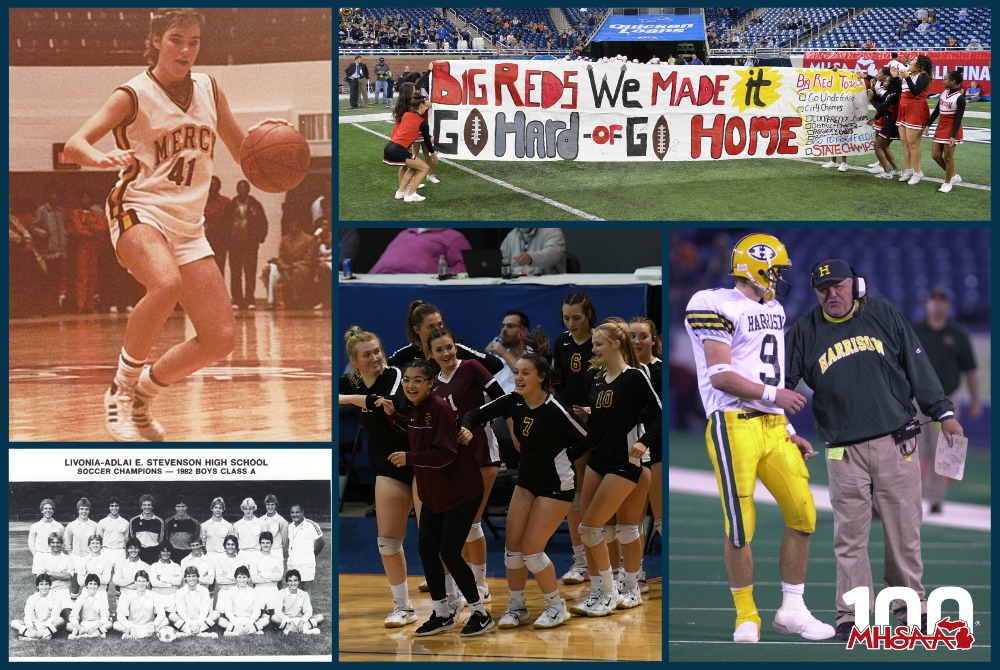
PHOTOS (Top) Clockwise from top left: Farmington Hills Mercy's Sarah Basford directs the offense during a 1982 Class A Semifinal against Lansing Everett. (2) Lansing Sexton's cheerleaders await their football team's entrance at Ford Field. (3) Farmington Hills Harrison football coach John Herrington sends a play in with quarterback Drew Stanton. (4) Reese volleyball players dance together during a break in the 2021 Division 3 Final. (5) The 1982 Livonia Stevenson boys soccer team takes a team photo used in the MHSAA Book of Champions. (Middle) Livonia Stevenson players carry their championship trophy after winning the 1982 Class A soccer title at Atwood Stadium. (Below) Members of the 1982 Farmington Hills Mercy girls basketball team pose for a team photo. (MHSAA file photos.)