

Casting Lines for Future Tournaments
August 12, 2016
By Jack Roberts
MHSAA Executive Director
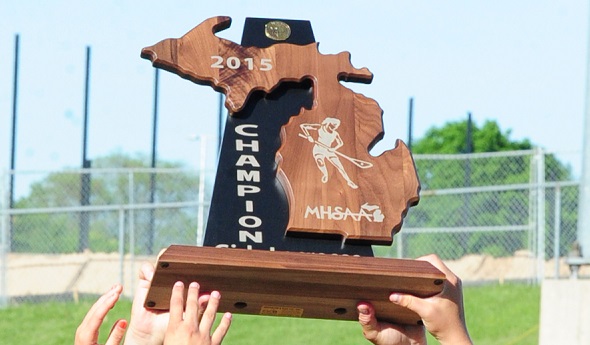
The MHSAA is best known to the public for the tournaments it conducts to conclude the fall, winter and spring seasons each school year.
These tournaments, the first and largest program of the MHSAA, have survived the Vietnam War, the Korean conflict and two World Wars. They have survived the technology bubble, the housing collapse, the energy crisis and the Great Depression.
MHSAA tournaments existed at the dawn of aviation and at the time of our nation’s lunar landing. Popes, presidents and governors have changed and changed again and again, and MHSAA tournaments roll on year after year.
But the sense of tradition and permanence and inevitability of MHSAA tournaments doesn’t dissuade us from asking questions about our tournaments, even some of the most basic questions. Here are two.
Question #1
I have long been and will always be an advocate for a Ryder Cup format for the MHSAA Golf Finals, and a team tennis approach to the MHSAA Tennis Finals; but 90 years of tradition is hard to overcome. Might this be a more exciting format? Could it be co-ed? Could it reverse the decline in boys tennis participation, and increase girls golf participation? Wouldn’t it be fun to try?
Periodically, the International Olympic Committee requires each of the designated Olympic sports to defend its status, to state its case why the sport should remain a part of the Olympic program. Then, after a series or votes that retain one sport at a time, the IOC drops the sport that makes the weakest case. It does so to make room for one of the previously unlisted sports that makes the best case for inclusion.
This would appear to keep the existing Olympic sports on their toes, and to keep the Olympic movement fresh and reflective of modern trends in sports.
While I would not enjoy the controversy, I can see the potential for some positive results if the MHSAA were to invoke the same policy for determining the 14 tournaments it will provide for girls and the 14 for boys.
This might cause us to consider more deeply what a high school sport should look like, or at least what an MHSAA tournament sport should stand for.
On the one hand, we might be inclined to drop tournaments for those sports that involve mostly non-faculty coaches and non-school venues, or require cooperative programs to generate enough participants to support a team, or resort almost entirely to non-school funding, or cater to individuals more than teams.
Or perhaps this process would cause policymakers to forget traditional thinking and ask: “In this day and age, should we shake off traditional notions of sport and consider more where modern kids are coming from?” That might mean fewer team sports and more individual sports, more “extreme” sports like snowboarding and skateboarding, and more lifetime sports, meaning not just golf and tennis and running sports, but also fishing and even shooting sports.
Currently, MHSAA policy states that the MHSAA will consider sponsorship of a tournament series for any sport which 64 member schools conduct on an interscholastic basis as a result of action by the governing boards of those schools.
Should the only question be how many schools sponsor a sport, or must an activity also have certain qualities and/or avoid certain “defects?” What should an MHSAA tournament sport look like and stand for?
Question #2
Bristling from criticism that his association is a money-grabbing exploiter of children, my counterpart in another state said, “If we were running our programs just to make money, we would do very many things very differently.” I knew exactly what he meant.
Because we care about the health and welfare of students, because we mean what we say that the athletic program needs to maximize the ways it enhances the school experience while minimizing academic conflicts, and because we try to model our claim that no sport is a minor sport when it comes to its potential to teach young people life lessons, we operate our programs in ways that make promoters, marketers and business entrepreneurs laugh, cry or cringe.
If money were the only object, we would seed and select sites to assure the teams that attracted the most spectators had the best chance to advance in our tournaments, regardless of the travel for any team or its fan base. If money were the only object, we would never schedule two tournaments to overlap and compete for public attention, much less tolerate three or four overlapping events. If money were the only object, we would allow signage like NASCAR events and promotions like minor league baseball games.
Those approaches to event sponsorship may not be all wrong; they’re just not all right for us. And we will live with the consequences of our belief system.
During a typical school year, more than 20 percent of the MHSAA’s 2,097 District, Regional and Final tournaments lose money. Not a single site in golf, skiing or tennis makes a single penny. In no sport did every District, Regional and Final site have revenue in excess of direct expenses.
In fact, in only three sports – boys and girls basketball and football – is revenue so much greater than direct expenses overall that it helps to pay for all the other tournaments in which the MHSAA invests.
That’s right: invests. When we present our budget to our board, we talk about the MHSAA’s investment in providing tournament opportunities in all those sports and all those places that cannot sustain the cost of those events on their own. How much is this investment worth to students, schools and society?
These two are core questions that require our focus far in advance of talk about scheduling, site selection, seeding and the myriad matters that too often hijack our time and attention.
In the Long Run: Only 15 Rushers Share State Record with 99-Yard Scoring Sprint
By
Steve Vedder
Special for MHSAA.com
August 26, 2024
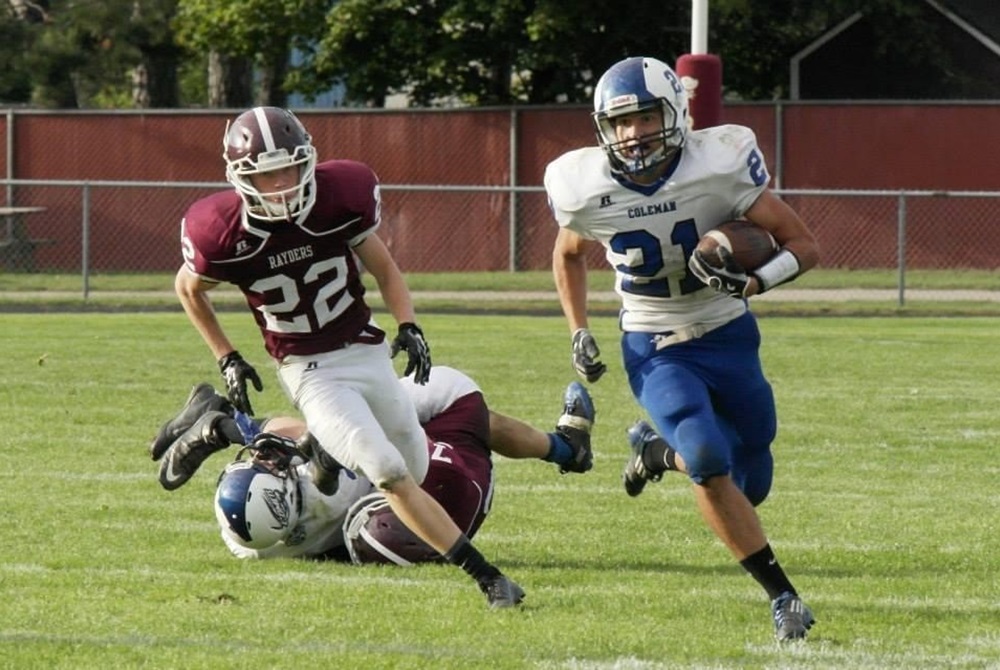
Jakob Price remembers the defense forcing him into a subtle change of plans at the line of scrimmage, then about a dozen seconds later finishing his run into the MHSAA record book.
It's a rare story that only 15 football players in MHSAA history can tell, most involving similar circumstances. A couple of key blocks, the opening of but a sliver of a hole, a fortuitous breakdown on defense including a broken tackle or two, capped, in many cases, by simple luck.
When it comes to a rusher busting loose on a 99-yard run, there is much that has to fall into place. In the case of Price, a sophomore at Muskegon when he became the last player to make that rare record-tying dash on Oct. 8, 2021, it was all the above.
"I remember we ran what we called a "power 6" and I hit the line hard," Price said. "I saw that the hole off the center was clogged, and I thought I was going to get hit, but I made a move. Three guys had a shot at me, but someone took out the tackle with a block and I saw nothing but green. It was almost a safety, but then this hole opened up and I was gone."
 In comparison, for instance, there have been 81 players who've thrown for at least six touchdowns in a game. But only 15 players in Michigan history have snatched a handoff and sped 99 yards to pay dirt. It's a wide cast of characters that stretches from one player who has played in 12 major league baseball games to another who collected three times as many receiving yards as rushing and whose previous longest run had been a modest 25.
The first 99-yard run chronicled in the MHSAA record book was by James Edington of Morrice, who raced 99 yards against Kingston on Oct. 29, 1999. Edington's run was one of his last during an outstanding four-year career that included being named all-state three times. He remembers the play, which came late in a playoff game, being an inside trap where he broke at least two tackles. Edington said the play wasn't designed for anything more than to keep the defense from notching a safety.
"I was just trying to get out of the end zone, get us some room," said Edington, who remembers having 4.7 speed in the 40-yard dash. "I remember it was at the end of the game and I was so tired. I was a two-way player who rarely came off the field. I know that in a 99-yard run the blocks have got to be there when the defense hits the box. I knew if I could just get past this linebacker, there was a lot of green grass in front of me."
Morrice, coincidentally, also is the only program to have a 99-yard runner in 8-player football. Morrice switched from 11 to 8-player with the start of the 2014 season, and Jake Rivers made the 99-yard sprint twice in 2015.
Saugatuck coach Bill Dunn is the only coach to have two players on the list, including his son Blake, on Sept. 25, 2015, against Decatur.
From a coaching standpoint, Bill Dunn said there is nothing like a crushing 99-yard burst to change a game's momentum. When a team is clinging to the ball at its 1-yard line, the possible outcomes are seemingly dark – from surrendering a safety to a punt that puts the opposition in prime position to score.
"A lot of things have to happen in a 99-yard run," Dunn said. "There can absolutely be luck. And it can be a backbreaker. You got a team at the 1-yard line, and the defense knows it's going to get good field position with a punt. But instead you get a guy who breaks one for 99."
 Blake Dunn, now a prospect in the Cincinnati Reds system, was an all-state sprinter in high school as part of earning 16 varsity letters across four sports. Dunn said he made a "mid-line read" after the fullback dove into the line. The defense collapsed on him, Dunn cut back against the grain and was off to the races.
"Our fullback dove down the mid-line, and my read crashed down to him," said Dunn, whose 101 career touchdowns are fourth in state history while his 6,954 rushing yards rank eighth.
"When I followed my blocks through the hole, there was a bunch of open grass. I think there might have been a linebacker that almost tripped me up from the backside, but nobody was able to get me and then 99 yards later it ended in a touchdown. It was pretty cool fun in the moment and fun to look back on it now."
Kyle Raycraft of Frankenmuth made his 99-yard run against Caro on Sept. 5, 2003. Like many of his brethren’s stories, Raycraft, who remembers running for more than 200 yards and three or four touchdowns in the game, said the play came down to a couple of blocks, shaking off potential tacklers, and having daylight in front of him.
"I went up the middle and got good blocking at the line and broke a couple tackles," said Raycraft, also an all-state sprinter and currently an emergency room doctor in Sault Ste. Marie. "I really didn't think that much of it at the time. I think it got us the lead at a key time and that was exciting, but I didn't think it was so rare. There's been a lot of high school football and only (15) kids have done this, so that's a pretty short list."
Matthew Hoffman of Sanford Meridian, by his own admission, wasn't particularly fast. So speed played a minimal part in his run Sept. 11, 2015, against Beaverton.
Hoffman ran track in the spring, but not as a sprinter; he ran distances. His piece of football history was more a result of getting a couple of key blocks, breaking through the line, making a cut and finding running room along the sideline.
"I broke to the line and swerved to the left to the sidelines," said Hoffman, now a certified rescue boat operator working on the Gordie Howe International Bridge for the Bridging North America company. "I was quick and shifty and I'd get a few breakaways, but I wasn't fast. I think the defense was looking for me on the right side, and it was a counterplay to the left. The offensive line did a great job on that play.
 "It was exciting, but (instead of records) it was more it just happened so quickly. People met me in the end zone after the play was over, but then we were just focused on defense and the next play."
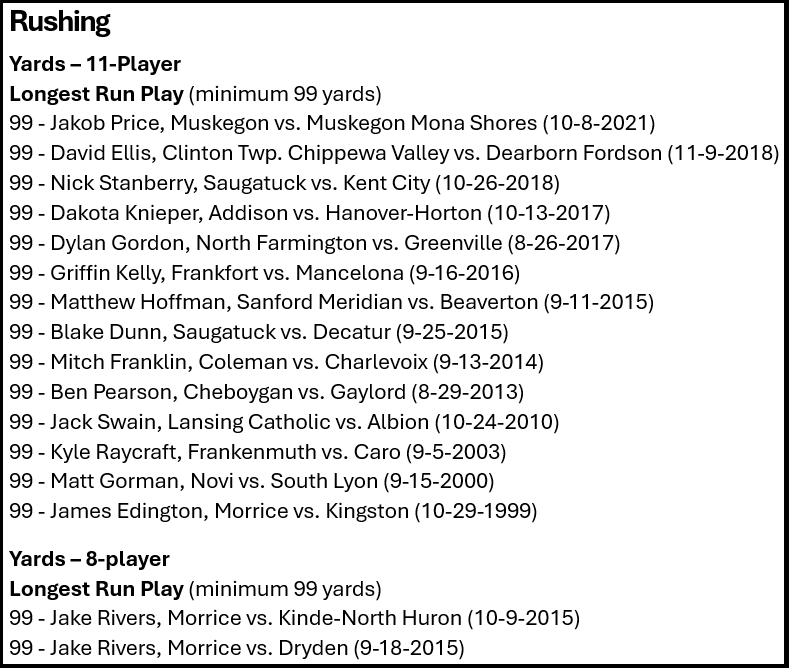
Coleman's Mitch Franklin has another different slant on his 99-yard story. He was primarily a receiver who recorded 1,014 yards at that position as opposed to around 300 as a running back. But on Sept. 13, 2014, against Charlevoix, Franklin took advantage of a rare handoff after a quarterback sneak had netted virtually no gain on first down.
"Best blocking we had all year. A hole opened up, I stiff-armed a guy and just ran," said Franklin, a former Gladwin County sheriff’s deputy. "I remember I was fortunate to run on our right side where we had bigger guys. It was fortunate that we caught the defense off guard. I think it was about our first power run that game and a lot of fortunate things had to happen.
"One of the things I remember is our principal patting me on the back and telling me what a good run it was."
While the members of the select 99-Yard Club may have different memories as to how they successfully dashed from their team's 1-yard line into the other team's end zone, their goals were the same: Just somehow move their team from the shadow of their own goalposts into more favorable territory.
And one last goal, recalled Franklin.
"Hey, you just don't want to make that long drive home with a big, fat ‘L,’” he said. "You want to win the game. That's what was important."
The MHSAA is continuously adding to its record books, and there is no deadline for an accomplishment to be submitted. Find directions to do so and the football record books in full at this link.
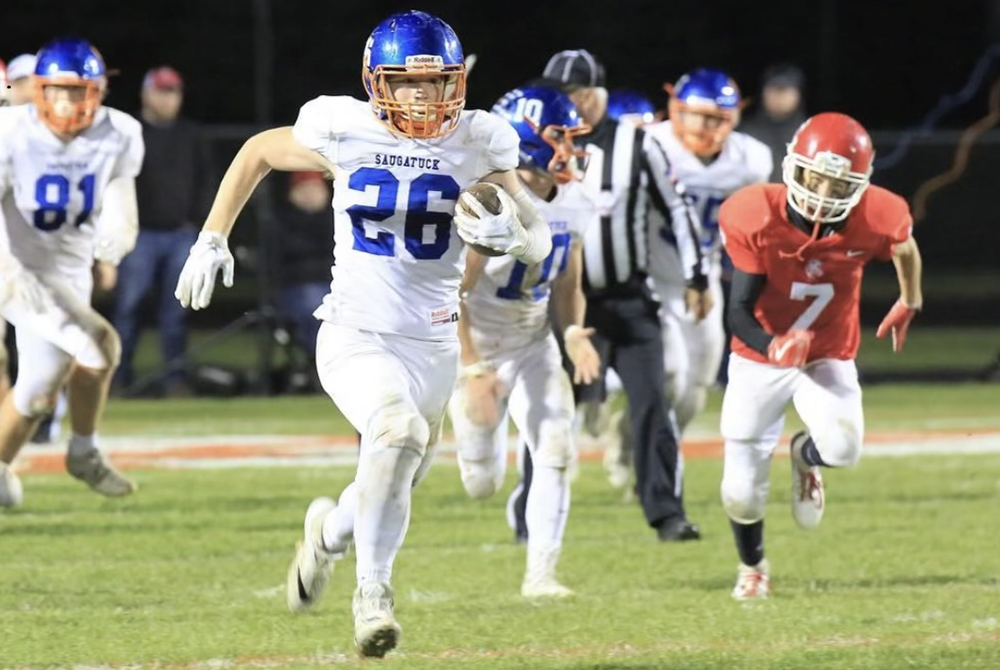
PHOTOS (Top) Coleman's Mitch Franklin (right) turns upfield during a 99-yard scoring run against Charlevoix on Sept. 13, 2014. (Middle) Muskegon's Jakob Price (left) makes a move on the way to a 99-yard touchdown run against Muskegon Mona Shores in 2021. (Below) Saugatuck's Nick Stanberry breaks away for a 99-yard TD run against Kent City in 2018. (Photos provided by Franklin, Price and the Saugatuck football program.)