

Casting Lines for Future Tournaments
August 12, 2016
By Jack Roberts
MHSAA Executive Director
The MHSAA is best known to the public for the tournaments it conducts to conclude the fall, winter and spring seasons each school year.
These tournaments, the first and largest program of the MHSAA, have survived the Vietnam War, the Korean conflict and two World Wars. They have survived the technology bubble, the housing collapse, the energy crisis and the Great Depression.
MHSAA tournaments existed at the dawn of aviation and at the time of our nation’s lunar landing. Popes, presidents and governors have changed and changed again and again, and MHSAA tournaments roll on year after year.
But the sense of tradition and permanence and inevitability of MHSAA tournaments doesn’t dissuade us from asking questions about our tournaments, even some of the most basic questions. Here are two.
Question #1
I have long been and will always be an advocate for a Ryder Cup format for the MHSAA Golf Finals, and a team tennis approach to the MHSAA Tennis Finals; but 90 years of tradition is hard to overcome. Might this be a more exciting format? Could it be co-ed? Could it reverse the decline in boys tennis participation, and increase girls golf participation? Wouldn’t it be fun to try?
Periodically, the International Olympic Committee requires each of the designated Olympic sports to defend its status, to state its case why the sport should remain a part of the Olympic program. Then, after a series or votes that retain one sport at a time, the IOC drops the sport that makes the weakest case. It does so to make room for one of the previously unlisted sports that makes the best case for inclusion.
This would appear to keep the existing Olympic sports on their toes, and to keep the Olympic movement fresh and reflective of modern trends in sports.
While I would not enjoy the controversy, I can see the potential for some positive results if the MHSAA were to invoke the same policy for determining the 14 tournaments it will provide for girls and the 14 for boys.
This might cause us to consider more deeply what a high school sport should look like, or at least what an MHSAA tournament sport should stand for.
On the one hand, we might be inclined to drop tournaments for those sports that involve mostly non-faculty coaches and non-school venues, or require cooperative programs to generate enough participants to support a team, or resort almost entirely to non-school funding, or cater to individuals more than teams.
Or perhaps this process would cause policymakers to forget traditional thinking and ask: “In this day and age, should we shake off traditional notions of sport and consider more where modern kids are coming from?” That might mean fewer team sports and more individual sports, more “extreme” sports like snowboarding and skateboarding, and more lifetime sports, meaning not just golf and tennis and running sports, but also fishing and even shooting sports.
Currently, MHSAA policy states that the MHSAA will consider sponsorship of a tournament series for any sport which 64 member schools conduct on an interscholastic basis as a result of action by the governing boards of those schools.
Should the only question be how many schools sponsor a sport, or must an activity also have certain qualities and/or avoid certain “defects?” What should an MHSAA tournament sport look like and stand for?
Question #2
Bristling from criticism that his association is a money-grabbing exploiter of children, my counterpart in another state said, “If we were running our programs just to make money, we would do very many things very differently.” I knew exactly what he meant.
Because we care about the health and welfare of students, because we mean what we say that the athletic program needs to maximize the ways it enhances the school experience while minimizing academic conflicts, and because we try to model our claim that no sport is a minor sport when it comes to its potential to teach young people life lessons, we operate our programs in ways that make promoters, marketers and business entrepreneurs laugh, cry or cringe.
If money were the only object, we would seed and select sites to assure the teams that attracted the most spectators had the best chance to advance in our tournaments, regardless of the travel for any team or its fan base. If money were the only object, we would never schedule two tournaments to overlap and compete for public attention, much less tolerate three or four overlapping events. If money were the only object, we would allow signage like NASCAR events and promotions like minor league baseball games.
Those approaches to event sponsorship may not be all wrong; they’re just not all right for us. And we will live with the consequences of our belief system.
During a typical school year, more than 20 percent of the MHSAA’s 2,097 District, Regional and Final tournaments lose money. Not a single site in golf, skiing or tennis makes a single penny. In no sport did every District, Regional and Final site have revenue in excess of direct expenses.
In fact, in only three sports – boys and girls basketball and football – is revenue so much greater than direct expenses overall that it helps to pay for all the other tournaments in which the MHSAA invests.
That’s right: invests. When we present our budget to our board, we talk about the MHSAA’s investment in providing tournament opportunities in all those sports and all those places that cannot sustain the cost of those events on their own. How much is this investment worth to students, schools and society?
These two are core questions that require our focus far in advance of talk about scheduling, site selection, seeding and the myriad matters that too often hijack our time and attention.
Gooding & King Work to Fill SW Michigan's Officiating Ranks, Schedules
By
Pam Shebest
Special for MHSAA.com
December 12, 2023
KALAMAZOO – Cheer them or boo them, without officials, there are no games. That’s just a fact in the sports world.
 Two area men are tasked with supplying those officials for Southwest Michigan schools, and it is not always as easy as it seems.
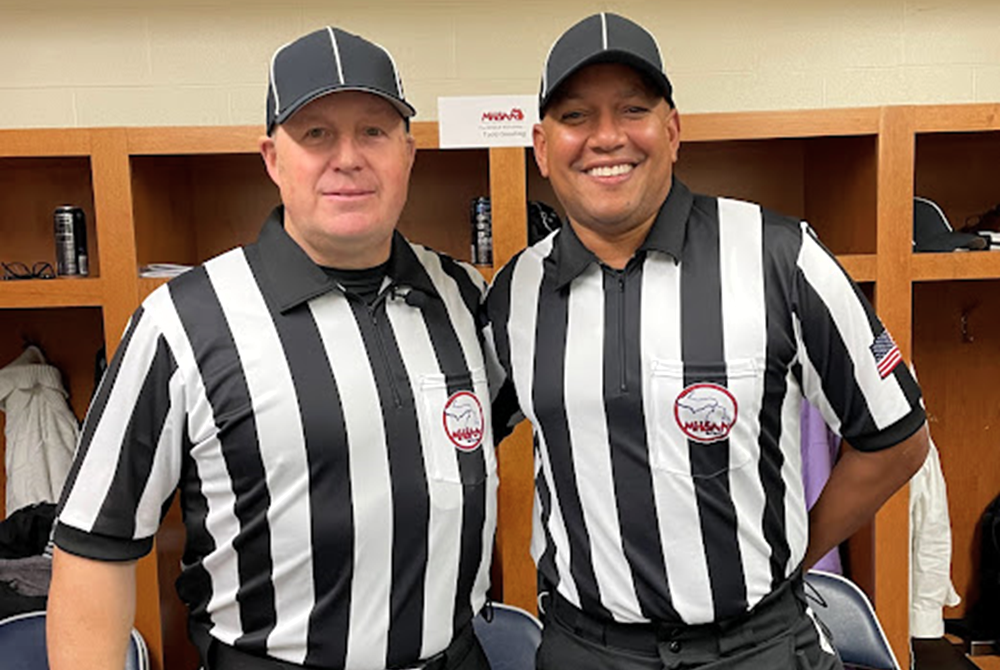
Portage’s Todd Gooding is in charge of assigning football referees for 70 schools across eight leagues, with 500 officials on his staff.
Vicksburg’s Rob King assigns officials for girls and boys basketball in five leagues and has 290 men and women on his roster to work 1,100 games throughout the hoops season.
“We have six females on staff,” King said. “We’re looking to add more. I think the girls who are playing enjoy having a female ref on the court with them, plus it shows them they can do this, too.”
Although totals were dropping a few percentage points every year, the MHSAA still registered an average of 10,317 officials annually during the decade ending in 2019-20. But the beginning of the COVID-19 pandemic that spring played a large part in a decrease in registered officials by 12 percent for 2020-21, down to 8,090.
The last two school years saw a bounce-back of four percent, and recruiting and retaining efforts continue. But Gooding and King – also veteran officials themselves, Gooding for 25 years and King for 24 – and their assigning colleagues across the state have the closest look at the effects of fewer officials as they work to schedule at the local level and make sure everything is covered.
Doing so gets even harder with unforeseen roadblocks.
One of those challenges for Gooding came in August when extreme heat forced most schools to reschedule or delay their football games.
“Everyone was trying to get their games in,” he said. “We were moving start times back, then we were moving days. Football is a little different than basketball or baseball because you can only play within so many days, so we were really squeezed against the schedule.
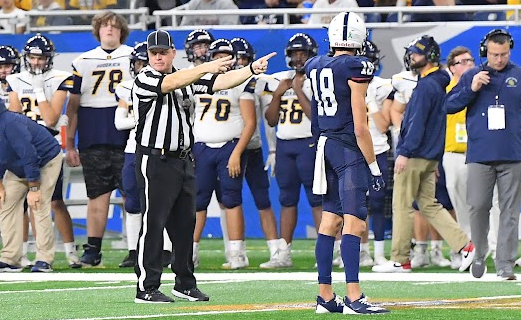 “I had a school or two reach out on Monday or Tuesday (before the Friday night game), so they looked ahead at the heat. Some of them waited, waited, waited, and then in some cases, it posed some big challenges because most of those crews had been spoken for.”
For a typical football Friday, Gooding staffs 30 or 35 games, “which is really difficult because everybody wants to play Friday night.”
Some referees in both football and basketball “double dip” by officiating games at freshman or junior varsity levels on nights other than Friday.
Gooding said at one time he hoped to go to seven officials for a football game, but with a shortage of officials, “Right now we’re just lucky to staff five in the games we have, and we’re still very short.
“Parents are a key component to a shortage of officials. A lot of it is more at the youth level, but everyone has to remember the sportsmanship aspect. Without officials there are no games, and sometimes we lose track of that, and that’s one reason there’s a shortage.”
Still, King noted that officiating provides more advantages than disadvantages.
“Everyone hears about the bad stuff, getting yelled at by fans and coaches, but those are so small,” he said.
“After a season of doing this, you learn to block out that stuff and realize it’s just part of the game. Fifty percent of people are mad at you every time you blow the whistle, so you get used to that.”
Pay raises in some leagues enticed many of those who “retired” to return, King said, but both he and Gooding agree the camaraderie developed while officiating is what makes it most special.
“It’s more about the time you spend on the floor with guys, in the locker room, driving to games, grabbing something to eat after the games, just talking about life, just building friendships,” King said. “That’s the part you remember.”
Gooding added some games stick in his memory more than others.
“My first varsity game (refereeing) was Lawton playing Saugatuck,” he said. “I show up and Channel 3 was there. I wondered what’s going on.
“Both schools were 0-8, both senior classes were 0-35. Somebody had to win, and it was my first varsity game. I think Saugatuck won, and it was close to 25 years ago.”
Another memory came as he officiated a basketball game.
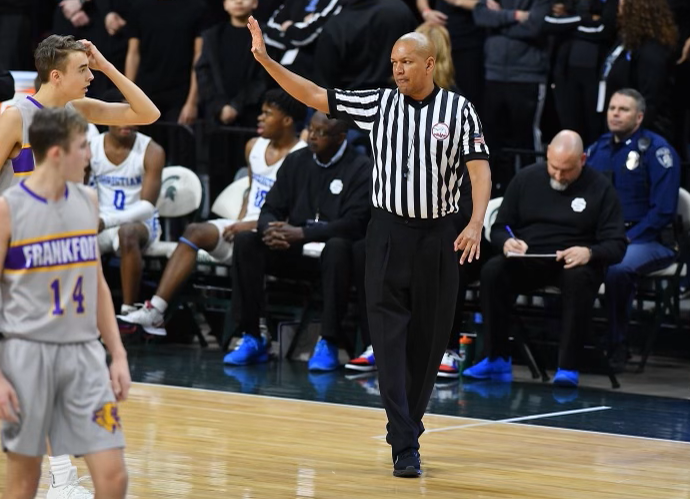 “A girl from Benton Harbor (Kysre Gondrezick in 2016) had 72 points,” he said. “It’s in the record books. and you’re just one small part of that and you remember them.”
Officiating is not only for adults. Even teenagers still in high school can become referees as part of the MHSAA Legacy Program.
King recently hosted an officiating summit at Paw Paw for high school athletes.
“There are nine schools in the Wolverine Conference and six of them brought 10 to 15 kids,” he said. “Myself and another official presented on basketball. They also did something on other sports.
“We got the kids up blowing the whistles and doing some of the signals. Three reached out wanting to get involved.”
King said officiating is a great way to earn money, especially while in college.
“You’ll work maybe two or three hours at the most and make $150 to $300 depending on the level,” he said. “Your friends will have to work six-, seven-, eight-hour days to make that much money.
“You can also block your schedule. We have a software with a calendar on it. If there are days you know you can’t work because you have classes or other things, you just block those days out, so you control your own schedule.”
With training, freshmen and sophomores can work junior high/middle school games, and juniors and seniors are able to officiate at the freshman and junior varsity levels.
“Usually what we do is get you a mentor,” King said, “and you work with that mentor and make some money.”
Those Legacy officials hopefully continue in the avocation, eventually becoming the next mentors.
Officiating, like school sports in general, is a cycle that’s constantly in motion – both when it comes to filling the ranks and filling the schedule to cover games ahead.
For example, although football season is over, “I don’t know if there really is an offseason,” Gooding said. “Leagues are going to start giving me their schedules. We’ll get those into an Arbiter system. Everything’s assigned by Arbiter, a computer system where officials get their assignments.
“I’ll start evaluating the crews, reach out to the crew chiefs. They’ll let me know any changes in their crew dynamics. I’ll evaluate the year gone by, how they performed and then start getting ready to work on getting those games staffed. That will start after the new year.”
For more information on officiating, including the Legacy Program, go to the Officials page of MHSAA.com.
 Pam Shebest served as a sportswriter at the Kalamazoo Gazette from 1985-2009 after 11 years part-time with the Gazette while teaching French and English at White Pigeon High School. She can be reached at [email protected] with story ideas for Calhoun, Kalamazoo and Van Buren counties.
PHOTOS (Top) Todd Gooding, left and Rob King take a photo together while officiating the Division 4 Final at Ford Field in 2022. (Middle) Gooding signals during that contest between Goodrich and Grand Rapids South Christian. (Below) King officiates the 2019 Division 4 Boys Basketball Final at Breslin Center. (Photos courtesy of Gooding and King.)