

Casting Lines for Future Tournaments
August 12, 2016
By Jack Roberts
MHSAA Executive Director
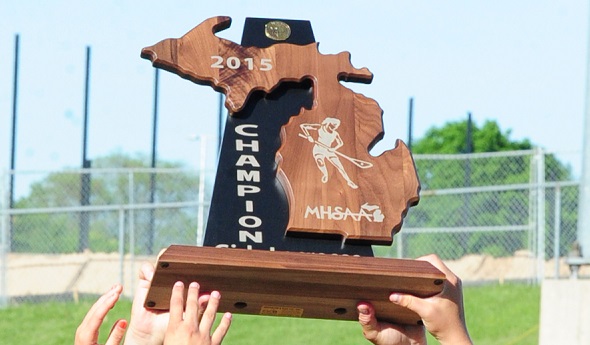
The MHSAA is best known to the public for the tournaments it conducts to conclude the fall, winter and spring seasons each school year.
These tournaments, the first and largest program of the MHSAA, have survived the Vietnam War, the Korean conflict and two World Wars. They have survived the technology bubble, the housing collapse, the energy crisis and the Great Depression.
MHSAA tournaments existed at the dawn of aviation and at the time of our nation’s lunar landing. Popes, presidents and governors have changed and changed again and again, and MHSAA tournaments roll on year after year.
But the sense of tradition and permanence and inevitability of MHSAA tournaments doesn’t dissuade us from asking questions about our tournaments, even some of the most basic questions. Here are two.
Question #1
I have long been and will always be an advocate for a Ryder Cup format for the MHSAA Golf Finals, and a team tennis approach to the MHSAA Tennis Finals; but 90 years of tradition is hard to overcome. Might this be a more exciting format? Could it be co-ed? Could it reverse the decline in boys tennis participation, and increase girls golf participation? Wouldn’t it be fun to try?
Periodically, the International Olympic Committee requires each of the designated Olympic sports to defend its status, to state its case why the sport should remain a part of the Olympic program. Then, after a series or votes that retain one sport at a time, the IOC drops the sport that makes the weakest case. It does so to make room for one of the previously unlisted sports that makes the best case for inclusion.
This would appear to keep the existing Olympic sports on their toes, and to keep the Olympic movement fresh and reflective of modern trends in sports.
While I would not enjoy the controversy, I can see the potential for some positive results if the MHSAA were to invoke the same policy for determining the 14 tournaments it will provide for girls and the 14 for boys.
This might cause us to consider more deeply what a high school sport should look like, or at least what an MHSAA tournament sport should stand for.
On the one hand, we might be inclined to drop tournaments for those sports that involve mostly non-faculty coaches and non-school venues, or require cooperative programs to generate enough participants to support a team, or resort almost entirely to non-school funding, or cater to individuals more than teams.
Or perhaps this process would cause policymakers to forget traditional thinking and ask: “In this day and age, should we shake off traditional notions of sport and consider more where modern kids are coming from?” That might mean fewer team sports and more individual sports, more “extreme” sports like snowboarding and skateboarding, and more lifetime sports, meaning not just golf and tennis and running sports, but also fishing and even shooting sports.
Currently, MHSAA policy states that the MHSAA will consider sponsorship of a tournament series for any sport which 64 member schools conduct on an interscholastic basis as a result of action by the governing boards of those schools.
Should the only question be how many schools sponsor a sport, or must an activity also have certain qualities and/or avoid certain “defects?” What should an MHSAA tournament sport look like and stand for?
Question #2
Bristling from criticism that his association is a money-grabbing exploiter of children, my counterpart in another state said, “If we were running our programs just to make money, we would do very many things very differently.” I knew exactly what he meant.
Because we care about the health and welfare of students, because we mean what we say that the athletic program needs to maximize the ways it enhances the school experience while minimizing academic conflicts, and because we try to model our claim that no sport is a minor sport when it comes to its potential to teach young people life lessons, we operate our programs in ways that make promoters, marketers and business entrepreneurs laugh, cry or cringe.
If money were the only object, we would seed and select sites to assure the teams that attracted the most spectators had the best chance to advance in our tournaments, regardless of the travel for any team or its fan base. If money were the only object, we would never schedule two tournaments to overlap and compete for public attention, much less tolerate three or four overlapping events. If money were the only object, we would allow signage like NASCAR events and promotions like minor league baseball games.
Those approaches to event sponsorship may not be all wrong; they’re just not all right for us. And we will live with the consequences of our belief system.
During a typical school year, more than 20 percent of the MHSAA’s 2,097 District, Regional and Final tournaments lose money. Not a single site in golf, skiing or tennis makes a single penny. In no sport did every District, Regional and Final site have revenue in excess of direct expenses.
In fact, in only three sports – boys and girls basketball and football – is revenue so much greater than direct expenses overall that it helps to pay for all the other tournaments in which the MHSAA invests.
That’s right: invests. When we present our budget to our board, we talk about the MHSAA’s investment in providing tournament opportunities in all those sports and all those places that cannot sustain the cost of those events on their own. How much is this investment worth to students, schools and society?
These two are core questions that require our focus far in advance of talk about scheduling, site selection, seeding and the myriad matters that too often hijack our time and attention.
Parchment Team On Verge of Never Playing Putting Off End As Long As Possible
By
Pam Shebest
Special for MHSAA.com
October 17, 2023
PARCHMENT — With just five returning players and no coach, things looked bleak for the Parchment soccer team at the beginning of summer.
 Boy, have things changed.
Former football offensive line coach Jesse Roder agreed to take the head soccer coach’s job and, with some intensive recruiting, the Panthers not only fielded a team this season but are headed into tonight’s Division 3 District Semifinal with an 11-6-1 record.
Those 11 wins are two more than the last three years combined and make this the first time in 14 years Parchment has had double-digit wins.
In fact, the Panthers’ record over the previous three seasons was 9-41-3 overall.
Athletic director Brennan Davis credits Roder for the turnaround.
“Our first-year coach has done an excellent job creating a positive environment for the team,” Davis said. “He is focused on building character and camaraderie within the program. Academics, participation, relationships, reliability are all important to Coach Roder.”
The players echo those accolades.
Junior goalkeeper Brady Caswell said it was an angry team the past two seasons with a lot of fighting among teammates.
“This year, everyone’s excited to play, ready to play, a little hungry to play, and I love that,” Caswell said. “Everybody works hard, and that’s the big change.
 “You can see it out there. We’re faster, we’re stronger, we have more ambition this year because no one pushed each other before.”
He credits the team’s defense for his own success this year.
“That’s one thing that has changed a lot over these last couple years,” the keeper said. “I used to see 20 or 30 shots a game and we’ve cut that down to about half, which gives me a way better chance at saving shots and less chance of getting injured.”
Major choice
Roder had a big decision to make before taking the head coaching job: His son, Brady Newington, is a senior lineman on the Panthers football team.
But Roder, who played soccer in high school while growing up in Garden in the Upper Peninsula, liked the challenge of turning the soccer program around.
Roder, who also coaches powerlifting and track, recruited from those ranks.
“Most of our athletes are first-year soccer players,” he said. “I approached a bunch of my powerlifters and told them I thought it would be right up their alley, so let’s give it a shot, and they did.”
Because of their dismal record the last few years, the Panthers have been underdogs in most of their games this season, including their District Quarterfinal last week, a 2-1 shootout win over South Haven.
“Last year they beat us 8-0,” Roder said. “We knew they were going to be a little confident, but our team’s philosophy starts with, ‘We’re going to outwork everybody in everything we do.’
![Micah Shank [5] steps into a kick.](/sites/default/files/article-images/2023/231017_Parchment_2H3.png) “We do an hour conditioning every day when we have practice. We played 100 minutes of soccer last night, and not a lick of them was tired.”
“We do an hour conditioning every day when we have practice. We played 100 minutes of soccer last night, and not a lick of them was tired.”
Roder also mandates lifting two days a week and has his own solution to any in-team fighting, holding players accountable.
“We have a three-strikes-and-you’re-out rule,” he said. “If you argue with a teammate once and I warn you about it, you’re sent home and you miss the next game.
“Do it again, you miss another game. You do it a third time, you’re off the team.”
The coach has given out just one warning all season.
Key players step up
Freshman Cameron Wagner, who leads the team with 26 goals, made an immediate impact.
“That kid’s vision of the field and his soccer IQ at the age of 15 is leaps and bounds beyond many coaches,” Roden said. “He’s got a real bright future in front of him.”
Wagner and teammate Caden Ragan were selected to the Southwestern Athletic Conference all-conference team Saturday.
Familiar with past Parchment teams, Wagner figured this season would be more of the same.
“I wasn’t going to take it seriously, but thought it would be good for conditioning,” the freshman said.
“Once (the season) started, it became more like a family.”
Wagner credits the coach with his success.
“The coach made me condition a lot, which helped me,” he said. “He changed dribble moves which I couldn’t even think of. At home, now I do the drills he taught me.”
Ragan was the one who fired the winning shot last week.
“I was the fourth (kicker) and I took the (shot) before the other person,” Ragan said. “Brady saved their fourth and saved us the game.”
Roder said the goalkeeper has been strong all season and is the most analytical and intelligent person he has met as far as goalkeeping goes.
![The Panthers’ Cayden Brown [4] defends.](/sites/default/files/article-images/2023/231017_Parchment_2H4.png) “During the game, he watches people and the way they play the ball off their foot,” the coach said. “He sees which way they go with the ball more often than not.
“During the game, he watches people and the way they play the ball off their foot,” the coach said. “He sees which way they go with the ball more often than not.
“So when we got into the shootout situation (in Districts), he actually was telling the ref before he walked up there which way the kid was going to go, and he guessed right every single time. He didn’t get to all the balls, but he still managed to pull off a couple stops which gave us the win.”
Another captain who has been on the team all four years is central defensive midfielder Ty Mulka.
“First two years weren’t the best,” he said. “My friends kept me on the team. This year was our best year.”
If Parchment did not field a team this year, “I was afraid we’d have to merge with our rival school, Comstock,” he said.
The coach said Mulka has been a workhorse.
“He’s been here every single day for everything,” Roder said. “He’s never missed, and he has a relentless work ethic.
“For being a small guy (5-foot-10, 150 pounds) he loves to put a body on people, so he plays a really physical style of soccer. Does a great job seeing the field, and he’s got a laser of a shot.”
Senior center midfielder Wyatt Nieboer said, “I thought 100 percent there would not be a team this year. I found out during the summer.
“I was just happy to play. I knew there was a new coach, and I heard he was really good, which he is, but I didn’t think there was going to be a massive change like there is.”
Roder said Nieboer is a “high energy, a bigger-bodied kid (5-8, 190). His work ethic will not let people beat him. He’s a honey badger.”
Not ready to end
Having tasted success this season, Ragan said the team is not ready to end it.
“The people want to play more,” the junior said. “We’ve had more practices that are actually helping us as a team.
“Things like the weight room are helping build the team and make us stronger, which helps us win games.”
Roder said Ragan, who is one of the captains, has good leadership qualities.
 “He has a natural good touch on the ball,” he said. “He’s very aggressive, very physically dominating. Does a great job going up to get balls, contesting people.”
The Panthers will have a tough test tonight when they host Grand Rapids South Christian (12-4-2), ranked seventh in the state in Division 3 and coming off a bye.
“They’re really good,” Roder said. “They move the ball really, really well. It’s going to be a tough test.
“The kids are excited about soccer around here, and that’s something we want to bring back. We’ve got eight seniors on the squad, probably the last time they’re going to play, so we’re trying to eke out as much time as we can.”
Caswell said all the credit goes to the coach.
“Thank Coach Roder for helping change everything here,” the goalkeeper said. “He’s been one of the biggest parts in changing the culture, changing the team, changing how we play soccer.”
Other seniors on the team are Devin Wilson, Myles Brooks, Kriss Patel, Tyler Lingbeek, Darius Baker and Akhil Veecumsee. Juniors are Keagan Cole, Trey Sukola, Conner Moynihan, Elijah Damron-Webster and Luka Lagina, while sophomores are Tyrone Edwards, Micah Shank, Cayden Brown and Hayden Hose.
 Pam Shebest served as a sportswriter at the Kalamazoo Gazette from 1985-2009 after 11 years part-time with the Gazette while teaching French and English at White Pigeon High School. She can be reached at [email protected] with story ideas for Calhoun, Kalamazoo and Van Buren counties.
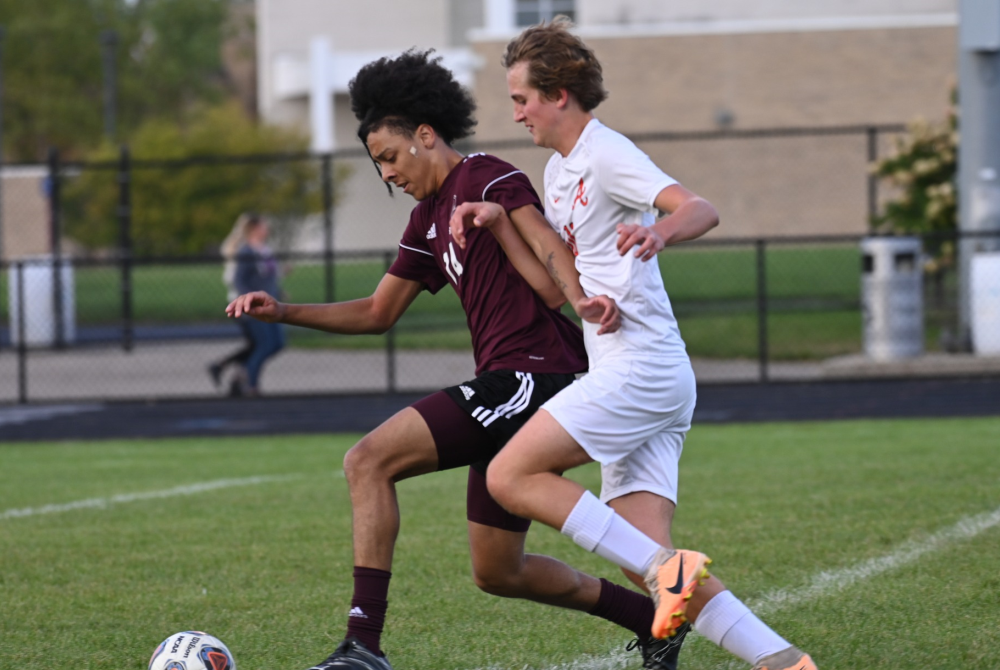
PHOTOS (Top) Parchment’s Darius Baker, left, controls possession during a game against Allegan. (2) From left: Parchment coach Jesse Roder, Brady Caswell and Caden Ragan. (3) Micah Shank [5] steps into a kick. (4) The Panthers’ Cayden Brown [11] defends. (5) From left: Wyatt Nieboer, Ty Mulka and Cameron Wagner. (Action photos by Shawnia Preston/Oh Shoot Photography, head shots by Pam Shebest.)