

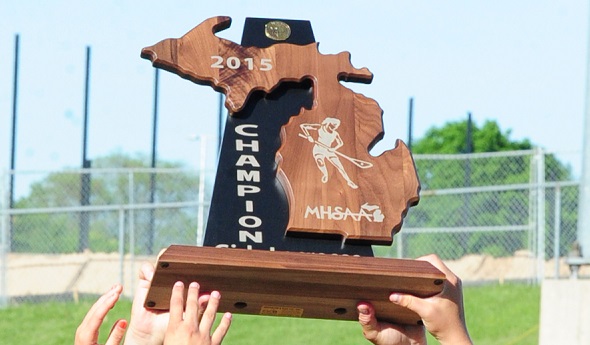
Casting Lines for Future Tournaments
August 12, 2016
By Jack Roberts
MHSAA Executive Director
The MHSAA is best known to the public for the tournaments it conducts to conclude the fall, winter and spring seasons each school year.
These tournaments, the first and largest program of the MHSAA, have survived the Vietnam War, the Korean conflict and two World Wars. They have survived the technology bubble, the housing collapse, the energy crisis and the Great Depression.
MHSAA tournaments existed at the dawn of aviation and at the time of our nation’s lunar landing. Popes, presidents and governors have changed and changed again and again, and MHSAA tournaments roll on year after year.
But the sense of tradition and permanence and inevitability of MHSAA tournaments doesn’t dissuade us from asking questions about our tournaments, even some of the most basic questions. Here are two.
Question #1
I have long been and will always be an advocate for a Ryder Cup format for the MHSAA Golf Finals, and a team tennis approach to the MHSAA Tennis Finals; but 90 years of tradition is hard to overcome. Might this be a more exciting format? Could it be co-ed? Could it reverse the decline in boys tennis participation, and increase girls golf participation? Wouldn’t it be fun to try?
Periodically, the International Olympic Committee requires each of the designated Olympic sports to defend its status, to state its case why the sport should remain a part of the Olympic program. Then, after a series or votes that retain one sport at a time, the IOC drops the sport that makes the weakest case. It does so to make room for one of the previously unlisted sports that makes the best case for inclusion.
This would appear to keep the existing Olympic sports on their toes, and to keep the Olympic movement fresh and reflective of modern trends in sports.
While I would not enjoy the controversy, I can see the potential for some positive results if the MHSAA were to invoke the same policy for determining the 14 tournaments it will provide for girls and the 14 for boys.
This might cause us to consider more deeply what a high school sport should look like, or at least what an MHSAA tournament sport should stand for.
On the one hand, we might be inclined to drop tournaments for those sports that involve mostly non-faculty coaches and non-school venues, or require cooperative programs to generate enough participants to support a team, or resort almost entirely to non-school funding, or cater to individuals more than teams.
Or perhaps this process would cause policymakers to forget traditional thinking and ask: “In this day and age, should we shake off traditional notions of sport and consider more where modern kids are coming from?” That might mean fewer team sports and more individual sports, more “extreme” sports like snowboarding and skateboarding, and more lifetime sports, meaning not just golf and tennis and running sports, but also fishing and even shooting sports.
Currently, MHSAA policy states that the MHSAA will consider sponsorship of a tournament series for any sport which 64 member schools conduct on an interscholastic basis as a result of action by the governing boards of those schools.
Should the only question be how many schools sponsor a sport, or must an activity also have certain qualities and/or avoid certain “defects?” What should an MHSAA tournament sport look like and stand for?
Question #2
Bristling from criticism that his association is a money-grabbing exploiter of children, my counterpart in another state said, “If we were running our programs just to make money, we would do very many things very differently.” I knew exactly what he meant.
Because we care about the health and welfare of students, because we mean what we say that the athletic program needs to maximize the ways it enhances the school experience while minimizing academic conflicts, and because we try to model our claim that no sport is a minor sport when it comes to its potential to teach young people life lessons, we operate our programs in ways that make promoters, marketers and business entrepreneurs laugh, cry or cringe.
If money were the only object, we would seed and select sites to assure the teams that attracted the most spectators had the best chance to advance in our tournaments, regardless of the travel for any team or its fan base. If money were the only object, we would never schedule two tournaments to overlap and compete for public attention, much less tolerate three or four overlapping events. If money were the only object, we would allow signage like NASCAR events and promotions like minor league baseball games.
Those approaches to event sponsorship may not be all wrong; they’re just not all right for us. And we will live with the consequences of our belief system.
During a typical school year, more than 20 percent of the MHSAA’s 2,097 District, Regional and Final tournaments lose money. Not a single site in golf, skiing or tennis makes a single penny. In no sport did every District, Regional and Final site have revenue in excess of direct expenses.
In fact, in only three sports – boys and girls basketball and football – is revenue so much greater than direct expenses overall that it helps to pay for all the other tournaments in which the MHSAA invests.
That’s right: invests. When we present our budget to our board, we talk about the MHSAA’s investment in providing tournament opportunities in all those sports and all those places that cannot sustain the cost of those events on their own. How much is this investment worth to students, schools and society?
These two are core questions that require our focus far in advance of talk about scheduling, site selection, seeding and the myriad matters that too often hijack our time and attention.
Traverse Bay Reps Teammates Unite to Take on Great Lakes Paddle Board Pursuit
By
Tom Spencer
Special for MHSAA.com
August 3, 2023
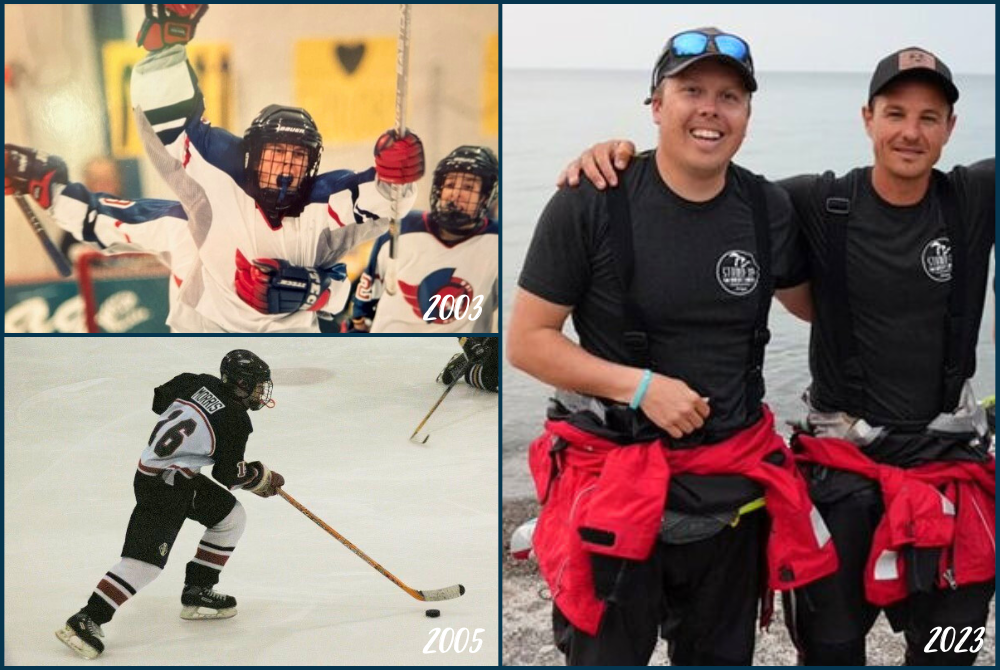
Twenty years ago, Kwin Morris and Jeff Guy were teammates on an MHSAA Quarterfinal-qualifying hockey team.
 Guy even scored the winning goal in the Regional Final for Bay Area Reps, which topped Traverse City West 2-1.
This summer’s accomplishment, though, will go deeper in the history books.
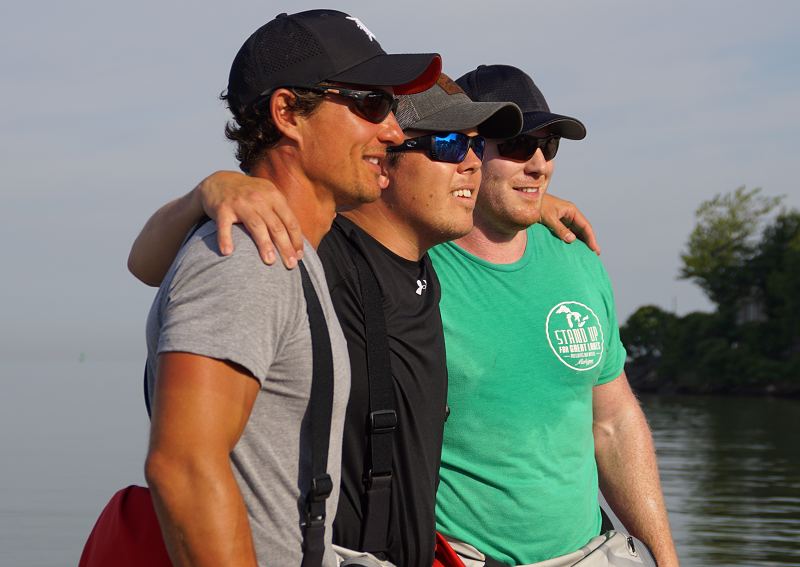
Guy and Morris teamed up with Joe Lorenz to complete a dream that started a decade ago. They crossed all five of the Great Lakes on paddle boards while raising awareness and funds for water quality.
They put their balance, endurance and stick-handling skills together for the cause.
‘After 10 years and over one hundred grand raised for the lakes, it feels amazing,” Morris said. “I think the best part is knowing my kids will grow up knowing their old man did something cool for the environment in a unique way.”
It all started at a December social event in Traverse City. Guy, a financial adviser, and Morris, a middle school science teacher, had just gotten into paddle boarding when they began to wonder if they could cross Lake Michigan.
Lorenz, a personal trainer, promptly gave assurances they could — and joined them — even though he had never been on a paddle board prior to the holiday gathering.
Morris, Guy and Lorenz successfully crossed Lake Michigan in 2015, pausing in the cold of the night to look at the Northern Lights. They finished the nearly 100-kilometer journey in just under 25 hours. That accomplishment convinced them to launch Stand Up for Great Lakes, a non-profit organization to raise money and awareness for the protection of the lakes.
The trio also is supporting the Cooperative Institute for Great Lakes Research, a non-profit housed at the University of Michigan.
“It feels amazing to have finished crossing all five lakes and complete a lifelong goal,” Guy acknowledged. “The dollars and awareness we have raised is incredible, and hopefully it continues to grow.”
Lake Huron was the toughest to cross by far, the former Reps noted. The 90-mile, 29-hour paddle brought seven hours of rain and high waves.
“Plus Joe knocked me in and Jeff fell in after catching a fish,” Morris observed.
Ontario was the team’s second-hardest challenge and the shortest paddle. Huge waves from the side all day took quite a toll on the paddlers, who were accompanied by safety boats on each crossing.
Lake Superior featured glassy water, a spectacular sunset and the paddlers pausing to conduct a ceremony over the Edmund Fitzgerald shipwreck. The northernmost Great Lake ranks as the group’s favorite.
 Guy graduated from Kalkaska High School in 2003 and went on to play hockey at Hope College. He also played football, baseball and golf for the Blazers. He and his wife, Melissa, have a daughter, Emma.
Morris graduated in 2005 from Elk Rapids High School, where he also played baseball. He went on to get a teaching degree from Western Michigan University. He and his wife, Megan, have two children, Fitz and Knox. He now works for his former school district, teaching science.
The pair played for the Reps through a co-op hosted by Traverse City St. Francis that included athletes from Charlevoix, Elk Rapids, Kalkaska, Kingsley, Lake Leelanau St Mary, Mancelona and Suttons Bay. The Reps’ first coach was Michigan High School Hockey Coaches Association Hall of Fame inductee Rex Luxton. He coached through 2008.
Morris and Guy look back at their high school playing days and coach with fondness.
“We had some great teams, and I think I still have the career goal record there,” Guy recalled. “Also, our coach on the Reps Rex Luxton was highly motivational to me while playing for him and later in life.”
Morris echoed Guy.
“I loved the whole experience,” Morris said. “Playing for my high school … Friday night games … school rivalries … playing for Rex Luxton … amazing friends and teammates — almost surreal that it will have been 20 years.”
The former coaching staff of the Reps are not at all surprised Morris and Guy challenged themselves to make a difference for the Great Lakes.
The coaching staff remembers Guy as a natural scorer coming through with big goals, and Morris as a strong two-way player who scored five goals in one period in Sault Ste. Marie. The past coaches also remember all the traveling the two did for practice and games because of the geographic nature of the squad.
“I had no idea they had any interest in the water kind of stuff,” Luxton said of his former players’ feat. “When I started following their bid to raise awareness, it didn’t surprise me they would attempt something like this.
 “I think it illustrates how much determination they have and how much hard work they were willing to put in,” he continued. “It is just outstanding, particularly with the cold weather in the Great Lakes.”
Cody Inglis, a senior assistant director for the MHSAA, was an assistant coach for the Reps during all of Morris and Guy’s time with the co-op. He finds himself beaming with pride and happiness knowing these former players are giving back and making it a better world.
“What Jeff and Kwin have done physically and mentally to cross all of the Great Lakes on stand-up paddle boards is remarkable in itself,” Inglis pointed out. “When you add in the fact that they have put in charitable causes and the preservation of the Great Lakes as a reason for doing it – it makes it even more special.
“It’s not surprising given my recollection and remembrances of Jeff and Kwin, as they were really good hockey players and better people.”
High school hockey is where Morris and Guy’ friendship blossomed. Spending 24 or more hours together — and with Lorenz — has forged a greater lifetime bond that already had included being a part of each other’s weddings.
But they admit they had no inkling of this type of accomplishment back in high school.
“Sports were the most important thing in my life in high school,” Guy revealed. “Working really hard to win as many games as possible was the main goal – along with getting good grades and trying to get into a good college.”
But teamwork, learned on the ice and through other high school sports, can make anything possible.
“Any sport where you have to work as a team helps push yourself out of your comfort zone,” Morris concluded. “That's where the best things in life happen.”
2023 Made In Michigan
August 1: Vast Experience Shapes Retired MLB-er Gates Into 3-Time Finals-Winning Coach - Read
July 25: After All-American Career, Rockford's Bennett Making Impact as Mat Mentor - Read
July 20: Oakridge 3-Sport Star Potts Applying Lessons to 'Second Chapter' in Sales - Read
July 18: Frankfort Hoops Staff Bolstered by Past Stars Giving Back in Banktson, Kreski - Read
July 12: Championship Memories, High School Tennis' Impact Stick with Hackett Pair - Read
July 6: Brother Rice Finals Hero Aiming to Ace Family Life, Financial World - Read
July 5: Lapeer West 4-Time Finals Winner Set to Build Champions at Oklahoma - Read
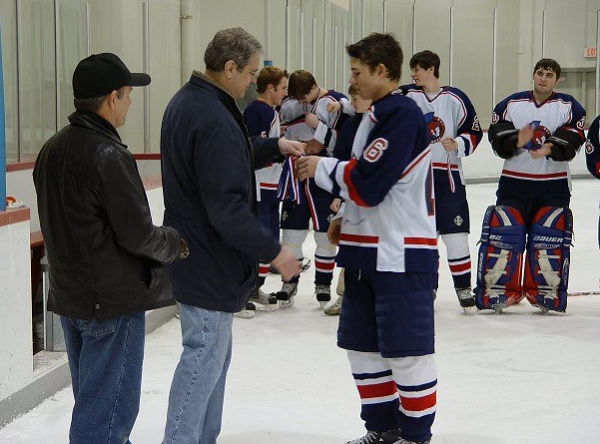
PHOTOS (Top) Clockwise from top left: Jeff Guy celebrates a goal while playing for Traverse Bay Reps with Kwin Morris to his left, Guy (left) and Morris (right) take a photo after one of their paddle board trips, and Morris bringing the puck up the ice for the Reps. (Middle) Guy, Morris and Joe Lorenz take a photo together on the lake shore. (Below) Morris accepts a medal during the 2004-05 season. (Photos courtesy of Jeff Guy, Kwin and Jo Morris.)