

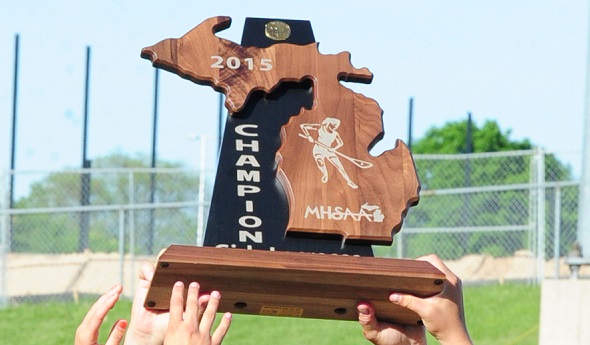
Casting Lines for Future Tournaments
August 12, 2016
By Jack Roberts
MHSAA Executive Director
The MHSAA is best known to the public for the tournaments it conducts to conclude the fall, winter and spring seasons each school year.
These tournaments, the first and largest program of the MHSAA, have survived the Vietnam War, the Korean conflict and two World Wars. They have survived the technology bubble, the housing collapse, the energy crisis and the Great Depression.
MHSAA tournaments existed at the dawn of aviation and at the time of our nation’s lunar landing. Popes, presidents and governors have changed and changed again and again, and MHSAA tournaments roll on year after year.
But the sense of tradition and permanence and inevitability of MHSAA tournaments doesn’t dissuade us from asking questions about our tournaments, even some of the most basic questions. Here are two.
Question #1
I have long been and will always be an advocate for a Ryder Cup format for the MHSAA Golf Finals, and a team tennis approach to the MHSAA Tennis Finals; but 90 years of tradition is hard to overcome. Might this be a more exciting format? Could it be co-ed? Could it reverse the decline in boys tennis participation, and increase girls golf participation? Wouldn’t it be fun to try?
Periodically, the International Olympic Committee requires each of the designated Olympic sports to defend its status, to state its case why the sport should remain a part of the Olympic program. Then, after a series or votes that retain one sport at a time, the IOC drops the sport that makes the weakest case. It does so to make room for one of the previously unlisted sports that makes the best case for inclusion.
This would appear to keep the existing Olympic sports on their toes, and to keep the Olympic movement fresh and reflective of modern trends in sports.
While I would not enjoy the controversy, I can see the potential for some positive results if the MHSAA were to invoke the same policy for determining the 14 tournaments it will provide for girls and the 14 for boys.
This might cause us to consider more deeply what a high school sport should look like, or at least what an MHSAA tournament sport should stand for.
On the one hand, we might be inclined to drop tournaments for those sports that involve mostly non-faculty coaches and non-school venues, or require cooperative programs to generate enough participants to support a team, or resort almost entirely to non-school funding, or cater to individuals more than teams.
Or perhaps this process would cause policymakers to forget traditional thinking and ask: “In this day and age, should we shake off traditional notions of sport and consider more where modern kids are coming from?” That might mean fewer team sports and more individual sports, more “extreme” sports like snowboarding and skateboarding, and more lifetime sports, meaning not just golf and tennis and running sports, but also fishing and even shooting sports.
Currently, MHSAA policy states that the MHSAA will consider sponsorship of a tournament series for any sport which 64 member schools conduct on an interscholastic basis as a result of action by the governing boards of those schools.
Should the only question be how many schools sponsor a sport, or must an activity also have certain qualities and/or avoid certain “defects?” What should an MHSAA tournament sport look like and stand for?
Question #2
Bristling from criticism that his association is a money-grabbing exploiter of children, my counterpart in another state said, “If we were running our programs just to make money, we would do very many things very differently.” I knew exactly what he meant.
Because we care about the health and welfare of students, because we mean what we say that the athletic program needs to maximize the ways it enhances the school experience while minimizing academic conflicts, and because we try to model our claim that no sport is a minor sport when it comes to its potential to teach young people life lessons, we operate our programs in ways that make promoters, marketers and business entrepreneurs laugh, cry or cringe.
If money were the only object, we would seed and select sites to assure the teams that attracted the most spectators had the best chance to advance in our tournaments, regardless of the travel for any team or its fan base. If money were the only object, we would never schedule two tournaments to overlap and compete for public attention, much less tolerate three or four overlapping events. If money were the only object, we would allow signage like NASCAR events and promotions like minor league baseball games.
Those approaches to event sponsorship may not be all wrong; they’re just not all right for us. And we will live with the consequences of our belief system.
During a typical school year, more than 20 percent of the MHSAA’s 2,097 District, Regional and Final tournaments lose money. Not a single site in golf, skiing or tennis makes a single penny. In no sport did every District, Regional and Final site have revenue in excess of direct expenses.
In fact, in only three sports – boys and girls basketball and football – is revenue so much greater than direct expenses overall that it helps to pay for all the other tournaments in which the MHSAA invests.
That’s right: invests. When we present our budget to our board, we talk about the MHSAA’s investment in providing tournament opportunities in all those sports and all those places that cannot sustain the cost of those events on their own. How much is this investment worth to students, schools and society?
These two are core questions that require our focus far in advance of talk about scheduling, site selection, seeding and the myriad matters that too often hijack our time and attention.
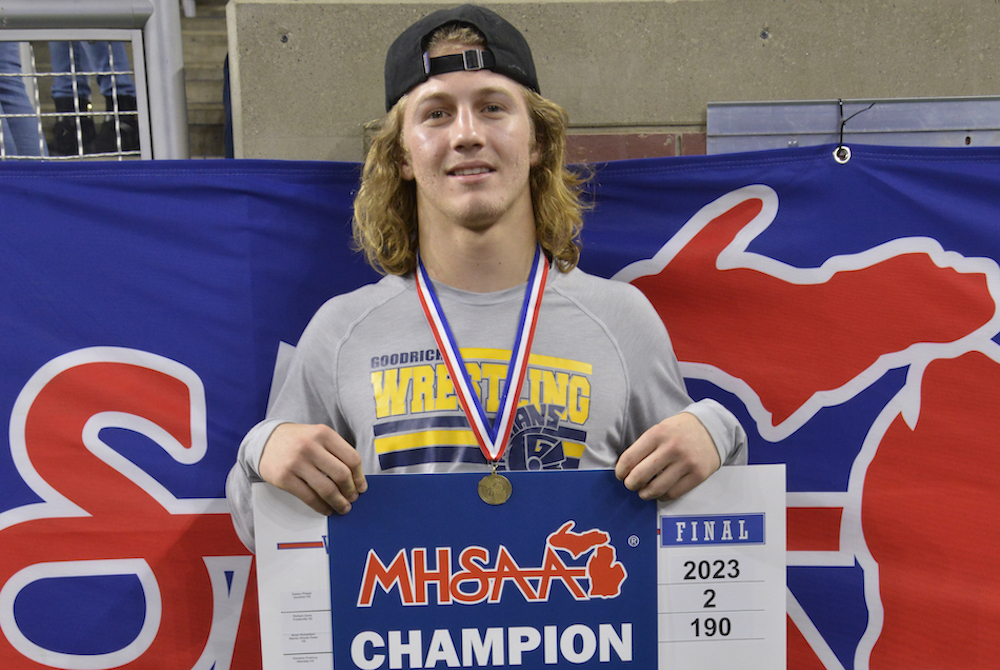
With Final Takedown, Goodrich's Phipps Arrives at Championship Destination
By
Drew Ellis
Special for MHSAA.com
March 4, 2023
DETROIT – A journey that had been 13 years in the making finally ended with a dream come true for Goodrich junior Easton Phipps.
Since he began wrestling at age 4, Phipps had been focused only on winning a state title.
At Saturday’s Division 2 Individual Finals, Phipps (41-4) had to tap into everything he had worked for to win the 190-pound championship.
After a 1-1 tie through three periods with Clio’s Jacob Marrs (37-5), the two remained tied after the sudden victory stage.
Things came down to the ultimate tiebreaker, which saw Phipps score a takedown to win.
“That state title is what was pushing me,” Phipps said. “I wanted to avenge all my teammates that didn’t get the shot to get a state title. I worked for them and the whole town. I get my picture on the wrestling room wall now.”
The junior said his championship match just came down to will power, as the two cancelled each other out in skill.
“I don’t really know what to say; the skill wasn’t there, it was just about toughness when it got into overtime,” Phipps said.
106
Champion: Brady Baker, Stevensville Lakeshore, Soph. (48-2)
Major Decision, 9-1, over Cristian Haslem, St. Clair, Fr. (46-2)
Baker had control throughout the whole match as the sophomore took home his first Finals championship.
He hit multiple takedowns and a reversal to keep Haslem from getting into the match.
“Things played out well,” Baker said. “I was getting into my attacks, scoring early and often. That’s what you have to do if you want to win.”
Baker failed to place at last year’s Finals and was motivated all season because of that. That motivation pushed him to a championship.
“It means a lot to not place last year and come in this year and win a state title,” Baker said. “It had been on my mind a lot, but there’s still bigger things to come.”
113
Champion: Malachi Kapenga, Hamilton, Soph. (48-4)
Decision 6-4 (OT) over Carter Cichocki, Lowell, Soph. (31-9)
The longest seconds of Kapenga’s life occurred as he awaited a referee’s decision at the end of the third period.
Trailing Cichocki 4-3, Kapenga managed to score an escape as the round ended, but also looked as if he may have had a takedown. Referees conferenced on whether he escaped in time, or even potentially won.
After ruling Kapenga got the escape point, he then went on to score a takedown in sudden victory to win his first Finals championship.
“I just was waiting and praying that they would at least give me one point,” Kapenga said. “I knew if I got the one point, I was at least still in the match. I was expecting a win or a loss, so getting the point, I was happy to at least be going into overtime.”
The match with Cichocki was back-and-forth, with both wrestlers holding leads during the first three rounds.
“It was a hard-fought match, and I had to be smart with my shots,” Kapenga said. “To win feels amazing. I have been working very hard toward it.”
120
Champion: Jackson Blum, Lowell, Soph. (39-3)
23-8 Technical Fall (4:52) over Tayden Miller, Mason, Sr. (37-2)
Blum was very workmanlike in winning a second championship.
The Lowell sophomore scored takedown after takedown to pick up the tech fall victory in the third period.
“There can be some built-up anxiety as you approach the match, but it’s just about getting into what you know you can do and the pressure goes away,” Blum said.
The pressure of a second consecutive title never seemed to get to Blum during the season, as he kept his focus on getting better each day.
“You feel that pressure, but you just have to block it out and do what you do in practice each day,” Blum said. “If you put in the work, the rest takes care of itself.”
126
Champion: Marcello Milani, Orchard Lake St. Mary’s, Sr. (50-0)
Decision, 3-0, over Bryce Shingelton, Linden, Sr. (45-3)
Milani had to wrestle a flawless match to get past Shingelton.
A first-round takedown got him off to a good start, and an escape in the third was the insurance point he needed to grind out the victory.
“I was just trusting in my wrestling, trusting in what I could do,” Milani said of what carried him through the match. “I have trained for this and had to trust that I did the work.”
The Orchard Lake St. Mary’s senior was able to cap off his career with a perfect 50-0 record on top of the title.
“This is something I really wanted since I was a freshman,” Milani said. “I am really glad I got to close it out this year.”
132
Champion: Grant Stahl, Mount Pleasant, Sr. (41-0)
Decision, 12-9, over Aaron Lucio, Stevensville Lakeshore, Sr. (49-2)
The long road to a Finals championship brought a lot of tough moments for Stahl, but it paid off Saturday.
The Oilers senior finished his career with a perfect season record capped by a 12-9 thriller against Lucio.
“This means everything. I had finished second and third and missed a year because of COVID,” Stahl said. “I have given everything to get this, and it feels incredible to finally get it. I wanted it so bad.”
Stahl was able to go up 8-1 thanks to a set of near-fall points early in the third period. He then had to fend off an aggressive Lucio to hang on for the championship.
“(Lucio) just shot in deep and he was sitting there, so I just reached back and hooked his arm, tilted him up and that was the difference,” Stahl said.
138
Champion: Jayden Schwartz, Charlotte, Sr. (52-2)
Decision, 11-5, over Owen Segorski, Lowell, Soph. (29-7)
Trailing 4-2 going into the third period, Jayden Schwartz knew it was time to go into overdrive.
Trusting in his stamina, Schwartz came out aggressive in the third and scored nine points to get past Segorski, a 2022 champion.
“All the work I have put in over the last few weeks, it was all for that third period,” Schwartz said. “I knew I had the stamina for the third to really push the pace.”
The top-seeded Schwartz finished with 52 wins while ending his prep career as a champion.
“This feels amazing,” Schwartz said of the title. “It hasn’t really hit me yet, but all the hard work really paid off.”
144
Champion: CJ Poole, Lowell, Sr. (31-8)
Injury Stoppage (5:00) over Louden Stradling, Gaylord, Sr. (50-1)
The final match of the night ended with unfortunate circumstances.
Tied 1-1 in the third, Poole shot in for a takedown on Stradling. The two collided heads and the impact from the shot, which finished out of the circle, left Stradling unable to continue.
Stradling suffered a head injury, and the match was ruled over and awarded to Poole.
“He’s a back-up-and-shoot kind of wrestler and I saw he was backing up and getting ready to shoot, so I shot for a double. He lowered his level and we hit heads and I was just trying to drive through on my shot,” Poole said.
The way the match ended wasn’t likely how Poole envisioned it, but he’s still grateful to be a champion.
“It still feels amazing,” Poole said of the title. “It’s been a lot of work.”
150
Champion: Trevor Swiss, Petoskey, Sr. (47-0)
Decision, 10-4, over Jack Conley, Lake Fenton, Sr. (31-3)
Swiss completed an unbeaten season, and the Petoskey senior never trailed in this match.
Going into the third period tied 4-4, Swiss picked up the pace and outscored Conley 6-0 to secure the championship.
“I knew I had to work, so I just came out knowing I needed to make something happen,” Swiss said. “I was able to capitalize when he got off-balanced, so I managed to put him on his back.”
Despite the unbeaten season, it was the Finals title that Swiss had been craving all year, fulfilling a childhood dream.
“This is what I have been dreaming of since I was in first grade,” Swiss said. “It feels amazing, and I really can’t put it into words.”
157
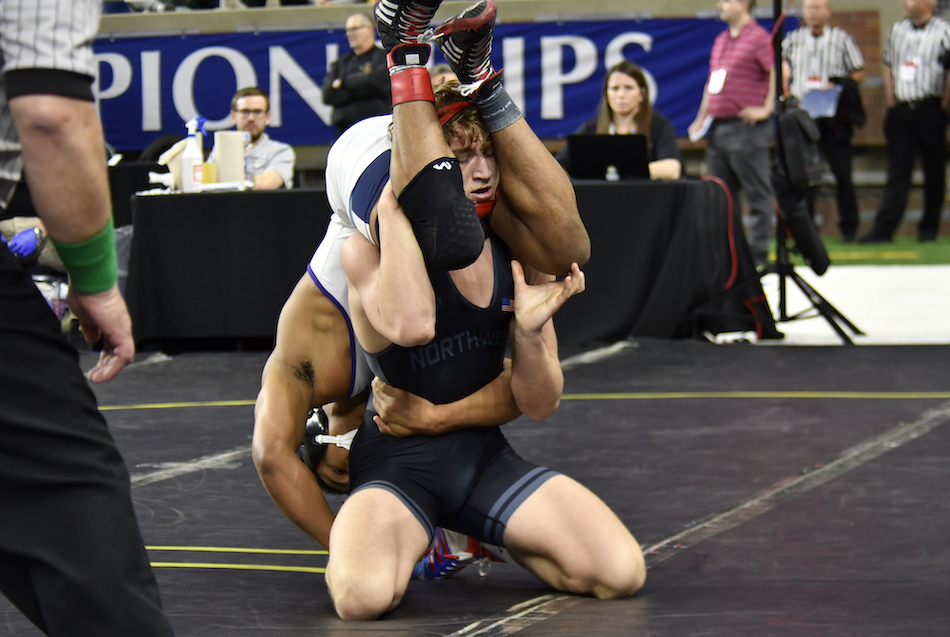
Champion: Cory Thomas Jr., Pontiac, Jr. (26-0)
Decision, 5-1, over Zach Jacobs, Jackson Northwest, Sr. (39-3)
After a scoreless first period, Thomas Jr. managed to ride out Jacobs in the second period to keep the match at 0-0.
In the third, Thomas Jr. knew he had put himself in position to win, which he did with an early escape and two takedowns during the closing two minutes.
“I work really hard at home, and I think that showed in being able to get those late takedowns,” Thomas Jr. said. “I was able to just keep pushing through.”
Thomas Jr. placed third at the 2021 D1 Finals at 125 pounds wrestling for Detroit Catholic Central, but being able to come back this year to win a title for Pontiac was even more rewarding.
“It’s been a crazy journey. I’m just so happy to be able to experience this,” Thomas Jr. said.
165
Champion: Philip Lamka, Fenton, Jr. (44-2)
Decision, 6-5, over Max Macklem, Goodrich, Soph. (33-5)
After placing third at last year’s Finals, Lamka wouldn’t let himself experience disappointment again.
He trailed Macklem 5-4 in the third period, but scored a late takedown to edge his opponent by one point.
“I’ve worked so hard for this all year,” Lamka said. “After last year, this is all I wanted. Coming up short in the semifinals in overtime to the eventual champ (in 2022) was hard. Coming in, I had one job to do and that was to win. I got it done.”
Following the victory, Lamka dropped to his knees and took in the moment.
“This is everything I have worked for my whole life,” Lamka said. “After coming up short before, (the emotions) just flood you.”
175
Champion: Brayden Gautreau, Gaylord, Sr. (52-1)
Decision, 3-1 (OT), over Carson Crace, Lowell, Sr. (33-6)
For Gautreau to come up with a second-consecutive championship, he needed a little more time. The senior was tied 1-1 with Crace through three periods after each scored an escape.
In OT, the past champ showed his mettle and came through with a takedown to earn the victory.
“I was on my stuff,” Gautreau said of the OT period. “(Crace) did a good job of keeping me off during most of the match. I just kept attacking, and it eventually paid off.”
Gautreau won the D2 171-pound title last year but said he never felt a lot of pressure to repeat.
“I didn’t feel a lot of the pressure. I just love wrestling, so I just love being able to compete,” Gautreau said. “You put in a lot of work for these moments, and this is where champions shine.”
215
Champion: Adam Haselius, Jackson Northwest, Sr. (50-0)
Decision, 5-1, over Joey Scaramuzzino, Croswell-Lexington, Jr. (51-4)
Haselius likes to be consistent, and he was very consistent Saturday night.
The Jackson Northwest senior claimed a second-consecutive Division 2 title after winning at 189 pounds in 2022.
“It feels great to repeat,” Haselius said. “Obviously that has been the goal since last year. It just comes down to consistency for me. Nobody that wins a state championship believes that they can’t win it again.”
Haselius never trailed, as he set the tone early with a takedown and added another in the second period before grinding out the victory in the third.
“I just wanted to keep myself in good positions,” Haselius said of the match. “Once I got the lead, I knew it was on him to bring the pressure, so I just had to wrestle smart.”
285
Champion: James Mahon, Goodrich, Soph. (14-0)
Decision, 5-4, over Aaron Holstege, Allendale, Sr. (49-1)
Battling through a labrum injury, Mahon managed to ride out Holstege for the final minute to secure a one-point victory.
“In a lot of my matches this year and last year, I’ve had to find ways to win 1-0 or win by one point,” Mahon said. “I’ve always found ways to get it done.”
Mahon trailed 4-3 in the third period, but scored a takedown with a minute left to go ahead and then worked on his top game to earn his first Finals title as a sophomore.
“I really expected this the whole year,” Mahon said. “It was never in doubt for me. Now I have to go and get two more.”
PHOTOS (Top) Goodrich’s Easton Phipps takes a champion’s photo at Ford Field. (Middle) Jackson Northwest’s Zach Jacobs, front, works to break the hold of Pontiac’s Cory Thomas Jr. on Saturday. (Click for more from High School Sports Scene.)