

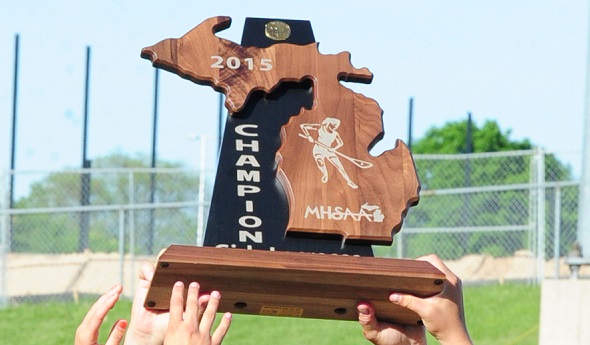
Casting Lines for Future Tournaments
August 12, 2016
By Jack Roberts
MHSAA Executive Director
The MHSAA is best known to the public for the tournaments it conducts to conclude the fall, winter and spring seasons each school year.
These tournaments, the first and largest program of the MHSAA, have survived the Vietnam War, the Korean conflict and two World Wars. They have survived the technology bubble, the housing collapse, the energy crisis and the Great Depression.
MHSAA tournaments existed at the dawn of aviation and at the time of our nation’s lunar landing. Popes, presidents and governors have changed and changed again and again, and MHSAA tournaments roll on year after year.
But the sense of tradition and permanence and inevitability of MHSAA tournaments doesn’t dissuade us from asking questions about our tournaments, even some of the most basic questions. Here are two.
Question #1
I have long been and will always be an advocate for a Ryder Cup format for the MHSAA Golf Finals, and a team tennis approach to the MHSAA Tennis Finals; but 90 years of tradition is hard to overcome. Might this be a more exciting format? Could it be co-ed? Could it reverse the decline in boys tennis participation, and increase girls golf participation? Wouldn’t it be fun to try?
Periodically, the International Olympic Committee requires each of the designated Olympic sports to defend its status, to state its case why the sport should remain a part of the Olympic program. Then, after a series or votes that retain one sport at a time, the IOC drops the sport that makes the weakest case. It does so to make room for one of the previously unlisted sports that makes the best case for inclusion.
This would appear to keep the existing Olympic sports on their toes, and to keep the Olympic movement fresh and reflective of modern trends in sports.
While I would not enjoy the controversy, I can see the potential for some positive results if the MHSAA were to invoke the same policy for determining the 14 tournaments it will provide for girls and the 14 for boys.
This might cause us to consider more deeply what a high school sport should look like, or at least what an MHSAA tournament sport should stand for.
On the one hand, we might be inclined to drop tournaments for those sports that involve mostly non-faculty coaches and non-school venues, or require cooperative programs to generate enough participants to support a team, or resort almost entirely to non-school funding, or cater to individuals more than teams.
Or perhaps this process would cause policymakers to forget traditional thinking and ask: “In this day and age, should we shake off traditional notions of sport and consider more where modern kids are coming from?” That might mean fewer team sports and more individual sports, more “extreme” sports like snowboarding and skateboarding, and more lifetime sports, meaning not just golf and tennis and running sports, but also fishing and even shooting sports.
Currently, MHSAA policy states that the MHSAA will consider sponsorship of a tournament series for any sport which 64 member schools conduct on an interscholastic basis as a result of action by the governing boards of those schools.
Should the only question be how many schools sponsor a sport, or must an activity also have certain qualities and/or avoid certain “defects?” What should an MHSAA tournament sport look like and stand for?
Question #2
Bristling from criticism that his association is a money-grabbing exploiter of children, my counterpart in another state said, “If we were running our programs just to make money, we would do very many things very differently.” I knew exactly what he meant.
Because we care about the health and welfare of students, because we mean what we say that the athletic program needs to maximize the ways it enhances the school experience while minimizing academic conflicts, and because we try to model our claim that no sport is a minor sport when it comes to its potential to teach young people life lessons, we operate our programs in ways that make promoters, marketers and business entrepreneurs laugh, cry or cringe.
If money were the only object, we would seed and select sites to assure the teams that attracted the most spectators had the best chance to advance in our tournaments, regardless of the travel for any team or its fan base. If money were the only object, we would never schedule two tournaments to overlap and compete for public attention, much less tolerate three or four overlapping events. If money were the only object, we would allow signage like NASCAR events and promotions like minor league baseball games.
Those approaches to event sponsorship may not be all wrong; they’re just not all right for us. And we will live with the consequences of our belief system.
During a typical school year, more than 20 percent of the MHSAA’s 2,097 District, Regional and Final tournaments lose money. Not a single site in golf, skiing or tennis makes a single penny. In no sport did every District, Regional and Final site have revenue in excess of direct expenses.
In fact, in only three sports – boys and girls basketball and football – is revenue so much greater than direct expenses overall that it helps to pay for all the other tournaments in which the MHSAA invests.
That’s right: invests. When we present our budget to our board, we talk about the MHSAA’s investment in providing tournament opportunities in all those sports and all those places that cannot sustain the cost of those events on their own. How much is this investment worth to students, schools and society?
These two are core questions that require our focus far in advance of talk about scheduling, site selection, seeding and the myriad matters that too often hijack our time and attention.
Dundee's Swiderski Becomes 4th to Earn 4 Individual, 4 Team Finals Titles
By
Paul Costanzo
Special for MHSAA.com
March 5, 2022
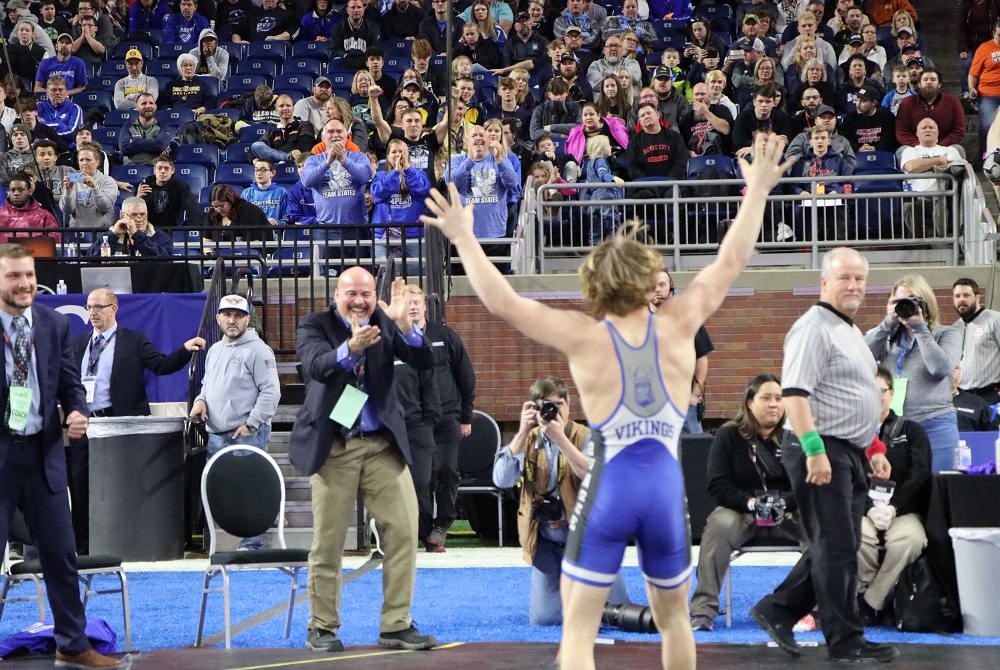
DETROIT – Casey Swiderski took a moment Saturday for himself.
The Dundee senior and four-time Individual Wrestling Finals champion had already had his hand raised. He had already addressed the crowd and had a post-match celebration.
But as fans continued to rain applause down on him, Swiderski crouched off to the side of the mat and took it all in.
“It’s tough walking away from this,” Swiderski said following his pinfall victory against Kingsley’s Aiden Shier in the Division 3, 152-pound final. “That was it. That was my last high school match in the MHSAA season. It’s tough. It’s a lot of hard work and years. I’ve got college to go to, but that’s tough right there.”
Swiderski deserved the moment, as he finished off one of the most dominant and successful careers in MHSAA history.
With his victory, and Dundee’s team title win a week earlier, Swiderski became the fourth wrestler in state history to win four team titles and four individual titles. He joined Davison’s Brent Metcalf (who will be one of his coaches at Iowa State), Lowell’s Austin Boone and his former teammate, Stoney Buell.
“It’s amazing,” Swiderski said. “When you put in all the hard work and the belief, this is the bonus day right here. This comes with it. It’s an awesome thing.”
Swiderski (45-0) was leading comfortably in the second period of the final when Shier was able to get his first burst of offense on a deep shot. Rather than give up the takedown, however, Swiderski turned it into his own pinning combination.
He finished the tournament with three pins and one technical fall. None of his matches went beyond the second period.
103
Champion: Talan Parsons, Ovid-Elsie, Soph. (37-1)
Major Decision, 9-0, over Landon Sopha, Yale, Fr. (53-2)
A year after coming one match short of his ultimate goal, Parsons wasn’t going to be denied Saturday.
“This was my biggest goal,” Parsons said. “Last year I was so close, and it hurt a lot to make it all that way and not take first. So I put in all the work to make my way back and win it this year.”
Parsons jumped on Sopha early and controlled the match throughout, adding a takedown, nearfall and reversal as the match went on to win with a major decision.
112
Champion: Kade Kluce, Dundee, Soph. (41-6)
Decision, 5-4, over Easton Moran, Yale, Sr. (51-3)
Kluce was a returning Finals champion, having won at 103 a year ago. But he wasn’t happy with how things started this season, and the emotions were evident as he celebrated his second title.
“I just felt grateful I got the opportunity to come here and wrestle,” said Kluce, who suffered a knee injury in the summer that lingered into the beginning of the season. “I lost six matches this year, three times as much as I did last year. I don’t know, I just didn’t feel proud of myself until now.”
Kluce fell behind 2-0 as Moran picked up an early takedown, but he battled back and a takedown with 37 seconds remaining won him the match.
119
Champion: Braeden Davis, Dundee, Jr. (41-2)
Technical Fall, 3:32, over Connor Busz, Clinton, Jr. (48-3)
Davis has not wrestled into the third period at the Individual Finals.
He’s a three-time champion.
“I’ve just been able to bonus my way through states the past three years, and I’m really grateful,” Davis said. “I’m really happy that I’m able to do things like that.”
Davis, who has already committed to Penn State, won at 103 pounds in 2020 and 112 in 2021. Saturday’s match was his first final to make it out of the first period, but it came against an opponent in Busz who was a runner-up a year ago.
As a three-time individual and team champion, Davis has a chance to match Swiderski’s achievement next season.
125
Champion: Cameron Chinavare, Dundee, Soph. (39-2)
Fall, 3:14, over Fabian Facundo, Alma, Fr. (38-4)
After an early-season match between these two was airtight, Chinavare – who won that first match 4-3 – was expecting another battle.
“I know I had to go out there and keep my feet moving,” Chinavare said. “I knew he was going to come at me. I dragged him right there at the end and took him to his back. I wasn’t expecting a pin at all, but it fell right into place, I guess.”
Chinavare led the match 2-0 after the first period, and before he was able to get the takedown and pin.
130
Champion: Zachary Gibson, Lake Odessa Lakewood, Sr. (39-0)
Major decision, 11-0, over Caiden Pelc, Portland, Sr. (34-7)
Gibson and Pelc had met three times throughout the season, with Gibson winning each matchup.
He wasn’t worried about Pelc figuring him out, though.
“I had something new against him every time,” Gibson said.
The title was the second straight for Gibson, who won at 125 pounds a year ago. This was his first at Ford Field.
“It’s way different,” he said. “Way bigger, way more exciting.”
135
Champion: Aidan Bernard, Montrose, Sr. (46-1)
Decision, 8-1, over Logan Sander, Dundee, Sr. (35-7)
After winning his first Finals title, Bernard couldn’t contain his emotions.
“I’m so happy,” he said. “I’ve been wrestling since I was 9, and this is all I’ve wanted for the past nine years. I’ve been close – my sophomore year I took third. Last year I thought I was going to have it, but I was in really bad shape because of COVID. This year, I really (worked hard) and I had great coaching staff, great family, great friends who pushed me and supported me. I’m just really grateful for the moment.”
Twice during his Finals match, Bernard’s injured knee flared up. But he wasn’t going to let that stop him.
“I knew I was going to keep going,” he said. “I told my parents and my friends, even if I break something early in the match, I’m going to keep going.”
140
Champion: Ryker Johnecheck, Williamston, Sr. (38-2)
Decision, 5-1, over Peter Pena, Milan, Jr. (21-2)
Johnecheck never planned to be flashy in claiming his third-straight individual title. He just wanted to be efficient.
He was certainly that as he controlled his match with Pena throughout.
“I think it’s one of those matches where it’s the state finals, I’m not going to go take any unnecessary risks,” he said. “I just went out there, wrestled smart. He can catch people, so my big thing was be smart, get a comfortable score, and take what’s there, and I think that’s what I did.”
Johnecheck won at 125 in 2020 and 130 in 2021.
“It’s not what I expected coming in as a freshman,” Johnecheck said. “It hasn’t really sunk in yet, that I’m going to be one of those guys in 10 years that they’re looking up (in the gymnasium) and say, ‘Oh, I knew him.’”
145
Champion: Aiden Davis, Dundee, Jr. (43-0)
Decision, 11-5, over Mason Cantu, Hart, Sr. (48-2)
Despite being a returning champion, Davis said he felt the pressure was on Cantu coming into their Finals match. So the Dundee junior picked his spots to finish off his unbeaten season and come away with another title.
“I’ve been here before. I sort of know the environment,” Davis said. “And I had to stay cool, calm and collected throughout the whole match.”
Davis won at 135 pounds a year ago, and was runner-up at 125 in 2020. Cantu was a Division 4 runner-up at 135 pounds in 2020.
160
Champion: Connor Owens, Flint Powers Catholic, Jr. (18-0)
Decision, 5-2, over Nick Marienfeld, Napoleon, Sr. (54-1)
Owens didn’t like the feeling of not winning a Finals title a year ago, when he finished runner-up at this weight. So he decided this season to simply not lose.
“This is dreams coming to reality right here, man; this is nuts,” he said. “This is my biggest wrestling dream ever, and I’m just in shock right now. That feeling of losing, whether in the state finals or not, when you’re a true competitor, you have to hate losing more than you love winning, and you just have to refuse to lose.”
The match was tied heading into the third period, but an escape and a takedown gave Owens the victory.
171
Champion: Kevin McKiernan, Richmond, Sr. (40-9)
Decision, 4-3, over Jake Nelson, Howard City, Sr. (38-8)
McKiernan is the youngest of five brothers, and all made a Final for Richmond. He’s now the third McKiernan to win a title.
“It means a ton,” he said. “You can’t be the only brother to not make it to the Finals. Then you’re the end of every joke. But it means a ton.”
McKiernan took third in his region, but battled through this bracket to get his first title. He scored a late first-period takedown to take his first lead, and never relinquished it.
“It’s the coaches standing in the corner, the practice partners in the room, all of that adds up to state titles,” McKiernan said. “I think this is just proof of that again.”
189
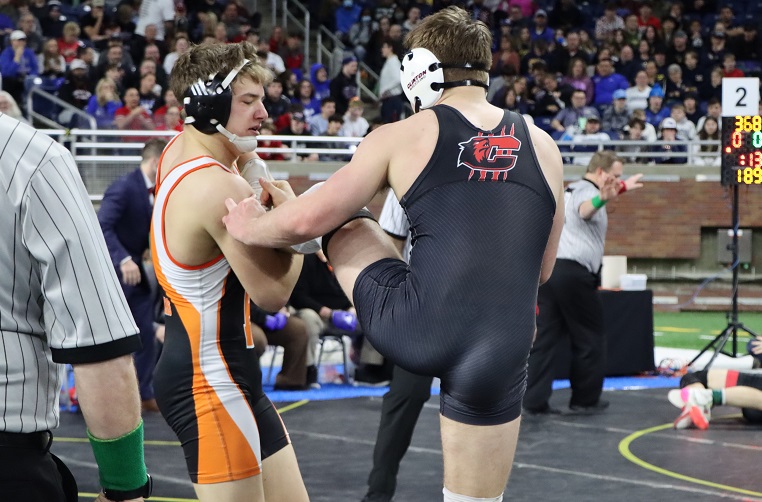
Champion: Jacob Munger, Alma, Sr. (43-2)
Decision, 11-5, over Logan Badge, Clinton, Sr. (36-6)
For the second time in as many weeks, Munger defeated Badge, this time claiming his first title, and denying Badge his fourth.
“All my coaches, they say to stay with the positive, remember what worked the last match and bring it to this match,” Munger said. “I stayed with the positive … I knew I had a great gas tank and brought that over. It’s just all positive.”
Munger led 6-3 heading into the third period, and added two more takedowns in the third to pad his lead.
Badge was a three-time champion in Division 4, winning at 189 in 2020 and 2021, and 215 in 2019.
215
Champion: Hunter Huguelet, Gladwin, Sr. (46-1)
Fall, 1:54, over Adam Garcia, Alma, Sr. (32-7)
Huguelet thought for a long time about what he could do to win his first individual title.
It didn’t take him that long to do it.
The Gladwin senior capped off his career with a first-period pin.
“That was great,” Huguelet said. “I just was focusing for the last two hours, all day today and last night, and I just came in ready to go. It feels amazing. It’s more than what I thought.”
285
Champion: Levi Harber, Montrose, (44-4)
Fall, 3:51, over Eli Marshall, Watervliet, Sr. (42-3)
Harber was dominant throughout the tournament, pinning each of his first three opponents in the opening minute.
His Finals match took a little longer, but ultimately had the same result.
Harber had Marshall on his back in the first period as well, but it didn’t result in a pin, and that wasn’t necessarily even the plan.
“I’m going to be honest, I threw that cradle to get some comfort points between me and him,” he said. “So, I wasn’t expecting a pin. He was getting pretty close, but I was not in the position that I felt I could pin him properly.”
PHOTOS (Top) Dundee’s Casey Swiderski is applauded after concluding his high school career with a fourth Division 3 individual championship. (Middle) Alma’s Jacob Munger, left, works toward a win at 189 pounds. (Click for more from HighSchoolSportsScene.com.)