

Casting Lines for Future Tournaments
August 12, 2016
By Jack Roberts
MHSAA Executive Director
The MHSAA is best known to the public for the tournaments it conducts to conclude the fall, winter and spring seasons each school year.
These tournaments, the first and largest program of the MHSAA, have survived the Vietnam War, the Korean conflict and two World Wars. They have survived the technology bubble, the housing collapse, the energy crisis and the Great Depression.
MHSAA tournaments existed at the dawn of aviation and at the time of our nation’s lunar landing. Popes, presidents and governors have changed and changed again and again, and MHSAA tournaments roll on year after year.
But the sense of tradition and permanence and inevitability of MHSAA tournaments doesn’t dissuade us from asking questions about our tournaments, even some of the most basic questions. Here are two.
Question #1
I have long been and will always be an advocate for a Ryder Cup format for the MHSAA Golf Finals, and a team tennis approach to the MHSAA Tennis Finals; but 90 years of tradition is hard to overcome. Might this be a more exciting format? Could it be co-ed? Could it reverse the decline in boys tennis participation, and increase girls golf participation? Wouldn’t it be fun to try?
Periodically, the International Olympic Committee requires each of the designated Olympic sports to defend its status, to state its case why the sport should remain a part of the Olympic program. Then, after a series or votes that retain one sport at a time, the IOC drops the sport that makes the weakest case. It does so to make room for one of the previously unlisted sports that makes the best case for inclusion.
This would appear to keep the existing Olympic sports on their toes, and to keep the Olympic movement fresh and reflective of modern trends in sports.
While I would not enjoy the controversy, I can see the potential for some positive results if the MHSAA were to invoke the same policy for determining the 14 tournaments it will provide for girls and the 14 for boys.
This might cause us to consider more deeply what a high school sport should look like, or at least what an MHSAA tournament sport should stand for.
On the one hand, we might be inclined to drop tournaments for those sports that involve mostly non-faculty coaches and non-school venues, or require cooperative programs to generate enough participants to support a team, or resort almost entirely to non-school funding, or cater to individuals more than teams.
Or perhaps this process would cause policymakers to forget traditional thinking and ask: “In this day and age, should we shake off traditional notions of sport and consider more where modern kids are coming from?” That might mean fewer team sports and more individual sports, more “extreme” sports like snowboarding and skateboarding, and more lifetime sports, meaning not just golf and tennis and running sports, but also fishing and even shooting sports.
Currently, MHSAA policy states that the MHSAA will consider sponsorship of a tournament series for any sport which 64 member schools conduct on an interscholastic basis as a result of action by the governing boards of those schools.
Should the only question be how many schools sponsor a sport, or must an activity also have certain qualities and/or avoid certain “defects?” What should an MHSAA tournament sport look like and stand for?
Question #2
Bristling from criticism that his association is a money-grabbing exploiter of children, my counterpart in another state said, “If we were running our programs just to make money, we would do very many things very differently.” I knew exactly what he meant.
Because we care about the health and welfare of students, because we mean what we say that the athletic program needs to maximize the ways it enhances the school experience while minimizing academic conflicts, and because we try to model our claim that no sport is a minor sport when it comes to its potential to teach young people life lessons, we operate our programs in ways that make promoters, marketers and business entrepreneurs laugh, cry or cringe.
If money were the only object, we would seed and select sites to assure the teams that attracted the most spectators had the best chance to advance in our tournaments, regardless of the travel for any team or its fan base. If money were the only object, we would never schedule two tournaments to overlap and compete for public attention, much less tolerate three or four overlapping events. If money were the only object, we would allow signage like NASCAR events and promotions like minor league baseball games.
Those approaches to event sponsorship may not be all wrong; they’re just not all right for us. And we will live with the consequences of our belief system.
During a typical school year, more than 20 percent of the MHSAA’s 2,097 District, Regional and Final tournaments lose money. Not a single site in golf, skiing or tennis makes a single penny. In no sport did every District, Regional and Final site have revenue in excess of direct expenses.
In fact, in only three sports – boys and girls basketball and football – is revenue so much greater than direct expenses overall that it helps to pay for all the other tournaments in which the MHSAA invests.
That’s right: invests. When we present our budget to our board, we talk about the MHSAA’s investment in providing tournament opportunities in all those sports and all those places that cannot sustain the cost of those events on their own. How much is this investment worth to students, schools and society?
These two are core questions that require our focus far in advance of talk about scheduling, site selection, seeding and the myriad matters that too often hijack our time and attention.
Rematch of Champs Brings Classic Conclusion to D1 Finals
By
Drew Ellis
Special for MHSAA.com
March 5, 2022
DETROIT – It was fitting that Josh Barr versus Manuel Rojas was the last bout of the night at Saturday’s Division 1 Individual Wrestling Finals, because that’s the match everyone was most excited to see.
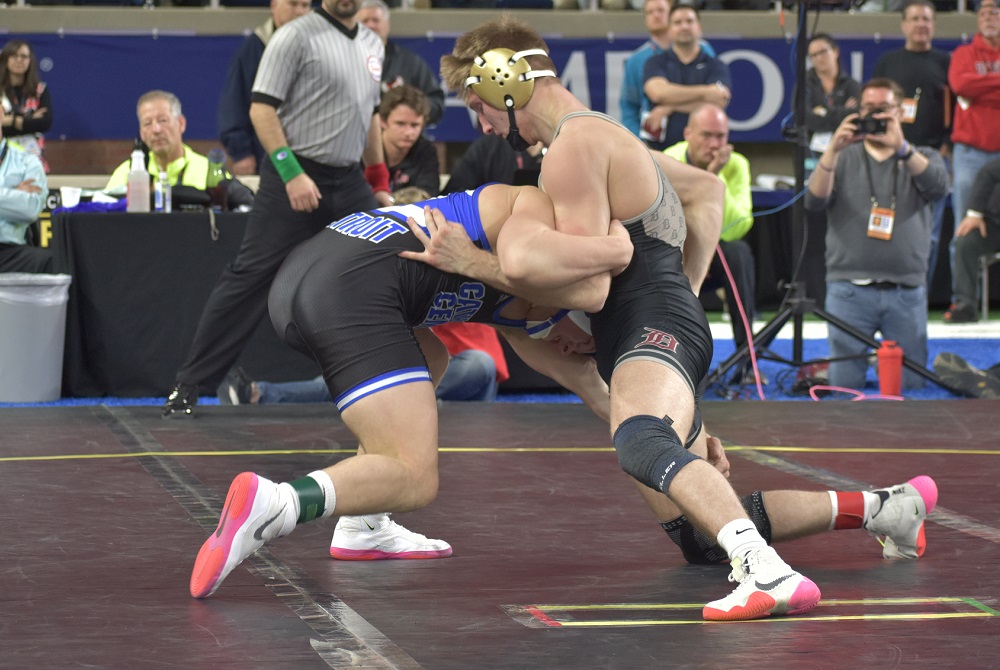
Two of the best in the country at 171 pounds, with a combined four state titles between them, Davison’s Barr emerged victorious with a 5-2 win over Detroit Catholic Central’s Rojas, with all eyes on them.
“This is what I’ve been talking about for a long time. I couldn’t wait to be part of something like this. Practically main eventing the state championships against one of the best wrestlers in the state, it’s amazing,” Barr said. “Having all these people around watching, it was awesome.”
Barr (28-1), a junior, set the tone right away with a takedown in the first period to lead 2-0.
Rojas (37-3) managed an escape in the first and another in the second to even the match at 2-2. Barr would answer with an escape to start the third and then drive home the win with a takedown in the final minute to earn his third title.
“It means a lot,” Barr said of his third championship. “It means what we’re doing is right, it’s working. Going to bed early, waking up early, eating clean. It all adds up.”
Rojas had just two losses in-state during his senior season, both coming to Barr over the last eight days. Barr edged Rojas 4-3 in last weekend’s Division 1 Team Final while leading Davison to a 29-21 victory.
“I think it just shows my character. I got right back to it last week. Winning that team state title was cool, but as soon as I got in my car, it was over,” Barr said. “I started training again right away. I knew (Rojas) was going to be sitting here waiting for me, so I got right back to it.”
103
Champion: Conor McAlary, Hudsonville, Fr. (45-1)
Decision, 4-2 (OT), over Ozia Wilson, Macomb Dakota, Fr. (47-1)
In a thrilling finish, McAlary scored a takedown in sudden victory to hand Wilson his only loss of the season.
“I knew going into this match that I had to take (Wilson) into deep waters to win this match,” McAlary said. “Heading into overtime, my coach told me this is right where we wanted to be. I knew I had it.”
The first two periods were scoreless, but McAlary got a takedown in the third to counter a pair of escapes from Wilson. It then came down to a quick takedown from McAlary in OT to earn the state title.
“I still can’t believe it,” he said. “The goal is always to win, but sometimes you can’t really wrap your head around it even after you win. I don’t really know what to feel. It’s wild.”
112
Champion: Caleb Weiand, Macomb Dakota, Jr. (48-0)
Decision, 3-1, over Mariano Lopez, Holt, Jr. (35-5)
After suffering his only loss of the 2021 season in a championship match, Weiand was determined not to suffer the same fate this year.
“Losing in the state finals was the worst feeling I ever had. I didn’t want to experience that again,” Weiand said.
His takedown in the first period proved to be the difference, as he held off a game Lopez over the final minutes.
“I just had to stay tough,” Weiand said. “I knew I could ride him out for most of the period. I feel very confident on top.”
119
Champion: Drew Heethuis, Detroit Catholic Central, Jr. (32-3)
Decision, 4-1, over Justin Gates, Davison, Soph. (30-4)
In a match that featured a pair of 2021 champions, Heethuis scored a takedown in the first period and a reversal in the second to secure his second title.
“It’s awesome. I had a couple of bumps in the road earlier in the year, and I wasn’t in the right mindset,” Heethuis said. “Over the past couple of months, because of my coaches, I was able to dial it in for the last half of the year. It feels great.”
The two met in last week’s Division 1 Team Final, with Heethuis grinding out a 2-1 victory over Gates.
“We wrestled last weekend and I knew it would be a tough match this time, too,” Heethuis said. “I knew that if I was able to get into a good attack in the first, it would be key.”
125
Champion: Cade Horwath, Davison, Jr. (30-0)
Decision, 10-5, over Fritz Mueller, Macomb Dakota, Sr. (40-7)
Horvath earned his 100th career win and locked up his third championship while also capping his second-consecutive undefeated season.
“This one means a little more,” Horwath said of his third title. “We had some team adversity this year, so it took a lot of hard work by the team to get everyone at their best.”
Horwath scored two takedowns early in the first period to set the tone and never trailed in the match.
“Honestly, I just wanted to have fun and score some points,” Horwath said. “It was a nice environment, being able to wrestle in front of my family and fans.”
130
Champion: Clayton Jones, Detroit Catholic Central, Jr. (36-3)
Decision, 9-2, over Elijah Bunn, Rockford, Jr. (42-2)
Jones secured his first championship with a dominant effort at 130 pounds, earning a 9-2 win over the top-seeded Bunn.
“I’m just thinking that all the hard work that we’ve been putting in got (me) the state championship,” Jones said.
Jones came out aggressive with an early takedown in the first and added two more in the second to keep in control.
“I made sure to get the first takedown,” Jones said. “I came out the gates and just kept going at him, going at him.”
135
Champion: Aidan Smith, Brighton, Sr. (44-1)
Decision, 8-4, over Caleb Youngblood, Romeo, Sr. (26-4)
Smith added his name to Brighton’s championship history with a hard-fought win.
“I have waited for this for a very long time,” Smith said. “I had previous teammates ahead of me that won state titles, and that was a lot of pressure on me. I just feel like all of that pressure has been lifted.”
Smith never trailed, as he scored the opening takedown and sprinkled in a few more throughout the bout.
“I knew the match was going to be tough. I just had to wrestle all six minutes hard,” he said. “I felt like I was getting into my attacks really well, and I just kept chain wrestling. I was really happy with my performance.”
140
Champion: Dylan Gilcher, Detroit Catholic Central, Jr. (39-0)
Decision, 7-1, over Evan Herriman, Davison, Jr. (20-4)
A quiet and composed Gilcher won his third championship at a third different weight class Saturday.
After winning at 112 pounds in 2020 and 135 pounds in 2021, Gilcher controlled his match from start-to-finish to earn the 140-pound crown.
This Finals matchup was a rematch from the 135-pound final in 2021. Gilcher won that 3-0. These two also met in last weekend’s D1 Team Final, a 7-5 victory for Gilcher.
“I had him last week and last year. I’ve been wrestling him since we were little, growing up. He was always kind of bigger than me, so he could beat me up a little bit,” Gilcher said. “It feels good.”
145
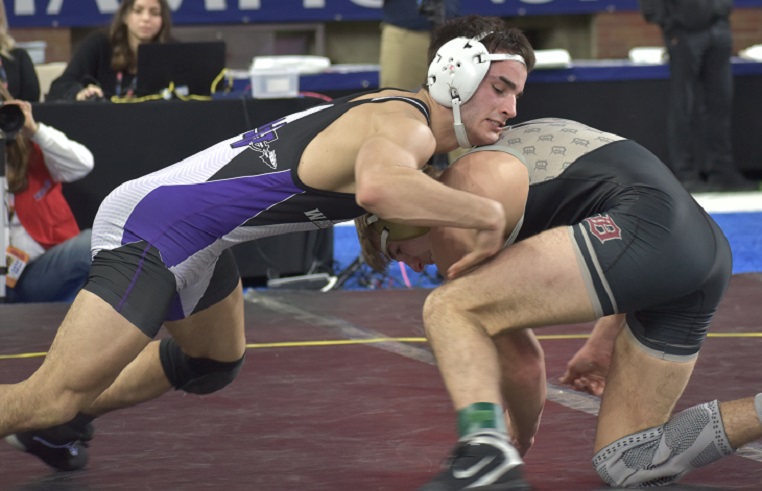
Champion: Nathan Jerore, Brownstown Woodhaven, Sr. (38-1)
Decision, 8-4, over Owen Payne, Davison, Sr. (15-2)
After seeing previous title bids ended prematurely by injuries and the pandemic, Jerore now can call himself a Finals champion.
“I literally can’t believe it. I wanted it so bad. It’s been taken from me for so long,” Jerore said. “Injuries and COVID, it’s been crazy, but I just kept working toward this goal.”
Jerore scored four takedowns in the match and was relentless on his feet against Payne.
“I knew he was going to be tough, but I knew that if I was as tough as I can be, anyone that I wrestled I could break,” Jerore said. “That’s what happened.”
152
Champion: Darius Marines, Detroit Catholic Central, Soph. (35-4)
Decision, 1-0, over Tatum Bunn, Detroit Catholic Central, Jr. (25-12)
For the second consecutive season, Marines had to face a teammate in a championship match.
For the second consecutive season, Marines came out victorious.
“It’s unfortunate, but it had to happen,” Marines said of facing a teammate in the final again. “(Bunn) was one of my best friends on the team. It kind of hurt. But, I had to set all that stuff aside.”
The match didn’t have much action. Marines rode out Bunn in the second period and then earned an escape in the third for the lone point.
“I felt pretty good (after the second period),” Marines said. “I’ve worked my whole life for this, so it feels pretty good (to win).”
160
Champion: Rollie Denker, Temperance Bedford, Sr. (55-2)
Decision, 3-1, over Brayden Mirjavadi, Romeo, Jr. (41-4)
A takedown in the closing second of the third period broke a 1-1 tie and gave Denker his first championship.
Mirjavadi got an escape in the second to take a 1-0 lead, and Denker answered with an escape of his own to start the third. He then turned up the heat late in the match to earn his title.
“I knew late in matches, we all get tired, but I knew (Mirjavadi) would be the exception, so I had to keep going and eventually I just got him,” Denker said.
189
Champion: Remey Cotton, Davison, Jr. (27-3)
Decision, 7-4, over Aidan Wardell, Midland Dow, Sr. (44-4)
Cotton got a takedown early in the bout and built a 5-1 lead in the second period before hanging on for the victory.
“I’ve trained for this my whole life,” Cotton said of the win. “Being able to come out here and get it done just feels amazing.”
Along with his first championship, Cotton also avenged a prior loss to Wardell to cap off his season.
“I practice every day to win every match,” Cotton said. “If I lose one match, I just look forward to the next one to be able to move that to the past.”
215
Champion: Jimmy Colley, Davison, Sr. (32-2)
Decision, 14-7, over Avery Dickerson, Hartland, Sr. (45-2)
Colley collected his second consecutive championship at 215 pounds in a wild scramble of a match.
“It feels great to come back here and end your career as a state champ two times in a row, as well as a team champ two times in a row,” Colley said. “It shows you are one of the best.”
The two contenders traded position often, but it was Colley who found himself with the advantage more consistently. He led 8-5 after two periods and then handled his business in the third.
“We both had that same funky style, and we always put on an exciting match,” Colley said. “You never know what (Dickerson) is going to do. It looks like we are just rolling around sometimes.”
285
Champion: Joshua Terrill, Holt, Sr. (43-2)
Decision, 6-2, over Giulian Bodiu, Canton, Sr. (28-1)
After finishing runner-up in 2021, Terrill grinded his way to a championship.
“I just kept telling myself to not be content. I wasn’t content, and I just won a state title,” Terrill said.
After a scoreless opening period, Terrill turned up the aggression and scored a pair of takedowns in the second period to take control. He credited his coaches for his strong finish.
“This means a whole lot to me, but this really goes to my coaches,” Terrill said. “None of this is about me, it’s about the coaches that got me here.”
PHOTOS (Top) Davison’s Josh Barr (right) and Detroit Catholic Central’s Manuel Rojas contend for the 171-pound title Saturday at Ford Field. (Middle) Woodhaven’s Nathan Jerore, left, works toward a win at 145 pounds. (Click for more from HighSchoolSportsScene.com.)