

Casting Lines for Future Tournaments
August 12, 2016
By Jack Roberts
MHSAA Executive Director
The MHSAA is best known to the public for the tournaments it conducts to conclude the fall, winter and spring seasons each school year.
These tournaments, the first and largest program of the MHSAA, have survived the Vietnam War, the Korean conflict and two World Wars. They have survived the technology bubble, the housing collapse, the energy crisis and the Great Depression.
MHSAA tournaments existed at the dawn of aviation and at the time of our nation’s lunar landing. Popes, presidents and governors have changed and changed again and again, and MHSAA tournaments roll on year after year.
But the sense of tradition and permanence and inevitability of MHSAA tournaments doesn’t dissuade us from asking questions about our tournaments, even some of the most basic questions. Here are two.
Question #1
I have long been and will always be an advocate for a Ryder Cup format for the MHSAA Golf Finals, and a team tennis approach to the MHSAA Tennis Finals; but 90 years of tradition is hard to overcome. Might this be a more exciting format? Could it be co-ed? Could it reverse the decline in boys tennis participation, and increase girls golf participation? Wouldn’t it be fun to try?
Periodically, the International Olympic Committee requires each of the designated Olympic sports to defend its status, to state its case why the sport should remain a part of the Olympic program. Then, after a series or votes that retain one sport at a time, the IOC drops the sport that makes the weakest case. It does so to make room for one of the previously unlisted sports that makes the best case for inclusion.
This would appear to keep the existing Olympic sports on their toes, and to keep the Olympic movement fresh and reflective of modern trends in sports.
While I would not enjoy the controversy, I can see the potential for some positive results if the MHSAA were to invoke the same policy for determining the 14 tournaments it will provide for girls and the 14 for boys.
This might cause us to consider more deeply what a high school sport should look like, or at least what an MHSAA tournament sport should stand for.
On the one hand, we might be inclined to drop tournaments for those sports that involve mostly non-faculty coaches and non-school venues, or require cooperative programs to generate enough participants to support a team, or resort almost entirely to non-school funding, or cater to individuals more than teams.
Or perhaps this process would cause policymakers to forget traditional thinking and ask: “In this day and age, should we shake off traditional notions of sport and consider more where modern kids are coming from?” That might mean fewer team sports and more individual sports, more “extreme” sports like snowboarding and skateboarding, and more lifetime sports, meaning not just golf and tennis and running sports, but also fishing and even shooting sports.
Currently, MHSAA policy states that the MHSAA will consider sponsorship of a tournament series for any sport which 64 member schools conduct on an interscholastic basis as a result of action by the governing boards of those schools.
Should the only question be how many schools sponsor a sport, or must an activity also have certain qualities and/or avoid certain “defects?” What should an MHSAA tournament sport look like and stand for?
Question #2
Bristling from criticism that his association is a money-grabbing exploiter of children, my counterpart in another state said, “If we were running our programs just to make money, we would do very many things very differently.” I knew exactly what he meant.
Because we care about the health and welfare of students, because we mean what we say that the athletic program needs to maximize the ways it enhances the school experience while minimizing academic conflicts, and because we try to model our claim that no sport is a minor sport when it comes to its potential to teach young people life lessons, we operate our programs in ways that make promoters, marketers and business entrepreneurs laugh, cry or cringe.
If money were the only object, we would seed and select sites to assure the teams that attracted the most spectators had the best chance to advance in our tournaments, regardless of the travel for any team or its fan base. If money were the only object, we would never schedule two tournaments to overlap and compete for public attention, much less tolerate three or four overlapping events. If money were the only object, we would allow signage like NASCAR events and promotions like minor league baseball games.
Those approaches to event sponsorship may not be all wrong; they’re just not all right for us. And we will live with the consequences of our belief system.
During a typical school year, more than 20 percent of the MHSAA’s 2,097 District, Regional and Final tournaments lose money. Not a single site in golf, skiing or tennis makes a single penny. In no sport did every District, Regional and Final site have revenue in excess of direct expenses.
In fact, in only three sports – boys and girls basketball and football – is revenue so much greater than direct expenses overall that it helps to pay for all the other tournaments in which the MHSAA invests.
That’s right: invests. When we present our budget to our board, we talk about the MHSAA’s investment in providing tournament opportunities in all those sports and all those places that cannot sustain the cost of those events on their own. How much is this investment worth to students, schools and society?
These two are core questions that require our focus far in advance of talk about scheduling, site selection, seeding and the myriad matters that too often hijack our time and attention.
Battle of the Fans X: Meet the Finalists
By
Geoff Kimmerly
MHSAA.com senior editor
January 24, 2022
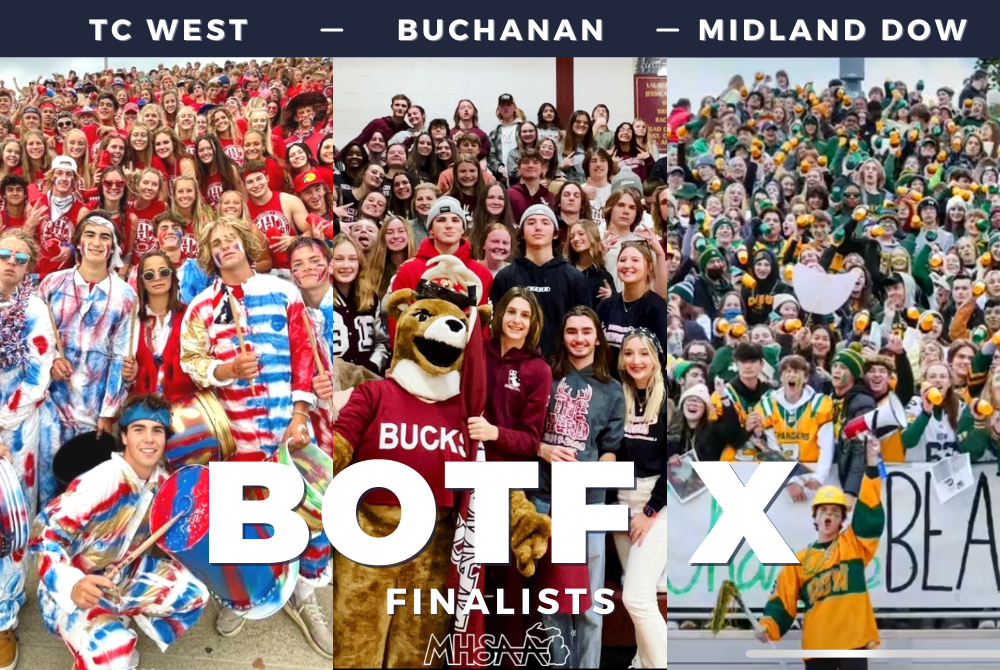
Two past champions and a first-time applicant have earned opportunities to vie for the Michigan High School Athletic Association’s “Battle of the Fans X” championship recognizing the top high school student cheering section in Michigan, as awarded by the MHSAA’s Student Advisory Council.
Buchanan, Midland Dow and Traverse City West were selected as finalists by the Advisory Council from a group of nine semifinalists that took part in a series of challenges highlighting their sections over the last two weeks.
Members of the MHSAA staff will visit all three finalists over the next three weeks, producing articles about each section and videos of those sections in action, all to be published on the MHSAA’s Second Half website.
The winner will be selected by another vote by the 16-member Advisory Council, with consideration given to a public vote on the MHSAA’s social media channels. This year’s winner will be announced Feb. 18 and recognized March 25 during the Boys Basketball Semifinals at the Breslin Center in East Lansing.
Buchanan is a three-time BOTF champ (2013, 2018 and 2020) and has reached the final round for the fourth-straight competition. Traverse City West was the winner in 2016 and has been a semifinalist seven times since 2014. Midland Dow entered the competition this school year for the first time.
The MHSAA will visit the finalists for the following home boys basketball games (unless noted):
Jan. 28: Midland Dow vs Midland (at Midland High)
Feb. 4: Buchanan vs South Haven
Feb. 8: Traverse City West vs Ludington
Howell, North Muskegon and Spring Lake filled out the next three spots, while Imlay City, Petersburg Summerfield and Yale also were semifinalists.
“After the pandemic cancelled the competition in 2021, it’s no surprise that two schools with rich student section histories made the final three this year,” said Andy Frushour, the MHSAA’s director of brand management and advisor to the Student Advisory Council.
“The Herd from Buchanan and the Bleacher Creatures at Traverse City West have to be considered the favorites going into the final round. They have been in this position many times, winning four of the nine championships. But don’t sleep on Midland Dow; we could tell right away this first-time challenger would be a contender, and this section has been strong all year long.”
Battle of the Fans is organized by MHSAA staff and the Student Advisory Council. Schools were invited throughout the fall to submit short videos, via TikTok, of their cheering sections in action. The Advisory Council then selected nine semifinalists to accomplish a list of tasks showing off their sections over a 12-day span.
Semifinalists were required to complete five mandatory challenges, and up to a total of 20, and highlight them in a three-minute TikTok. The mandatory challenges focused on contest criteria: positive sportsmanship, student body participation, school spirit, originality of cheers, organization of the group, student section leadership and overall fun. Descriptions of all 20 challenges are available on the MHSAA Website.
Let's meet the finalists:
 BUCHANAN - THE HERD
Follow on TikTok and Instagram
@theherd_bhs #MHSAABOTF2022 @mhsaasports ♬ The Nights - Avicii
 MIDLAND DOW
@dowstudentsection Herbs House 💛💚 semifinals #mhsaabotf2022 @mhsaasports ♬ this is what falling in love feels like - JVKE
 TRAVERSE CITY WEST - BLEACHER CREATURES
Follow on TikTok and Instagram
@tcwbleachercreatures 🚨ATTENTION WEST WINNERS🚨 💯FINALS IMMINENT💯 @mhsaasports #mhsaabotf2022 ♬ original sound - Tcw BC
Battle of the Fans is organized by MHSAA staff and the Student Advisory Council. Schools were invited throughout the fall to submit short videos, via YouTube, of their cheering sections in action. The Advisory Council then selected nine semifinalists to accomplish a list of tasks showing off their sections over a 12-day span.
Semifinalists were required to complete 10 challenges via their social media channels. Five mandatory challenges focused on contest criteria: positive sportsmanship, student body participation, school spirit, originality of cheers, organization of the group, student section leadership and overall fun. Semifinalists then selected five elective challenges (taken from a list of 15 opportunities). Descriptions of all 20 challenges are available on the MHSAA Website.
The contest is sponsored in part by the United Dairy Industry of Michigan, which promotes Michigan's locally-produced dairy products and nutrition education. Rules plus links to past years’ coverage of the contest can be found on the MHSAA's BOTF web page.
The Student Advisory Council is made up of eight seniors and eight juniors who each serve two-year terms. The Council acts as the voice of Michigan's student-athletes; it serves as a student sounding board for the MHSAA's Representative Council, assists in planning Sportsmanship Summits, Captains Clinics and other student leadership events; participates in a yearly focus group about the state of high school sports for Michigan State University's Institute for the Study of Youth Sports and assists with medal ceremonies at MHSAA championship events.
A record-tying 27 schools applied for this year’s contest, including 14 schools for the first time. Three semifinalists each were selected from the Class A, Class B and Class C/D applicants. See below for a compilation of highlights from all nine semifinalists:
@mhsaasports 🚨𝙱𝙰𝚃𝚃𝙻𝙴 𝙾𝙵 𝚃𝙷𝙴 𝙵𝙰𝙽𝚂 𝚇🚨Congrats to all 9 Semifinalists! #MHSAABOTF2022 #battleofthefans #letsgo #sportsmanship #MHSAA #fyp ♬ Let's go! - Official Sound Studio