

Casting Lines for Future Tournaments
August 12, 2016
By Jack Roberts
MHSAA Executive Director
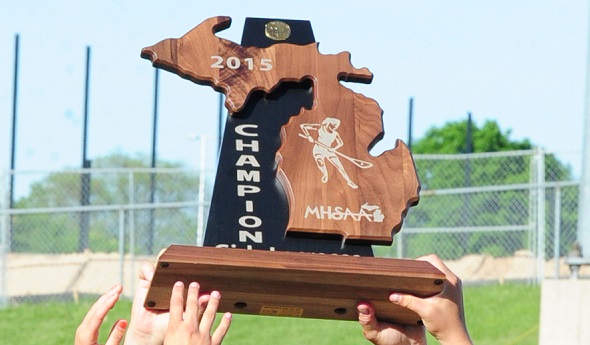
The MHSAA is best known to the public for the tournaments it conducts to conclude the fall, winter and spring seasons each school year.
These tournaments, the first and largest program of the MHSAA, have survived the Vietnam War, the Korean conflict and two World Wars. They have survived the technology bubble, the housing collapse, the energy crisis and the Great Depression.
MHSAA tournaments existed at the dawn of aviation and at the time of our nation’s lunar landing. Popes, presidents and governors have changed and changed again and again, and MHSAA tournaments roll on year after year.
But the sense of tradition and permanence and inevitability of MHSAA tournaments doesn’t dissuade us from asking questions about our tournaments, even some of the most basic questions. Here are two.
Question #1
I have long been and will always be an advocate for a Ryder Cup format for the MHSAA Golf Finals, and a team tennis approach to the MHSAA Tennis Finals; but 90 years of tradition is hard to overcome. Might this be a more exciting format? Could it be co-ed? Could it reverse the decline in boys tennis participation, and increase girls golf participation? Wouldn’t it be fun to try?
Periodically, the International Olympic Committee requires each of the designated Olympic sports to defend its status, to state its case why the sport should remain a part of the Olympic program. Then, after a series or votes that retain one sport at a time, the IOC drops the sport that makes the weakest case. It does so to make room for one of the previously unlisted sports that makes the best case for inclusion.
This would appear to keep the existing Olympic sports on their toes, and to keep the Olympic movement fresh and reflective of modern trends in sports.
While I would not enjoy the controversy, I can see the potential for some positive results if the MHSAA were to invoke the same policy for determining the 14 tournaments it will provide for girls and the 14 for boys.
This might cause us to consider more deeply what a high school sport should look like, or at least what an MHSAA tournament sport should stand for.
On the one hand, we might be inclined to drop tournaments for those sports that involve mostly non-faculty coaches and non-school venues, or require cooperative programs to generate enough participants to support a team, or resort almost entirely to non-school funding, or cater to individuals more than teams.
Or perhaps this process would cause policymakers to forget traditional thinking and ask: “In this day and age, should we shake off traditional notions of sport and consider more where modern kids are coming from?” That might mean fewer team sports and more individual sports, more “extreme” sports like snowboarding and skateboarding, and more lifetime sports, meaning not just golf and tennis and running sports, but also fishing and even shooting sports.
Currently, MHSAA policy states that the MHSAA will consider sponsorship of a tournament series for any sport which 64 member schools conduct on an interscholastic basis as a result of action by the governing boards of those schools.
Should the only question be how many schools sponsor a sport, or must an activity also have certain qualities and/or avoid certain “defects?” What should an MHSAA tournament sport look like and stand for?
Question #2
Bristling from criticism that his association is a money-grabbing exploiter of children, my counterpart in another state said, “If we were running our programs just to make money, we would do very many things very differently.” I knew exactly what he meant.
Because we care about the health and welfare of students, because we mean what we say that the athletic program needs to maximize the ways it enhances the school experience while minimizing academic conflicts, and because we try to model our claim that no sport is a minor sport when it comes to its potential to teach young people life lessons, we operate our programs in ways that make promoters, marketers and business entrepreneurs laugh, cry or cringe.
If money were the only object, we would seed and select sites to assure the teams that attracted the most spectators had the best chance to advance in our tournaments, regardless of the travel for any team or its fan base. If money were the only object, we would never schedule two tournaments to overlap and compete for public attention, much less tolerate three or four overlapping events. If money were the only object, we would allow signage like NASCAR events and promotions like minor league baseball games.
Those approaches to event sponsorship may not be all wrong; they’re just not all right for us. And we will live with the consequences of our belief system.
During a typical school year, more than 20 percent of the MHSAA’s 2,097 District, Regional and Final tournaments lose money. Not a single site in golf, skiing or tennis makes a single penny. In no sport did every District, Regional and Final site have revenue in excess of direct expenses.
In fact, in only three sports – boys and girls basketball and football – is revenue so much greater than direct expenses overall that it helps to pay for all the other tournaments in which the MHSAA invests.
That’s right: invests. When we present our budget to our board, we talk about the MHSAA’s investment in providing tournament opportunities in all those sports and all those places that cannot sustain the cost of those events on their own. How much is this investment worth to students, schools and society?
These two are core questions that require our focus far in advance of talk about scheduling, site selection, seeding and the myriad matters that too often hijack our time and attention.
Portage Northern Coach Nurturing New Roots After Arriving from Crosstown Rival
By
Pam Shebest
Special for MHSAA.com
October 19, 2021
PORTAGE — When Kurt Twichell was hired as Portage Northern’s head football coach last May, he had some serious closet cleaning to do.
 As an assistant coach at crosstown rival Portage Central, his wardrobe was filled with blue and gold.
“I had to clean out probably 80 percent of my closet,” Twichell said, laughing. “Being a phys. ed. guy, I had quite a bit of blue and gold PC stuff.
“That all went into a big old bag, and I actually donated it back to them. I had a lot of work to do from a wardrobe perspective, no doubt about that.”
Twichell is nearing the conclusion of his first season as a head coach, with Portage Northern 2-6 this fall heading into its season finale Friday against Kalamazoo Central.
He had spent the previous seven seasons at Portage Central, finishing his tenure with the Mustangs last fall as their defensive coordinator. Across town at that time, Pete Schermerhorn was completing his 27th and final season leading the Huskies’ football program – and after some thought, Twichell applied to be his replacement and was named Northern’s next coach this spring.
Twichell made sure to wear orange when he met with his new team for the first time.
If he had worn any hint of blue, “We wouldn’t have let him in,” said senior and two-way player Xavier Thomas with a big grin.
Twichell said he understood why players were apprehensive.
 “I think naturally, with teenagers, it was like what the heck is going on?” he said. “We hired a guy from Portage Central. This is crazy.”
Twichell said he worked very hard to establish a rapport with the players.
“You’re trying to build trust within your program,” he said. “As soon as I accepted this job, I’m diving full on in, orange, brown and white as a Huskie.”
Thomas said players did not know what to expect.
“The initial feeling, we were a little nervous as far as what his path for us was going to be. Having come from that school, would he hold a grudge against us or not?” he recalled.
“After meeting him and sitting down and having a conversation with him, we understood that he was fully on the path of Portage Northern Huskies. He fully supports all of our sports programs, not just football. He’s just a great guy that we need in our community.”
Climbing the ladder
Twichell said his love of football started at Haslett High School in “an up-and-coming program” under head coach Charlie Otlewski and defensive coordinator Rob Porritt, adding “Those are my guys.”
After a football injury at Hope College derailed his playing career, Twichell transferred to Michigan State as a “regular student” and started working with Otlewski and Haslett’s football team.
“I spent a couple years there doing it for fun,” Twichell said. “I ended up loving it so much.”
He scrapped plans for med school and earned a teaching degree.
Taking his first job at White Pigeon, “I was just a young guy looking for any job I could get.”
 Two years later he contacted Enders, who happened to have a job available. Twichell spent the next seven years at Central, working his way up to defensive coordinator.
When he heard about the opening at Northern, which included a teaching position, he was not sure about applying.
“I was very, very rooted with Central and really enjoyed the staff and the opportunity they gave me to work my way up to d-coordinator,” he said. “When this job came up, I actually sat down and thought about it for more than three seconds. Being a head coach is a goal of mine.”
Twichell’s wife, Kate, coaches the Portage schools’ co-op girls lacrosse team and he said the family, including 3-year-old twins, are happy living in the community.
Ironically, shortly after accepting the Northern coaching job, his wife left Hackett Catholic Prep to teach Spanish and English at Portage Central.
That makes for some interesting family dynamics, especially during the rivalry game.
“I try to push the (twins) one way; Kate doesn’t necessarily try to push them either way but we still hear the ‘M’ (Mustangs) word after “Go” from the kids,” Kurt said. “They’ll say every now and then, Go Mustangs or Go Huskies. Kate just cheers for ‘no injuries,’ the way she puts it.”
No longer just Xs and Os
“The biggest change is how much of your role has almost nothing to do with football from an Xs and Os perspective or from an actual coaching kids perspective,” Twichell said.
“It’s community relations, youth involvement, financial management, recruiting.”
He said it is like the iceberg analogy.
“People just see Friday nights and results, but below the surface is all these components that go into building a good program,” he said. “Coach Shermerhorn left a pretty good foundation in terms of that iceberg, but I definitely want to put my own spin on things.”
During the day, Twichell is in the weight room, teaching a full day of power lifting.
The academic classes are open to all students, and Twichell hopes to resurrect the school’s power lifting team.
Chris Riker, Northern’s athletic director, said when hiring a coach, it is not where he coached but if he was a good fit for the program.
“We had some outstanding candidates and Kurt had a good plan on developing culture, developing not just the football player but the whole athlete, the whole person,” Riker said. “Academics were important. Getting involved in your community is important, and being a role model for the younger kids is important as well as being a good football player, good person.”
Riker said the team is very involved with the community.
“He’s done some things with our kids and Rocket Football to establish that connection with the youth program,” he said.
He added that Twichell and Enders collaborated on Camp Ability in July.
“It’s a camp for special needs kids who want to be involved with football,” Riker said. “It’s pretty cool to get out there and see kids who aren’t involved in football be that excited and be next to our football players. Kids had big smiles on their faces, just to be able to try on the shoulder pads and football jerseys.”
The children also ran drills, tossed footballs and ran for touchdowns, helped by players from both teams.
Not just another game
The Huskies are still settling into a new system (although a highlight was a Week 4 win over Division 3 No. 10 Stevensville Lakeshore). But Twichell has surrounded himself with solid support, carrying over several assistants from Schermerhorn’s staff.
 “Those guys have been phenomenal,” Twichell said. “Just about every coach who wanted to come back did.”
As the defensive coordinator at Portage Central, Twichell was familiar with Tom Laskarides, Schermerhorn’s defensive coordinator.
“People probably wondered what that was going to look like, but I have nothing but admiration and respect for Tom,” Twichell said. “We also brought back Mike McGuire who was on staff here probably 10 years ago. He’s a quarterbacks, offensive guy and a former head coach himself. That’s been huge to have these guys.”
Twichell said the team lost several outstanding players to graduation the last three years.
“When you go through losing groups like that, there’s going to be a transition there, regardless of a new coach,” he said. “We have a very young team, an inexperienced team.”
One game on Twichell’s radar this fall was the battle of the Portages, a game Northern lost, 33-17, two weeks ago.
“I’m not sure there’s a playbook out there that anybody’s ever written,” he said. “Not just competing against players that you had physically coached and had invested so much in their lives, but you know their families, their career aspirations, especially that senior class.”
Twichell said the “coach speak” was that it was just another game.
But the emotions surfaced during the postgame handshakes.
“Lots of hugs and some emotions. It was a good feeling from a human standpoint, but obviously we’re disappointed the game didn’t go the way we wanted it to,” he said.
Thomas said his coach warned the players that the game would generate more than the usual hype.
“He let us know there would be a lot of attention brought on us from the media, being (Central head coach Mick) Enders vs. Twichell,” Thomas said.
“But with his preparation, we were pretty dialed into the game. Hopefully we can take the things we learned from that game and assess them moving forward so the things that happened in that game won’t happen again.”
 Pam Shebest served as a sportswriter at the Kalamazoo Gazette from 1985-2009 after 11 years part-time with the Gazette while teaching French and English at White Pigeon High School. She can be reached at [email protected] with story ideas for Calhoun, Kalamazoo and Van Buren counties.
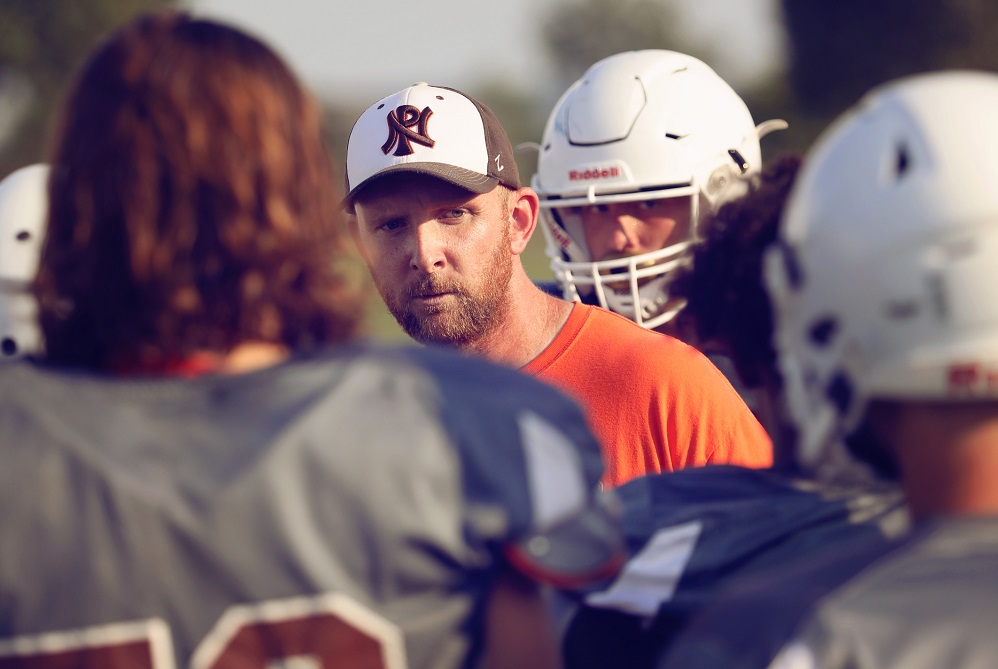
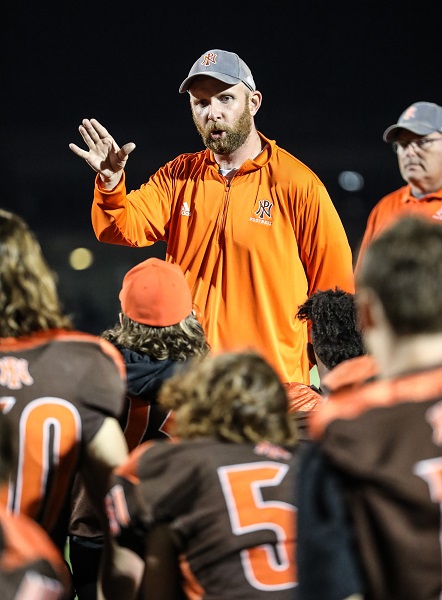
PHOTOS (Top) First-year Portage Northern varsity football coach Kurt Twichell talks with his team this season. (2) Portage Northern senior Xavier Thomas, top, and athletic director Chris Riker. (3) Twichell, left, works with his players during a practice this fall. (4) Twichell addresses the Huskies after a game. (Action photos by Jason Altwies; head shots by Pam Shebest.)