

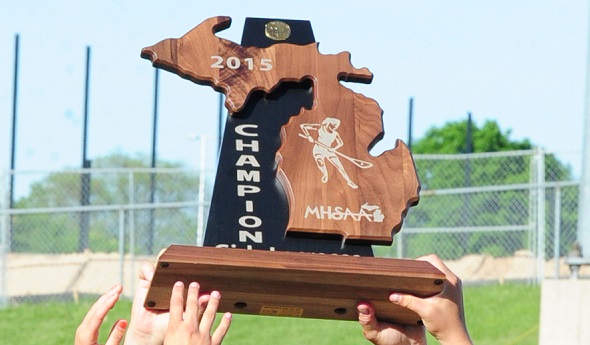
Casting Lines for Future Tournaments
August 12, 2016
By Jack Roberts
MHSAA Executive Director
The MHSAA is best known to the public for the tournaments it conducts to conclude the fall, winter and spring seasons each school year.
These tournaments, the first and largest program of the MHSAA, have survived the Vietnam War, the Korean conflict and two World Wars. They have survived the technology bubble, the housing collapse, the energy crisis and the Great Depression.
MHSAA tournaments existed at the dawn of aviation and at the time of our nation’s lunar landing. Popes, presidents and governors have changed and changed again and again, and MHSAA tournaments roll on year after year.
But the sense of tradition and permanence and inevitability of MHSAA tournaments doesn’t dissuade us from asking questions about our tournaments, even some of the most basic questions. Here are two.
Question #1
I have long been and will always be an advocate for a Ryder Cup format for the MHSAA Golf Finals, and a team tennis approach to the MHSAA Tennis Finals; but 90 years of tradition is hard to overcome. Might this be a more exciting format? Could it be co-ed? Could it reverse the decline in boys tennis participation, and increase girls golf participation? Wouldn’t it be fun to try?
Periodically, the International Olympic Committee requires each of the designated Olympic sports to defend its status, to state its case why the sport should remain a part of the Olympic program. Then, after a series or votes that retain one sport at a time, the IOC drops the sport that makes the weakest case. It does so to make room for one of the previously unlisted sports that makes the best case for inclusion.
This would appear to keep the existing Olympic sports on their toes, and to keep the Olympic movement fresh and reflective of modern trends in sports.
While I would not enjoy the controversy, I can see the potential for some positive results if the MHSAA were to invoke the same policy for determining the 14 tournaments it will provide for girls and the 14 for boys.
This might cause us to consider more deeply what a high school sport should look like, or at least what an MHSAA tournament sport should stand for.
On the one hand, we might be inclined to drop tournaments for those sports that involve mostly non-faculty coaches and non-school venues, or require cooperative programs to generate enough participants to support a team, or resort almost entirely to non-school funding, or cater to individuals more than teams.
Or perhaps this process would cause policymakers to forget traditional thinking and ask: “In this day and age, should we shake off traditional notions of sport and consider more where modern kids are coming from?” That might mean fewer team sports and more individual sports, more “extreme” sports like snowboarding and skateboarding, and more lifetime sports, meaning not just golf and tennis and running sports, but also fishing and even shooting sports.
Currently, MHSAA policy states that the MHSAA will consider sponsorship of a tournament series for any sport which 64 member schools conduct on an interscholastic basis as a result of action by the governing boards of those schools.
Should the only question be how many schools sponsor a sport, or must an activity also have certain qualities and/or avoid certain “defects?” What should an MHSAA tournament sport look like and stand for?
Question #2
Bristling from criticism that his association is a money-grabbing exploiter of children, my counterpart in another state said, “If we were running our programs just to make money, we would do very many things very differently.” I knew exactly what he meant.
Because we care about the health and welfare of students, because we mean what we say that the athletic program needs to maximize the ways it enhances the school experience while minimizing academic conflicts, and because we try to model our claim that no sport is a minor sport when it comes to its potential to teach young people life lessons, we operate our programs in ways that make promoters, marketers and business entrepreneurs laugh, cry or cringe.
If money were the only object, we would seed and select sites to assure the teams that attracted the most spectators had the best chance to advance in our tournaments, regardless of the travel for any team or its fan base. If money were the only object, we would never schedule two tournaments to overlap and compete for public attention, much less tolerate three or four overlapping events. If money were the only object, we would allow signage like NASCAR events and promotions like minor league baseball games.
Those approaches to event sponsorship may not be all wrong; they’re just not all right for us. And we will live with the consequences of our belief system.
During a typical school year, more than 20 percent of the MHSAA’s 2,097 District, Regional and Final tournaments lose money. Not a single site in golf, skiing or tennis makes a single penny. In no sport did every District, Regional and Final site have revenue in excess of direct expenses.
In fact, in only three sports – boys and girls basketball and football – is revenue so much greater than direct expenses overall that it helps to pay for all the other tournaments in which the MHSAA invests.
That’s right: invests. When we present our budget to our board, we talk about the MHSAA’s investment in providing tournament opportunities in all those sports and all those places that cannot sustain the cost of those events on their own. How much is this investment worth to students, schools and society?
These two are core questions that require our focus far in advance of talk about scheduling, site selection, seeding and the myriad matters that too often hijack our time and attention.
Forsythe Honorees Give All to Educational Athletics
By
Geoff Kimmerly
MHSAA.com senior editor
April 6, 2021
At one time during his four tenures as a Michigan high school athletic director, Leroy Hackley Jr. hosted MHSAA Finals in tennis and track & field and Districts in baseball, softball and soccer – all on the same day.
Another time, a neighboring athletic director hosting a Regional basketball game called because a dunk had just broken a backboard. An hour after Hackley took the call, the entire game had been moved to his school and play resumed.
Patti Tibaldi moved to Traverse City in 1995 already a high school and college basketball coaching legend and with district-wide administrative duties her next mission after also having served as a college assistant athletic director.
But with West High School set to open for the 1997-98 school year, and the most experienced applicant for the girls basketball varsity job having no more than seventh-grade experience, she stepped in again to build another program and make sure that generation of students received a great experience as well.
For nearly the entirety of their careers, and in multiple roles, Hackley and Tibaldi have been immersed in improving educational athletics. To celebrate their continued dedication and contributions over the years, they have been named honorees for the Michigan High School Athletic Association’s Charles E. Forsythe Award for 2021.
The annual award is in its 44th year and named after former MHSAA Executive Director Charles E. Forsythe, the Association's first full-time and longest-serving chief executive. Forsythe Award recipients are selected each year by the MHSAA Representative Council, based on an individual's outstanding contributions to the interscholastic athletics community.
Tibaldi spent 40 years in educational athletics at Comstock Park, Grand Rapids West Catholic and Traverse City West and also Aquinas College in Grand Rapids, serving as a coach, athletic director and physical education specialist. Hackley has spent the last 22 years of more than 40 in sports as an athletic director at Byron Center, Jenison, Grant and currently Muskegon Orchard View, as well as serving as an MHSAA-registered game official for 37 years. Both are recognized statewide among the best in their various fields.
“Patti Tibaldi has given more to athletics in our state at the small college and high school levels than perhaps anyone over the last 40 years,” MHSAA Executive Director Mark Uyl said. “She was a pioneer in small-school college basketball at Aquinas College, and my wife Marcy played against her there, and 30 years ago you could see that passion for women's sports that was unmatched. During her time at Traverse City West, her passion for kids was unchanged, and most of her students had no idea she had been that pioneer. She was a trailblazer for women in leadership positions in coaching and administration.
“Leroy and I were first-year athletic directors together in the same conference in 1999, and it's been a pleasure to watch him grow into one of the most respected voices over the last 22 years,” Uyl said. “At its core, athletics is a people business, and Leroy is all about those relationships. He's a guy who genuinely enjoys going to work every day.
Hackley has served as an athletic director first at Byron Center for five years, then Jenison for seven, Grant for three and Muskegon Orchard View for the last seven. Before those stops he served as director of health, recreation & wellness at Grand Valley State University for 14 years after serving as assistant director of recreation/intramurals for four years at Eastern Michigan University. His first administrative experience came while as a graduate assistant at the University of Iowa serving as supervisor of officials for the recreational services department. He’s also served as an adjunct professor in physical education at GVSU, Aquinas College and Muskegon Community College.
As well as hosting numerous postseason events, Hackley has served on eight MHSAA committees over the years and four years on its Representative Council. He’s been a registered MHSAA official in boys and girls basketball, softball, baseball, swimming & diving, volleyball, cross country and track & field over 37 years and has officiated every collegiate level of women’s basketball including Division I in the Mid-American Conference. He has officiated three MHSAA Basketball Finals and NCAA Division III and NAIA national championship games.
Just this week he changed his spring break plans to step in and host a Boys Basketball Quarterfinal and serve as a manager at MHSAA Semifinals on Wednesday and Thursday at Van Andel Arena in Grand Rapids.
“I’ve always wanted to step in because I know what it’s like when you need help. I’m one of those guys who doesn’t like to say no. I try to find a way to lend a hand wherever I can,” Hackley said. “I’ve always enjoyed sports; all my free times has been spent watching sports or playing sports, and I’ve been fortunate enough to have a wife who enjoys watching sports. Pretty much my whole live has been centered around recreation and athletics. Coming from a big family (as one of 13 children), that’s one of the things we always did.”
Tibaldi spent 40 years in education and athletics at the high school and college levels, beginning first at Comstock Park from 1973-75 before spending the next six years at Grand Rapids West Catholic where she led the girls basketball team to the Class B championship in 1979 and the softball team to four league titles.
Simultaneously for the final three years at West Catholic, Tibaldi also served as women’s basketball coach, then also softball coach at Aquinas College, where she also became assistant athletic director in 1981. While at Aquinas she led the Saints to a 340-136 record on the court and the National Catholic Basketball Championship in 1984.
Tibaldi then moved to Traverse City Area Public Schools, first as the district’s K-12 physical education coordinator but eventually in multiple physical education specialist roles. She also was named the first varsity girls basketball coach at the new Traverse City West High School from 1997-2011 and served as West’s athletic director from 2004 until retiring in December 2014. As coach, she led the Titans to multiple league and District championships and the final few hundred wins of more than 800 total on high school and college basketball courts.
She’s also played a prevalent role in helping make MHSAA policy over her decades. She’s served on a variety of MHSAA committees, including the Basketball Committee, and served in multiple roles with the Basketball Coaches Association of Michigan including as president. She also served at the collegiate level on the NAIA Executive Committee, the Wolverine-Hoosier Athletic Conference (WHAC) Executive Council and as part of NAIA Women in Sports Leadership program and the Michigan Women’s Foundation Tribute to Women Athletes Committee.
Tibaldi has received various honors for her coaching and administrative contributions, including the MHSAA’s Women In Sports Leadership Award in 2011. She was The Associated Press’ Class B Coach of the Year in 1981 and twice earned special mention, and she’s a member of the BCAM Hall of Fame. She also was named state Coach of the Year for basketball by the National Federation of State High School Associations (NFHS) in 2004, and named Regional Athletic Director of the Year by the Michigan Interscholastic Athletic Administrators Association (MIAAA) in 2011. She also was named BCAM’s College Coach of the Year in 1988 and is a member of the NAIA’s National Coaches Hall of Fame. She earned multiple NAIA District Coach of the Year awards for both basketball and softball and was the WHAC Coach of the Year four times.
“To me, teaching life lessons is everything,” Tibaldi said. “I had great kids, and it makes me proud to see where they’re at – the things they’re doing are mind-boggling, and it makes me really proud. The thing they all tell me is they learned what hard work was, about teamwork and persistence, and resilience. That to me is what’s valuable.”
Tibaldi also co-authored and was granted a $1 million federal grant as part of the Every Step Counts program to provide the Traverse City community with funds to fight obesity, and wrote and coordinated a USDA-funded Michigan Fitness Foundation grant for promotion of healthy school environments in five high-needs schools. She’s been an active volunteer with the Boys and Girls Club and presented at the annual Girl-Tech Conference to encourage young women to choose non-traditional careers. She continues to do work with the Michigan Fitness Foundation.
Tibaldi is a graduate of the former Redford St. Mary’s High School in Detroit and earned her bachelor’s degrees in English and physical education from Aquinas in 1973. She was named Aquinas’ Outstanding Alumni of the Year in 1995 and is a member of that school’s Hall of Fame as well as Grand Rapids West Catholic’s and the Grand Rapids Sports Hall of Fame.
Hackley is a graduate of Culpeper County High School, located southwest of Washington, D.C. He earned his bachelor’s degree in recreation administration from Bethany College in Kansas and his master’s in recreation education from Iowa.
A member of the West Michigan Officials Association (WMOA) and National Association of Sports Officials (NASO), Hackley was co-founder and has been co-director of the Michigan Intramural and Recreation Sports Association (MIRSA) basketball officials camp and served on six committees as part of the National Intramural and Recreation Sports Association (NIRSA). He also was appointed to the Board of Directors of the West Michigan Sports Commission.
He’s also volunteered with Michigan Special Olympics, Georgetown Little League, National Kidney Foundation and Habitat for Humanity, served three years on the Board of Directors for the Downtown Metro YMCA in Grand Rapids and nine years on the Board of Directors at Bethany College.
Hackley was named WMOA Athletic Director of the Year in 2011 and an MIAAA Regional Athletic Director of the Year in 2018. He also has received MIRSA’s Tom Jones Service Award.
Past recipients of the Charles E. Forsythe Award
1978 - Brick Fowler, Port Huron; Paul Smarks, Warren
1979 - Earl Messner, Reed City; Howard Beatty, Saginaw
1980 - Max Carey, Freesoil
1981 - Steven Sluka, Grand Haven; Samuel Madden, Detroit
1982 - Ernest Buckholz, Mt. Clemens; T. Arthur Treloar, Petoskey
1983 - Leroy Dues, Detroit; Richard Maher, Sturgis
1984 - William Hart, Marquette; Donald Stamats, Caro
1985 - John Cotton, Farmington; Robert James, Warren
1986 - William Robinson, Detroit; Irving Soderland, Norway
1987 - Jack Streidl, Plainwell; Wayne Hellenga, Decatur
1988 - Jack Johnson, Dearborn; Alan Williams, North Adams
1989 - Walter Bazylewicz, Berkley; Dennis Kiley, Jackson
1990 - Webster Morrison, Pickford; Herbert Quade, Benton Harbor
1991 - Clifford Buckmaster, Petoskey; Donald Domke, Northville
1992 - William Maskill, Kalamazoo; Thomas G. McShannock, Muskegon
1993 - Roy A. Allen Jr., Detroit; John Duncan, Cedarville
1994 - Kermit Ambrose, Royal Oak
1995 - Bob Perry, Lowell
1996 - Charles H. Jones, Royal Oak
1997 - Michael A. Foster, Richland; Robert G. Grimes, Battle Creek
1998 - Lofton C. Greene, River Rouge; Joseph J. Todey, Essexville
1999 - Bernie Larson, Battle Creek
2000 - Blake Hagman, Kalamazoo; Jerry Cvengros, Escanaba
2001 - Norm Johnson, Bangor; George Lovich, Canton
2002 - John Fundukian, Novi
2003 - Ken Semelsberger, Port Huron
2004 - Marco Marcet, Frankenmuth
2005 - Jim Feldkamp, Troy
2006 - Dan McShannock, Midland; Dail Prucka, Monroe
2007 - Keith Eldred, Williamston; Tom Hickman, Spring Lake
2008 - Jamie Gent, Haslett; William Newkirk, Sanford Meridian
2009 - Paul Ellinger, Cheboygan
2010 - Rudy Godefroidt, Hemlock; Mike Boyd, Waterford
2011 - Eric C. Federico, Trenton
2012 - Bill Mick, Midland
2013 - Jim Gilmore, Tecumseh; Dave Hutton, Grandville
2014 - Dan Flynn, Escanaba
2015 - Hugh Matson, Saginaw
2016 - Gary Hice, Petoskey; Gina Mazzolini, Lansing
2017 - Chuck Nurek, Rochester Hills
2018 - Gary Ellis, Allegan
2019 - Jim Derocher, Negaunee; Fredrick J. Smith, Stevensville
2020 - Michael Garvey, Lawton
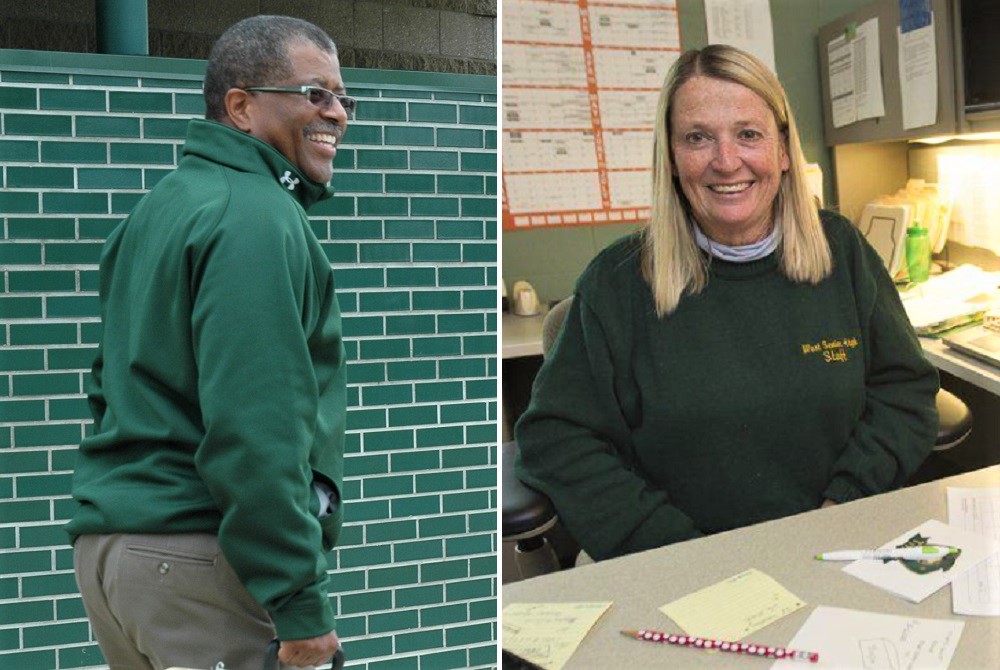
PHOTOS: Muskegon Orchard View athletic director Leroy Hackley Jr., left during his time at Jenison High, and retired Traverse City West athletic director and basketball coach Patti Tibaldi are the 2021 Charles E. Forsythe Award honorees. (Hackley photo by Rob Kaminski; Tibaldi photo courtesy of Traverse City Record-Eagle.)