

Casting Lines for Future Tournaments
August 12, 2016
By Jack Roberts
MHSAA Executive Director
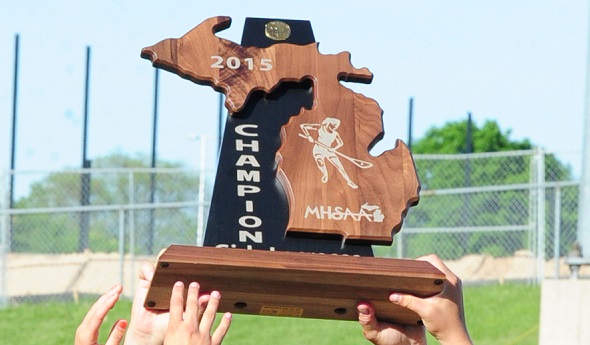
The MHSAA is best known to the public for the tournaments it conducts to conclude the fall, winter and spring seasons each school year.
These tournaments, the first and largest program of the MHSAA, have survived the Vietnam War, the Korean conflict and two World Wars. They have survived the technology bubble, the housing collapse, the energy crisis and the Great Depression.
MHSAA tournaments existed at the dawn of aviation and at the time of our nation’s lunar landing. Popes, presidents and governors have changed and changed again and again, and MHSAA tournaments roll on year after year.
But the sense of tradition and permanence and inevitability of MHSAA tournaments doesn’t dissuade us from asking questions about our tournaments, even some of the most basic questions. Here are two.
Question #1
I have long been and will always be an advocate for a Ryder Cup format for the MHSAA Golf Finals, and a team tennis approach to the MHSAA Tennis Finals; but 90 years of tradition is hard to overcome. Might this be a more exciting format? Could it be co-ed? Could it reverse the decline in boys tennis participation, and increase girls golf participation? Wouldn’t it be fun to try?
Periodically, the International Olympic Committee requires each of the designated Olympic sports to defend its status, to state its case why the sport should remain a part of the Olympic program. Then, after a series or votes that retain one sport at a time, the IOC drops the sport that makes the weakest case. It does so to make room for one of the previously unlisted sports that makes the best case for inclusion.
This would appear to keep the existing Olympic sports on their toes, and to keep the Olympic movement fresh and reflective of modern trends in sports.
While I would not enjoy the controversy, I can see the potential for some positive results if the MHSAA were to invoke the same policy for determining the 14 tournaments it will provide for girls and the 14 for boys.
This might cause us to consider more deeply what a high school sport should look like, or at least what an MHSAA tournament sport should stand for.
On the one hand, we might be inclined to drop tournaments for those sports that involve mostly non-faculty coaches and non-school venues, or require cooperative programs to generate enough participants to support a team, or resort almost entirely to non-school funding, or cater to individuals more than teams.
Or perhaps this process would cause policymakers to forget traditional thinking and ask: “In this day and age, should we shake off traditional notions of sport and consider more where modern kids are coming from?” That might mean fewer team sports and more individual sports, more “extreme” sports like snowboarding and skateboarding, and more lifetime sports, meaning not just golf and tennis and running sports, but also fishing and even shooting sports.
Currently, MHSAA policy states that the MHSAA will consider sponsorship of a tournament series for any sport which 64 member schools conduct on an interscholastic basis as a result of action by the governing boards of those schools.
Should the only question be how many schools sponsor a sport, or must an activity also have certain qualities and/or avoid certain “defects?” What should an MHSAA tournament sport look like and stand for?
Question #2
Bristling from criticism that his association is a money-grabbing exploiter of children, my counterpart in another state said, “If we were running our programs just to make money, we would do very many things very differently.” I knew exactly what he meant.
Because we care about the health and welfare of students, because we mean what we say that the athletic program needs to maximize the ways it enhances the school experience while minimizing academic conflicts, and because we try to model our claim that no sport is a minor sport when it comes to its potential to teach young people life lessons, we operate our programs in ways that make promoters, marketers and business entrepreneurs laugh, cry or cringe.
If money were the only object, we would seed and select sites to assure the teams that attracted the most spectators had the best chance to advance in our tournaments, regardless of the travel for any team or its fan base. If money were the only object, we would never schedule two tournaments to overlap and compete for public attention, much less tolerate three or four overlapping events. If money were the only object, we would allow signage like NASCAR events and promotions like minor league baseball games.
Those approaches to event sponsorship may not be all wrong; they’re just not all right for us. And we will live with the consequences of our belief system.
During a typical school year, more than 20 percent of the MHSAA’s 2,097 District, Regional and Final tournaments lose money. Not a single site in golf, skiing or tennis makes a single penny. In no sport did every District, Regional and Final site have revenue in excess of direct expenses.
In fact, in only three sports – boys and girls basketball and football – is revenue so much greater than direct expenses overall that it helps to pay for all the other tournaments in which the MHSAA invests.
That’s right: invests. When we present our budget to our board, we talk about the MHSAA’s investment in providing tournament opportunities in all those sports and all those places that cannot sustain the cost of those events on their own. How much is this investment worth to students, schools and society?
These two are core questions that require our focus far in advance of talk about scheduling, site selection, seeding and the myriad matters that too often hijack our time and attention.
Preview: Lowell Seeks to Run Title Streak to Great 8
By
Geoff Kimmerly
MHSAA.com senior editor
March 30, 2021
The success has become so familiar, and some of the names to match, it’s like Lowell has been sending out the same wrestlers the last eight years.
That’s not true or possible, of course. But more than a handful of current Red Arrows have played major roles in carrying on the program’s seven-year MHSAA Finals record championship streak.
Lowell is the top seed again as it seeks to make that eight in a row Tuesday at Wings Event Center. The Quarterfinal pairings are as follows:
Division 2 - 12:30 pm - The Arena
#1 Lowell vs. #8 Charlotte - Mat 2
#4 Monroe Jefferson vs. #5 Fremont - Mat 1
#3 Goodrich vs. #6 Warren Woods Tower- Mat 4
#2 Stevensville Lakeshore vs. #7 Allendale - Mat 3
Spectator limits remain in effect, but all matches will be broadcast live and viewable with subscription on MHSAA.tv. Below is a look at all eight teams competing in Division 2, listed by seed.
#1 LOWELL
Record/rank: 17-3, No. 1
League finish: First in Ottawa-Kent Conference White
Coach: R.J. Boudro, seventh season (134-21)
Championship history: Ten MHSAA championships (most recent 2020), six runner-up finishes.
Individual Finals qualifiers: 119 Ramsy Mutschler (21-4) jr., 125 Landon Miller (10-5) soph., 130 James Link (17-6) jr., 135 Zeth Strejc (17-3) sr., 145 Will Link (21-3) sr., 145 Tacho Gonzales (19-6) fr., 160 Doak Dean (21-2) sr., 160 Carson Crace (17-4) soph., 171 Jacob Lee (18-1) sr., 189 Derek Mohr (19-2) sr., 215 Carter Blough (21-2) jr., 285 Keegan Nugent (24-0) sr.
Outlook: Lowell’s Finals-record championship streak is at seven straight titles and counting. Half of last season’s championship match lineup returns for a team that also starts half seniors. The Red Arrows defeated No. 4 Middleville Thornapple Kellogg 50-22 in the Regional Final. Strejc (130) and Nugent (215) were individual runners-up last season, while Will Link (fourth at 140), Dean (fifth at 160) and Lee (third at 171) also placed.
#2 STEVENSVILLE LAKESHORE
Record/rank: 18-0, No. 3
League finish: First in Southwestern Michigan Athletic Conference
Coach: Bruce Bittenbender, 51st season (958-265-2)
Championship history: Class B runner-up 1994 and 1986.
Individual Finals qualifiers: 103 Taylor Lucas (17-5) jr., 119 Cameron Litaker (19-3) jr., 125 Aaron Lucio (19-0) soph., 125 Kyle Stampfly (16-6) jr., 140 Micah Hanau (21-0) jr.
Outlook: Lakeshore is seeded to contend for its first championship match berth since 1994, which would be another achievement for Bittenbender – the winningest coach in MHSAA wrestling history. The Lancers sandwiched a 28-point District win over St. Joseph with a couple of postseason nail-biters, defeating Paw Paw by one and Edwardsburg by three points. Hanau is the reigning individual champ at 130, while Lucio was third at 119 last season and Litaker was sixth at 112.
#3 GOODRICH
Record/rank: 16-0, No. 6
League finish: First in Flint Metro League
Coach: Kenneth Sirignano, 11th season (record N/A)
Championship history: Two MHSAA championships (most recent 2009), three runner-up finishes
Individual Finals qualifiers: 112 Brody Orcutt (19-2) fr., 119 Heremius Cheff (16-3) soph., 125 Ryan Angelo (15-8) jr., 135 Carson Richards (18-2) jr., 140 Easton Phipps (16-3) fr., 152 Brady Benson (19-4) soph., 189 Cameron Macklem (15-5) jr., 215 Zach Schmitz (10-8) sr.
Outlook: Goodrich was runner-up as recently as 2019, when it fell to Lowell by only six points in the Final. The Martians didn’t make it to Quarterfinals last season but return for the fourth time in six seasons and with a starting lineup featuring 10 underclassmen. Richards finished sixth at 140 at the Individual Finals last season.
#4 MONROE JEFFERSON
Record/rank: 12-2, No. 5
League finish: First in Huron League
Coach: Mike Humphrey, 18th season (349-154)
Championship history: Has never appeared in an MHSAA Final.
Individual Finals qualifiers: 103 Cody Richards (16-0) jr., 103 Issac Masserant (13-6) fr., 119 John Allen (14-2) soph., 125 Dylan Garcia (15-3) jr., 130 Hunter Major (16-3) sr., 135 Ethan Brabant (15-5) sr., 145 Seth Minney (14-5) soph., 152 Jac White (15-4) sr., 189 Brendan Bashaw (12-4) sr.
Outlook: Jefferson is making its second trip to the Quarterfinals and first since 1995. The Bears have won District titles three straight seasons, but their league title was the first since 2017. Ten upperclassmen bring experience to the starting lineup, with Richards a returning individual placer having come in sixth at 103 last season.
#5 FREMONT
Record/rank: 26-2, unranked
League finish: Second in Central State Activities Association
Coach: Craig Zeerip, seventh season (155-62)
Championship history: Has never appeared in an MHSAA Final.
Individual Finals qualifiers: 103 RJ Thome (31-0) jr., 112 Tee Ward (29-2) fr., 119 Eli Beasley (29-4) sr., 130 Trey Myers (26-4) fr., 160 Trey Breuker (30-2) sr., 189 Michael Romero (20-10) soph.
Outlook: Fremont reached the Quarterfinals last season for the first time, in Division 3, and repeated that achievement against larger competition this winter. The Packers have won all four of their postseason matches by at least 16 points. Thome was fifth at 103 last season, and Breuker was eighth at 152.
#6 WARREN WOODS TOWER
Record/rank: 13-8, No. 10
League finish: Third in Macomb Area Conference Red
Co-coaches: Greg Mayer, 21st season (402-258), Russell Correll, eighth season (165-62)
Championship history: Division 2 runner-up 2017.
Individual Finals qualifiers: 103 Tyler Daniel (16-7) jr., 125 Joe Haynes (19-1) sr., 130 Dru Wilson (13-5) sr., 135 Gavin Shoobridge (16-2) sr., 140 Mathew Booth (12-8) sr., 140 Josh Howey (21-1) jr., 152 Dominic Johnson (14-9) sr.
Outlook: The Titans have now reached the Quarterfinals six straight seasons, this time rolling through with every postseason win by at least 36 points. They will miss junior two-time individual champ Omari Embree (171, 17-1), who is out for this weekend, but return another champ in Haynes, last season’s 119 title winner. Also placing last season were Daniel (eighth at 103), Howey (eighth at 125), Wilson (fifth at 130) and sophomore Ryan Radvansky (160, 16-4), who was eighth at 160.
#7 ALLENDALE
Record/rank: 22-7, unranked
League finish: First in O-K Blue
Coach: Duane Watson, 33rd season (682-259)
Championship history: Has never appeared in an MHSAA Final.
Individual Finals qualifiers: 112 Harrison Meekhof (27-6) fr., 112 Jack Guerrero (26-7) fr., 135 Cris Perez (23-5) sr., 152 Jordan Silva (21-13) sr.
Outlook: After two seasons away, Allendale is back at the Quarterfinals for the third time in five years and with a fifth-straight league title and 14th-straight District championship. The team has four Individual Finals qualifiers, but eight wrestlers have won at least 22 matches this abbreviated season. Perez finished eighth at 130 in 2020.
#8 CHARLOTTE
Record/rank: 18-8, unranked
League finish: Second in Capital Area Activities Conference White
Coach: Korey Knapp, fourth season (63-47)
Championship history: Class B champion 1968, runner-up 1965.
Individual Finals qualifiers: 119 Jayden Schwartz (22-4) soph., 140 Logan Haughton (25-3) jr., 152 Bo Brandt (24-8) sr.
Outlook: Charlotte is returning to the Quarterfinals for the first time since 1990, and second time in program history. The Orioles defeated perennial power Eaton Rapids to win their District, then upset another annual force in No. 7 Mason at the Regional. Charlotte has had individual standouts over the years – their lone individual qualifier last season won a championship – but this week will also see the Orioles send triple that number to the Individual Finals.
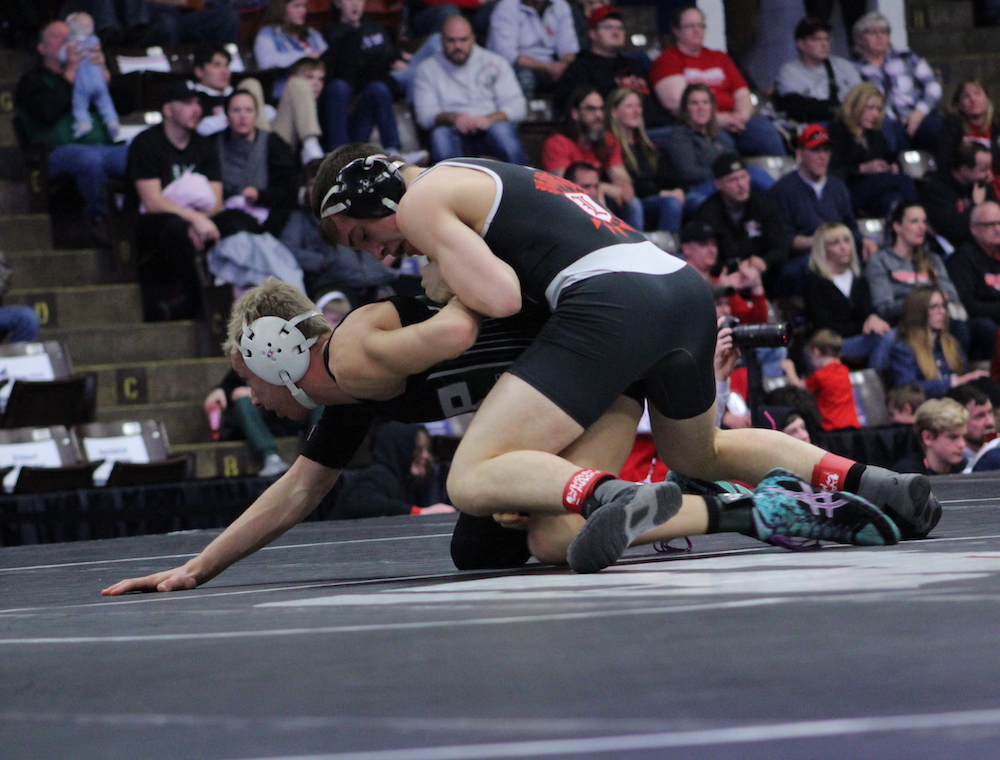
PHOTO: Will Link, right, works toward a pin during Lowell’s Semifinal win last season at Wings Event Center. (Click for more from HighSchoolSportsScene.com.)