

Casting Lines for Future Tournaments
August 12, 2016
By Jack Roberts
MHSAA Executive Director
The MHSAA is best known to the public for the tournaments it conducts to conclude the fall, winter and spring seasons each school year.
These tournaments, the first and largest program of the MHSAA, have survived the Vietnam War, the Korean conflict and two World Wars. They have survived the technology bubble, the housing collapse, the energy crisis and the Great Depression.
MHSAA tournaments existed at the dawn of aviation and at the time of our nation’s lunar landing. Popes, presidents and governors have changed and changed again and again, and MHSAA tournaments roll on year after year.
But the sense of tradition and permanence and inevitability of MHSAA tournaments doesn’t dissuade us from asking questions about our tournaments, even some of the most basic questions. Here are two.
Question #1
I have long been and will always be an advocate for a Ryder Cup format for the MHSAA Golf Finals, and a team tennis approach to the MHSAA Tennis Finals; but 90 years of tradition is hard to overcome. Might this be a more exciting format? Could it be co-ed? Could it reverse the decline in boys tennis participation, and increase girls golf participation? Wouldn’t it be fun to try?
Periodically, the International Olympic Committee requires each of the designated Olympic sports to defend its status, to state its case why the sport should remain a part of the Olympic program. Then, after a series or votes that retain one sport at a time, the IOC drops the sport that makes the weakest case. It does so to make room for one of the previously unlisted sports that makes the best case for inclusion.
This would appear to keep the existing Olympic sports on their toes, and to keep the Olympic movement fresh and reflective of modern trends in sports.
While I would not enjoy the controversy, I can see the potential for some positive results if the MHSAA were to invoke the same policy for determining the 14 tournaments it will provide for girls and the 14 for boys.
This might cause us to consider more deeply what a high school sport should look like, or at least what an MHSAA tournament sport should stand for.
On the one hand, we might be inclined to drop tournaments for those sports that involve mostly non-faculty coaches and non-school venues, or require cooperative programs to generate enough participants to support a team, or resort almost entirely to non-school funding, or cater to individuals more than teams.
Or perhaps this process would cause policymakers to forget traditional thinking and ask: “In this day and age, should we shake off traditional notions of sport and consider more where modern kids are coming from?” That might mean fewer team sports and more individual sports, more “extreme” sports like snowboarding and skateboarding, and more lifetime sports, meaning not just golf and tennis and running sports, but also fishing and even shooting sports.
Currently, MHSAA policy states that the MHSAA will consider sponsorship of a tournament series for any sport which 64 member schools conduct on an interscholastic basis as a result of action by the governing boards of those schools.
Should the only question be how many schools sponsor a sport, or must an activity also have certain qualities and/or avoid certain “defects?” What should an MHSAA tournament sport look like and stand for?
Question #2
Bristling from criticism that his association is a money-grabbing exploiter of children, my counterpart in another state said, “If we were running our programs just to make money, we would do very many things very differently.” I knew exactly what he meant.
Because we care about the health and welfare of students, because we mean what we say that the athletic program needs to maximize the ways it enhances the school experience while minimizing academic conflicts, and because we try to model our claim that no sport is a minor sport when it comes to its potential to teach young people life lessons, we operate our programs in ways that make promoters, marketers and business entrepreneurs laugh, cry or cringe.
If money were the only object, we would seed and select sites to assure the teams that attracted the most spectators had the best chance to advance in our tournaments, regardless of the travel for any team or its fan base. If money were the only object, we would never schedule two tournaments to overlap and compete for public attention, much less tolerate three or four overlapping events. If money were the only object, we would allow signage like NASCAR events and promotions like minor league baseball games.
Those approaches to event sponsorship may not be all wrong; they’re just not all right for us. And we will live with the consequences of our belief system.
During a typical school year, more than 20 percent of the MHSAA’s 2,097 District, Regional and Final tournaments lose money. Not a single site in golf, skiing or tennis makes a single penny. In no sport did every District, Regional and Final site have revenue in excess of direct expenses.
In fact, in only three sports – boys and girls basketball and football – is revenue so much greater than direct expenses overall that it helps to pay for all the other tournaments in which the MHSAA invests.
That’s right: invests. When we present our budget to our board, we talk about the MHSAA’s investment in providing tournament opportunities in all those sports and all those places that cannot sustain the cost of those events on their own. How much is this investment worth to students, schools and society?
These two are core questions that require our focus far in advance of talk about scheduling, site selection, seeding and the myriad matters that too often hijack our time and attention.
Country Day Delivers for Longtime Coach
January 22, 2021
By Jason Schmitt
Special for Second Half
DETROIT – As the final seconds ran off the clock during the Division 4 championship game Friday night at Ford Field, it all began to set in for Detroit Country Day senior Danny MacLean.
He finally got to see his dad, Yellowjackets’ head coach Dan, win an MHSAA Football Finals championship.
“I’ve been here five times now, we hadn’t won a game at Ford Field,” the younger MacLean said. “I was always the ball boy, the water boy out on the field. Now, senior year, coming out here and getting one for that guy, it means the world to me. It’s the best feeling in the world.”
Country Day defeated first-time finalist Cadillac, 13-0, picking up its third-straight shutout in these playoffs. The Yellowjackets last won a Finals championship in 1999, that coming in MacLean’s second year as the head coach at the school. His teams fell a win short in 2007, 2008, 2012, 2016 and again in 2019.
“I thought I couldn’t win in Ford Field. I was like, ‘Can we get the Silverdome back?,’” MacLean joked after the game. “It is very good to be back (winning). This was wonderful to do this, especially with this group of kids in particular. I said it many times this week. I was a single guy when I started at Country Day 36 years ago, and (Danny) is my youngest child of five, and it’s just a joy.”
MacLean’s children – Jack, Maureen, Mike, Kathleen and Danny – all graduated (or will) from Country Day. Each of the three boys played football for the Yellowjackets.
“He’s built a family around (Country Day),” Danny said.
MacLean and fellow senior Nick Wachol spearheaded a dominant Yellowjackets defense, which limited the Vikings to just 166 total yards. MacLean and Wachol each finished with a team-leading nine tackles. Wachol had three tackles for a loss to go along with two sacks. MacLean had a key interception late in the second quarter, helping to keep Cadillac off the scoreboard just before halftime.
 “We’ve been riding our defense all year,” Coach MacLean said. “They just have a tremendous amount of pride, and they just do their job. I would be remiss if I didn’t mention my coaches. John Wilson, Steve Mann, who’s been with us a long time. Dave Furlong and Jake Topp, who was really instrumental tonight. He is more of an offensive guy in certain ways, but he designed that scheme to stop their option and the kids executed.”
Cadillac used five running backs in the game, along with junior quarterback Aden Gurden, who led the team with 14 carries. Junior Collin Johnston led the Vikings with 53 yards rushing, while sophomore Kaleb McKinley and Gurden added 39 and 37, respectively.
Coach Cody Mallory’s team moved the ball at times against Country Day’s stout defense, but couldn’t finish when it needed to.
“Their defense is very good; they’re very physical,” Mallory said. “I felt like this was the first time all year that we haven’t been able to move the ball. Even in our losses prior to this, we were able to get things going on offense. Country Day was extremely physical up front and very fast on the back end.”
Country Day opened its scoring with a pair of Graham Doman field goals in the second quarter. The first came with 11:09 to play in the half, as Cadillac’s defense turned the Yellowjackets away and forced them to settle for a 19-yard field goal. Same thing happened later in the second quarter, as the Vikings’ red-zone defense forced Country Day to kick a 26-yard field goal with 3:42 left before the break.
The Yellowjackets’ offense scored its lone touchdown of the game with a 12-play drive which took 6:33 off the clock to open the third quarter. Four Country Day players ran the ball, with freshman Gabe Winowich capping things off with a four-yard touchdown to give his team a 13-0 lead.
From there, the defense took over for the Yellowjackets. Cadillac had just six possessions in the game. The Vikings punted twice, turned the ball over on downs twice, threw the interception to MacLean, with the sixth possession ending at halftime. Senior Joe Miller collected eight tackles in the win, while juniors Caleb Mathis-Miller and Brandon Mann each added six.
Offensively, Country Day just wore Cadillac down. Junior Parker Yearego had 12 carries for 71 yards, and Mann had 11 more for 40 yards. In all, the Yellowjackets rushed the ball 36 times. Mann was also 11-for-14 passing for 106 yards.
“If you can keep the ball away from them, then they get frustrated,” MacLean said. “They like to bleed the clock. We kind of flipped the script on them. The key was our defense allowed us to get them off the field at times.”
While Country Day was making its ninth trip to the championship game, it was Cadillac’s first time playing for a title. Mallory was proud of the way his team battled Friday night and excited his program could proudly represent northern Michigan.
“I feel like football up north does get overlooked a bit,” Mallory said. “I’m really happy our conference had two teams go deep in the playoffs. That says a lot about where football is up there.”
Mallory said it was a great learning experience for his team.
“It takes failure for you to grow,” Mallory said. “While there were a lot of successes to get us to this point, in this game, we fell short and we’re going to have to grow.”
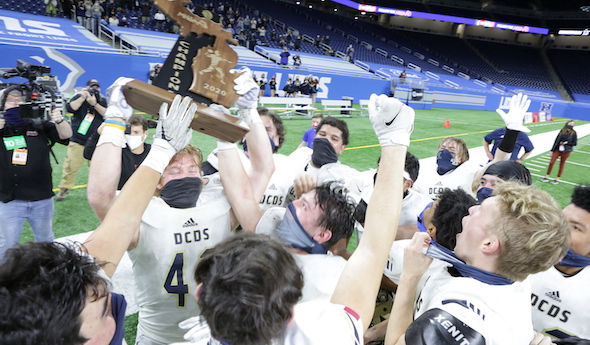
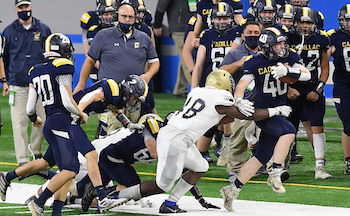
PHOTOS: (Top) Danny MacLean raises the trophy as Detroit Country Day celebrates its Division 4 championship Friday. (Middle) Country Day’s Caleb Mathis-Miller (48) helps drive Cadillac’s Collin Johnston out of bounds. (Click for more from Hockey Weekly Action Photos.)