

Casting Lines for Future Tournaments
August 12, 2016
By Jack Roberts
MHSAA Executive Director
The MHSAA is best known to the public for the tournaments it conducts to conclude the fall, winter and spring seasons each school year.
These tournaments, the first and largest program of the MHSAA, have survived the Vietnam War, the Korean conflict and two World Wars. They have survived the technology bubble, the housing collapse, the energy crisis and the Great Depression.
MHSAA tournaments existed at the dawn of aviation and at the time of our nation’s lunar landing. Popes, presidents and governors have changed and changed again and again, and MHSAA tournaments roll on year after year.
But the sense of tradition and permanence and inevitability of MHSAA tournaments doesn’t dissuade us from asking questions about our tournaments, even some of the most basic questions. Here are two.
Question #1
I have long been and will always be an advocate for a Ryder Cup format for the MHSAA Golf Finals, and a team tennis approach to the MHSAA Tennis Finals; but 90 years of tradition is hard to overcome. Might this be a more exciting format? Could it be co-ed? Could it reverse the decline in boys tennis participation, and increase girls golf participation? Wouldn’t it be fun to try?
Periodically, the International Olympic Committee requires each of the designated Olympic sports to defend its status, to state its case why the sport should remain a part of the Olympic program. Then, after a series or votes that retain one sport at a time, the IOC drops the sport that makes the weakest case. It does so to make room for one of the previously unlisted sports that makes the best case for inclusion.
This would appear to keep the existing Olympic sports on their toes, and to keep the Olympic movement fresh and reflective of modern trends in sports.
While I would not enjoy the controversy, I can see the potential for some positive results if the MHSAA were to invoke the same policy for determining the 14 tournaments it will provide for girls and the 14 for boys.
This might cause us to consider more deeply what a high school sport should look like, or at least what an MHSAA tournament sport should stand for.
On the one hand, we might be inclined to drop tournaments for those sports that involve mostly non-faculty coaches and non-school venues, or require cooperative programs to generate enough participants to support a team, or resort almost entirely to non-school funding, or cater to individuals more than teams.
Or perhaps this process would cause policymakers to forget traditional thinking and ask: “In this day and age, should we shake off traditional notions of sport and consider more where modern kids are coming from?” That might mean fewer team sports and more individual sports, more “extreme” sports like snowboarding and skateboarding, and more lifetime sports, meaning not just golf and tennis and running sports, but also fishing and even shooting sports.
Currently, MHSAA policy states that the MHSAA will consider sponsorship of a tournament series for any sport which 64 member schools conduct on an interscholastic basis as a result of action by the governing boards of those schools.
Should the only question be how many schools sponsor a sport, or must an activity also have certain qualities and/or avoid certain “defects?” What should an MHSAA tournament sport look like and stand for?
Question #2
Bristling from criticism that his association is a money-grabbing exploiter of children, my counterpart in another state said, “If we were running our programs just to make money, we would do very many things very differently.” I knew exactly what he meant.
Because we care about the health and welfare of students, because we mean what we say that the athletic program needs to maximize the ways it enhances the school experience while minimizing academic conflicts, and because we try to model our claim that no sport is a minor sport when it comes to its potential to teach young people life lessons, we operate our programs in ways that make promoters, marketers and business entrepreneurs laugh, cry or cringe.
If money were the only object, we would seed and select sites to assure the teams that attracted the most spectators had the best chance to advance in our tournaments, regardless of the travel for any team or its fan base. If money were the only object, we would never schedule two tournaments to overlap and compete for public attention, much less tolerate three or four overlapping events. If money were the only object, we would allow signage like NASCAR events and promotions like minor league baseball games.
Those approaches to event sponsorship may not be all wrong; they’re just not all right for us. And we will live with the consequences of our belief system.
During a typical school year, more than 20 percent of the MHSAA’s 2,097 District, Regional and Final tournaments lose money. Not a single site in golf, skiing or tennis makes a single penny. In no sport did every District, Regional and Final site have revenue in excess of direct expenses.
In fact, in only three sports – boys and girls basketball and football – is revenue so much greater than direct expenses overall that it helps to pay for all the other tournaments in which the MHSAA invests.
That’s right: invests. When we present our budget to our board, we talk about the MHSAA’s investment in providing tournament opportunities in all those sports and all those places that cannot sustain the cost of those events on their own. How much is this investment worth to students, schools and society?
These two are core questions that require our focus far in advance of talk about scheduling, site selection, seeding and the myriad matters that too often hijack our time and attention.
Preview: Past Champs Back in Running
November 5, 2020
By Geoff Kimmerly
Second Half editor
The first runners down the home stretch at Michigan International Speedway this weekend could look familiar for at least three divisions of the MHSAA Lower Peninsula Girls Cross Country Finals.
The fourth? That’s guaranteed to finish much differently than a year ago.
Reigning champions are expected to set the pace again in Divisions 1, 2 and 3. But Division 4 will be another story entirely, as the reigning team and individual champions are running in Division 3 this time.
A change in format also will switch things up a bit. To limit the number of participants in each race, the four divisions will be run over two days – Friday and Saturday – with each gender in each division spread over two races. Third-place teams and individual qualifiers from Regionals will run first, and first and second-place Regional finishers will run second.
Watching this year’s Finals at MIS also will be different. Attendance is limited due to COVID-19 precautions, but opportunities to watch off-site are available again via MHSAA.tv. Coverage will be enhanced this year with an additional camera on the back of the course to better capture the first 800 meters, 1.5-mile and 2.25-mile marks of the race. The traditional Finish Line camera also will cover the action, with commentary from a crew of announcers.
Here’s the schedule, with links to broadcasts of each race:
Friday – Nov. 6
Division 1 Finals - Boys at 9:30 and 10 a.m. - Girls at 11 and 11:30 a.m.
Division 2 Finals - Boys at 1:30 and 2 p.m. - Girls at 3 and 3:30 p.m.
Saturday – Nov. 7
Division 3 Finals - Boys at 9:30 and 10 a.m. - Girls at 11 and 11:30 a.m.
Division 4 Finals - Boys at 1:30 and 2 p.m. - Girls at 3 and 3:30 p.m.
Come back both Friday and Saturday for coverage of all four meets on Second Half, and see below for teams and individuals who should be in the running. References to a list of fastest times per division this fall includes only the top time for each runner and can be found with the Finals program and much more information on or linked to MHSAA.com.
Division 1
Reigning champion: Ann Arbor Pioneer
2019 runner-up: Traverse City Central
2020 top-ranked: 1. Traverse City Central, 2. Ann Arbor Pioneer, 3. Holland West Ottawa
This could come down to Pioneer and Central again after the Pioneers edged the Trojans 80-113 at the top of the standings of last year’s Final. Pioneer graduated last season’s individual champion Zofia Dudek and total two of its top five but is keyed by a Regional champion freshman in Rachel Forsyth, while Central brings back five of last season’s top six who are joined by a pair of standout freshmen. Trojans junior Julia Flynn didn’t run at her team’s Regional but has the fastest time in Division 1 this fall at 16:51.27 and finished third at the Final a year ago. Pioneer junior Sarah Forsyth was ninth at the Final in 2019, and Central senior Avery McLean was 17th. West Ottawa is expected to move up from seventh last season as it pursues its first Finals championship, anchored by Arianne Olson – the individual runner-up last season as a freshman.
Individuals: Although Dudek graduated, 14 of last season’s top 20 finishers will reload the field. Following Olson and Flynn last year was Saline now-junior Madi Wood in fourth and Birmingham Seaholm now-senior Audrey DaDamio in fifth, with Novi now-senior Elizabeth Babcock in seventh. Those five finished within 17 seconds of each other, and DaDamio’s season-best 17:16.40 is the second-fastest time in Division 1 this fall. Also back from last season’s top 20 are Forsyth, Plymouth junior Lauren Kiley (11th), Grand Rapids Ottawa Hills senior Madison Ebright (12th), Lake Orion senior Sophie Novak (13th), East Lansing senior Abbie Draheim (14th), McLean, Plymouth senior Londyn Swenson (18th), Northville senior Yasmine Mansi (19th) and Ottawa Hills’ junior Adit Dau (20th). Two more freshmen – Grand Rapids Forest Hills Central’s Clara James-Heer and Macomb Dakota’s Jayden Harberts – have posted times among the 10 fastest in Division 1 this fall.
Division 2
Reigning champion: East Grand Rapids
2019 runner-up: Petoskey
2020 top-ranked: 1. East Grand Rapids, 2. Petoskey, 3. Grand Rapids Christian
Like in Division 1, last season’s top finishers are expected to push for the championship again – East Grand Rapids for the third straight season and Petoskey attempting to win for the first time. The Pioneers won the race at the top in 2019 36-92, placing five of the top 14 individuals but graduating two last spring including champion Anna Petr. At the same time, freshman Drew Muller, junior Ainsley Workman and senior Hannah Bodine have posted times among the 11 fastest in Division 2; Bodine was seventh and Workman 10th at the Final last season. Petoskey senior Emma Squires has the fastest time in Division 2 (17:26.70), with senior Cambrie Smith fifth (18:07,60), senior Sarah Liederbach 12th and junior Noel Vanderwall 13th – Squires was fifth at the 2019 Final, Liederbach was 20th and Vanderwall was 27th. Grand Rapids Christian finished 12th last season but has three titles and a runner-up finish over the last decade and one of the fastest individuals in junior Madelyn Frens, who edged Muller by just more than a second at their league’s championship race and was sixth at her most recent Finals in 2018.
Individuals: Squires, Bodine and Workman are the only top-10 finishers from 2019 back in the field, but six more return who came in 13-20th – Plainwell sophomore Grace Pettit (13th), Whitehall junior Ryann Jibson (15th), Lansing Catholic sophomore Hannah Pricco (16th), Freeland junior Kiera Hansen (17th), Otsego junior Joy Wolfe (18th) and Liederbach, with two more currently scratched for this weekend's race. Cadillac junior Kendall Schopieray was 47th last year but has the sixth-fastest time in Division 2 this fall. A trio of freshmen as well should make a massive impact on the individual standings: Muller, along with Mason’s Meghan Ford and Frankenmuth’s Mary Richmond. Ford’s best of 17:36.40 ranks second in Division 2 this season, and Richmond’s best is seventh on the list. Shepherd senior Madde Skeel, who ran 20th in Division 3 last season, also is in this field.
Division 3
Reigning champion: Hart
2019 runner-up: Shepherd
2020 top-ranked: 1. Hart, 2. Grandville Calvin Christian, 3. Benzie Central
Hart is hoping to become the fourth Lower Peninsula girls cross country program to win four consecutive Finals, and the Pirates remain formidable coming off a Regional where they took the top four places. Freshman Alyson Enns (17:46.75) ranks fifth on the list of fastest Division 3 times this fall, with senior Savannah Ackley (4th), junior Audrienna Enns (5th) and senior Lynae Ackley (14th) the team’s top three finishers from last season’s impressive win. Calvin Christian is looking to make a jump from third last season, when now-junior Leanne Krombeen led the way with a 19th-place individual finish. Senior teammate Catherine Kortman also has been among Division 3’s fastest this fall. Benzie Central was seventh last season and is led by standout freshman Mylie Kelly joining four of the team’s top five Finals finishers from 2019.
Individuals: A fast returning field will be bolstered even more by another two-time champion. Stockbridge junior Rylee Tolson won Division 3 last season and is back, and Muskegon Western Michigan Christian junior Abby VanderKooi is in Division 3 this weekend after winning Division 4 the last two years. She has the fastest Division 3 time this fall at 16:48.71. Ithaca junior Lani Bloom, Roscommon junior Allison Chmielewski and Jackson Lumen Christi junior Faith Smith have the next three fastest times, respectively, and the finished 18th, third and 22nd in 2019. Other top-20 finishers from last season running again are Boyne City sophomore Ava Maginity (7th), Harbor Springs junior Maye Burns (8th), St. Louis junior Libby Munderloh (10th), New Lothrop junior Clara Krupp (11th), Reed City senior Abbigail Kiaunis (13th) and Kent City senior Layla Martini (16th). Bridgman senior Karsyn Stewart, who set the pace for her team's Division 4 championship last fall by coming in sixth, is running in Division 3 as well.
Division 4
Reigning champion: Bridgman
2019 runner-up: Mount Pleasant Sacred Heart
2020 top-ranked: 1. Lansing Christian, 2. Hillsdale Academy, 3. Beal City
Lansing Christian and Hillsdale Academy are running for what would be a first championship, while Beal City is hoping to add a third after topping Division 4 back-to-back in 2013 and 2014. The Pilgrims didn’t qualify for the Finals as a team last season, but did enjoy a third-place individual finish from now-senior Madison Volz, a 20th by now-sophomore Ashlyn Kephart and a 35th place by now-senior Natalie Tebben. Those three rank among the top 19 in Division 4 this fall. Hillsdale Academy is looking to move up from fourth in 2019 with sophomore Megan Roberts again among the division’s fastest after placing 22nd individually a year ago. The Aggies will follow a speedy 1-2 punch of sophomore Kaylee Locke and junior Rachal Weber, who crossed eighth and 10th, respectively, last season as the team finished 17th. Sophomore Tailor Onstott also has run among the leaders this season.
Individuals: This field opens up with VanderKooi running in Division 3. Volz is the highest-placing returnee and also finished second in Division 4 as a sophomore and fifth as a freshman. Maple City Glen Lake junior Makenna Scott (18:42.84) has the fastest time in Division 4 this fall and finished fourth at the 2019 Final, and Buckley freshman Aiden Harrand (18:43.07) surely will be in the mix with the second-fastest time in Division 4, just ahead of the best by Volz (18:47.37). Concord senior Skylar Thompson was fifth last season and ranks fifth on this year’s fastest times list, with Westland Huron Valley sophomore Erika Van Loton fourth this season and coming off a seventh-place 2019 finish. Also back from last season’s top 20 are Mayville senior Haley Rowbotham (9th), Sacred Heart sophomore Olivia Ervin (12th), Gaylord St. Mary freshman Miriam Murrell (14th), Brethren senior Alexis Tracy (15th) and Harbor Beach senior Makara Kramer (19th).
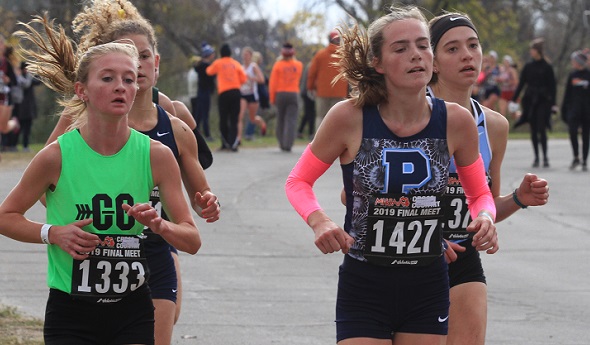
PHOTO: Petoskey's Emma Squires (1427) leads a pack through the middle of last season's Division 2 championship race at Michigan International Speedway. (Click for more from RunMichigan.com.)