

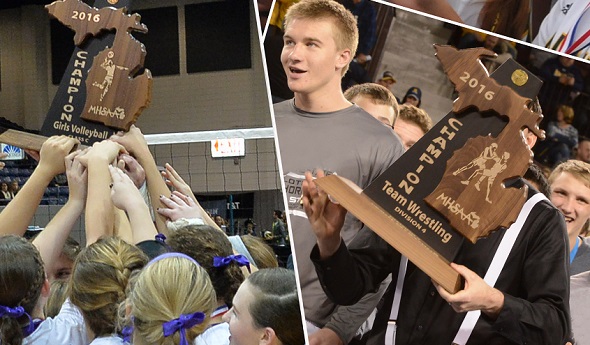
Class in Session: A History in Classification
July 24, 2017
By Rob Kaminski
MHSAA benchmarks editor
This is the first part in a series on MHSAA tournament classification, past and present, that will be published over the next two weeks. This series originally ran in this spring's edition of MHSAA benchmarks.
Conversation and discussion at the March 2017 MHSAA Representative Council Meeting leaned heavily toward the subject of 8-Player Football and how to properly balance its tournament with the growing number of schools sponsoring the sport.
While the proposal to split the tournament into two divisions beginning with the 2017 school year was adopted, the MHSAA then faced questions such as when to set the divisions, how to determine qualifiers and where to host the championship games.
The topic continues to create a buzz in Class D schools across both peninsulas, and likely will do into the start of school this fall.
Likewise, the lone holdouts still conducting tournaments by class – MHSAA Boys and Girls Basketball and Girls Volleyball – took center stage at the May Council discussion, and following the 2017-18 school year, class is out for good. Both genders of basketball, and girls volleyball, will move to divisional formats thereafter.
There is much to be decided to be sure; but as those in education are well aware, history is the best teacher.
Fortunately for the sports in flux and for all sports under the governance of the MHSAA, the Association more or less wrote the book on the subject of sport classification. Following is a history lesson, with a little advanced division thrown in.
Class structure
Credited with being the first state with multiple tournament classifications, Michigan’s attention to trends and shifts in philosophy aimed at fair play and equal tournament opportunity can be traced from 80 years ago to the present.
In the earliest years of the MHSAA, there were four classifications for elections and tournaments – Classes A, B, C and D. Classes C and D had far more schools than Classes A and B. For example, 80 years ago (1937), there were only 58 schools in Class A, 94 schools in Class B, 297 schools in Class C and 253 schools in Class D.
Gradually through the years, as Michigan’s major cities spawned suburbs, there was a shift in the other direction to the point 30 years ago (1987) when school size became more balanced: 173 Class A schools, 178 Class B schools, 179 Class C schools and 182 Class D schools.
Up until 1987, the MHSAA published the dividing line between each classification, after which schools submitted their enrollments. Then, for 1988 and thereafter, the MHSAA adopted the plan of gathering all enrollments first and then placing 25 percent of the schools in each of four classes. This completed the equalization of the number of schools in each class for elections.
However, the change for 1988 did nothing to equalize the number of teams actually entered by each class in each sport. And unlike the early years of the Association when there were many more Class C and D teams than A and B teams, there were more Class A and B teams than C and D teams entering MHSAA tournaments decades later.
Moreover, the difference in number of teams entered in the different classifications for a sport continued to increase as many small schools, the fastest growing portion of the MHSAA's membership, sponsor only a few sports, or they sponsor no sports at all but enter into cooperative programs with other schools.
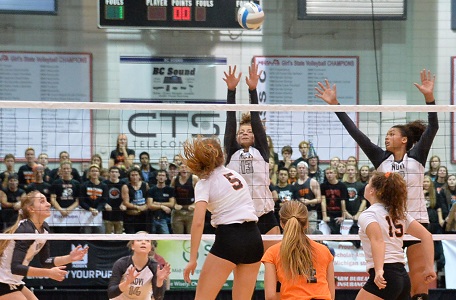 Because of these differences, Class A or B schools sometimes had to win twice as many games as Class C or D schools to reach the MHSAA Finals in a sport. At times, the larger classifications had District Tournaments, even rat-tail games, and/or a Quarterfinal game, and the smaller classifications did not. Most Class D Districts have had four teams (some only three), while Class A Districts often had seven or eight teams. In Regional levels of individual sports, the number of entries in the larger classification once greatly outnumbered those in the smaller classifications of the tournament for the same sport.
Over the years, these dividing lines between classes escalated gradually, as did the differences in enrollments of largest and small schools in each class. In 1937 the dividing lines were 700, 300 and 100 between Class A and B, B and C, and C and D, respectively. By 1987, the dividing lines were 1,129, 571 and 298, respectively, leading to the current method of collecting enrollments and then setting the classification.
With the pendulum swinging well past center by the late 1980s, coaches associations, MHSAA sport committees, tournament managers and school administrators began discussion and offered proposals to correct what many believed had become a flawed system of MHSAA tournament classification.
At the 1996 MHSAA Update Meetings, ¾ of 858 respondents to that year’s annual survey indicated they favored a system that would divide schools which actually sponsor each sport into two, three or four nearly equal divisions.
Problem solving
At its meeting May 4-6, 1997, the Representative Council defeated a motion that would have adopted in one action a coordinated plan of reclassification for all sports to equalize the number of schools in each tournament for each respective sport. Instead, the Council discussed and voted on each proposal that had been presented from sport committees.
This resulted in the Representative Council adopting four equal divisions for baseball and softball, four equal divisions for boys and girls tennis, four equal divisions for boys soccer and three equal divisions for girls soccer, effective with the 1997-98 school year. Helping in the decision was the success of the 1995-96 MHSAA Wrestling season, which saw the sport move to four divisions for its tournament structure
The Council delayed action on similar proposals for football and boys golf at that time to glean additional input. The same decision was made with respect to a proposal from the Ice Hockey Committee that would have split the Class A schools in two divisions and left the Class B/C/D Tournament unchanged.
“The gist of the move from classes to divisions was to equalize the path to championships for students of all schools, regardless of the size of those schools,” said MHSAA Executive Director Jack Roberts.
While the restructuring accomplished that goal for the majority of competitors, opposition exists now as it did then. The primary argument in opposition to the changes is that, in some sports, it increases the range between largest and smallest schools in the division for smallest schools, even as the range is usually reduced for other divisions.
Larger schools offered a counterpoint.
“The larger schools suggested that while they may have more students, they also attempt to sponsor more sports than the smaller schools, in some cases spreading the enrollment as thin as a much smaller school with fewer sports,” Roberts said.
“Even today, the idea of four equal divisions can be unpopular among some Class D schools which feel especially burdened by the equal division concept,” Roberts said. “There was enough opposition in 1997 that equal divisions were rejected for boys and girls basketball and girls volleyball, and some of that opposition remains.”
The numbers of schools sponsoring each MHSAA tournament are still close to the totals today, with the exception of soccer in both genders, which has enjoyed substantial increases. This spring, 466 girls teams were scheduled to compete in the MHSAA Soccer Tournament, while 473 boys teams will suit up this fall.
Since the beginning of MHSAA divisions in 1996 with wrestling, 147 additional team champions have been crowned and countless individuals have known the thrill of victory due to an extra level of Finals in various sports. Girls soccer has seen the most growth in opportunity, moving from two classes in 1987 to three divisions the following year, and then four divisions in 2000. Boys soccer had enjoyed four classes for two years prior to the new four-division format, and it was the sport of soccer that helped to create a caveat in the nearly equal division movement.
Lower Peninsula boys and girls swimming & diving expanded from two to three divisions in 2008, while boys and girls bowling are the most recent sports to enjoy increased tournament opportunity, adding a fourth division in 2010.
“Fairness is in the eye of the beholder. While having the same number of schools in each division is one kind of fairness, holding in check the enrollment range between the largest and smallest schools in Division 4 is another kind of fairness that is dear to a great number of people,” Roberts said. “Because more schools sponsor basketball and volleyball than other sports, Class D schools would have been least affected by the equal divisions concept in those sports; but that, and ‘tradition,’ did not dissuade the opponents in the 1990s.”
The shift to divisions not only paved the way for student-athletes, but also assisted administrators and schools hosting tournaments. MHSAA tournament mangers looked to equal divisions to more closely equalize the number of schools in District or Regional Tournaments and to better equalize the length of day required for these rounds of tournaments, both for management and participating teams and individuals.
Pinning down an answer
Wrestling became the first MHSAA Tournament to be conducted in nearly equal divisions when team and individual champions were crowned in Divisions 1, 2, 3 and 4 rather than Classes A, B, C/D for the 1996 winter championships.
The movement was well received, as schools saw more opportunity for success: four champions where there once were three at the District, Regional and Final levels, and a smaller range of enrollment between the smallest and largest school in all four tournaments, leading to the impetus for the Fall 1996 Update Meeting Survey of schools regarding similar movement in other sports.
Team champions that year were Holt (D1), Petoskey (D2), Middleville Thornapple Kellogg (D3) and Dundee (D4).
Getting their kicks
When the "equal divisions" concept was approved by the Representative Council for most MHSAA Tournaments for the 1997-98 school year, there was opposition from the smallest schools which, under the equal divisions, are forced to play against larger schools than reside in Class D. Compelling arguments were made – and still are – that an enrollment difference between schools with smaller enrollments (e.g., Class D) is more difficult to overcome in athletic competition than an even larger enrollment difference between schools with larger enrollments (e.g., Class A).
The opposition was most intense in soccer because of the number of students needed to field a team and the physical nature of the sport. As a result, from 2000-01 through 2010-11, soccer operated with a “20-percent modification.” This placed 20 percent of all schools that actually sponsored soccer in Division 4, and the remaining 80 percent were placed equally in Divisions 1, 2 and 3.
At the time the 20 percent modification was adopted, it was also established that soccer would return to four equal divisions when the largest Division 4 soccer school had an enrollment equal to or smaller than the mid point for Class C schools. That occurred in 2010.
Last class on the schedule
In the same volume of “history being the best teacher,” one can also find the adage, “times change.” While the division format was a welcome change in some sports, others were left to hold class without change.
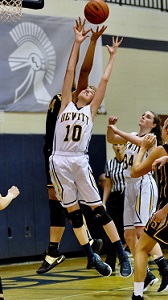 In the sports of boys and girls basketball, and girls volleyball, the number of schools sponsoring the sports were so close to the overall membership of the MHSAA that divisions were not necessary; the enrollment breakdowns themselves were enough to delineate equal opportunity for tournament success.
That is no longer the case, according to MHSAA membership. The last move from classes to divisions occurred for the 2006-07 school year following Council action. Before this May, that is. Action at the most recent Representative Council meeting, May 2017, called for the shift to divisions for MHSAA Boys and Girls Basketball, and Girls Volleyball, beginning with the 2018-19 season.
“Because the MHSAA Volleyball Committee had requested this change several times a number of years ago, and because the Council felt the change inevitable, there should not be further delay,” Roberts said. “It is an important detail that the Class D maximum has dropped 50 students over the past decade so the objection that much larger schools would be competing in Division 4 isn’t very strong now.”
Using the 2017-18 enrollment figures, just eight Class C schools would be competing in Division 4 for boys basketball, 11 for girls basketball and 14 for girls volleyball.
Good things came of the previous most-recent switches in 2006-07. Competitive Cheer was re-classified from Class A, B and C-D into four equal divisions assisting in the rapid growth of sponsoring schools (approximately 80 schools per division). Alpine skiing was changed from Class A and B-C D to two equal divisions.
At that time, the MHSAA Basketball Committee had recommended to the Council the study of increased classifications, but status quo remained.
Back on the grid
As such, MHSAA Basketball and Volleyball remained the only holdovers of the MHSAA class structure. Discussion resurfaced periodically during the last two decades to bring those tournaments in line with the other MHSAA sports.
Regular-season football-playing schools are separated by class, then are reshuffled by divisions for the playoffs. Football, as we know, underwent a significant postseason facelift in the late 1990s.
While MHSAA Football also remained a class sport through 1998, it had expanded from four to eight classes from 1990-98, becoming the first MHSAA sport to crown more than four team champions. Member schools were asked to consider a pair of options in November of 1997. One called for eight equal divisions, and the second would leave Class D by itself as division 8, and split Class A, B and C schools into seven nearly equal divisions.
After much discussion, retooling, and crunching of formulas, the MHSAA unveiled its revised Football Playoff model that continues to roll today, nearly 20 years later. It was determined that 256 teams would qualify for the tournament based first on a minimum of six wins, then by Playoff Points determined by formula. From there, the field would be divided into eight divisions, with the field being filled out by a nearly equal number of five-win teams in each division as needed to reach 256.
Eight championships would indeed be enough, until football sponsorship among the MHSAA’s smallest schools – some with rich football traditions – began to trend downward. The MHSAA again went to the drawing board, examining the viability of 8-player football. After an experimental year in 2010 without a tournament, the 8-player game was playoff-ready for 2011, with a field of 16 qualifiers embarking on a four-week tournament.
Not only did the 8-player option restore recently canceled programs, but it also created teams in schools which previously had none, and convinced some 11-player schools that this new division was the best path to take.
What did this do for the Class D holdovers staying in the traditional 11-player game? Well, a couple of things, positive and negative. As two and three dozen Class D schools opted for the 8-player game, the remaining 11-player Class D schools at times found themselves in disrupted leagues and had to travel further to complete schedules. They also competed against larger teams in Division 8 of the 11-player MHSAA Football Playoffs.
However, the growth of the 8-player game among the smallest schools also resulted in more Class D schools qualifying for the MHSAA Football Playoffs than ever before. In 2012, an all-time high 44 percent of Class D schools sponsoring football qualified for either the 8-player tournament or Division 8 of the 11-player tournament. That compared to 42.2 percent of Class C schools, 44.9 percent of Class B schools and 41.6 percent of Class A schools which qualified for the 2012 playoffs.
Much is to be determined in the most recent chapter of MHSAA Tournament expansion as the 8-Player Football Playoffs welcome a second division. As the past illustrates, there will be pluses and minuses. History also shows that the MHSAA has received maximum input from its constituents, researched all possibilities, and will find solutions to questions still in the balance before an additional group of athletes hoists a new trophy in November.
Through the Years
A chronology of when which sports moved from Class to Division in the MHSAA.
1995-96: LP Wrestling
1997-98: Baseball, Boys Soccer, Girls Soccer, Softball, LP Girls Tennis, LP Boys Tennis
1998-99: LP Boys Golf, LP Girls Golf
1999-2000: Ice Hockey, LP Boys Track & Field, LP Girls Track & Field
2000-01: LP Boys Cross Country, LP Girls Cross Country, UP Boys Cross Country, UP Girls Cross Country, UP Boys Golf, UP Girls Golf, UP Boys Tennis, UP Girls Tennis, UP Boys Track & Field, UP Girls Track & Field
2002-03: LP Girls Swimming & Diving, LP Boys Swimming & Diving
2005-06: Boys Bowling, Girls Bowling
2006-07: Girls Competitive Cheer, Boys Skiing, Girls Skiing
2018-19: Boys Basketball, Girls Basketball, Girls Volleyball
Note: Boys and Girls Lacrosse has been a divisional sport since it began in during the 2004-05 school year.

2023 Scholar-Athlete Award Recipients Announced in Class A
By
Geoff Kimmerly
MHSAA.com senior editor
February 21, 2023
The Michigan High School Athletic Association has selected 14 student-athletes from Class A member schools to receive scholarships through the MHSAA/Farm Bureau Insurance Scholar-Athlete Award program.
 Farm Bureau Insurance, in its 34th year of sponsoring the award, will give $2,000 college scholarships to 32 individuals who represent their member schools in at least one sport in which the Association sponsors a postseason tournament. The first 30 scholarships are awarded proportionately by school classification and the number of student-athletes involved in those classes; also, there are two at-large honorees who can come from any classification.
Students applying for the Scholar-Athlete Award must be carrying at least a 3.5 (on a 4.0 scale) grade-point average and have previously won a letter in a varsity sport in which the Michigan High School Athletic Association sponsors a postseason tournament. Other requirements for the applicants were to show active participation in other school and community activities and produce an essay on the importance of sportsmanship in educational athletics.
The 32 scholarship recipients will be recognized March 25 during the MHSAA Boys Basketball Finals at the Breslin Student Events Center in East Lansing.
The Class A Scholar-Athlete Award honorees are Jane Barnett, Royal Oak; Ella Blank, Birmingham Groves; Nora Chamas, Dearborn; Caroline Colt, Milford; Abby Frushour, DeWitt; Naomi Sowa, East Lansing; Keira Tolmie, Clarkston; James Baer, Holland; Brendan Downey, Grosse Pointe South; Ryan Lee, Grand Rapids Forest Hills Northern; Shubhan Nagarkar, Midland Dow; Shane Pitcher, Saline; Isaac Postema, Grand Haven; and Ian Robertson, Traverse City West.
Overviews of the scholarship recipients of the Class A Scholar-Athlete Award follow. A quote from each recipient's essay also is included:
(NOTE: If an athlete intended to play and was part of a spring sports team in 2020, that sport is counted among the athlete’s total although the season was canceled due to COVID-19.)
 Jane Barnett, Royal Oak
Ran four seasons of varsity cross country and will compete in her fourth of track & field this spring. Also participating in Special Olympics Michigan Unified basketball. Helped cross country team to MHSAA Finals three times and earned all-league honors in track. Contributed to academic all-state team honor. Served or will serve as captain of both varsities. Serving as senior class secretary, second year as representative officer to district’s Parent Student Teacher Association and third year as officer for Model United Nations; also has served on student council all four years of high school. Playing fourth year in symphony orchestra, and was principal cellist. Participating in second year of National Honor Society, and designed and taught lessons weekly to second-grade student as a Study Buddy program mentor. Will attend University of Michigan and study public health sciences.
Essay Quote: “As a coach’s daughter, I have had a lifetime of appreciating the joys and the heartaches of the sport. Supporting others has taught me to be a better runner and person. Sportsmanship is not only a way to keep the peace; it's the foundation upon which the transformative nature of sports can take place.”
 Ella Blank, Birmingham Groves
Played three seasons of varsity golf, playing second of varsity basketball and will play fourth of varsity softball this spring; also played junior varsity volleyball as a freshman. Earned all-league in softball and was part of academic all-state teams in golf and softball. Served as captain of varsity golf and softball teams and junior varsity basketball team. Named National Merit Commended Scholar. Participating in second year of National Honor Society and third of National Math Honor Society. Serving as president of math club and co-president of Big Brothers Big Sisters organization. Playing fourth year in marching and jazz bands and symphony, and second as section leader. Founded and directs Sandlot Summer Camp and has umpired youth softball all four years of high school. Serving as The Hidden Opponent student-athletes mental health program campus captain, and has served as volunteer religious school teacher and camp counselor also throughout her high school career. Will attend University of Michigan and study physics.
Essay Quote: “Being a good sport goes beyond cordiality and shaking hands after a match. Good sportsmanship creates trust, and trust creates respect. ... Actions on the field have effects on opinions off of it.”
 Nora Chamas, Dearborn
Ran two seasons of varsity cross country and will play her fourth of varsity tennis this spring. Helped tennis team to league championship as a junior and served as captain in that sport and as alternate captain for cross country. Participating in second year of National Honor Society and serving as chapter president, and also serving fourth year on student council. Serving second year on superintendent’s student advisory council and participating in fourth year of key club, serving as treasurer. Playing fourth year in orchestra and as first chair violinist. Participating in second year of social justice club and as social media manager, and serving as president of Discover Islam Club and DHS Pad Project having also founded the latter. Serving as treasurer of future medical professions club and representative in Arabic club, and in second year of tutoring elementary students. Earned multiple awards for work in voter registration. Is undecided where she will attend college and is still considering her future course of study.
Essay Quote: “To me, sportsmanship is the act of believing in others. … If we want to cultivate a flourishing population of students, we must first believe in one another. Only then will we find thoughtful pupils and passionate futurists.”
 Caroline Colt, Milford
Played three seasons of varsity golf and will play fourth of varsity tennis this spring; also created team and is participating in second year of Unified basketball. Qualified for MHSAA Golf Finals as individual as a junior and was part of academic all-state team, and also earned academic all-league in both sports. Served multiple seasons as golf varsity captain and will serve as tennis co-captain this spring. Participating in second years of National Honor Society, DECA and as part of student docent scholarship program with the Milford Historical Society. Serving as vice president of NHS chapter, assistant editor of school newspaper, ambassador for The Letter Project and treasurer of stock market club; also has served as assistant tennis coach for local parks & recreation department. Earned multiple DECA district championships. Is undecided where she will attend college, but plans to pursue studies in medicine and humanities.
Essay Quote: “As a golfer, tennis player, and all-around athlete, I have been told my entire life to follow the rules, play fair, and have fun. Yet, when faced with difficult choices, I often see my competitors lack honor and integrity. I believe that true sportsmanship is rare, yet is the most crucial characteristic of being a great athlete.”
 Abby Frushour, DeWitt
Competed four seasons on varsity swimming & diving team and will play her fourth season of tennis this spring. Helped swim & dive team to three league championships and earned all-zone honorable mention and all-league academic honors. Served as that team’s co-captain two seasons. Named a finalist for National Merit Scholarship and earned AP Scholar honor as a junior. Serving as class council president in fourth year as officer. Represented student body at district’s strategic planning retreat. Participating in second year of National Honor Society and first as part of school’s chamber choir. Participating in third year as part of youth camp teen service team. Is undecided where she will attend college, but intends to study political science.
Essay Quote: “We all know the rules for a socially acceptable handshake: right hand, firm grip, eye contact. However, you’ll find that these rules do not apply at the end of the 500-yard freestyle. After charging into the wall, with a pounding heart and burning arms and numb legs and not a single ounce of energy left, it’s difficult to care if you look stupid while congratulating your opponents. … But here’s the truth: It doesn’t matter how strange the interaction may look. So long as you make a genuine effort to recognize and respect the achievements of your opponent, you are practicing good sportsmanship.”
 Naomi Sowa, East Lansing
Played three seasons of varsity volleyball and will play her fourth of varsity softball this spring. Earned all-area and all-league in both sports, all-region in volleyball, and also all-league academic honors in both. Served as captain of both varsity teams. Carrying 4.0 GPA and earned AP Scholar Award posting highest-possible score on two exams. Participating in second year of National Honor Society and as chapter historian. Playing fourth year in school’s wind ensemble, as first chair clarinet as a senior, and previously earned festival award and performed at Michigan Music Conference. Is undecided where she will attend college, but intends to study computational mathematics or data science.
Essay Quote: “True sportsmanship lies in respecting others, and you cannot call yourself a conductor of sportsmanship without looking inward and reflecting on the actions you take and decisions you make. … Whether we accept it or not, the person we are on the playing surface is the same person we are in our everyday lives. Sportsmanship can be sought out in all things, in all places, and in all people. The empathetic capability goes beyond the playing surface, transcends the world of sports, and prepares athletes to journey through the world with a purpose, cultivating a duty to make the world a better place.”
 Keira Tolmie, Clarkston
Playing fourth season of varsity basketball and will play fourth of varsity softball this spring. Made all-state first team in softball and all-league and county in basketball, helping the latter to three District championships entering this winter. Selected as captain of both varsity teams multiple seasons. Carries 4.2 GPA and is participating in second year of National Honor Society. Serving second year on MHSAA Student Advisory Council and participating in third year in school’s leadership program. Served through high school as youth sports camp counselor and this year as elementary school mentor for refugee student. Will attend Central Michigan University and study on a pre-medical track as she pursues a career as a radiologist.
Essay Quote: “The only way I will be successful in life is to put others first and to earn the respect of those around me. Even in competition, it is possible to be respectful, show kindness, empathy and compassion all while working as hard as possible with a winning spirit. Complaining to officials, faking injuries and displaying anger after a loss does not show any respect as an athlete for the sport that you’ve worked so hard to excel at, and is counter-intuitive to why we compete.”
 James Baer, Holland
Competing in fourth varsity season on swimming & diving team and played second season of varsity tennis in the fall. Will compete in second varsity season of track & field this spring and also played junior varsity soccer as a freshman and sophomore. Earned all-state in swimming as a three-time Finals qualifier entering this season, and reached Finals flight quarterfinals in tennis. Serving as captain of swim & dive team and was captain of tennis team in the fall. Participating in second years of National Honor Society, serving on the executive board, and student senate. Participating in second year of chess club, as team captain, and also second year of quiz bowl. Selected for school’s top show choir in first year, as a senior, and was lead in school musical as a junior. Is undecided where he will attend college, but intends to study economics.
Essay Quote: “Ultimately, high school sports are outlets for student athletes to gain mental fortitude while learning valuable cooperative and leadership abilities. I am a naturally competitive person who is driven by goals; however, upon entering high school I quickly realized that I stood to gain more through building relationships with teammates and competitors than through setting records or winning matches.”
 Brendan Downey, Grosse Pointe South
Ran four seasons of varsity cross country and will compete in fourth of track & field this spring; also played junior varsity basketball as a freshman. Qualified for MHSAA Finals in track the last two seasons and placed 16th in Lower Peninsula Division 1 in 1,600 meters. Earned all-league and all-county in cross country while ranking among school’s fastest all-time in that sport. Served as captain of cross country team and will serve as track & field captain this spring. Named National Merit Commended Scholar as a senior and AP Scholar with Distinction as a junior. Participating in second year of National Honor Society, serving as secretary, second year of Mu Alpha Theta Math Honor Society and first of Spanish Honor Society. Serving second year as copy editor and staff judge for school’s art and literary magazine, and has had poetry published. Participating in third year of school’s Interact Club and second in peer-to-peer program assisting students with autism. Will attend University of Michigan and major in public policy.
Essay Quote: “Sports are not just about the championship trophy or all-state status. Sports are a blueprint for life: they teach student-athletes to be respectful, to practice empathy, to be generous, and sometimes, to put another’s success before one’s own.”
 Ryan Lee, Grand Rapids Forest Hills Northern
Played four seasons of varsity tennis, earning three all-state honors including making the first team twice, and helped team to two Lower Peninsula Division 2 Finals championships while also earning one individual flight Finals title. Served as captain multiple seasons. Participating in second year of National Honor Society and participated in DECA throughout high school, earning state championship in 2022 and serving as club president. Participating in second year with Van Andel Institute Student Journal Club, as chapter president. Founded and serves as president of Racquets for Rapids, which refurbishes used racquets for redistribution to community organizations. Conducted carbon tax research through International Socioeconomic Laboratory, with findings approved for publication in Journal of Student Research. Is undecided where he will attend college, but intends to study economics and mathematics.
Essay Quote: “In a peculiar way, sports are a microcosm of life. We win, and we lose. We form the strongest of bonds and the greatest of rivalries. We learn the value of discipline and resilience, and we compete fiercely with others to reach victory. Through all this turmoil, it is sometimes a challenge to maintain sportsmanship, integrity, and compassion. Through tennis, more so than any other activity, I have had opportunities to develop these qualities such that they have become more important than the outcome.”
 Shubhan Nagarkar, Midland Dow
Played four years of tennis, helping team to Lower Peninsula Division 2 Finals championship this past fall and reaching flight final and semifinals during last two seasons. Earned all-state honorable mention and ranks in MHSAA record book for multiple doubles categories. Named National Merit Scholarship semifinalist, and AP Scholar with Distinction twice. Qualified for national competitions as part of American Computer Science League and Math League, and earned MathCon national honorable mention. Serving as Michigan State University St. Andrews Research intern, and participated in robotics and math club all four years. Participating in second year of National Honor Society and third on A.H. Nickless Innovation Competition team. Playing fourth year in symphonic band and symphony orchestra, as clarinet section leader, and earned “1” state ratings for solo and ensemble clarinet, and piano from Michigan School Band and Orchestra Association. Is undecided where he will attend college, but intends to study biomedical engineering.
Essay Quote: “More than learning every detail about tennis in that first year of varsity, I absorbed the complex dynamics of sportsmanship and saw the ubiquity of it outside of sports. Whether it is displaying respect and gratitude to an opponent following a heart-wrenching loss in the state finals or restraining your pride and supporting others after a key win, you will never regret your actions.”
 Shane Pitcher, Saline
Ran two years of varsity cross country and will compete in third of varsity track & field this spring. Earned all-region in cross country and all-league in track, and will finish senior year having served as captain of both teams. Participating in second years of National Honor Society – earning silver service honor – and student council. Participated in Boy Scouts throughout high school, attaining Eagle Scout plus earning two Eagle Palms, and was selected to BSA’s Order of the Arrow. Participating in third year including second on executive council for Connecting Club, and wrote $10,000 grant for a disability-inclusive space. Participated with Students About Staying Healthy chapter all four years including as treasurer as a senior, and three years in Generation Global program. Will attend Hope College and study social studies secondary education, with a minor in exercise science.
Essay Quote: “I understand that sports are emotional especially in the wake of a poor performance, but to be a sore loser after that says something about that person. It says to your opponent that you aren’t able to compose yourself and aren’t able to respond to hard situations. Responding with grace is always a more rewarding approach. Taking an inevitable loss with grace is a huge part of sportsmanship.”
 Isaac Postema, Grand Haven
Played four seasons of varsity tennis, including at No. 1 singles his final three years. Won league championship and reached MHSAA Finals as a senior and earned all-state honorable mention for second time, and also senior all-state academic award. Served as team captain. Earned National Merit Scholarship Commendation as a junior and made academic honors list at Muskegon Community College during two years of early college program. Participating in second year of National Honor Society. Playing third year in orchestra and second as part of honors orchestra, as first chair cello, and earned “1” state rating from Michigan School Band and Orchestra Association and invitation to Michigan Music Conference. Playing third year in school’s GOTAK Fiddle Club and as rhythm leader as a senior. Is undecided where he will attend college.
Essay Quote: “Winning meant nothing if it was accompanied by taunting and celebrations, and losing was incredibly honorable if it was taken with humility and poise. Poor sportsmanship not only reflects badly on the individual but can also influence how people may feel about the sport, degrading it as a whole. Good sportsmanship reflects positively on the player and the sport, allowing everyone to enjoy it.”
 Ian Robertson, Traverse City West
Playing third season of varsity basketball, played two of varsity soccer and will play his third of varsity baseball this spring. Earned all-state honorable mention and league Player of the Year recognition in soccer and all-league and all-District in baseball. Helped those two teams to District championships and served as captain of all three varsity teams. Participating in fourth year of student senate, as student governor after also having served as recording secretary, and third year of National Honor Society. Has helped raise more than $20,000 for charity through student government work and contributed more than 85 hours of community service. Served as youth basketball coach throughout high school. Served as section leader of school’s “Bleacher Creatures” student section that won the 2021-22 MHSAA Battle of the Fans. Will attend Tufts University in Massachusetts and study on a pre-medical track.
Essay Quote: “At the end of the day, while winning and competing are some of the forefront goals of competitors, equally important is the experience and educational aspect that high school sports have to offer.”
Other Class A girls finalists for the Scholar-Athlete Award were Colleen Blackwood, Linden; Sophia Borowski, Grosse Pointe North; Abigail Cumings, Grand Rapids Forest Hills Central; Kathleen Doneth, Mason; Ana Dunfee, Kalamazoo Loy Norrix; Amyla Eberhart, South Lyon East; Ella Eitniear, Grand Rapids Kenowa Hills; Miryam El-Saghir, Dearborn Edsel Ford; Sophia Hekkema, Muskegon Reeths-Puffer; Daria Igonin, Belleville; Kate Mazur, South Lyon East; Leah Merriam, Milford; Wendy Miedema, Kalamazoo Loy Norrix; Adrienne Staib, Fenton; Ella Thomas, Brownstown Woodhaven; Eva Whiteman, Holland; and Rachel Williamson, East Grand Rapids.
Other Class A boys finalists for the Scholar-Athlete Award were Connor Anderson, Cadillac; Abhinav Attaluri, Northville; Jack Bakus, Midland Dow; Treyton William Carr, Hudsonville; Isaac David Clark, Caledonia; Samuel Gibson, Plainwell; Braylen Himmelein, Davison; Henry Jackson, Bloomfield Hills; Nathan Katic, Fenton; Brayden Ryan LaCroix, Grandville; James Patterson Jr., Lake Orion; James Rocco, Kalamazoo Loy Norrix; Danny Safadi, Midland Dow; Harsimmer Sohi, Portage Central; Gavyn Stout, Muskegon Mona Shores; Trevor Wallar, Zeeland West; and David Whitaker, Northville.
The Class C/D scholarship award recipients were announced Feb. 7, and the Class B honorees were announced Feb. 14.
Farm Bureau Insurance of Michigan was founded in 1949 by Michigan farmers who wanted an insurance company that worked as hard as they did. Those values still guide the company today and are a big reason why it is known as Michigan’s Insurance Company, dedicated to protecting the farms, families, and businesses of this great state. Farm Bureau Insurance agents across Michigan provide a full range of insurance services—life, home, auto, farm, business, retirement, Lake Estate®, and more—protecting nearly 500,000 Michigan policyholders.
The MHSAA is a private, not-for-profit corporation of voluntary membership by more than 1,500 public and private senior high schools and junior high/middle schools which exists to develop common rules for athletic eligibility and competition. No government funds or tax dollars support the MHSAA, which was the first such association nationally to not accept membership dues or tournament entry fees from schools. Member schools which enforce these rules are permitted to participate in MHSAA tournaments, which attract more than 1.3 million spectators each year.