

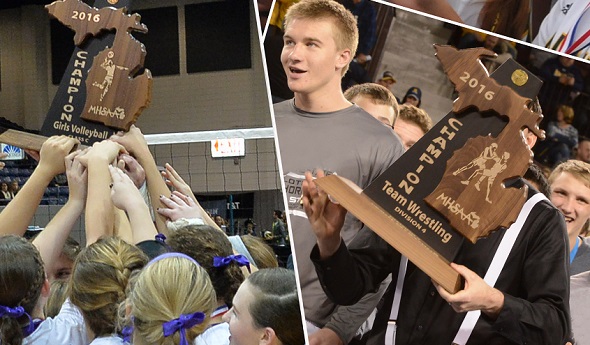
Class in Session: A History in Classification
July 24, 2017
By Rob Kaminski
MHSAA benchmarks editor
This is the first part in a series on MHSAA tournament classification, past and present, that will be published over the next two weeks. This series originally ran in this spring's edition of MHSAA benchmarks.
Conversation and discussion at the March 2017 MHSAA Representative Council Meeting leaned heavily toward the subject of 8-Player Football and how to properly balance its tournament with the growing number of schools sponsoring the sport.
While the proposal to split the tournament into two divisions beginning with the 2017 school year was adopted, the MHSAA then faced questions such as when to set the divisions, how to determine qualifiers and where to host the championship games.
The topic continues to create a buzz in Class D schools across both peninsulas, and likely will do into the start of school this fall.
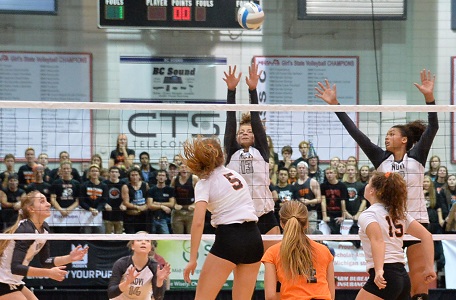
Likewise, the lone holdouts still conducting tournaments by class – MHSAA Boys and Girls Basketball and Girls Volleyball – took center stage at the May Council discussion, and following the 2017-18 school year, class is out for good. Both genders of basketball, and girls volleyball, will move to divisional formats thereafter.
There is much to be decided to be sure; but as those in education are well aware, history is the best teacher.
Fortunately for the sports in flux and for all sports under the governance of the MHSAA, the Association more or less wrote the book on the subject of sport classification. Following is a history lesson, with a little advanced division thrown in.
Class structure
Credited with being the first state with multiple tournament classifications, Michigan’s attention to trends and shifts in philosophy aimed at fair play and equal tournament opportunity can be traced from 80 years ago to the present.
In the earliest years of the MHSAA, there were four classifications for elections and tournaments – Classes A, B, C and D. Classes C and D had far more schools than Classes A and B. For example, 80 years ago (1937), there were only 58 schools in Class A, 94 schools in Class B, 297 schools in Class C and 253 schools in Class D.
Gradually through the years, as Michigan’s major cities spawned suburbs, there was a shift in the other direction to the point 30 years ago (1987) when school size became more balanced: 173 Class A schools, 178 Class B schools, 179 Class C schools and 182 Class D schools.
Up until 1987, the MHSAA published the dividing line between each classification, after which schools submitted their enrollments. Then, for 1988 and thereafter, the MHSAA adopted the plan of gathering all enrollments first and then placing 25 percent of the schools in each of four classes. This completed the equalization of the number of schools in each class for elections.
However, the change for 1988 did nothing to equalize the number of teams actually entered by each class in each sport. And unlike the early years of the Association when there were many more Class C and D teams than A and B teams, there were more Class A and B teams than C and D teams entering MHSAA tournaments decades later.
Moreover, the difference in number of teams entered in the different classifications for a sport continued to increase as many small schools, the fastest growing portion of the MHSAA's membership, sponsor only a few sports, or they sponsor no sports at all but enter into cooperative programs with other schools.
 Because of these differences, Class A or B schools sometimes had to win twice as many games as Class C or D schools to reach the MHSAA Finals in a sport. At times, the larger classifications had District Tournaments, even rat-tail games, and/or a Quarterfinal game, and the smaller classifications did not. Most Class D Districts have had four teams (some only three), while Class A Districts often had seven or eight teams. In Regional levels of individual sports, the number of entries in the larger classification once greatly outnumbered those in the smaller classifications of the tournament for the same sport.
Over the years, these dividing lines between classes escalated gradually, as did the differences in enrollments of largest and small schools in each class. In 1937 the dividing lines were 700, 300 and 100 between Class A and B, B and C, and C and D, respectively. By 1987, the dividing lines were 1,129, 571 and 298, respectively, leading to the current method of collecting enrollments and then setting the classification.
With the pendulum swinging well past center by the late 1980s, coaches associations, MHSAA sport committees, tournament managers and school administrators began discussion and offered proposals to correct what many believed had become a flawed system of MHSAA tournament classification.
At the 1996 MHSAA Update Meetings, ¾ of 858 respondents to that year’s annual survey indicated they favored a system that would divide schools which actually sponsor each sport into two, three or four nearly equal divisions.
Problem solving
At its meeting May 4-6, 1997, the Representative Council defeated a motion that would have adopted in one action a coordinated plan of reclassification for all sports to equalize the number of schools in each tournament for each respective sport. Instead, the Council discussed and voted on each proposal that had been presented from sport committees.
This resulted in the Representative Council adopting four equal divisions for baseball and softball, four equal divisions for boys and girls tennis, four equal divisions for boys soccer and three equal divisions for girls soccer, effective with the 1997-98 school year. Helping in the decision was the success of the 1995-96 MHSAA Wrestling season, which saw the sport move to four divisions for its tournament structure
The Council delayed action on similar proposals for football and boys golf at that time to glean additional input. The same decision was made with respect to a proposal from the Ice Hockey Committee that would have split the Class A schools in two divisions and left the Class B/C/D Tournament unchanged.
“The gist of the move from classes to divisions was to equalize the path to championships for students of all schools, regardless of the size of those schools,” said MHSAA Executive Director Jack Roberts.
While the restructuring accomplished that goal for the majority of competitors, opposition exists now as it did then. The primary argument in opposition to the changes is that, in some sports, it increases the range between largest and smallest schools in the division for smallest schools, even as the range is usually reduced for other divisions.
Larger schools offered a counterpoint.
“The larger schools suggested that while they may have more students, they also attempt to sponsor more sports than the smaller schools, in some cases spreading the enrollment as thin as a much smaller school with fewer sports,” Roberts said.
“Even today, the idea of four equal divisions can be unpopular among some Class D schools which feel especially burdened by the equal division concept,” Roberts said. “There was enough opposition in 1997 that equal divisions were rejected for boys and girls basketball and girls volleyball, and some of that opposition remains.”
The numbers of schools sponsoring each MHSAA tournament are still close to the totals today, with the exception of soccer in both genders, which has enjoyed substantial increases. This spring, 466 girls teams were scheduled to compete in the MHSAA Soccer Tournament, while 473 boys teams will suit up this fall.
Since the beginning of MHSAA divisions in 1996 with wrestling, 147 additional team champions have been crowned and countless individuals have known the thrill of victory due to an extra level of Finals in various sports. Girls soccer has seen the most growth in opportunity, moving from two classes in 1987 to three divisions the following year, and then four divisions in 2000. Boys soccer had enjoyed four classes for two years prior to the new four-division format, and it was the sport of soccer that helped to create a caveat in the nearly equal division movement.
Lower Peninsula boys and girls swimming & diving expanded from two to three divisions in 2008, while boys and girls bowling are the most recent sports to enjoy increased tournament opportunity, adding a fourth division in 2010.
“Fairness is in the eye of the beholder. While having the same number of schools in each division is one kind of fairness, holding in check the enrollment range between the largest and smallest schools in Division 4 is another kind of fairness that is dear to a great number of people,” Roberts said. “Because more schools sponsor basketball and volleyball than other sports, Class D schools would have been least affected by the equal divisions concept in those sports; but that, and ‘tradition,’ did not dissuade the opponents in the 1990s.”
The shift to divisions not only paved the way for student-athletes, but also assisted administrators and schools hosting tournaments. MHSAA tournament mangers looked to equal divisions to more closely equalize the number of schools in District or Regional Tournaments and to better equalize the length of day required for these rounds of tournaments, both for management and participating teams and individuals.
Pinning down an answer
Wrestling became the first MHSAA Tournament to be conducted in nearly equal divisions when team and individual champions were crowned in Divisions 1, 2, 3 and 4 rather than Classes A, B, C/D for the 1996 winter championships.
The movement was well received, as schools saw more opportunity for success: four champions where there once were three at the District, Regional and Final levels, and a smaller range of enrollment between the smallest and largest school in all four tournaments, leading to the impetus for the Fall 1996 Update Meeting Survey of schools regarding similar movement in other sports.
Team champions that year were Holt (D1), Petoskey (D2), Middleville Thornapple Kellogg (D3) and Dundee (D4).
Getting their kicks
When the "equal divisions" concept was approved by the Representative Council for most MHSAA Tournaments for the 1997-98 school year, there was opposition from the smallest schools which, under the equal divisions, are forced to play against larger schools than reside in Class D. Compelling arguments were made – and still are – that an enrollment difference between schools with smaller enrollments (e.g., Class D) is more difficult to overcome in athletic competition than an even larger enrollment difference between schools with larger enrollments (e.g., Class A).
The opposition was most intense in soccer because of the number of students needed to field a team and the physical nature of the sport. As a result, from 2000-01 through 2010-11, soccer operated with a “20-percent modification.” This placed 20 percent of all schools that actually sponsored soccer in Division 4, and the remaining 80 percent were placed equally in Divisions 1, 2 and 3.
At the time the 20 percent modification was adopted, it was also established that soccer would return to four equal divisions when the largest Division 4 soccer school had an enrollment equal to or smaller than the mid point for Class C schools. That occurred in 2010.
Last class on the schedule
In the same volume of “history being the best teacher,” one can also find the adage, “times change.” While the division format was a welcome change in some sports, others were left to hold class without change.
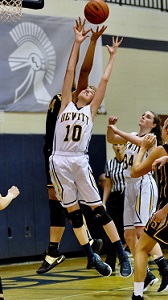 In the sports of boys and girls basketball, and girls volleyball, the number of schools sponsoring the sports were so close to the overall membership of the MHSAA that divisions were not necessary; the enrollment breakdowns themselves were enough to delineate equal opportunity for tournament success.
That is no longer the case, according to MHSAA membership. The last move from classes to divisions occurred for the 2006-07 school year following Council action. Before this May, that is. Action at the most recent Representative Council meeting, May 2017, called for the shift to divisions for MHSAA Boys and Girls Basketball, and Girls Volleyball, beginning with the 2018-19 season.
“Because the MHSAA Volleyball Committee had requested this change several times a number of years ago, and because the Council felt the change inevitable, there should not be further delay,” Roberts said. “It is an important detail that the Class D maximum has dropped 50 students over the past decade so the objection that much larger schools would be competing in Division 4 isn’t very strong now.”
Using the 2017-18 enrollment figures, just eight Class C schools would be competing in Division 4 for boys basketball, 11 for girls basketball and 14 for girls volleyball.
Good things came of the previous most-recent switches in 2006-07. Competitive Cheer was re-classified from Class A, B and C-D into four equal divisions assisting in the rapid growth of sponsoring schools (approximately 80 schools per division). Alpine skiing was changed from Class A and B-C D to two equal divisions.
At that time, the MHSAA Basketball Committee had recommended to the Council the study of increased classifications, but status quo remained.
Back on the grid
As such, MHSAA Basketball and Volleyball remained the only holdovers of the MHSAA class structure. Discussion resurfaced periodically during the last two decades to bring those tournaments in line with the other MHSAA sports.
Regular-season football-playing schools are separated by class, then are reshuffled by divisions for the playoffs. Football, as we know, underwent a significant postseason facelift in the late 1990s.
While MHSAA Football also remained a class sport through 1998, it had expanded from four to eight classes from 1990-98, becoming the first MHSAA sport to crown more than four team champions. Member schools were asked to consider a pair of options in November of 1997. One called for eight equal divisions, and the second would leave Class D by itself as division 8, and split Class A, B and C schools into seven nearly equal divisions.
After much discussion, retooling, and crunching of formulas, the MHSAA unveiled its revised Football Playoff model that continues to roll today, nearly 20 years later. It was determined that 256 teams would qualify for the tournament based first on a minimum of six wins, then by Playoff Points determined by formula. From there, the field would be divided into eight divisions, with the field being filled out by a nearly equal number of five-win teams in each division as needed to reach 256.
Eight championships would indeed be enough, until football sponsorship among the MHSAA’s smallest schools – some with rich football traditions – began to trend downward. The MHSAA again went to the drawing board, examining the viability of 8-player football. After an experimental year in 2010 without a tournament, the 8-player game was playoff-ready for 2011, with a field of 16 qualifiers embarking on a four-week tournament.
Not only did the 8-player option restore recently canceled programs, but it also created teams in schools which previously had none, and convinced some 11-player schools that this new division was the best path to take.
What did this do for the Class D holdovers staying in the traditional 11-player game? Well, a couple of things, positive and negative. As two and three dozen Class D schools opted for the 8-player game, the remaining 11-player Class D schools at times found themselves in disrupted leagues and had to travel further to complete schedules. They also competed against larger teams in Division 8 of the 11-player MHSAA Football Playoffs.
However, the growth of the 8-player game among the smallest schools also resulted in more Class D schools qualifying for the MHSAA Football Playoffs than ever before. In 2012, an all-time high 44 percent of Class D schools sponsoring football qualified for either the 8-player tournament or Division 8 of the 11-player tournament. That compared to 42.2 percent of Class C schools, 44.9 percent of Class B schools and 41.6 percent of Class A schools which qualified for the 2012 playoffs.
Much is to be determined in the most recent chapter of MHSAA Tournament expansion as the 8-Player Football Playoffs welcome a second division. As the past illustrates, there will be pluses and minuses. History also shows that the MHSAA has received maximum input from its constituents, researched all possibilities, and will find solutions to questions still in the balance before an additional group of athletes hoists a new trophy in November.
Through the Years
A chronology of when which sports moved from Class to Division in the MHSAA.
1995-96: LP Wrestling
1997-98: Baseball, Boys Soccer, Girls Soccer, Softball, LP Girls Tennis, LP Boys Tennis
1998-99: LP Boys Golf, LP Girls Golf
1999-2000: Ice Hockey, LP Boys Track & Field, LP Girls Track & Field
2000-01: LP Boys Cross Country, LP Girls Cross Country, UP Boys Cross Country, UP Girls Cross Country, UP Boys Golf, UP Girls Golf, UP Boys Tennis, UP Girls Tennis, UP Boys Track & Field, UP Girls Track & Field
2002-03: LP Girls Swimming & Diving, LP Boys Swimming & Diving
2005-06: Boys Bowling, Girls Bowling
2006-07: Girls Competitive Cheer, Boys Skiing, Girls Skiing
2018-19: Boys Basketball, Girls Basketball, Girls Volleyball
Note: Boys and Girls Lacrosse has been a divisional sport since it began in during the 2004-05 school year.

1st & Goal: 2022 11-Player Finals Preview
By
Geoff Kimmerly
MHSAA.com senior editor
November 23, 2022
We like to say every score has a story, and this weekend's 11-Player Football Finals at Ford Field have foundations laid for many to be told.
 The Division 1 and 2 matchups feature reigning champions against opponents returning to the Finals for the first time in a decade or more. The Division 5 and 8 games pit undefeated teams, with three of the four seeking their first championship at this level. The Division 3 and 7 games are rematches of powerhouse-packed playoff rivalries. The Division 4 and 6 games feature former Finals mainstays making their returns, but against teams looking to start their own traditions of traveling to Detroit for the holiday weekend. And the list goes on and on.
Here's the schedule for Friday and Saturday's games:
Friday, Nov. 25
Division 8 – Ottawa Lake Whiteford (13-0) vs. Ubly (13-0) – 10 a.m.
Division 2 – Grand Rapids Forest Hills Central (13-0) vs. Warren De La Salle Collegiate (12-1) – 1 p.m.
Division 6 – Grand Rapids West Catholic (12-1) vs. Negaunee (13-0) – 4:30 p.m.
Division 4 – Grand Rapids South Christian (13-0) vs. Goodrich (12-1) – 7:30 p.m.
Saturday, Nov. 26
Division 7 – Traverse City St. Francis (13-0) vs. Jackson Lumen Christi (10-3) – 10 a.m.
Division 1 – Belleville (13-0) vs. Caledonia (12-1) – 1 p.m.
Division 5 – Frankenmuth (13-0) vs. Gladwin (13-0) – 4:30 p.m.
Division 3 – Muskegon (11-2) vs. Detroit Martin Luther King (9-3) – 7:30 p.m.
All games will be broadcast live on Bally Sports Detroit’s primary channel except the Division 4 Final, which will be broadcast on the Bally Sports Detroit website and Bally Sports app, and Stadium College Sports. Additionally, all eight championship games will be available for listening from the MHSAA Network at MHSAANetwork.com.
Below is a glance at all eight matchups. Statistics are through Semifinals unless noted.
Division 1
 BELLEVILLE
Record/rank: 13-0, No. 1
Coach: Dejuan Rogers, interim coach (4-0)
League finish: First in Kensington Lakes Activities Association East and overall
Championship history: Division 1 champion 2021.
Best wins: 29-28 (OT) over Detroit Cass Tech in Semifinal, 33-10 over No. 10 (tie) Detroit Catholic Central in Regional Final, 62-44 over Saline in District Final, 42-3 over No. 10 (tie) Brighton, 42-14 over Division 2 No. 3 Livonia Franklin.
Players to watch: QB Bryce Underwood, 6-2/180 soph. (2,599 yards/35 TDs passing, 478 yards/7 TDs rushing); RB/LB Jeremiah Beasley, 6-1/215 jr. (1,177 yards/23 TDs rushing); RB Colbey Reed, 5-9/210, jr. (462 yards/9 TDs rushing); DL Jeremiah Warren, 6-3/285, sr.
Outlook: The Tigers bring a 24-game winning streak into this Final, with Cass Tech last week the only team to come within single digits of matching them. Underwood is considered one of the top sophomores nationally, and he showed why in leading Belleville’s comeback win over the Technicians with two touchdowns rushing and another passing. He was The Associated Press’ Division 1-2 all-state Player of the Year as a freshman, while junior defensive back James Robinson also made the first team and Warren, junior receiver/safety Jalen Johnson, senior defensive lineman Camden Weaver, Beasley and senior receiver/defensive back Mychal Yharbrough earned honorable mentions. Junior offensive lineman Nathaniel Johnson (6-5/330) is another highly-regarded talent.
CALEDONIA
Record/rank: 12-1, No. 8
Coach: Derek Pennington, second season (22-3)
League finish: Second in Ottawa-Kent Conference Red
Championship history: Division 3 champion 2005.
Best wins: 14-13 (2OT) over No. 3 Rockford in District Final, 21-0 over No. 7 Clarkston in Semifinal, 48-26 (District Semifinal) and 50-40 over Grandville, 42-14 over Grand Ledge in Regional Final.
Players to watch: RB/DB Brock Townsend, 6-0/200 RB/DB jr. (1,179 yards/17 TDs rushing, 5 interceptions); QB Mason McKenzie, 6-0/180 sr. (1,375 yards/20 TDs passing, 1,537 yards/19 TDs rushing); HB/LB Derek Pennington Jr., 6-2/225 jr. (308 yards/5 TDs receiving); OL/DL Carlo Aybar, 6-1/275 sr.
Outlook: The Fighting Scots have shown remarkable resilience over the last month, bouncing back from a 38-15 loss to Rockford in Week 9 to rumble back to the Finals – with their best win arguably a 14-13 victory over the Rams only two weeks after the defeat, although the shutout of Clarkston clearly was noteworthy as well. A strong running attack long has been the name of Caledonia’s game, and the Fighting Scots went over 3,400 yards and 45 touchdowns rushing in the Semifinal win. Last week’s also was their fifth shutout of the season, but really the last three weeks have seen some of the team’s most impressive performances on that side of the ball as Rockford was averaging 37 points per game, Grand Ledge was averaging 30 and Clarkston was averaging 41.
Division 2
 GRAND RAPIDS FOREST HILLS CENTRAL
Record/rank: 13-0, No. 4
Coach: Tim Rogers, 11th season (76-39)
League finish: First in O-K White
Championship history: Class A runner-up 1994.
Best wins: 20-17 (2OT) over No. 1 Dexter in Semifinal, 31-21 over No. 7 Muskegon Mona Shores in District Final, 21-17 over East Lansing in Regional Final, 21-13 over Byron Center.
Players to watch: WR/DB Ty Hudkins, 6-0/182 jr. (843 yards/10 TDs receiving); DB/QB Mason McDonald jr. (355 yards/6 TDs passing, 374 yards/2 TDs rushing); LB/RB JT Hartman jr. (941 yards/8 TDs rushing); DL/OL Crandall Quinn, 6-2/235 sr. (Statistics through Regional Finals.)
Outlook: The Rangers have pulled through one-score games the last two weeks with a defense that’s given up 8.6 points per game on the season and hasn’t backed down against the tougher competition of the playoffs – seeing that average rise to only 15 ppg over four postseason games. Quinn and senior linebacker Raymond Cargill are among the pacesetters of that group. McDonald has stepped in admirably at quarterback the last two weeks – he threw and ran for another touchdown in the Dexter win – after senior Justin Osterhouse (654 yards/15 TDs rushing, 1,070 yards/13 TDs passing) was reportedly on crutches following the District Final.
WARREN DE LA SALLE COLLEGIATE
Record/rank: 12-1, No. 2
Coach: Dan Rohn, third season (32-6)
League finish: Tied for first in Detroit Catholic League Central
Championship history: Four MHSAA titles (most recent 2021), three runner-up finishes.
Best wins: 37-7 over No. 9 Roseville in District Final, 28-0 over Division 1 No. 10 (tie) Detroit Catholic Central, 19-18 over Division 3 No. 4 River Rouge, 49-16 over Division 3 No. 7 Muskegon.
Players to watch: QB/DB Brady Drogosh, 6-4/215 sr. (1,839 yards/33 TDs passing, 1,088 yards/13 TDs rushing); RB/LB Rhett Roeser, 6-0/225 jr. (727 yards/13 TDs rushing); DL/TE Mason Muragin, 6-3/240 sr. (71 tackles/14.5 sacks); LB/TE James McDonald, 6-1/220 sr. (115 tackles/17 tackles for loss).
Outlook: The Pilots navigated another strong regular-season schedule with their only loss by a point to Bloomfield Brother Rice, and that’s no doubt paid off as they’ve been unchallenged during the playoffs outscoring their four opponents by a combined 175-29. Drogosh, who will continue at Cincinnati, made the all-state first team as a junior, while Muragin – playing next at Illinois – earned an honorable mention last season. Defensive back Jamari Allen is committed to continue at Central Michigan. Senior receivers Jack Yanachik (523 yards/8 TDs receiving) and Triston Nichols (449/8) are among top Drogosh targets.
Division 3
 MUSKEGON
Record/rank: 11-2, No. 7
Coach: Shane Fairfield, 13th season (142-26)
League finish: Tied for first in O-K Green
Championship history: Six championships (most recent 2017), six runner-up finishes.
Best wins: 27-20 over No. 6 Zeeland West in Regional Final, 49-21 over No. 9 DeWitt in Semifinal, 55-35 over Division 2 No. 7 Muskegon Mona Shores, 28-20 over Muskegon Reeths-Puffer.
Players to watch: QB/DB M’Khi Guy, 5-9/155 jr. (1,638 yards/24 TDs rushing, 647 yards/11 TDs passing); SL/DB Destin Piggee, 5-7/160, sr. (718 yards/5 TDs rushing, 351 yards/5 TDs receiving); RB/LB Jakob Price, 5-7/175 jr. (971 yards/14 TDs rushing); OL/DL D’Andre Hudgins, 6-3/285 sr.
Outlook: The Big Reds are making a familiar trip back to Ford Field for the first time since 2019, featuring familiar strengths – multiple playmakers including a tough-to-tackle running quarterback, and a giant line leading the way. Hudgins is joined by three more linemen 6-4 or 6-5, with two of those at 300 or more pounds. Guy ran for more than 300 yards and six touchdowns against DeWitt, and Price and Piggee stretch defenses as well – all three were averaging at least seven yards per carry entering last weekend. The losses came Week 2 to Division 2 finalist Warren De La Salle and Week 5 to Zeeland West, the latter avenged in the Regional Final. Price earned an all-state honorable mention last season.
DETROIT MARTIN LUTHER KING
Record/rank: 9-3, No. 1
Coach: Tyrone Spencer, seventh season (74-17)
League finish: Second in Detroit Public School League Blue
Championship history: Five MHSAA titles (most recent 2021), three runner-up finishes.
Best wins: 52-17 over No. 3 Mason in Semifinal, 22-12 over Bloomfield Hills Brother Rice in Regional Final, 41-28 over No. 4 River Rouge in District Semifinal, 28-23 over Detroit Cass Tech.
Players to watch: QB Dante Moore, 6-2/210, sr. (2,239 yards/28 TDs passing, 5 TDs rushing – includes Semifinal); WR/DB Jameel Croft Jr., 6-1/185 sr. (671 yards/8 TDs receiving, 6 interceptions); DE Kenny Merrieweather, 6-3/235, sr. (45 tackles, 16 tackles for loss, 12 sacks); RB Sterling Anderson Jr., 5-8/165, sr. (918 yards/12 TDs rushing). (Statistics through Regional Finals except Moore’s.)
Outlook: The reigning Division 3 champion will return with a star-studded cast, headlined by Moore as he finishes his four-year varsity career before continuing at Oregon. Anderson went over 1,000 yards rushing during the Semifinal win and scored six total touchdowns against Mason, while Croft snagged two more interceptions. Croft is committed to Kansas, Merrieweather is committed to Iowa and both joined Moore on the all-state first team last season, when Moore also was named Associated Press Division 3-4 Player of the Year. The Crusaders lost their final two games of the regular season, to Cass Tech and Cincinnati Moeller, but had only one single-digit game before (against Cass Tech) and none since.
Division 4
 GRAND RAPIDS SOUTH CHRISTIAN
Record/rank: 13-0, No. 2
Coach: Danny Brown, fourth season (35-11)
League finish: First in O-K Gold
Championship history: Three MHSAA titles (most recent 2014), four runner-up finishes.
Best wins: 26-20 over No. 5 Edwardsburg in Semifinal, 28-21 over No. 1 Whitehall in Regional Final, 35-20 over Hudsonville Unity Christian in District Final, 36-34 over Division 1 No. 5 Grand Rapids Catholic Central.
Players to watch: QB/LB Jacob DeHaan, 6-2/190 sr. (2,574 yards/33 TDs passing, 1,128 yards/17 TDs rushing); WR/DB Seth Ritsema, 6-2/200 sr. (776 yards/10 TDs receiving); WR/RB Carson Vis, 6-3/180, soph. (659 yards/15 TDs receiving); OL/LB Cameron Post, 6-4/250 sr. (54.5 tackles/14.5 tackles for loss).
Outlook: South Christian is making its first Finals trip since that championship season in 2014, and after not only defeating two top-five teams in the playoffs but also downing last season’s Division 4 runner-up in Unity Christian. The regular-season win over GRCC ended the Cougars’ 41-game winning streak. DeHaan earned an all-state honorable mention last season as a junior, as did running back/kicker Nate Brinks (689 yards/8 TDs rushing, 60-64 XP/1 FG kicking). Senior linebacker Cayden Dykema (6-5/205) leads the defense with 77.5 tackles, plus has totaled 12.5 tackles for loss.
GOODRICH
Record/rank: 12-1, unranked
Coach: Tom Alward, 30th season (186-113)
League finish: First in Flint Metro League Stars
Championship history: Has never played in an MHSAA Final.
Best wins: 51-26 over No. 3 Riverview in Semifinal, 40-20 over Orchard Lake St. Mary’s in Regional Final, 10-9 over No. 6 Freeland in District Final, 42-21 over Almont.
Players to watch: QB/DB Gavin Hart, 6-3/180 sr. (1,732 yards/20 TDs passing); RB/LB Jace Simerson, 5-10/200 sr. (1,380 yards/20 TDs); WR/DB Caden Kolanowski, 6-1/180, sr. (622 yards/6 TDs receiving); TE/DE Jace Williams, 6-4/200, sr.
Outlook: Goodrich has won 12 straight games on the way to Ford Field after suffering its only loss Week 1 to Division 5 finalist Frankenmuth, and also set a program record for victories along the way. Only three of those wins were decided by a score or less, and Goodrich improved on a 6-0 win over Linden in Week 2 with a 21-0 shutout in a Week 8 rematch. Simerson ran for five touchdowns last weekend in the victory over previously-undefeated Riverview. Kolanowski earned an all-state honorable mention last season as a specialist; he’s kicked and connected on 50 of 51 extra-point attempts and four field goals this season. Junior linebacker Easton Phipps joins Williams in anchoring the defense.
Division 5
 FRANKENMUTH
Record/rank: 13-0, No. 5
Coach: Phil Martin, 10th season (104-16)
League finish: First in Tri-Valley Conference 8
Championship history: Division 5 runner-up 2020.
Best wins: 38-0 over No. 7 Detroit Country Day in Semifinal, 49-7 over Flint Hamady in Regional Final, 21-0 over Division 4 No. 6 Freeland, 27-2 over Goodrich.
Players to watch: QB Aidan Hoard, 6-4/205 sr. (1,406 yards/18 TDs passing, 682 yards/11 TDs rushing); RB/LB Griffin Barker, 5-9/170 jr. (861 yards/14 TDs rushing); TE/DE Brenden Marker, 6-3/220 sr. (40 tackles/16 tackles for loss/8 sacks); RB/LB Dalton DeBeau, 6-0/220 sr. (79 tackles/23 tackles for loss).
Outlook: The Eagles are headed back to the Finals for the second time in three years in part driven by a defense that has given up 64 points this season – with two of their five shutouts coming over the last three playoff games. The most points Frankenmuth has given up is 16, to Saginaw Swan Valley in Week 2, and the Eagles shut out Swan Valley 31-0 in the District Final. Frankenmuth also has allowed 135 total yards per game this fall – and 317 rushing yards total over 13 games. Junior Colin Main is another impressive defender, with 69 tackles, 22 for loss and nine sacks. The Eagles spread the wealth offensively; Hoard has thrown a touchdown pass to 10 receivers, and senior Sam Barger is another reliable rusher with 717 yards and 11 touchdowns on the ground.
GLADWIN
Record/rank: 13-0, No. 2
Coach: Marc Jarstfer, fourth season (27-13)
League finish: First in Jack Pine Conference
Championship history: Has never played in an MHSAA Final.
Best wins: 28-21 over No. 1 Grand Rapids Catholic Central in Semifinal, 26-8 over No. 4 Muskegon Oakridge in Regional Final, 33-27 over No. 8 Pontiac Notre Dame Prep, 38-0 over Clare.
Players to watch: QB/S Nick Wheeler, 6-1/190 sr. (956 yards/11 TDs passing, 881 yards/19 TDs rushing, 57 tackles/5 interceptions); RB/LB Logan Kokotovich, 5-11/195 sr. (932 yards/13 TDs rushing, 84 tackles); SL/LB Earl Esiline, 5-10/170 sr. (1,073 yards/14 TDs rushing, 45 tackles); OL/DL Lincoln McKinnon, 6-2/240 sr.
Outlook: A long-anticipated senior class has made good in taking Gladwin on its first trip to the Finals, after the Flying Gs also claimed their first Jack Pine Conference title since sharing it in 2002. The win over GRCC last weekend ended the Cougars’ three-year Finals streak and earned Gladwin a major dose of attention to help shine a light on those other accomplishments. The defense opened this fall with four straight shutouts and five over six games, giving up only seven points through the end of September. Senior safety Kaden McDonald (56 tackles) made the all-state second team last season, while McKinnon, Kokotovich and Wheeler earned honorable mentions. Four players have caught multiple touchdowns passes, led by junior Jhace Massey (5) and senior Lucas Mead (4).
Division 6
 GRAND RAPIDS WEST CATHOLIC
Record/rank: 12-1, No. 1
Coach: Landon Grove, first season (12-1)
League finish: Tied for first in O-K Blue
Championship history: Six MHSAA titles (most recent 2017), two runner-up finishes.
Best wins: 33-14 over No. 2 Clinton in Semifinal, 50-24 over No. 8 Constantine in District Final, 36-18 over Hudsonville Unity Christian, 28-20 over Division 4 No. 5 Edwardsburg.
Players to watch: QB Bernie Varnesdeel, 6-1/192 sr. (1,424 yards/20 TDs passing); RB/OLB Timmy Kloska, 6-0/220 sr. (2,158 yards/35 TDs rushing, 52 tackles/12 sacks); WR/DB Ryer Snow, 6-4/180 jr. (510 yards/7 TDs receiving, 75 tackles/12 sacks/4 interceptions); RB/SL/LB Charlie DeBruyn, 6-0/170 jr. (102 tackles/15 sacks).
Outlook: West Catholic last left Ford Field with a fifth-straight championship in 2017, and the Falcons are making their return with their statistically-strongest offensive and defensive units since that season. DeBruyn helps key a defense with 79 sacks total – junior Ethan Stoner adds another 10 to those leaders listed above – and junior Josh Mitchell (39 tackles) starts on both lines. Kloska is the name most know – he made the all-state first team last season, and his 35 rushing touchdowns qualify for the MHSAA record book. The team’s only loss came 28-20 to Fruitport in Week 7, and the Falcons came back with two shutouts over their next three games and last week limited a Clinton offense averaging 41 points per game to just 14.
NEGAUNEE
Record/rank: 13-0, No. 3
Coach: Paul Jacobson, 23rd season (177-69)
League finish: First in Western Peninsula Athletic Conference Copper
Championship history: Division 6 champion 2002, Class CC runner-up 1991.
Best wins: 13-12 over No. 5 Reed City in Semifinal, 18-12 (Regional Final) and 24-6 over Gladstone, 19-14 over Division 8 No. 4 Iron Mountain.
Players to watch: WR/DB/K/P Phil Nelson, 6-1/185 sr. (326 yards/2 TDs receiving, 39-47 XP/2 FG kicking); RB/DB Kai Lacar, 5-11/185, jr. (1,233 yards/17 TDs rushing, 4 interceptions); WR/LB Niko Lukkarinen, 6-0/215 sr. (1,174 yards/19 TDs rushing); OL/DL Drake Spickerman, 5-11/225 sr.
Outlook: The Miners opened with a close win over Iron Mountain and advanced with one-score victories the last two weeks, but absolutely dominated in between. They didn’t allow a point from Week 8 through the District Final, and total have given up only 148 yards and 6.7 points per game this fall. Senior Easton Palomaki has added another 509 yards and 13 touchdowns on the ground as total Negaunee has rushed for 3,400 and 58, respectively. Sophomore quarterback Ty Jacobson has kept defenses honest with 580 yards and seven touchdowns through the air. Nelson made the all-state second team as a specialist last season, and in addition to kicking and punting he’s also returned three punts for touchdowns this fall.
Division 7
 TRAVERSE CITY ST. FRANCIS
Record/rank: 13-0, No. 2
Coach: Josh Sellers, 13th season (145-19)
League finish: First in Northern Michigan Football Conference Legends
Championship history: Six MHSAA titles (most recent 2009), four runner-up finishes.
Best wins: 53-8 over No. 5 New Lothrop in Semifinal, 63-0 over No. 8 Ithaca in Regional Final, 42-7 over No. 10 Lawton, 42-35 over No. 4 Jackson Lumen Christi, 45-20 over Division 5 No. 7 Detroit Country Day
Players to watch: QB/DB Wyatt Nausadis, 6-4/210 sr. (1,145 yards/19 TDs passing, 1,007 yards/11 TDs rushing); RB/DB Burke Flowers, 5-11/175 jr. (699 yards/7 TDs rushing, 347 yards/7 TDs receiving); RB/LB Joey Donahue, 6-2/215 sr. (563 yards/14 TDs rushing, 105 tackles/13 tackles for loss); RB/LB Garrett Hathaway, 6-2/220 sr. (851 yards/17 TDs rushing, 4 TDs receiving, 64 tackles).
Outlook: The Gladiators have mostly dominated on their way back to Ford Field for the first time since finishing Division 7 runner-up in 2020; their only close game other than the Week 2 win over Lumen Christi was a 16-pointer over Benzie Central in the District Final after previously defeating Benzie 49-12 in Week 3. Nausadis was an all-state receiver last season and has taken over for a graduated all-state quarterback with the best possible results. Donahue also made the all-state first team last season and leads a defense that’s raised its game even more during the playoffs giving up only 34 points total over four wins.
JACKSON LUMEN CHRISTI
Record/rank: 10-3, No. 4
Coach: Herb Brogan, 43rd season (394-94)
League finish: Second in Interstate 8 Athletic Conference
Championship history: 11 MHSAA titles (most recent 2018), three runner-up finishes.
Best wins: 20-7 over No. 7 Napoleon in Semifinal, 7-6 over No. 10 Lawton in Regional Final, 35-0 over No. 3 Hudson in District Final, 19-14 over Parma Western.
Players to watch: FB/LB Devian Franklin, 6-1/210, sr. (438 yards/11 TDs rushing); RB/DB Derrick Walker, 6-0/195 sr. (1,159 yards/15 TDs rushing); QB/LB Joe Lathers, 6-1/190 sr. (844 yards/7 TDs passing, 743 yards/17 TDs rushing); TE/LB Conor Smith, 6-1/210 sr. (Lathers’ passing does not include Semifinal.)
Outlook: Lumen Christi returns to Ford Field for the first time since finishing Division 7 runner-up in 2019. Freshmen who made that trip are now seniors, and the backfield features three veterans in Lathers, Franklin and Walker. They helped the Titans pulled off the rare feat of starting 0-3 but making the final weekend of the season, but those three losses also require context – they came 12-7 to No. 5 New Lothrop, 42-35 to St. Francis and 24-21 to Division 4 No. 8 Hastings. The defense, keyed in part by Smith, Franklin and Lathers at linebacker, has given up a combined 20 points over four playoff games and only 11.5 points per game all season. Brogan sits third on the all-time state football coaching wins list.
Division 8
 OTTAWA LAKE WHITEFORD
Record/rank: 13-0, No. 2
Coach: Todd Thieken, first season (13-0)
League finish: First in Tri-County Conference
Championship history: Division 8 champion 2017, runner-up 2016.
Best wins: 44-6 over Clarkston Everest Collegiate in Semifinal, 38-26 over White Pigeon in Regional Final, 56-19 over Riverview Gabriel Richard in District Final, 50-14 over Erie Mason.
Players to watch: QB/DB Shea Ruddy, 5-11/170 sr. (1,129 yards/19 TDs passing, 725 yards/17 TDs rushing, 64 tackles); RB/DB Hunter DeBarr, 5-11/150 jr. (1,116 yards/10 TDs rushing, 361 yards/7 TDs receiving, 59 tackles); RB/LB Jake Iott, 6-1/180 jr. (1,121 yards/21 TDs rushing, 190 tackles/14 tackles for loss); TE/DB Ryin Ruddy, 6-1/170 jr. (279 yards/8 TDs receiving, 115 tackles/4 interceptions).
Outlook: Whiteford built back to the Semifinals last season and took the next step this fall winning every game by double digits and 49-12 on average. Shea Ruddy made the all-state second team at quarterback last year and has helped the Bobcats top 50 points seven times including during the first two rounds of the playoffs. His 19 touchdown passes are a school record, as are Iott’s 190 tackles. Thieken previously served as head coach from 2005-10 at Evergreen, Ohio, and more than 25 seasons as an assistant before taking over the Whiteford varsity this fall. Junior fullback Drew Knaggs is another reliable option on offense; he’s run for 524 yards and seven touchdowns.
UBLY
Record/rank: 13-0, No. 1
Coach: Eric Sweeney, third season (35-0)
League finish: First in Greater Thumb Conference East
Championship history: Division 8 runner-up 2020, Division 7 runner-up 2008.
Best wins: 41-14 over No. 4 Iron Mountain in Semifinal, 49-7 over No. 8 Fowler in Regional Final, 49-14 over No. 5 Saginaw Michigan Lutheran Seminary in District Final, 42-0 over Harbor Beach.
Players to watch: QB/DB Evan Peruski, 5-11/170 jr. (312 yards/6 TDs passing, 1,165 yards/20 TDs rushing, 46 tackles); RB/LB Aiden Mackowiak, 5-10/175 sr. (943 yards/13 TDs rushing, 121 tackles); RB/DB Mark Heilig, 5-10/175 sr. (1,354 yards/29 TDs rushing, 77 tackles); RB/DE Seth Maurer, 5-11/190 jr. (714 yards/12 TDs rushing, 59 tackles).
Outlook: Ubly can argue it’s been the most dominant team in Michigan, relative to division, this fall. The Bearcats’ closest game was last week’s 27-point win over Iron Mountain, and their average score this fall is 49-7. On defense, no opponent has scored more than 16 points and three have put up more than seven. The offense has scored at least 41 points in every game. Peruski started at quarterback as a freshman at Ford Field in 2020, and he earned an all-state honorable mention last season. Heilig and Mackowiak are among others who saw action in that last championship game appearance, and Mackowiak also earned all-state honorable mention last season, at linebacker. Junior Brett Mueller is another important option on offense; he made the all-state first team last season and this fall has connected on 84 of 87 extra-point attempts and a field goal.
MHSAA.com's weekly “1st & Goal” previews and reviews are powered by MI Student Aid, a part of the Office of Postsecondary Financial Planning located within the Michigan Department of Treasury. MI Student Aid encourages students to pursue postsecondary education by providing access to student financial resources and information. MI Student Aid administers the state’s 529 college savings programs (MET/MESP), as well as scholarship and grant programs that help make college Accessible, Affordable and Attainable for you. Connect with MI Student Aid at www.michigan.gov/mistudentaid and find more information on Facebook and Twitter @mistudentaid.