


Class in Session: A History in Classification
July 24, 2017
By Rob Kaminski
MHSAA benchmarks editor
This is the first part in a series on MHSAA tournament classification, past and present, that will be published over the next two weeks. This series originally ran in this spring's edition of MHSAA benchmarks.
Conversation and discussion at the March 2017 MHSAA Representative Council Meeting leaned heavily toward the subject of 8-Player Football and how to properly balance its tournament with the growing number of schools sponsoring the sport.
While the proposal to split the tournament into two divisions beginning with the 2017 school year was adopted, the MHSAA then faced questions such as when to set the divisions, how to determine qualifiers and where to host the championship games.
The topic continues to create a buzz in Class D schools across both peninsulas, and likely will do into the start of school this fall.
Likewise, the lone holdouts still conducting tournaments by class – MHSAA Boys and Girls Basketball and Girls Volleyball – took center stage at the May Council discussion, and following the 2017-18 school year, class is out for good. Both genders of basketball, and girls volleyball, will move to divisional formats thereafter.
There is much to be decided to be sure; but as those in education are well aware, history is the best teacher.
Fortunately for the sports in flux and for all sports under the governance of the MHSAA, the Association more or less wrote the book on the subject of sport classification. Following is a history lesson, with a little advanced division thrown in.
Class structure
Credited with being the first state with multiple tournament classifications, Michigan’s attention to trends and shifts in philosophy aimed at fair play and equal tournament opportunity can be traced from 80 years ago to the present.
In the earliest years of the MHSAA, there were four classifications for elections and tournaments – Classes A, B, C and D. Classes C and D had far more schools than Classes A and B. For example, 80 years ago (1937), there were only 58 schools in Class A, 94 schools in Class B, 297 schools in Class C and 253 schools in Class D.
Gradually through the years, as Michigan’s major cities spawned suburbs, there was a shift in the other direction to the point 30 years ago (1987) when school size became more balanced: 173 Class A schools, 178 Class B schools, 179 Class C schools and 182 Class D schools.
Up until 1987, the MHSAA published the dividing line between each classification, after which schools submitted their enrollments. Then, for 1988 and thereafter, the MHSAA adopted the plan of gathering all enrollments first and then placing 25 percent of the schools in each of four classes. This completed the equalization of the number of schools in each class for elections.
However, the change for 1988 did nothing to equalize the number of teams actually entered by each class in each sport. And unlike the early years of the Association when there were many more Class C and D teams than A and B teams, there were more Class A and B teams than C and D teams entering MHSAA tournaments decades later.
Moreover, the difference in number of teams entered in the different classifications for a sport continued to increase as many small schools, the fastest growing portion of the MHSAA's membership, sponsor only a few sports, or they sponsor no sports at all but enter into cooperative programs with other schools.
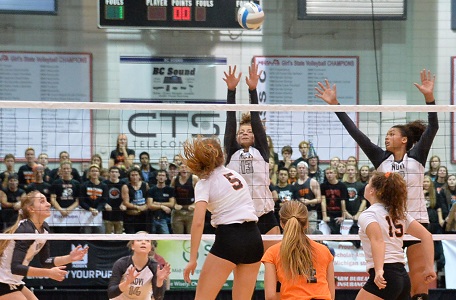 Because of these differences, Class A or B schools sometimes had to win twice as many games as Class C or D schools to reach the MHSAA Finals in a sport. At times, the larger classifications had District Tournaments, even rat-tail games, and/or a Quarterfinal game, and the smaller classifications did not. Most Class D Districts have had four teams (some only three), while Class A Districts often had seven or eight teams. In Regional levels of individual sports, the number of entries in the larger classification once greatly outnumbered those in the smaller classifications of the tournament for the same sport.
Over the years, these dividing lines between classes escalated gradually, as did the differences in enrollments of largest and small schools in each class. In 1937 the dividing lines were 700, 300 and 100 between Class A and B, B and C, and C and D, respectively. By 1987, the dividing lines were 1,129, 571 and 298, respectively, leading to the current method of collecting enrollments and then setting the classification.
With the pendulum swinging well past center by the late 1980s, coaches associations, MHSAA sport committees, tournament managers and school administrators began discussion and offered proposals to correct what many believed had become a flawed system of MHSAA tournament classification.
At the 1996 MHSAA Update Meetings, ¾ of 858 respondents to that year’s annual survey indicated they favored a system that would divide schools which actually sponsor each sport into two, three or four nearly equal divisions.
Problem solving
At its meeting May 4-6, 1997, the Representative Council defeated a motion that would have adopted in one action a coordinated plan of reclassification for all sports to equalize the number of schools in each tournament for each respective sport. Instead, the Council discussed and voted on each proposal that had been presented from sport committees.
This resulted in the Representative Council adopting four equal divisions for baseball and softball, four equal divisions for boys and girls tennis, four equal divisions for boys soccer and three equal divisions for girls soccer, effective with the 1997-98 school year. Helping in the decision was the success of the 1995-96 MHSAA Wrestling season, which saw the sport move to four divisions for its tournament structure
The Council delayed action on similar proposals for football and boys golf at that time to glean additional input. The same decision was made with respect to a proposal from the Ice Hockey Committee that would have split the Class A schools in two divisions and left the Class B/C/D Tournament unchanged.
“The gist of the move from classes to divisions was to equalize the path to championships for students of all schools, regardless of the size of those schools,” said MHSAA Executive Director Jack Roberts.
While the restructuring accomplished that goal for the majority of competitors, opposition exists now as it did then. The primary argument in opposition to the changes is that, in some sports, it increases the range between largest and smallest schools in the division for smallest schools, even as the range is usually reduced for other divisions.
Larger schools offered a counterpoint.
“The larger schools suggested that while they may have more students, they also attempt to sponsor more sports than the smaller schools, in some cases spreading the enrollment as thin as a much smaller school with fewer sports,” Roberts said.
“Even today, the idea of four equal divisions can be unpopular among some Class D schools which feel especially burdened by the equal division concept,” Roberts said. “There was enough opposition in 1997 that equal divisions were rejected for boys and girls basketball and girls volleyball, and some of that opposition remains.”
The numbers of schools sponsoring each MHSAA tournament are still close to the totals today, with the exception of soccer in both genders, which has enjoyed substantial increases. This spring, 466 girls teams were scheduled to compete in the MHSAA Soccer Tournament, while 473 boys teams will suit up this fall.
Since the beginning of MHSAA divisions in 1996 with wrestling, 147 additional team champions have been crowned and countless individuals have known the thrill of victory due to an extra level of Finals in various sports. Girls soccer has seen the most growth in opportunity, moving from two classes in 1987 to three divisions the following year, and then four divisions in 2000. Boys soccer had enjoyed four classes for two years prior to the new four-division format, and it was the sport of soccer that helped to create a caveat in the nearly equal division movement.
Lower Peninsula boys and girls swimming & diving expanded from two to three divisions in 2008, while boys and girls bowling are the most recent sports to enjoy increased tournament opportunity, adding a fourth division in 2010.
“Fairness is in the eye of the beholder. While having the same number of schools in each division is one kind of fairness, holding in check the enrollment range between the largest and smallest schools in Division 4 is another kind of fairness that is dear to a great number of people,” Roberts said. “Because more schools sponsor basketball and volleyball than other sports, Class D schools would have been least affected by the equal divisions concept in those sports; but that, and ‘tradition,’ did not dissuade the opponents in the 1990s.”
The shift to divisions not only paved the way for student-athletes, but also assisted administrators and schools hosting tournaments. MHSAA tournament mangers looked to equal divisions to more closely equalize the number of schools in District or Regional Tournaments and to better equalize the length of day required for these rounds of tournaments, both for management and participating teams and individuals.
Pinning down an answer
Wrestling became the first MHSAA Tournament to be conducted in nearly equal divisions when team and individual champions were crowned in Divisions 1, 2, 3 and 4 rather than Classes A, B, C/D for the 1996 winter championships.
The movement was well received, as schools saw more opportunity for success: four champions where there once were three at the District, Regional and Final levels, and a smaller range of enrollment between the smallest and largest school in all four tournaments, leading to the impetus for the Fall 1996 Update Meeting Survey of schools regarding similar movement in other sports.
Team champions that year were Holt (D1), Petoskey (D2), Middleville Thornapple Kellogg (D3) and Dundee (D4).
Getting their kicks
When the "equal divisions" concept was approved by the Representative Council for most MHSAA Tournaments for the 1997-98 school year, there was opposition from the smallest schools which, under the equal divisions, are forced to play against larger schools than reside in Class D. Compelling arguments were made – and still are – that an enrollment difference between schools with smaller enrollments (e.g., Class D) is more difficult to overcome in athletic competition than an even larger enrollment difference between schools with larger enrollments (e.g., Class A).
The opposition was most intense in soccer because of the number of students needed to field a team and the physical nature of the sport. As a result, from 2000-01 through 2010-11, soccer operated with a “20-percent modification.” This placed 20 percent of all schools that actually sponsored soccer in Division 4, and the remaining 80 percent were placed equally in Divisions 1, 2 and 3.
At the time the 20 percent modification was adopted, it was also established that soccer would return to four equal divisions when the largest Division 4 soccer school had an enrollment equal to or smaller than the mid point for Class C schools. That occurred in 2010.
Last class on the schedule
In the same volume of “history being the best teacher,” one can also find the adage, “times change.” While the division format was a welcome change in some sports, others were left to hold class without change.
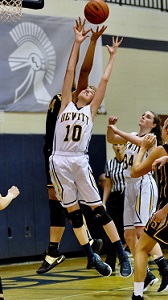 In the sports of boys and girls basketball, and girls volleyball, the number of schools sponsoring the sports were so close to the overall membership of the MHSAA that divisions were not necessary; the enrollment breakdowns themselves were enough to delineate equal opportunity for tournament success.
That is no longer the case, according to MHSAA membership. The last move from classes to divisions occurred for the 2006-07 school year following Council action. Before this May, that is. Action at the most recent Representative Council meeting, May 2017, called for the shift to divisions for MHSAA Boys and Girls Basketball, and Girls Volleyball, beginning with the 2018-19 season.
“Because the MHSAA Volleyball Committee had requested this change several times a number of years ago, and because the Council felt the change inevitable, there should not be further delay,” Roberts said. “It is an important detail that the Class D maximum has dropped 50 students over the past decade so the objection that much larger schools would be competing in Division 4 isn’t very strong now.”
Using the 2017-18 enrollment figures, just eight Class C schools would be competing in Division 4 for boys basketball, 11 for girls basketball and 14 for girls volleyball.
Good things came of the previous most-recent switches in 2006-07. Competitive Cheer was re-classified from Class A, B and C-D into four equal divisions assisting in the rapid growth of sponsoring schools (approximately 80 schools per division). Alpine skiing was changed from Class A and B-C D to two equal divisions.
At that time, the MHSAA Basketball Committee had recommended to the Council the study of increased classifications, but status quo remained.
Back on the grid
As such, MHSAA Basketball and Volleyball remained the only holdovers of the MHSAA class structure. Discussion resurfaced periodically during the last two decades to bring those tournaments in line with the other MHSAA sports.
Regular-season football-playing schools are separated by class, then are reshuffled by divisions for the playoffs. Football, as we know, underwent a significant postseason facelift in the late 1990s.
While MHSAA Football also remained a class sport through 1998, it had expanded from four to eight classes from 1990-98, becoming the first MHSAA sport to crown more than four team champions. Member schools were asked to consider a pair of options in November of 1997. One called for eight equal divisions, and the second would leave Class D by itself as division 8, and split Class A, B and C schools into seven nearly equal divisions.
After much discussion, retooling, and crunching of formulas, the MHSAA unveiled its revised Football Playoff model that continues to roll today, nearly 20 years later. It was determined that 256 teams would qualify for the tournament based first on a minimum of six wins, then by Playoff Points determined by formula. From there, the field would be divided into eight divisions, with the field being filled out by a nearly equal number of five-win teams in each division as needed to reach 256.
Eight championships would indeed be enough, until football sponsorship among the MHSAA’s smallest schools – some with rich football traditions – began to trend downward. The MHSAA again went to the drawing board, examining the viability of 8-player football. After an experimental year in 2010 without a tournament, the 8-player game was playoff-ready for 2011, with a field of 16 qualifiers embarking on a four-week tournament.
Not only did the 8-player option restore recently canceled programs, but it also created teams in schools which previously had none, and convinced some 11-player schools that this new division was the best path to take.
What did this do for the Class D holdovers staying in the traditional 11-player game? Well, a couple of things, positive and negative. As two and three dozen Class D schools opted for the 8-player game, the remaining 11-player Class D schools at times found themselves in disrupted leagues and had to travel further to complete schedules. They also competed against larger teams in Division 8 of the 11-player MHSAA Football Playoffs.
However, the growth of the 8-player game among the smallest schools also resulted in more Class D schools qualifying for the MHSAA Football Playoffs than ever before. In 2012, an all-time high 44 percent of Class D schools sponsoring football qualified for either the 8-player tournament or Division 8 of the 11-player tournament. That compared to 42.2 percent of Class C schools, 44.9 percent of Class B schools and 41.6 percent of Class A schools which qualified for the 2012 playoffs.
Much is to be determined in the most recent chapter of MHSAA Tournament expansion as the 8-Player Football Playoffs welcome a second division. As the past illustrates, there will be pluses and minuses. History also shows that the MHSAA has received maximum input from its constituents, researched all possibilities, and will find solutions to questions still in the balance before an additional group of athletes hoists a new trophy in November.
Through the Years
A chronology of when which sports moved from Class to Division in the MHSAA.
1995-96: LP Wrestling
1997-98: Baseball, Boys Soccer, Girls Soccer, Softball, LP Girls Tennis, LP Boys Tennis
1998-99: LP Boys Golf, LP Girls Golf
1999-2000: Ice Hockey, LP Boys Track & Field, LP Girls Track & Field
2000-01: LP Boys Cross Country, LP Girls Cross Country, UP Boys Cross Country, UP Girls Cross Country, UP Boys Golf, UP Girls Golf, UP Boys Tennis, UP Girls Tennis, UP Boys Track & Field, UP Girls Track & Field
2002-03: LP Girls Swimming & Diving, LP Boys Swimming & Diving
2005-06: Boys Bowling, Girls Bowling
2006-07: Girls Competitive Cheer, Boys Skiing, Girls Skiing
2018-19: Boys Basketball, Girls Basketball, Girls Volleyball
Note: Boys and Girls Lacrosse has been a divisional sport since it began in during the 2004-05 school year.
'World's Game' Makes Home in Metro Detroit, Then Grows Statewide
By
Ron Pesch
MHSAA historian
November 3, 2021
In the fall of 1982, Livonia Stevenson assistant coach Ralph Aulicino suggested to Detroit Free Press stringer Jon Pepper that “somewhere along the Livonia city limits” there should be a sign erected that proclaimed the Detroit suburb as “the state capital of soccer.”
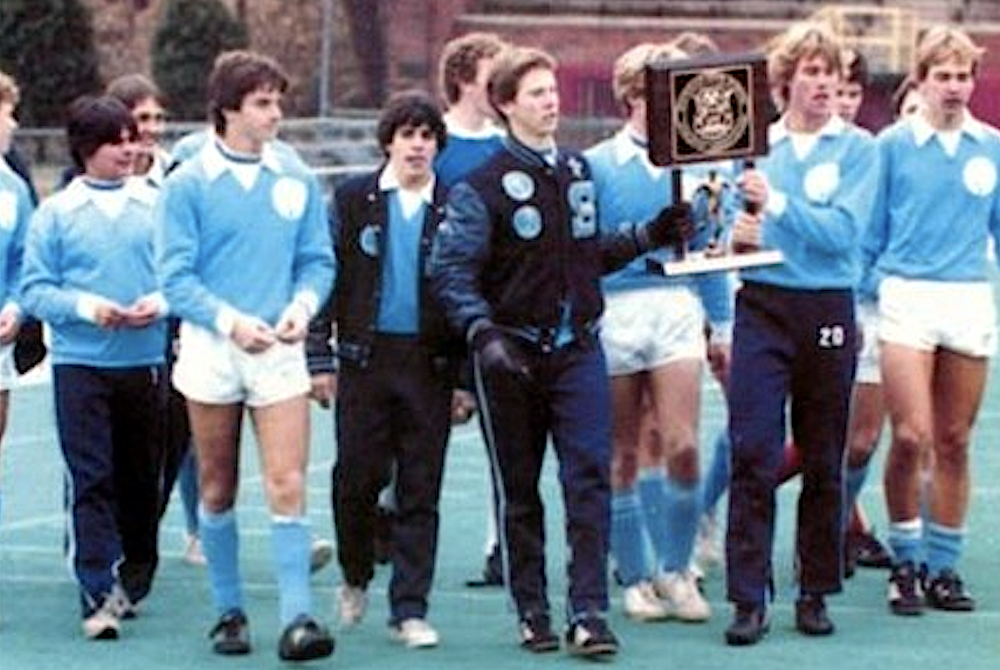
Stevenson’s Spartans had just beaten crosstown rival Livonia Churchill 4-1 in what some called “The Battle of Livonia.” The contest, played at Flint’s Atwood Stadium, was the first-ever Class A Boys Soccer Final sponsored by the Michigan High School Athletic Association.
Guided by head coach Pious (Pete) Scerri, a former first division player in England, Stevenson finished the year with a flawless 22-0 record. Gary Mexicotte scored twice for the Spartans in the title game, finishing with 48 goals on the season. In December, he was named prep All-American.
Aulicino’s statement might have been considered a bit arrogant within the soccer community. Still, there was little question that the surrounding burgs of the Motor City were the hub of the prep soccer world in Michigan at the time.
The Hamtramck Cosmos, coached by John Geremich, finished with the MHSAA’s Class B-C honor while Grosse Pointe Woods University Liggett, coached by David Backhurst, earned the Class D trophy in the autumn tournament. The Knights finished the year with an 18-1-1 mark, and would repeat as champs in 1983, but this time in Class B-C.
Dominant
Looking back today, Aulicino’s words were prognostic.
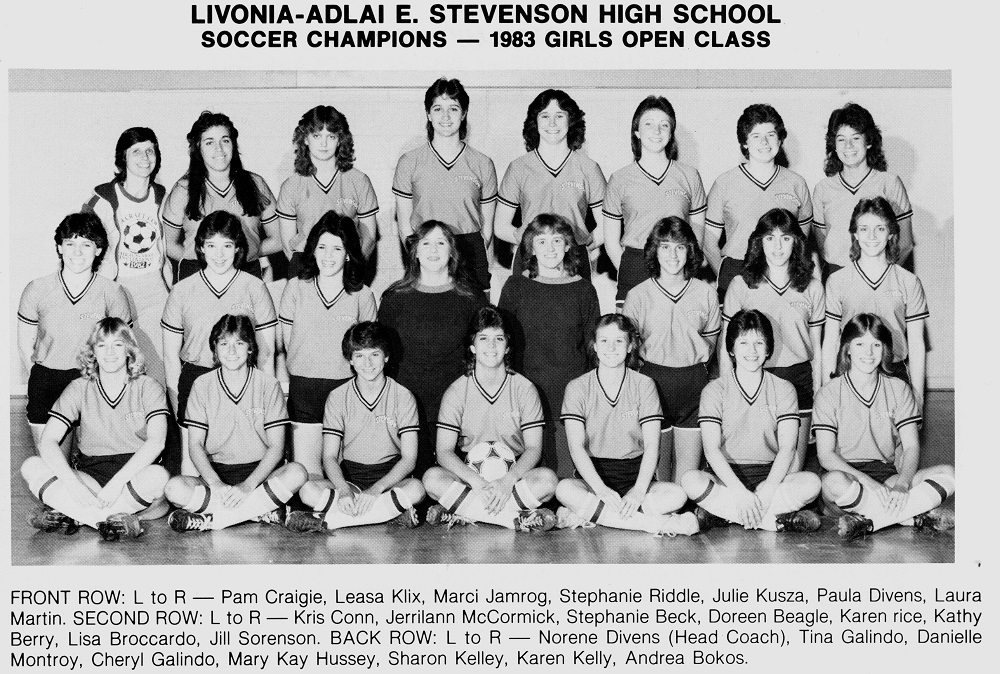
In the spring of 1983, Stevenson’s girls, coached by Norene Divens, grabbed the MHSAA’s first Open Class championship – meaning schools of all sizes competed in one division – with an 8-0 win over Saginaw Eisenhower.
Then Scerri’s boys would appear in an incredible six of the first seven Class A title games, winning four. Divens’ girls appeared in the first three Open championships, winning two while finishing runners-up to Northville in a 5-4 overtime battle in 1984. Churchill’s girls won the 1986 Open title. When the MHSAA expanded the girls postseason to two divisions, Churchill finished runner-up in Class A to Plymouth Salem – yet another metro Detroit high school – in the springs of both 1987 and 1988.
Allen Park Inter-City Baptist won three straight boys Class D titles from 1983 to 1985.
Coach Scerri did emphasize the importance of the moment to the development and changing landscape of sports in Michigan following that first championship:
“Let me put it this way. Usually, we get the rejects from the football team. This year, the football team took three rejects from us. It’s going the other way around now.”
Culinary Delights, Old World Music, and Soccer
The chance to play for an MHSAA Finals title must have been a joyous occasion in the vibrant community of Hamtramck. Geremich, whose team won that first Class B-C championship, explained the city’s connection to the sport in 1980.
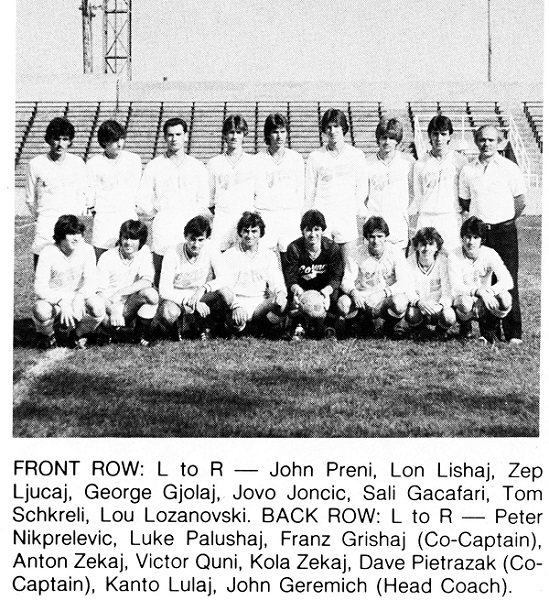 “We’ve got a lot of Yugoslavian and Albanian kids who were brought up on soccer,” he told the Free Press. “Their parents never played football and baseball, so they look to soccer.”
Geremich himself was one of those kids. He came to America in 1958 from Serbia and attended Hamtramck. Soccer, however, wasn’t an option at Hamtramck during his days in high school.
Without that outlet, Geremich along with classmates Francisco ‘Pancho’ Castillo from Colombia and Jerry Podesek from Poland, all became standouts in the school’s outstanding tennis program instead. The Cosmos won 11 consecutive MHSAA Class A team tennis state titles from 1949 to 1959, and 18 of 21 between 1949 and 1969. The trio would later attend and play tennis at Southern Illinois University together.
“All three readily admit that soccer and not tennis are the national pastimes in their homelands,” stated the Grand Rapids Press in 1958.
Hamtramck’s top player in 1982 was Kanto Lulaj, who had been playing soccer since the third grade. Only a few years earlier, his family had come to Hamtramck from Albania. A 150-pound junior center-forward, he finished that championship season as Michigan’s most prolific scorer, notching 56 goals. A four-year varsity starter, he was named All-American in 1983, then played collegiately at the University of Connecticut.
Pockets
Delving into the game’s earliest history at the prep level in Michigan certainly helps explain the area’s dominance. Wildly popular among the immigrant population employed in plants across southeastern Michigan, men’s factory and recreational soccer leagues flourished in and around Detroit for years.
The Holley Carburetor F.C. team, sponsored by Detroit’s Holley Brothers Company, gained coast-to-coast attention as it battled to the National Challenge Cup championship game (today known as the Lamar Hunt US Open Cup), played before 10,000 fans at University of Detroit stadium in May 1927. A Detroit professional circuit even came into existence that same year. The short-lived Detroit Cougars, according to the Free Press, were the first incorporated soccer club in Michigan.
“School soccer enjoyed a successful season,” said the Free Press in 1928, “especially in the elementary and intermediate grades, in which more than 17,000 boys participated in the schedule formulated by the health education department of the Detroit public schools.”
Ultimately, the increasing popularity of American football among boys (and spectators) overwhelmed soccer within public school districts, and soccer never became much more than an activity played outside school, or perhaps sometimes during gym class.
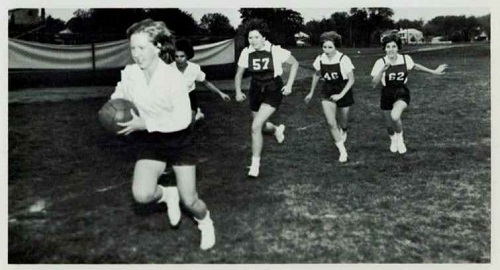 Soccer, or at least a form of the game, did appear as an intramural athletic activity in girls gym classes across the state dating back into the 1920s. Occasionally, especially in small towns, contests were played between schools from neighboring districts. For example, Buchanan’s senior girls defeated the sophomore girls from their old rival Niles, 2-0, in 1928.
As state and national debate grew concerning the capacity and value of athletic activity and competition amongst girls, the sport was often modified within districts. At Ludington, speedball replaced soccer in 1948-49. At Birmingham Seaholm in 1962, girls participated in speed-o-way, a game similar to soccer that allowed use of the hands.
A Spark
Prep soccer programs found a spark among the boys at select schools in the suburbs of Detroit during the late 1950s and early 60s.
“(Initially) the only people that were playing anything approaching league soccer were the private schools,” recalled John Sala, a former coach at Birmingham Groves.
These programs were started as club sports, representing a school, but generally run outside the finances, guidance, and official sponsorship of a school’s athletic department. Opponents came where they could be found.
School yearbooks from the past help tell the tale.
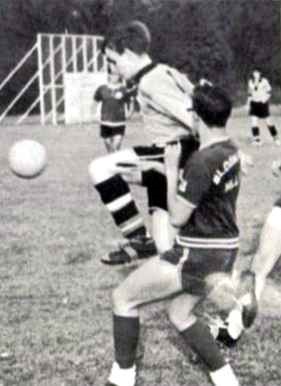 The sport was played at Bloomfield Hills Cranbrook in the 1930s, 1940s, and 1950s with games played against other private schools in Canada, Ohio, Illinois, western New York state, and Pennsylvania. Michigan schools first began appearing on the schedule in the 1960s.
The team at Grosse Pointe University School (GPUS), according to its 1964 annual, “was founded five years ago by Mr. Preston, who returned this year to coach it.” The season was comprised of only six games, played against three opponents – Cranbrook, Bloomfield Hills and a season-ending game with “Preston’s Ringers.”
“With soccer only in its second year as a Varsity sport … the 1965 team showed a promise of successful seasons to come,” read the Bloomfield Hills High School yearbook. The boys finished the year with a 5-3-1 record. “Since soccer has yet to become a league sport,” the Barons faced squads from Cranbrook, GPUS, and Oakland University, as well as teams from Lowe Tech and Sarnia, both from Ontario, Canada.
Soccer became a varsity sport at Detroit Country Day School in 1965. That team finished with a 3-2-3 mark, playing contests with GPUS, Maumee, Ohio, and a newly-formed club team from Groves:
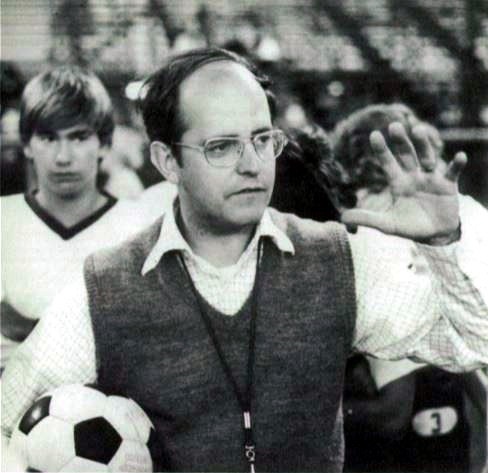 “After a late start in practice because they lacked a coach and equipment, Groves’ first soccer team introduced the rugged game to Birmingham varsity sports. Mr. John Sala took over coaching duties and helped the boys make the transition from last year’s club status to a varsity team with a full season schedule. The arrival of goals and other equipment and the donation of uniforms by Mr. Harrison Tracy boosted team morale and their play improved noticeably.”
“When I was at Groves and starting out coaching (in 1966), I knew absolutely nothing other than having watched it,” recalled Sala, laughing at the memory. “They had a club team run by another staff member … and he left. Basically, they called me down to the office … I thought I was going to get reprimanded. (Instead) she says, ‘We have to have a coach by 4:00 today.’ I said, ‘How much does it pay?’ She said ‘$300.’ It sounds like a lot of money to me. So, I learned by doing.”
Sponsorship of soccer soon spread to other public schools in the immediate area, with teams appearing at Bloomfield Hills schools Andover and Lahser, the Livonia schools, Birmingham Seaholm, and Ferndale.
West Michigan
On the other side of the state, the soccer seed was taking root in the Greater Grand Rapids area.
“Central Christian, champion of the Christian High School Soccer League, completed its season Saturday morning at Calvin College’s Knollcrest Field by defeating Holland Christian, 3-1,” stated the Grand Rapids Press in October 1966. The four-team league also included Hudsonville Unity Christian and Grand Rapids Calvin Christian.
A year later, Kalamazoo Christian was added to the league, then Muskegon Western Michigan Christian (WMC). Casey Ver Haar, an honorable mention All-American goalie in soccer at Calvin College, coached Central Christian. Dave VerMerris, a former track star at Central Christian, then at Calvin College, took the job at WMC as coach at age 22. He had first given soccer a try as a freshman in college.
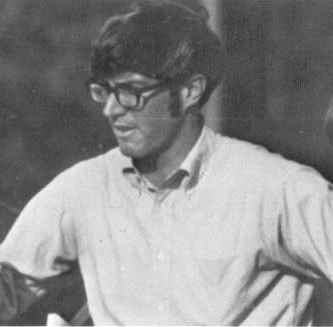 “Calvin that year had graduated quite a few of their soccer players,” recalled VerMerris, explaining how that began. “(Several) of their soccer players were immigrants – Dutch immigrants. They were hurting for bodies …”
Marv Zuidema, the soccer coach, approached VerMerris sometime in August of 1964 and suggested he give the sport a try.
“I had some speed back in those days, and speed can take care of a lot of things if you don’t have the skill,” said VerMerris, chuckling. “His dream was I would outrun their defense and put the ball in the net. That never happened.”
Sport of the Future
Christian League officials were pleased with the level of competition and attendance at games. Between 100 and 150 spectators were showing up for contests.
“While (the) majority of West Michigan schools compete in nine major sports now,” noted longtime Press sportswriter Joe Vanderhoff in 1968, “it would be a good idea for some of the officials (at other schools) to look into the game of soccer. It’s been the No. 1 sport in Europe for years.”
According to MHSAA surveys, only 12 schools sponsored boys varsity soccer teams during the 1969-70 school year, with somewhere around 300 participants. By the 1975-76 school year, the numbers had grown to 35 schools and 1,085 participants. (Another dozen or so schools had club teams).
Without the numbers needed to meet the threshold for tournament sponsorship set by the MHSAA, the Michigan High School Soccer Coaches Association chose to host a 16-team playoff invitational beginning in the fall of 1975 to name a state champion. Groves, which had played in the 10-team North Woodward Conference, emerged from the knockout brackets to win that first title, defeating Hudsonville Unity Christian, 6-1. According to Free Press coverage at the time, more than 500 attended the championship game.
Undeniably, the sport was exploding in popularity at the participation level with American Youth Soccer Organization (AYSO)-affiliated clubs across the state. A Free Press article had noted that “a soccer team can be outfitted for about one-tenth the cost of a hockey player or one-fifth the cost of a football candidate.”
Still, it would take time. Invitational title tourneys, initially sponsored by the Coaches Association, were continued for six more years. The 1977 open-class single-elimination tournament featured 32 teams, with the state broken into eight regions.
“After a few years, they split it into an ‘A-B’ and ‘C-D’ (classification), recalled VerMerris, who remained at WMC for 30 years. “In 1979, we won the whole shooting match. In 1980, we won ‘C-D’.”
Soccer in Mid and Northern Michigan
Too small to sponsor 11-player football teams, Leland, Northport, Buckley, Lake Leelanau St. Mary, and The Leelanau School in Glen Arbor added soccer to the mix of varsity sports played within the Cherryland Conference in the fall of 1970. Leland’s Comets won the league’s first title that season.
Soccer first hit the Lansing area as a varsity sport beginning in the late 1970s.
“Right now East Lansing High is the only major area school which has included soccer in its interscholastic program,” Lansing Journal correspondent Keith Gave wrote in 1978. “In only its second year, the program brought out 70 students, enough for a varsity team and two junior varsity teams.
“Filling a schedule was a slight problem because few area schools play the game. Holt St. Matthew has had a program for about four years and Lansing Capitol City Christian has one. In fact, up until a few years ago the only soccer to be found at the interscholastic level was in the smaller, parochial schools which didn’t have football programs.
“But,” said East Lansing coach Nick Archer, “it’s just a matter of time before it’ll be all over. The game is just exploding at the youth level.”
Archer, who would coach the Trojans for 41 years, had played soccer at Michigan State and was part of the 1967 and 1968 national champion squads with the Spartans. He had scheduled games with Roeper, Cranbrook, first-year varsity teams from Saginaw Eisenhower and Flint Carman, and with Ann Arbor schools Pioneer and Huron, both in their second year of varsity competition.
Critical Mass Achieved
“In 1974-75, the cheerleaders came to me and said, ‘We want to play soccer,’” recalled Sala. “I had about 85 girls show up so I split them up into four teams – a freshman, sophomore, junior and senior team – an informal thing for the first few years. With Title IX, we already had a club team going – a reliable program.”
Soccer was made a girls varsity sport at Groves during the 1977-78 school year. Girls teams were also active at Livonia and Farmington schools, as well as at Andover, Seaholm, Lahser, and Roeper.
Numbers grew across the state to 71 boys teams and eight girls teams during the 1979-80 school year, then to 84 boys and 36 girls squads a year later.
In December 1980, a committee of superintendents, principals and athletic directors recommended to the MHSAA Representative Council that it sponsor a state soccer tournament for boys and girls beginning with the 1982-83 school year. The Representative Council concurred with the suggestion.
Troy Athens, coached by Tim Storch, one of Sala’s former players at Birmingham Groves, won the last of the A-B invitational soccer championships, played in November 1981. Four of his boys teams and four of his girls teams would later go on to win MHSAA soccer titles. Detroit Country Day won the final C-D Division invitational crown in the spring of 1982.
“More than 45,000 boys and girls in the Detroit metropolitan area – the majority of them in Oakland County – now play in youth soccer programs sponsored by communities, clubs and businesses,” stated Johnette Howard in a Free Press article on the country’s “latest boom sport,” published in September 1982.
“The skill levels of the players are unbelievably improved,” said Bloomfield Hills Lahser coach Chet Schultz. “There is not a boy on my varsity team that hasn’t played at least five or six years.”
Not all coaches were in favor of the move to MHSAA sponsorship.
“Some coaches didn’t like having the MHSAA dictate the number of games to be played, when the season could start, rules for playing Canadian teams, coaching accountability, etc.,” stated VerMerris, who played witness to, then researched and captured detail on those early days of play in West Michigan and across the state.
“The MHSSCA was very instrumental in helping make this a smooth transition and the MHSAA was very willing to work with us. Not surprisingly, not everyone was happy but this legitimized the sport and put it on a par with all the other MHSAA sponsored sports.”
 Ron Pesch has taken an active role in researching the history of MHSAA events since 1985 and began writing for MHSAA Finals programs in 1986, adding additional features and "flashbacks" in 1992. He inherited the title of MHSAA historian from the late Dick Kishpaugh following the 1993-94 school year, and resides in Muskegon. Contact him at [email protected] with ideas for historical articles.
PHOTOS (Top) Livonia Stevenson carries its trophy off the field at Atwood Stadium. (2) Hamtramck was the first Class B-C champion. (3) Birmingham Seaholm students play speed-o-way during the 1962-63 school year. (4) A Bloomfield Hills Cranbrook player possesses the ball during the 1964-65 school year. (5) Birmingham Groves coach John Sala speaks to his team during the 1975 season. (6) Dave VerMerris became the Western Michigan Christian coach at age 22 and led the program for 30 years. (7) Stevenson’s girls won the first MHSAA Open Class championship in 1983. (Photos collected by Ron Pesch.)