

Class in Session: A History in Classification
July 24, 2017
By Rob Kaminski
MHSAA benchmarks editor
This is the first part in a series on MHSAA tournament classification, past and present, that will be published over the next two weeks. This series originally ran in this spring's edition of MHSAA benchmarks.
Conversation and discussion at the March 2017 MHSAA Representative Council Meeting leaned heavily toward the subject of 8-Player Football and how to properly balance its tournament with the growing number of schools sponsoring the sport.
While the proposal to split the tournament into two divisions beginning with the 2017 school year was adopted, the MHSAA then faced questions such as when to set the divisions, how to determine qualifiers and where to host the championship games.
The topic continues to create a buzz in Class D schools across both peninsulas, and likely will do into the start of school this fall.
Likewise, the lone holdouts still conducting tournaments by class – MHSAA Boys and Girls Basketball and Girls Volleyball – took center stage at the May Council discussion, and following the 2017-18 school year, class is out for good. Both genders of basketball, and girls volleyball, will move to divisional formats thereafter.
There is much to be decided to be sure; but as those in education are well aware, history is the best teacher.
Fortunately for the sports in flux and for all sports under the governance of the MHSAA, the Association more or less wrote the book on the subject of sport classification. Following is a history lesson, with a little advanced division thrown in.
Class structure
Credited with being the first state with multiple tournament classifications, Michigan’s attention to trends and shifts in philosophy aimed at fair play and equal tournament opportunity can be traced from 80 years ago to the present.
In the earliest years of the MHSAA, there were four classifications for elections and tournaments – Classes A, B, C and D. Classes C and D had far more schools than Classes A and B. For example, 80 years ago (1937), there were only 58 schools in Class A, 94 schools in Class B, 297 schools in Class C and 253 schools in Class D.
Gradually through the years, as Michigan’s major cities spawned suburbs, there was a shift in the other direction to the point 30 years ago (1987) when school size became more balanced: 173 Class A schools, 178 Class B schools, 179 Class C schools and 182 Class D schools.
Up until 1987, the MHSAA published the dividing line between each classification, after which schools submitted their enrollments. Then, for 1988 and thereafter, the MHSAA adopted the plan of gathering all enrollments first and then placing 25 percent of the schools in each of four classes. This completed the equalization of the number of schools in each class for elections.
However, the change for 1988 did nothing to equalize the number of teams actually entered by each class in each sport. And unlike the early years of the Association when there were many more Class C and D teams than A and B teams, there were more Class A and B teams than C and D teams entering MHSAA tournaments decades later.
Moreover, the difference in number of teams entered in the different classifications for a sport continued to increase as many small schools, the fastest growing portion of the MHSAA's membership, sponsor only a few sports, or they sponsor no sports at all but enter into cooperative programs with other schools.
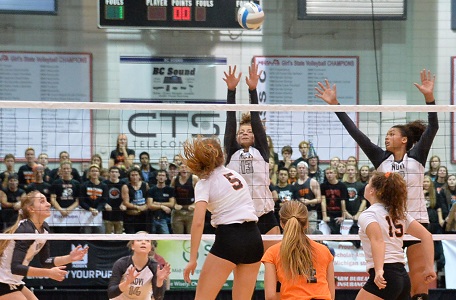 Because of these differences, Class A or B schools sometimes had to win twice as many games as Class C or D schools to reach the MHSAA Finals in a sport. At times, the larger classifications had District Tournaments, even rat-tail games, and/or a Quarterfinal game, and the smaller classifications did not. Most Class D Districts have had four teams (some only three), while Class A Districts often had seven or eight teams. In Regional levels of individual sports, the number of entries in the larger classification once greatly outnumbered those in the smaller classifications of the tournament for the same sport.
Over the years, these dividing lines between classes escalated gradually, as did the differences in enrollments of largest and small schools in each class. In 1937 the dividing lines were 700, 300 and 100 between Class A and B, B and C, and C and D, respectively. By 1987, the dividing lines were 1,129, 571 and 298, respectively, leading to the current method of collecting enrollments and then setting the classification.
With the pendulum swinging well past center by the late 1980s, coaches associations, MHSAA sport committees, tournament managers and school administrators began discussion and offered proposals to correct what many believed had become a flawed system of MHSAA tournament classification.
At the 1996 MHSAA Update Meetings, ¾ of 858 respondents to that year’s annual survey indicated they favored a system that would divide schools which actually sponsor each sport into two, three or four nearly equal divisions.
Problem solving
At its meeting May 4-6, 1997, the Representative Council defeated a motion that would have adopted in one action a coordinated plan of reclassification for all sports to equalize the number of schools in each tournament for each respective sport. Instead, the Council discussed and voted on each proposal that had been presented from sport committees.
This resulted in the Representative Council adopting four equal divisions for baseball and softball, four equal divisions for boys and girls tennis, four equal divisions for boys soccer and three equal divisions for girls soccer, effective with the 1997-98 school year. Helping in the decision was the success of the 1995-96 MHSAA Wrestling season, which saw the sport move to four divisions for its tournament structure
The Council delayed action on similar proposals for football and boys golf at that time to glean additional input. The same decision was made with respect to a proposal from the Ice Hockey Committee that would have split the Class A schools in two divisions and left the Class B/C/D Tournament unchanged.
“The gist of the move from classes to divisions was to equalize the path to championships for students of all schools, regardless of the size of those schools,” said MHSAA Executive Director Jack Roberts.
While the restructuring accomplished that goal for the majority of competitors, opposition exists now as it did then. The primary argument in opposition to the changes is that, in some sports, it increases the range between largest and smallest schools in the division for smallest schools, even as the range is usually reduced for other divisions.
Larger schools offered a counterpoint.
“The larger schools suggested that while they may have more students, they also attempt to sponsor more sports than the smaller schools, in some cases spreading the enrollment as thin as a much smaller school with fewer sports,” Roberts said.
“Even today, the idea of four equal divisions can be unpopular among some Class D schools which feel especially burdened by the equal division concept,” Roberts said. “There was enough opposition in 1997 that equal divisions were rejected for boys and girls basketball and girls volleyball, and some of that opposition remains.”
The numbers of schools sponsoring each MHSAA tournament are still close to the totals today, with the exception of soccer in both genders, which has enjoyed substantial increases. This spring, 466 girls teams were scheduled to compete in the MHSAA Soccer Tournament, while 473 boys teams will suit up this fall.
Since the beginning of MHSAA divisions in 1996 with wrestling, 147 additional team champions have been crowned and countless individuals have known the thrill of victory due to an extra level of Finals in various sports. Girls soccer has seen the most growth in opportunity, moving from two classes in 1987 to three divisions the following year, and then four divisions in 2000. Boys soccer had enjoyed four classes for two years prior to the new four-division format, and it was the sport of soccer that helped to create a caveat in the nearly equal division movement.
Lower Peninsula boys and girls swimming & diving expanded from two to three divisions in 2008, while boys and girls bowling are the most recent sports to enjoy increased tournament opportunity, adding a fourth division in 2010.
“Fairness is in the eye of the beholder. While having the same number of schools in each division is one kind of fairness, holding in check the enrollment range between the largest and smallest schools in Division 4 is another kind of fairness that is dear to a great number of people,” Roberts said. “Because more schools sponsor basketball and volleyball than other sports, Class D schools would have been least affected by the equal divisions concept in those sports; but that, and ‘tradition,’ did not dissuade the opponents in the 1990s.”
The shift to divisions not only paved the way for student-athletes, but also assisted administrators and schools hosting tournaments. MHSAA tournament mangers looked to equal divisions to more closely equalize the number of schools in District or Regional Tournaments and to better equalize the length of day required for these rounds of tournaments, both for management and participating teams and individuals.
Pinning down an answer
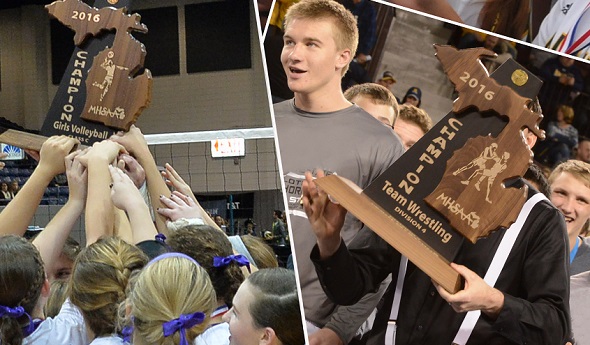
Wrestling became the first MHSAA Tournament to be conducted in nearly equal divisions when team and individual champions were crowned in Divisions 1, 2, 3 and 4 rather than Classes A, B, C/D for the 1996 winter championships.
The movement was well received, as schools saw more opportunity for success: four champions where there once were three at the District, Regional and Final levels, and a smaller range of enrollment between the smallest and largest school in all four tournaments, leading to the impetus for the Fall 1996 Update Meeting Survey of schools regarding similar movement in other sports.
Team champions that year were Holt (D1), Petoskey (D2), Middleville Thornapple Kellogg (D3) and Dundee (D4).
Getting their kicks
When the "equal divisions" concept was approved by the Representative Council for most MHSAA Tournaments for the 1997-98 school year, there was opposition from the smallest schools which, under the equal divisions, are forced to play against larger schools than reside in Class D. Compelling arguments were made – and still are – that an enrollment difference between schools with smaller enrollments (e.g., Class D) is more difficult to overcome in athletic competition than an even larger enrollment difference between schools with larger enrollments (e.g., Class A).
The opposition was most intense in soccer because of the number of students needed to field a team and the physical nature of the sport. As a result, from 2000-01 through 2010-11, soccer operated with a “20-percent modification.” This placed 20 percent of all schools that actually sponsored soccer in Division 4, and the remaining 80 percent were placed equally in Divisions 1, 2 and 3.
At the time the 20 percent modification was adopted, it was also established that soccer would return to four equal divisions when the largest Division 4 soccer school had an enrollment equal to or smaller than the mid point for Class C schools. That occurred in 2010.
Last class on the schedule
In the same volume of “history being the best teacher,” one can also find the adage, “times change.” While the division format was a welcome change in some sports, others were left to hold class without change.
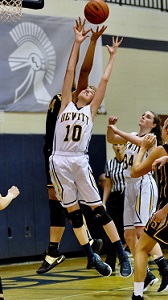 In the sports of boys and girls basketball, and girls volleyball, the number of schools sponsoring the sports were so close to the overall membership of the MHSAA that divisions were not necessary; the enrollment breakdowns themselves were enough to delineate equal opportunity for tournament success.
That is no longer the case, according to MHSAA membership. The last move from classes to divisions occurred for the 2006-07 school year following Council action. Before this May, that is. Action at the most recent Representative Council meeting, May 2017, called for the shift to divisions for MHSAA Boys and Girls Basketball, and Girls Volleyball, beginning with the 2018-19 season.
“Because the MHSAA Volleyball Committee had requested this change several times a number of years ago, and because the Council felt the change inevitable, there should not be further delay,” Roberts said. “It is an important detail that the Class D maximum has dropped 50 students over the past decade so the objection that much larger schools would be competing in Division 4 isn’t very strong now.”
Using the 2017-18 enrollment figures, just eight Class C schools would be competing in Division 4 for boys basketball, 11 for girls basketball and 14 for girls volleyball.
Good things came of the previous most-recent switches in 2006-07. Competitive Cheer was re-classified from Class A, B and C-D into four equal divisions assisting in the rapid growth of sponsoring schools (approximately 80 schools per division). Alpine skiing was changed from Class A and B-C D to two equal divisions.
At that time, the MHSAA Basketball Committee had recommended to the Council the study of increased classifications, but status quo remained.
Back on the grid
As such, MHSAA Basketball and Volleyball remained the only holdovers of the MHSAA class structure. Discussion resurfaced periodically during the last two decades to bring those tournaments in line with the other MHSAA sports.
Regular-season football-playing schools are separated by class, then are reshuffled by divisions for the playoffs. Football, as we know, underwent a significant postseason facelift in the late 1990s.
While MHSAA Football also remained a class sport through 1998, it had expanded from four to eight classes from 1990-98, becoming the first MHSAA sport to crown more than four team champions. Member schools were asked to consider a pair of options in November of 1997. One called for eight equal divisions, and the second would leave Class D by itself as division 8, and split Class A, B and C schools into seven nearly equal divisions.
After much discussion, retooling, and crunching of formulas, the MHSAA unveiled its revised Football Playoff model that continues to roll today, nearly 20 years later. It was determined that 256 teams would qualify for the tournament based first on a minimum of six wins, then by Playoff Points determined by formula. From there, the field would be divided into eight divisions, with the field being filled out by a nearly equal number of five-win teams in each division as needed to reach 256.
Eight championships would indeed be enough, until football sponsorship among the MHSAA’s smallest schools – some with rich football traditions – began to trend downward. The MHSAA again went to the drawing board, examining the viability of 8-player football. After an experimental year in 2010 without a tournament, the 8-player game was playoff-ready for 2011, with a field of 16 qualifiers embarking on a four-week tournament.
Not only did the 8-player option restore recently canceled programs, but it also created teams in schools which previously had none, and convinced some 11-player schools that this new division was the best path to take.
What did this do for the Class D holdovers staying in the traditional 11-player game? Well, a couple of things, positive and negative. As two and three dozen Class D schools opted for the 8-player game, the remaining 11-player Class D schools at times found themselves in disrupted leagues and had to travel further to complete schedules. They also competed against larger teams in Division 8 of the 11-player MHSAA Football Playoffs.
However, the growth of the 8-player game among the smallest schools also resulted in more Class D schools qualifying for the MHSAA Football Playoffs than ever before. In 2012, an all-time high 44 percent of Class D schools sponsoring football qualified for either the 8-player tournament or Division 8 of the 11-player tournament. That compared to 42.2 percent of Class C schools, 44.9 percent of Class B schools and 41.6 percent of Class A schools which qualified for the 2012 playoffs.
Much is to be determined in the most recent chapter of MHSAA Tournament expansion as the 8-Player Football Playoffs welcome a second division. As the past illustrates, there will be pluses and minuses. History also shows that the MHSAA has received maximum input from its constituents, researched all possibilities, and will find solutions to questions still in the balance before an additional group of athletes hoists a new trophy in November.
Through the Years
A chronology of when which sports moved from Class to Division in the MHSAA.
1995-96: LP Wrestling
1997-98: Baseball, Boys Soccer, Girls Soccer, Softball, LP Girls Tennis, LP Boys Tennis
1998-99: LP Boys Golf, LP Girls Golf
1999-2000: Ice Hockey, LP Boys Track & Field, LP Girls Track & Field
2000-01: LP Boys Cross Country, LP Girls Cross Country, UP Boys Cross Country, UP Girls Cross Country, UP Boys Golf, UP Girls Golf, UP Boys Tennis, UP Girls Tennis, UP Boys Track & Field, UP Girls Track & Field
2002-03: LP Girls Swimming & Diving, LP Boys Swimming & Diving
2005-06: Boys Bowling, Girls Bowling
2006-07: Girls Competitive Cheer, Boys Skiing, Girls Skiing
2018-19: Boys Basketball, Girls Basketball, Girls Volleyball
Note: Boys and Girls Lacrosse has been a divisional sport since it began in during the 2004-05 school year.
Scholars & Athletes 2021: Class A
By
Geoff Kimmerly
MHSAA.com senior editor
February 23, 2021
The Michigan High School Athletic Association has selected 14 student-athletes from Class A member schools to receive scholarships through the MHSAA/Farm Bureau Insurance Scholar-Athlete Award program.

Farm Bureau Insurance, in its 32nd year of sponsoring the award, will give $1,000 college scholarships to 32 individuals who represent their member schools in at least one sport in which the Association sponsors a postseason tournament. The first 30 scholarships are awarded proportionately by school classification and the number of student-athletes involved in those classes; also, there are two at-large honorees who can come from any classification.
Students applying for the Scholar-Athlete Award must be carrying at least a 3.5 (on a 4.0 scale) grade-point average and have previously won a letter in a varsity sport in which the Michigan High School Athletic Association sponsors a postseason tournament. Other requirements for the applicants were to show active participation in other school and community activities and produce an essay on the importance of sportsmanship in educational athletics.
Each of the scholarship recipients will be honored during an online ceremony later this winter. Commemorative medallions will be given to the finalists in recognition of their accomplishments.
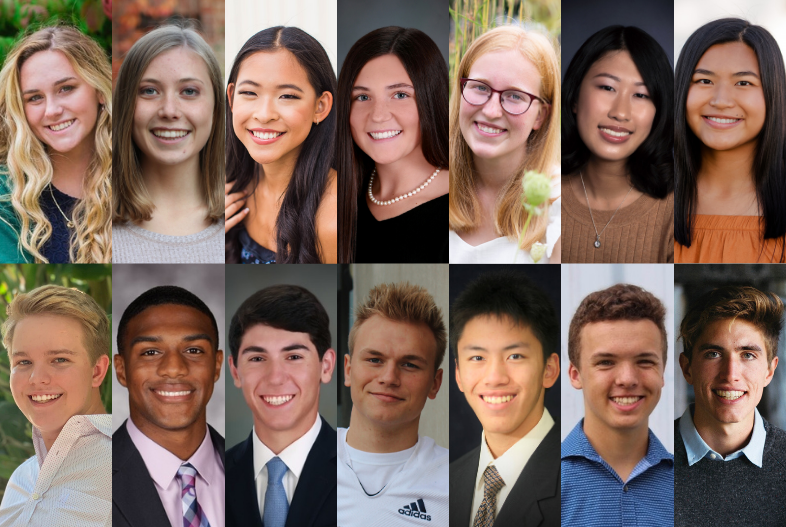
The Class A Scholar-Athlete Award honorees are: Michaela Castle, Ionia; Audrey DaDamio, Birmingham Seaholm; Iris Hwang, Mount Pleasant; Madeline Kohler, Grosse Pointe North; Laura O’Brien, Ann Arbor Skyline; Emily Song, Canton; Zoe Ziegler, Okemos; Aidan Eichman, Portage Central; Lawrence Gilliam, Detroit U-D Jesuit; Jacob Harris, Grosse Pointe South; Troy Pratley, St. Joseph; Caleb Qiu, Midland Dow; Liam Smith, Rockford; and Maxwell Werner, Traverse City Central.
Overviews of the scholarship recipients of the Class A Scholar-Athlete Award follow. A quote from each recipient's essay also is included:
(NOTE: If an athlete intended to play and was part of a spring sports team in 2020, that sport is counted among the athlete’s total although the season was canceled due to COVID-19.)
 Michaela Castle, Ionia
Played two seasons of varsity volleyball, is playing her second of varsity basketball and will play her fourth of varsity softball this spring. Earned all-league recognition in volleyball and softball and all-league academic honors multiple seasons. Captained teams in all three sports. Participating in fourth years of student council and National Honor Society, serving as senior student body president and NHS secretary. Also served as secretary of Ionia Athletic Advisory Committee and Ionia County Youth Advisory Council. Participating in fourth years of county youth council and school Principal’s Student Advisory Committee. Participated in four years of debate and forensics and captained both teams. Placed among top five at debate state finals and competed in national competition. Played four years in school’s jazz, symphonic and marching band. Will attend University of Michigan and study political science.
Essay Quote: “The thing I love about athletics, is that while they involve winning or losing, they are also a basis for growth. When a team or individual wins, it reflects the hard work they put in for that growth. When a team or individual loses, it teaches them where to grow so that they may get back up and try again. Thus, win or lose, an athlete grows. Without that respect for your opponents and for the game however, one cannot have respect for oneself and one simply cannot grow.”
 Audrey DaDamio, Birmingham Seaholm
Ran four seasons of varsity cross country and will run her fourth of varsity track & field this spring. Earned all-state in cross country three seasons including as champion in Lower Peninsula Division 1 this past fall. Made MHSAA Finals six times in track and earned three all-state finishes. Also earned academic all-state honors multiple seasons in both sports and captained cross country team. Named National Merit Scholarship semifinalist and earned AP Scholar with Distinction. Participating in second years of National Honor Society and National Chinese Honor Society, and served as chapter co-founder and vice president for latter. Playing fourth year as part of school’s marching band and third year as part of symphony, earning 1 and 2 ratings in district competition and serving as marching band section captain. Participating in fourth year of forensics and qualified for state competition as a sophomore. Will attend Stanford University and study human biology.
Essay Quote: “(Sportsmanship) also fosters confidence – without being overly focused on beating opponents, athletes are able to enjoy the process of competition instead of fixating on whether they win or lose. When I cross the finish line, the pride I feel for my performance is independent of where I finish in relation to my competitors. As long as I put forth my best effort, I’m happy with the result.”
 Iris Hwang, Mount Pleasant
Ran four years of varsity cross country and participated in three years of varsity track & field, and will play her third season of varsity tennis this spring – which included playing on the boys team as a junior. Served as captain of cross country and track teams and earned all-conference and all-academic recognition in both of those sports. Carries 4.37 GPA and is top-ranked student in graduating class. Participating in fourth year of student senate and served as class president and executive board president. Participating in second year of National Honor Society and served as junior representative and chapter vice president. Participating in fourth year of Business Professionals of America and earned multiple regional championships and state conference third place. Participating in school service club for fourth year and has served as chair of community outreach. Participated in research program at Central Michigan University and Emerging Rural Leaders program at University of Chicago. Is undecided where she will attend college but intends to study economics.
Essay Quote: “(Sportsmanship) blurs the line between competitiveness and humanity, connecting an athlete to her team, her supporters, and herself. Sportsmanship is understanding between one and another, treating others how we wish to be treated ourselves. It also is a necessity to treating ourselves with the respect we deserve …”
 Madeline Kohler, Grosse Pointe North
Playing fourth season of varsity basketball and will play her third season of varsity soccer this spring. Earned multiple all-conference and all-state honorable mention honors in basketball and helped that team to multiple league and District titles and a Regional championship and MHSAA Semifinals appearance in 2018. Earned all-league scholar-athlete honors in both sports and academic all-state in basketball, and captained basketball team. Participating in second year of National Honor Society and also second years of Link Crew and Interact Club, and provided mentorship and tutoring through a variety of roles. Played in school’s concert band as freshman and served as section co-leader. Served as official for youth soccer throughout high school. Is undecided where she will attend college, but intends to study nursing.
Essay Quote: “Now, this is what sportsmanship means to me – the continuous appreciation and respect for others no matter the circumstances and the sacrifices you make for one another … . Due to this idea, I have been made aware of its importance most specifically because it establishes a set of morals within all individuals, not just athletes. For me, it has made me become more optimistic, a better student and human being, more giving, and in school it has allowed me to be more cooperative within a group and have more respect for everyone around me.”
 Laura O’Brien, Ann Arbor Skyline
Ran four seasons of varsity cross country and will participate in her fourth of track & field this spring. Ran in two MHSAA Finals for cross country and also qualified for MHSAA Finals for track and earned all-region in that sport. Earned academic all-state honors in both and helped both teams to all-academic awards. Served as cross country captain this past season. Participating in second years of National Honor Society and Freeman Environmental Education Youth Council, and drafted mission statement and future projects among other leadership duties with latter. Participated in University of Michigan School for Environment and Sustainability climate change workshops and presented on PFAS in local waterways at 2019 Southeast Michigan Stewardship Coalition community forum. Performing for fourth year in school choirs and this year as part of virtual state honors choir. Serving as website designer and administrator as co-founder of virtual tutoring program. In undecided where she will attend college, but intends to study environmental science.
Essay Quote: “Sportsmanship is a core value of athletics. It is only through the application of sportsmanship to one’s athletic career that a sport can truly and deeply be appreciated. Most athletes want to win and be recognized for their hard work, but the greatest athletes are those who work towards their personal goals while being cognizant of the hard work of their competitors.”
 Emily Song, Canton
Participating in varsity swimming & diving and will play her second season of varsity tennis this spring. Earned scholar-athlete honors in both sports and served as captain of tennis and club soccer teams and as new player ambassador for tennis team. Ranked number one academically in graduating class, participating in fourth year of district’s STEM academy, and earned AP Scholar with Distinction and selected to National Honor Society. Earned highest level and ratings in piano and saxophone in Michigan Music Teachers Association student achievement testing. Performed various dance styles over 12 years including in competition, and served as team choreographer. Participating in fourth year of Asian Pacific American Club and served as Association of Chinese Americans summer camp counselor. Served as soccer official and youth coach throughout high school. Participating in fourth years of Key Club and GET-IT cyberstart club. Teaches/tutors in math and English, and instructed students in Wuhan, China, during COVID-19. Will attend University of Michigan and study computer science.
Essay Quote: “Amidst the messages that I have learned through school and my coaches, the repetitive message ‘treat others like how (you) would want to be treated’ truly has a prevalent role in sports. However, in sports, this message has a distinctive meaning. In athletics, we have sportsmanship instead of this message; there is a moral code when competing against opponents, yes even against your biggest rival.”
 Zoe Ziegler, Okemos
Ran three seasons of varsity cross country and will play fourth season of varsity lacrosse this spring. Earned multiple all-state honors in lacrosse and academic all-conference in both sports, and served as captain of lacrosse team multiple seasons. Played for China U-19 national lacrosse team at 2019 World Championships. Served as youth lacrosse coach, earning Level 2 certification from US Lacrosse. Attained third-degree black belt in taekwondo. Earned AP Scholar with Distinction and selected to National Honor Society. Participating in fourth year of student council, having served as class vice president three years and student body vice president this year. Founded and served as president of Literature Club. Participating in Science Olympiad for third year. Participating in fourth year of A.C.T.I.O.N. service group. Will attend Grand Valley State University and study behavioral neuroscience.
Essay Quote: “Those who raise us – parents, grandparents, teachers, and pastors – teach us the basic principles of sportsmanship at a young age. However, school-based sports provide us with arguably our first chance at internalizing these ideals as our own. Only you and your teammates are on the field. Coaches are on the sidelines, and parents are in the stands. We have the sole responsibility for the manner in which we choose to competitively engage with each other on and off the field – an opportunity provided to us by athletics.”
 Aidan Eichman, Portage Central
Will play his third season of varsity baseball this spring and played freshman and junior varsity basketball. Earned all-league in baseball and helped team to academic all-state honor; also helped baseball team to league title as a sophomore. Served as captain of subvarsity baseball and basketball teams and travel baseball team. Participating in second year of National Honor Society, and also second year in school’s performing arts/theater program. Serving as student advisory board member for Kalamazoo Area Math and Science Center and has been active in a variety of KAMSC programs throughout high school including as part of cybersecurity team, research team in conjunction with Western Michigan University, and computer science programming team. Earned KAMSC AP Computer Science-A Book Award, named co-champion of American Computer Science League classroom division and earned USA Computing Olympiad silver medal. Helped cybersecurity team to sixth place in state competition. Founded and participated in school tutoring program and KAMSC study table, and also served as part of tutoring program for students in New York City during COVID-19. Is undecided where he’ll attend college but intends to study computer science.
Essay Quote: “Sportsmanship is the glue that permanently holds together ‘student-athlete’ puzzle pieces of different sizes, shapes, and purposes. … It connects nearly 300,000 student athletes in Michigan without regard for their various socioeconomic, educational, or personal circumstances.”
 Lawrence Gilliam, Detroit U-D Jesuit
Will participate in his fourth season of varsity track & field this spring and also ran junior varsity cross country as a freshman. Earned all-county and all-league honors and served as both captain and team chaplain in track & field. Earned College Board National African American Recognition Award and cum laude on National Latin Exam. Participating in National Honor Society and fourth year of student senate. Participating in fourth year as part of school’s Black Awareness Society for Education and third in Detroit Kappa League, and served on BASE executive board. Played in school symphonic band throughout high school and served as president and section leader. Co-founded and participating in second year of school’s be nice. mental health awareness program. Participating in second year of University of Michigan’s Ross School of Business Enriching Academics in Collaboration with High Schools (MREACH) program. Is undecided where he will attend college but intends to study finance and business management.
Essay Quote: “At an early age, I learned about the team line-up following my first T-ball game, giving me early exposure to the concept of sportsmanship. The ceremonial process of shaking hands taught me how to honor the sporting experience with not only my teammates, but with competitors as well, no matter the outcome. These activities taught me how to transition beyond the activity by fostering an environment to raise the spirits of others.”
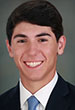 Jacob Harris, Grosse Pointe South
Played four seasons of varsity tennis, is playing second of varsity basketball and will play second of varsity baseball this spring. Made MHSAA Finals and earned multiple all-state honors in tennis. Earned all-state academic in baseball and served as varsity captain in all three sports. Carries GPA above 4.0 and twice was medalist on National Spanish Exam. Participating in second year of National Honor Society and LINK Crew and serving as vice president of student pep club. Serving as editor-in-chief in fourth year on staff of student newspaper, and also has participated in DECA throughout high school. Served as youth tennis instructor for three years of high school. Serving second year as student mentor assisting those with academic struggles, and fourth year as part of peer-to-peer program assisting students with disabilities. Designed and distributed bracelets to raise funds for local suicide prevention foundation. Is undecided where he will attend college, but intends to study international relations.
Essay Quote: “Good sportsmanship is contagious. What I saw my freshman year was instilled in me to the point that I had no hesitation to replicate it as an upperclassman myself. In a sport like tennis, sportsmanship is everything. Line calls, rooting on your teammates, and being a team player are all examples of the daily calling for good sportsmanship each player answers.”
 Troy Pratley, St. Joseph
Played three seasons of varsity football, playing second of varsity basketball and will play his third of varsity baseball this spring. Earned all-league in football and tied or broke multiple school records in leading teams to two playoff appearances. Served as captain of all three varsity teams. Participating in National Honor Society and third year of student government, and participated two years in be nice. mental health awareness program and Student Leaders Initiating Change group. Participated in choir throughout high school, earning 1 ratings for solo and ensemble, and sang at Carnegie Hall in New York City. Participating in second year of Interact Club and served as membership director. Served as youth sports official and public address announcer. Nominated to represent state at U.S. Marine Corps Semper Fidelis All-American Program’s Battles Won Academy. Will attend Concordia University Chicago and study special education.
Essay Quote: “If you ask a group of middle schoolers and a group of high schoolers about sportsmanship, you will get very similar answers. Because most of the time kids think of it as something they HAVE to do and not something they CHOOSE to do. In my eyes, it's a choice about how I will be seen and the legacy I will leave.”
 Caleb Qiu, Midland Dow
Played four seasons of varsity tennis, earning all-state honors and serving as team captain. Earned four flight Regional titles as part of four Regional championship teams, and helped 2018 team to runner-up finish in Lower Peninsula Division 2. Also helped team to all-state academic recognition. Trained in taekwondo throughout high school and earned red belt (2nd Kup). Named National Merit Scholarship semifinalist and AP Scholar. Published COVID-19 exposure notification app on Google/Apple stores. Participating in fourth years with robotics team and school’s symphony and honors orchestras. Earned all-state in orchestra as 1st violinist and placed first in quartet state competition. Served as programming co-lead and student director on robotics team’s non-profit board and was named FIRST Robotics FTC Young Mentor Award runner-up. Founded and served as team leader on school’s Lemelson-MIT InvenTeam that earned national grant award. Made finals of U.S. National Chemistry Olympiad. Participating in second years of National Honor Society and math team, and helped latter to state final. Is unsure where he will attend college but intends to study computer science.
Essay Quote: “I view sportsmanship as rising above the intensity and competitive nature of the sport to value your opponent first and foremost, as your peer and fellow passionate competitor. My goal for a match extends beyond winning or even improving my technique. I want to get to know my opponents.”
 Liam Smith, Rockford
Participating in fourth season of varsity swimming & diving. Competed on U.S. Paralympics Swimming national Emerging and C teams. Earned silver and four bronze medals at 2019 Parapan American Games, has won nine national championships, owns an Americas and world para swimming record and 24 U.S. Paralympic national records. Earned six Para All-America honors from National Interscholastic Swim Coaches Association, and three scholastic All-America awards. Served as club team captain. Participated in Boy Scouts throughout high school; attained Eagle Scout and named to Order of the Arrow national honor society. Served as assistant patrol leader and earned Presidential Service Award three years. Participating in National Honor Society and second year as part of peer listening group with school counseling department. Participated two years on student council. Is undecided where he will attend college, but intends to study computer science.
Essay Quote: “Imagine living life the height of a 10-year-old while competing against peers over 6-feet tall. That is my perspective as a person with hypochondroplasia, a type of dwarfism which affects one in 180,000 births. Being the shortest in my high school of 2,400+ students, I have learned to look at life differently. I have been given athletic opportunities sometimes because of my short stature and sometimes despite of it. To me, sportsmanship is a reaction and a choice that defines a person’s character.”
 Maxwell Werner, Traverse City Central
Played three seasons of varsity soccer, skied four seasons on varsity and will participate in his third of varsity track & field this spring. Earned all-league and all-District honors in soccer, all-league and all-region in skiing and competed at multiple MHSAA Ski Finals and helped 2018 team to Division 1 runner-up finish. Earned academic all-state recognition in skiing. Served as team captain of ski and soccer teams. Participating in third years of National Honor Society and Students for Environmental Activism club, and served as chair of fundraising committee for latter. Named Student Environmentalist of the Year by Northern Michigan Environmental Action Council. Owns and operates bike-powered neighborhood composting business. Earned honorable mention at SciMaTech Symposium. Participated throughout high school with Notre Liderato youth-focused advocacy organization and served as vice president, as well as counselor at summer bike camps throughout high school. Played in school orchestra throughout high school. Is undecided where he will attend college, but intends to study environmental engineering.
Essay Quote: “With opportunities for everyone to participate, the interactions between athletes both on the field and in the classroom are critical to character development and healthy relationships. Although sportsmanship is usually thought of as interactions between teams, I believe its most important aspect does not fall into this category, but rather is demonstrated through the impact that teams have on individuals.”
Other Class A girls finalists for the Scholar-Athlete Award were: Addison Bruwer, Lowell; Alexa Downey, Grosse Pointe South; Regina Duerst, Saline; Kennedy Dumas, Holland West Ottawa; Charity Dundas, Lapeer; Sadie Freisthler, Ann Arbor Pioneer; Catelyn Gagnier, Grosse Pointe North; Sadie Gerlach, Dearborn Edsel Ford; Jane C. Heystek, Kalamazoo Loy Norrix; Alyssa M. Karner, Holland West Ottawa; Sarah Liederbach, Petoskey; Megan Lorenzo, Rochester; Tatiana Mason, Grand Ledge; Emma Muir, Lapeer; Katherine Potter, South Lyon; Grace Ann Whipple, Mason; and Samantha Yamin, Bloomfield Hills.
Other Class A boys finalists for the Scholar-Athlete Award were: Jack Eiden, Portage Northern; Brendan Evert, Sterling Heights; Daniel Forsythe, Mount Pleasant; Charles Frank, Dearborn; Kyle Hamlin, Hartland; Jonathan Holland, Walled Lake Western; Kameron Karp, Marquette; Michael Kim, Ann Arbor Huron; Matthew Kozma, Detroit Catholic Central; Michael MacDonald, Grand Haven; Thomas MacDonald, Grand Haven; Chase R. Mahabir, Midland; Alex Mooney, Orchard Lake St. Mary's; Ryan Royston, Traverse City Central; Drew Seabase, Traverse City Central; Grant Uyl, DeWitt; and Ethan Vander Roest, Traverse City Central.
The Class C and D scholarship award recipients were announced Feb. 9, and the Class B honorees were announced Feb. 16.
Farm Bureau Insurance of Michigan was founded in 1949 by Michigan farmers who wanted an insurance company that worked as hard as they did. Those values still guide the company today and are a big reason why it is known as Michigan’s Insurance Company, dedicated to protecting the farms, families, and businesses of this great state. Farm Bureau Insurance agents across Michigan provide a full range of insurance services—life, home, auto, farm, business, retirement, Lake Estate®, and more—protecting nearly 500,000 Michigan policyholders.