

Class in Session: A History in Classification
July 24, 2017
By Rob Kaminski
MHSAA benchmarks editor
This is the first part in a series on MHSAA tournament classification, past and present, that will be published over the next two weeks. This series originally ran in this spring's edition of MHSAA benchmarks.
Conversation and discussion at the March 2017 MHSAA Representative Council Meeting leaned heavily toward the subject of 8-Player Football and how to properly balance its tournament with the growing number of schools sponsoring the sport.
While the proposal to split the tournament into two divisions beginning with the 2017 school year was adopted, the MHSAA then faced questions such as when to set the divisions, how to determine qualifiers and where to host the championship games.
The topic continues to create a buzz in Class D schools across both peninsulas, and likely will do into the start of school this fall.
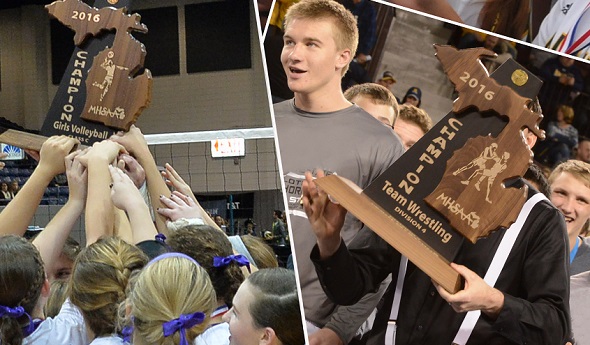
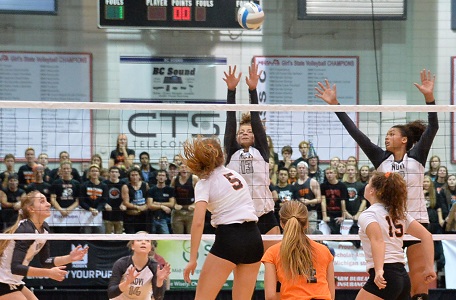
Likewise, the lone holdouts still conducting tournaments by class – MHSAA Boys and Girls Basketball and Girls Volleyball – took center stage at the May Council discussion, and following the 2017-18 school year, class is out for good. Both genders of basketball, and girls volleyball, will move to divisional formats thereafter.
There is much to be decided to be sure; but as those in education are well aware, history is the best teacher.
Fortunately for the sports in flux and for all sports under the governance of the MHSAA, the Association more or less wrote the book on the subject of sport classification. Following is a history lesson, with a little advanced division thrown in.
Class structure
Credited with being the first state with multiple tournament classifications, Michigan’s attention to trends and shifts in philosophy aimed at fair play and equal tournament opportunity can be traced from 80 years ago to the present.
In the earliest years of the MHSAA, there were four classifications for elections and tournaments – Classes A, B, C and D. Classes C and D had far more schools than Classes A and B. For example, 80 years ago (1937), there were only 58 schools in Class A, 94 schools in Class B, 297 schools in Class C and 253 schools in Class D.
Gradually through the years, as Michigan’s major cities spawned suburbs, there was a shift in the other direction to the point 30 years ago (1987) when school size became more balanced: 173 Class A schools, 178 Class B schools, 179 Class C schools and 182 Class D schools.
Up until 1987, the MHSAA published the dividing line between each classification, after which schools submitted their enrollments. Then, for 1988 and thereafter, the MHSAA adopted the plan of gathering all enrollments first and then placing 25 percent of the schools in each of four classes. This completed the equalization of the number of schools in each class for elections.
However, the change for 1988 did nothing to equalize the number of teams actually entered by each class in each sport. And unlike the early years of the Association when there were many more Class C and D teams than A and B teams, there were more Class A and B teams than C and D teams entering MHSAA tournaments decades later.
Moreover, the difference in number of teams entered in the different classifications for a sport continued to increase as many small schools, the fastest growing portion of the MHSAA's membership, sponsor only a few sports, or they sponsor no sports at all but enter into cooperative programs with other schools.
 Because of these differences, Class A or B schools sometimes had to win twice as many games as Class C or D schools to reach the MHSAA Finals in a sport. At times, the larger classifications had District Tournaments, even rat-tail games, and/or a Quarterfinal game, and the smaller classifications did not. Most Class D Districts have had four teams (some only three), while Class A Districts often had seven or eight teams. In Regional levels of individual sports, the number of entries in the larger classification once greatly outnumbered those in the smaller classifications of the tournament for the same sport.
Over the years, these dividing lines between classes escalated gradually, as did the differences in enrollments of largest and small schools in each class. In 1937 the dividing lines were 700, 300 and 100 between Class A and B, B and C, and C and D, respectively. By 1987, the dividing lines were 1,129, 571 and 298, respectively, leading to the current method of collecting enrollments and then setting the classification.
With the pendulum swinging well past center by the late 1980s, coaches associations, MHSAA sport committees, tournament managers and school administrators began discussion and offered proposals to correct what many believed had become a flawed system of MHSAA tournament classification.
At the 1996 MHSAA Update Meetings, ¾ of 858 respondents to that year’s annual survey indicated they favored a system that would divide schools which actually sponsor each sport into two, three or four nearly equal divisions.
Problem solving
At its meeting May 4-6, 1997, the Representative Council defeated a motion that would have adopted in one action a coordinated plan of reclassification for all sports to equalize the number of schools in each tournament for each respective sport. Instead, the Council discussed and voted on each proposal that had been presented from sport committees.
This resulted in the Representative Council adopting four equal divisions for baseball and softball, four equal divisions for boys and girls tennis, four equal divisions for boys soccer and three equal divisions for girls soccer, effective with the 1997-98 school year. Helping in the decision was the success of the 1995-96 MHSAA Wrestling season, which saw the sport move to four divisions for its tournament structure
The Council delayed action on similar proposals for football and boys golf at that time to glean additional input. The same decision was made with respect to a proposal from the Ice Hockey Committee that would have split the Class A schools in two divisions and left the Class B/C/D Tournament unchanged.
“The gist of the move from classes to divisions was to equalize the path to championships for students of all schools, regardless of the size of those schools,” said MHSAA Executive Director Jack Roberts.
While the restructuring accomplished that goal for the majority of competitors, opposition exists now as it did then. The primary argument in opposition to the changes is that, in some sports, it increases the range between largest and smallest schools in the division for smallest schools, even as the range is usually reduced for other divisions.
Larger schools offered a counterpoint.
“The larger schools suggested that while they may have more students, they also attempt to sponsor more sports than the smaller schools, in some cases spreading the enrollment as thin as a much smaller school with fewer sports,” Roberts said.
“Even today, the idea of four equal divisions can be unpopular among some Class D schools which feel especially burdened by the equal division concept,” Roberts said. “There was enough opposition in 1997 that equal divisions were rejected for boys and girls basketball and girls volleyball, and some of that opposition remains.”
The numbers of schools sponsoring each MHSAA tournament are still close to the totals today, with the exception of soccer in both genders, which has enjoyed substantial increases. This spring, 466 girls teams were scheduled to compete in the MHSAA Soccer Tournament, while 473 boys teams will suit up this fall.
Since the beginning of MHSAA divisions in 1996 with wrestling, 147 additional team champions have been crowned and countless individuals have known the thrill of victory due to an extra level of Finals in various sports. Girls soccer has seen the most growth in opportunity, moving from two classes in 1987 to three divisions the following year, and then four divisions in 2000. Boys soccer had enjoyed four classes for two years prior to the new four-division format, and it was the sport of soccer that helped to create a caveat in the nearly equal division movement.
Lower Peninsula boys and girls swimming & diving expanded from two to three divisions in 2008, while boys and girls bowling are the most recent sports to enjoy increased tournament opportunity, adding a fourth division in 2010.
“Fairness is in the eye of the beholder. While having the same number of schools in each division is one kind of fairness, holding in check the enrollment range between the largest and smallest schools in Division 4 is another kind of fairness that is dear to a great number of people,” Roberts said. “Because more schools sponsor basketball and volleyball than other sports, Class D schools would have been least affected by the equal divisions concept in those sports; but that, and ‘tradition,’ did not dissuade the opponents in the 1990s.”
The shift to divisions not only paved the way for student-athletes, but also assisted administrators and schools hosting tournaments. MHSAA tournament mangers looked to equal divisions to more closely equalize the number of schools in District or Regional Tournaments and to better equalize the length of day required for these rounds of tournaments, both for management and participating teams and individuals.
Pinning down an answer
Wrestling became the first MHSAA Tournament to be conducted in nearly equal divisions when team and individual champions were crowned in Divisions 1, 2, 3 and 4 rather than Classes A, B, C/D for the 1996 winter championships.
The movement was well received, as schools saw more opportunity for success: four champions where there once were three at the District, Regional and Final levels, and a smaller range of enrollment between the smallest and largest school in all four tournaments, leading to the impetus for the Fall 1996 Update Meeting Survey of schools regarding similar movement in other sports.
Team champions that year were Holt (D1), Petoskey (D2), Middleville Thornapple Kellogg (D3) and Dundee (D4).
Getting their kicks
When the "equal divisions" concept was approved by the Representative Council for most MHSAA Tournaments for the 1997-98 school year, there was opposition from the smallest schools which, under the equal divisions, are forced to play against larger schools than reside in Class D. Compelling arguments were made – and still are – that an enrollment difference between schools with smaller enrollments (e.g., Class D) is more difficult to overcome in athletic competition than an even larger enrollment difference between schools with larger enrollments (e.g., Class A).
The opposition was most intense in soccer because of the number of students needed to field a team and the physical nature of the sport. As a result, from 2000-01 through 2010-11, soccer operated with a “20-percent modification.” This placed 20 percent of all schools that actually sponsored soccer in Division 4, and the remaining 80 percent were placed equally in Divisions 1, 2 and 3.
At the time the 20 percent modification was adopted, it was also established that soccer would return to four equal divisions when the largest Division 4 soccer school had an enrollment equal to or smaller than the mid point for Class C schools. That occurred in 2010.
Last class on the schedule
In the same volume of “history being the best teacher,” one can also find the adage, “times change.” While the division format was a welcome change in some sports, others were left to hold class without change.
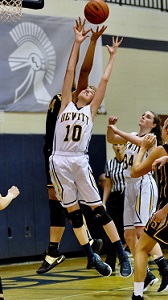 In the sports of boys and girls basketball, and girls volleyball, the number of schools sponsoring the sports were so close to the overall membership of the MHSAA that divisions were not necessary; the enrollment breakdowns themselves were enough to delineate equal opportunity for tournament success.
That is no longer the case, according to MHSAA membership. The last move from classes to divisions occurred for the 2006-07 school year following Council action. Before this May, that is. Action at the most recent Representative Council meeting, May 2017, called for the shift to divisions for MHSAA Boys and Girls Basketball, and Girls Volleyball, beginning with the 2018-19 season.
“Because the MHSAA Volleyball Committee had requested this change several times a number of years ago, and because the Council felt the change inevitable, there should not be further delay,” Roberts said. “It is an important detail that the Class D maximum has dropped 50 students over the past decade so the objection that much larger schools would be competing in Division 4 isn’t very strong now.”
Using the 2017-18 enrollment figures, just eight Class C schools would be competing in Division 4 for boys basketball, 11 for girls basketball and 14 for girls volleyball.
Good things came of the previous most-recent switches in 2006-07. Competitive Cheer was re-classified from Class A, B and C-D into four equal divisions assisting in the rapid growth of sponsoring schools (approximately 80 schools per division). Alpine skiing was changed from Class A and B-C D to two equal divisions.
At that time, the MHSAA Basketball Committee had recommended to the Council the study of increased classifications, but status quo remained.
Back on the grid
As such, MHSAA Basketball and Volleyball remained the only holdovers of the MHSAA class structure. Discussion resurfaced periodically during the last two decades to bring those tournaments in line with the other MHSAA sports.
Regular-season football-playing schools are separated by class, then are reshuffled by divisions for the playoffs. Football, as we know, underwent a significant postseason facelift in the late 1990s.
While MHSAA Football also remained a class sport through 1998, it had expanded from four to eight classes from 1990-98, becoming the first MHSAA sport to crown more than four team champions. Member schools were asked to consider a pair of options in November of 1997. One called for eight equal divisions, and the second would leave Class D by itself as division 8, and split Class A, B and C schools into seven nearly equal divisions.
After much discussion, retooling, and crunching of formulas, the MHSAA unveiled its revised Football Playoff model that continues to roll today, nearly 20 years later. It was determined that 256 teams would qualify for the tournament based first on a minimum of six wins, then by Playoff Points determined by formula. From there, the field would be divided into eight divisions, with the field being filled out by a nearly equal number of five-win teams in each division as needed to reach 256.
Eight championships would indeed be enough, until football sponsorship among the MHSAA’s smallest schools – some with rich football traditions – began to trend downward. The MHSAA again went to the drawing board, examining the viability of 8-player football. After an experimental year in 2010 without a tournament, the 8-player game was playoff-ready for 2011, with a field of 16 qualifiers embarking on a four-week tournament.
Not only did the 8-player option restore recently canceled programs, but it also created teams in schools which previously had none, and convinced some 11-player schools that this new division was the best path to take.
What did this do for the Class D holdovers staying in the traditional 11-player game? Well, a couple of things, positive and negative. As two and three dozen Class D schools opted for the 8-player game, the remaining 11-player Class D schools at times found themselves in disrupted leagues and had to travel further to complete schedules. They also competed against larger teams in Division 8 of the 11-player MHSAA Football Playoffs.
However, the growth of the 8-player game among the smallest schools also resulted in more Class D schools qualifying for the MHSAA Football Playoffs than ever before. In 2012, an all-time high 44 percent of Class D schools sponsoring football qualified for either the 8-player tournament or Division 8 of the 11-player tournament. That compared to 42.2 percent of Class C schools, 44.9 percent of Class B schools and 41.6 percent of Class A schools which qualified for the 2012 playoffs.
Much is to be determined in the most recent chapter of MHSAA Tournament expansion as the 8-Player Football Playoffs welcome a second division. As the past illustrates, there will be pluses and minuses. History also shows that the MHSAA has received maximum input from its constituents, researched all possibilities, and will find solutions to questions still in the balance before an additional group of athletes hoists a new trophy in November.
Through the Years
A chronology of when which sports moved from Class to Division in the MHSAA.
1995-96: LP Wrestling
1997-98: Baseball, Boys Soccer, Girls Soccer, Softball, LP Girls Tennis, LP Boys Tennis
1998-99: LP Boys Golf, LP Girls Golf
1999-2000: Ice Hockey, LP Boys Track & Field, LP Girls Track & Field
2000-01: LP Boys Cross Country, LP Girls Cross Country, UP Boys Cross Country, UP Girls Cross Country, UP Boys Golf, UP Girls Golf, UP Boys Tennis, UP Girls Tennis, UP Boys Track & Field, UP Girls Track & Field
2002-03: LP Girls Swimming & Diving, LP Boys Swimming & Diving
2005-06: Boys Bowling, Girls Bowling
2006-07: Girls Competitive Cheer, Boys Skiing, Girls Skiing
2018-19: Boys Basketball, Girls Basketball, Girls Volleyball
Note: Boys and Girls Lacrosse has been a divisional sport since it began in during the 2004-05 school year.
Flyers to Terriers, Quakers & Orioles
December 15, 2020
By Ron Pesch
Special for Second Half
Education and all that comes with it, in case you haven’t noticed, is changing. Of course, that’s always been the case. Virtual learning is simply the latest transformation.
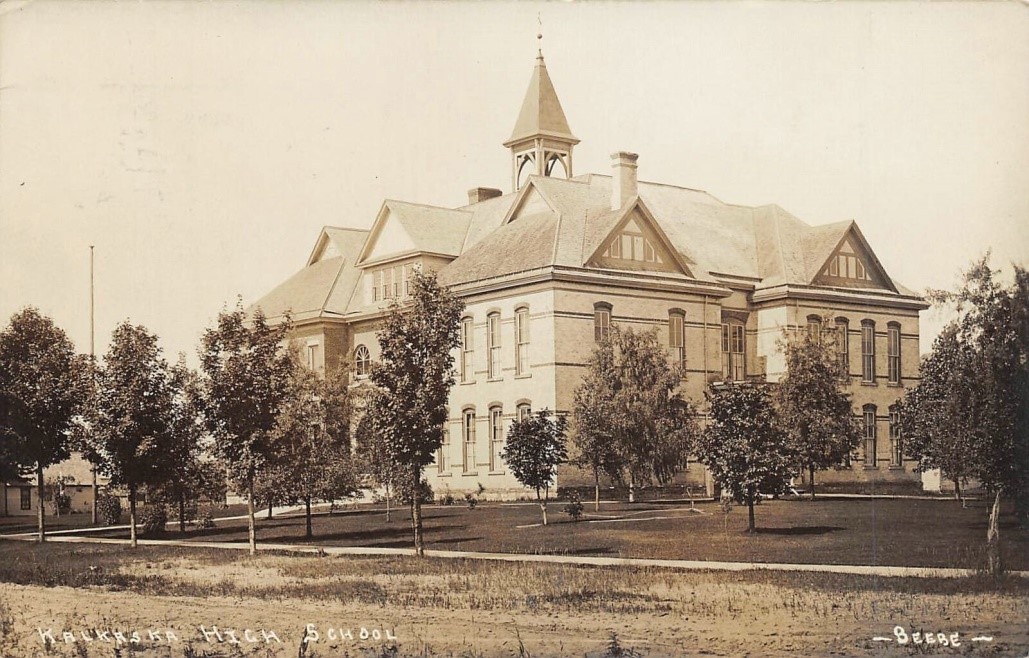
Once we were a nation filled with one-room school houses. By 1910, postcard evidence shows that, at least in Michigan, nearly every town of size had a high school, and that these buildings were showcases for community pride. From wood to brick to limestone, many of the earliest structures had bell towers. By the 1920s, in larger cities, small schools run by neighborhood churches were quite common. Most from those days were multiple-story buildings.
In hindsight, some of those buildings seem incredibly large for the communities they served. Others, too small – especially come the post-war baby boom era, when the suburbs exploded with growth and opportunity and Michigan’s major cities began to shrink in size. The 1950s and 1960s saw numerous Upper Peninsula and rural schools consolidate, while various big-city suburban districts split into two.
 Continued development beyond the first ring of suburbs and decreasing birth rates have combined, with the introduction of school of choice in 1996, to played havoc with enrollments and facilities in more recent times. Today, public and private academies seem to pop up and disappear overnight.
For someone trying to follow along, there are plenty of challenges.
A TOOLBOX
Historians, like many others, require a toolbox to accomplish their work. One of my favorite tools is a spreadsheet that I created several years back. I refer to it as “The List.” It’s my Master List of Michigan High Schools, and I reference it often. But lately, the document has been in a bit of disarray.
It’s been a mess before. Without a focused sabbatical or a grant, it likely will never be polished quite to my satisfaction.
Lost somewhere in time
Scattered to the four winds are details about the naming of schools, their consolidations, relocations and closings. Sadly, stories of how and why schools selected nicknames are often forgotten.
Parochial schools can present challenges of their own. Seemingly countless have opened, closed, consolidated or relocated over the years in Michigan. The city of Detroit alone has played host to a least 32 “Saint” high schools, from St. Agatha to St. Vincent.
 Detroit Catholic Central’s history includes five sites in three separate cities. As noted in my document, Catholic Central is an “All-Boys” school and today located in Novi. Few recall that, beginning in the fall of 1928, there was also a Detroit Girls Catholic Central. It closed in 1969.
Grand Rapids Catholic Central, founded in 1906, states it is the “oldest coeducational Catholic high school in the nation.” They have been known as the Cougars since 1930 or before. Muskegon Catholic Central consolidated three local schools – St. Mary, St. Joseph and St. Jean – and opened in the fall of 1953.
Flint Powers represents another example. My spreadsheet notes that the school’s full name is Flint Powers Catholic Central, and that it was named in honor of Rev. Luke M. Powers. The athletic teams are nicknamed the Chargers. The school was formed by the merger of seven Genesee County schools in 1970 – Flint Catholic schools Holy Redeemer, St. Agnes, St. John Vianney, St. Mary, St. Matthew, St. Michael and Mt. Morris St. Mary. Within the spreadsheet, I also capture their team nicknames: Flyers, Crusaders, Hornets, Wildcats, Panthers, Warriors, and Shamrocks, valuable information in case I find opportunity to write about their athletic accomplishments.
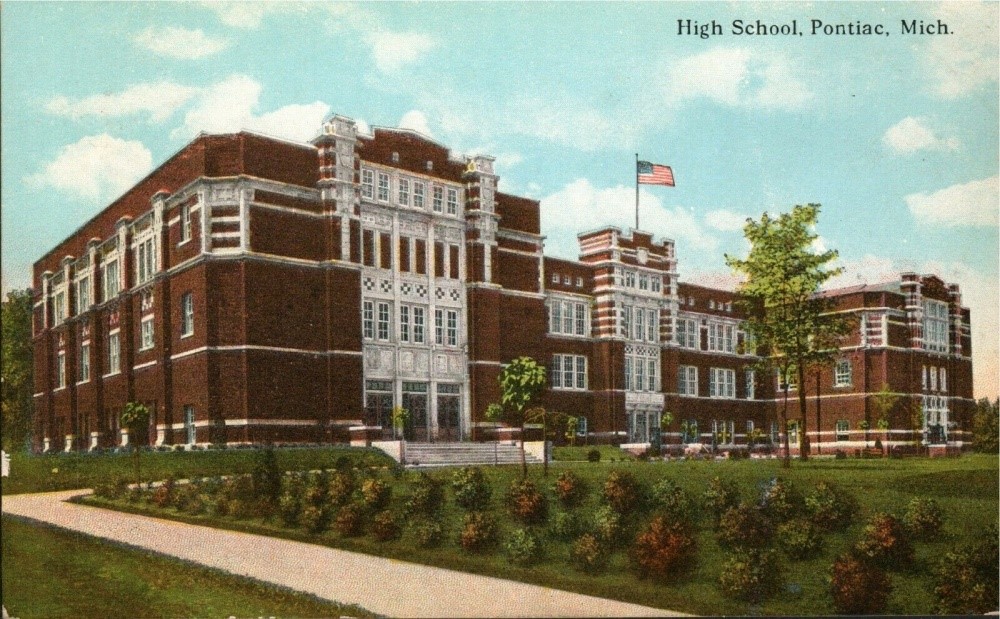
Garden City High School split into Garden City East and West in the mid-1960s, then reunited beginning with the 1982-83 school year. Royal Oak divided into Dondero and Kimball high schools in the late ’50s. They again unified in 2006. Pontiac High School split into Central and Northern in 1958. They merged back into Pontiac High in 2009.
More recently, in 2012, Wyoming Park and Wyoming Rogers merged. Ypsilanti Willow Run and Ypsilanti High School consolidated into Ypsilanti Community Schools in 2013.
Flint’s oldest high school, Central, shuttered in 2009, followed by Flint Northern in 2013. Albion was absorbed into Marshall in 2013. Word is Saginaw and Saginaw Arthur Hill will soon unite.
 Once, Michigan had four high schools that used “Flyers” as their nickname: previously mentioned Flint Holy Redeemer, Detroit St. Andrew, Grosse Pointe St. Paul and Willow Run, which used the nickname as a nod to the area’s ties to Airforce Plant 31, constructed by Ford to manufacture twin-finned B-24 bombers during the early 1940s for the war effort. Today, there are no schools left in Michigan that carry the nickname.
“The List” reminds me that Ferndale changed from the “Railsplitters” to the “Eagles” when they moved from old Ferndale Lincoln High into the newly-opened Ferndale High School in the fall of 1958. They are not to be confused with the “Railsplitters” of Ypsilanti Lincoln or Lincoln Park.
Caledonia once used “Scotties” as the nickname for its athletic teams, but the students chose to change the nickname to the more intimidating “Fighting Scots” in the late 1960s. (I’m still trying to chase down the actual school year of the alteration.)
“The List” explains why the Midland “Chemics” have a lion named Vic for a mascot. (It seems that in 1938, a new high school was built and “the Student Union decided to start some new traditions in order to display pride in their new high school. The school purchased a stuffed lion – a symbol of pride – to be used as a mascot. The name Vic was chosen for the mascot in short for the word ‘Victory’, voted in by the students.”)
Uniqueness
Distinctive nicknames fascinate me, but I always want the story behind the choice. I have written on the subject previously. Digging around the internet, I recently found a reference that was new to me. Alpena St. Anne’s high school athletic teams apparently were nicknamed the “Couturemen.”
The dictionary describes “Couture” as a designer, maker and seller of custom clothing. The word is French in origin. So I shipped off an e-mail the other day to a parish secretary in Alpena, with a question about the very unusual nickname. My question worked its way to Fr. Frank Muszkiewicz.
“St. Anne Church had been the "French" church here in Alpena when there were the more ethnic heritage Catholic communities,” he responded. “My understanding is that St. Anne had a high school until 1951, when Catholic Central High School opened in Alpena …
“Looking at a history book of St. Anne Church in Alpena,” he continued, “I did see a couple of pictures of boys' basketball teams from the 1920's and 1940's, however it seems the team name was the "Big Reds". So, I'm not sure where the "Couturemen" name came from that you found.”
From the late 1920s into the 1940s, it became quite popular to tie nicknames to teams. But before a moniker was assigned, it wasn’t unusual for newspaper writers to refer to a team by the school colors, or blend the last name of a coach with the word “men” when penning a story about a local squad. For example, Bay City Central’s teams often were called “Nevittmen” after coach Garland Nevitt before taking on the nickname “Wolves” around 1927. Muskegon’s teams were “Jacksmen” after their coach, J. Francis Jacks, before they were called the “Big Reds.”
A December 1940 newspaper, covering a game between Ludington St. Simon and St. Anne, gives a hint that this might be the case at St. Anne’s. A player at St. Anne, who happened to foul out of the game, had the last name, Couture. Perhaps there is a similar connection in St. Anne’s history.
Identities
In September 1928, Lansing Eastern athletic teams became known as the Quakers. “The name is derived from the location of the school,” stated the Lansing State Journal, explaining the unusual choice. “Pennsylvania was the original home of the Quakers of the Colonial period of our history, and the new high school, being situated on Pennsylvania Avenue, will be known by the name of the original settlers in the Keystone State.”
 In a November 1929 contest conducted by the State Journal, East Lansing, “long without a nickname,” became the Trojans. “The nickname was the choice of more than 50 per cent of the students.”
In May 1930, The Ludington Daily News noted that “Recently the Northern Michigan Big Six Athletic conference stimulated interest among pupils of the six cities in athletics and team competition … High School pupils of the respective towns proposed nicknames for their school teams and indicated their favorite by vote. Manistee chose the name of ‘Chippewas,’ Traverse City, ‘Trojans,’ Petoskey ‘Northmen,’ Cadillac ‘Vikings’ and Big Rapids ‘Cardinals.’ The time-honored name of ‘Orioles’ was voted to be retained by Ludington high school pupils, completing the list of six schools.”
Impressed, the Daily News quickly went to work to sponsor a county-wide contest with schools in Oceana County to select team nicknames. Later in the month, they announced results of the project.
“Scottville high school teams will henceforth be known as ‘Spartans,’ and Freesoil aggregation as ‘Buccaneers.’
“The team nicknames were decided upon by pupils of their respective institutions under a program of selections sponsored by the News.
“Two schools, Custer and Shelby, will retain their original team titles, (Ludington) St. Simon’s and Hart have not announced a final decision and Pentwater and Walkerville have made no report.”
Scottville’s choice of “Spartans” succeeded the name ‘Canners’ which had been used for a number of years, “a significant, but an unpicturesque appellation.” A rich agricultural part of the state, Scottville was home to a huge W.R. Roach and Co. canning facility. It closed in 2000 after nearly 90 years in business, displacing nearly 300 workers. “Wolverines” had also “won a goodly number of votes as did ‘Hornets.’”
“Cardinals” was retained at Custer.
“Word from Coach T.T. Thatcher at Shelby discloses Shelby’s choice as ‘Pee Wees.’ A selection made last year.
“Shelby voted in 1929 to use that name,’ he says, ‘and since then we have used an emblem on all our suits showing a Pee Wee and S.H.S on it. Our school colors are purple and white so the name is symbolic of the colors.”
For two of the schools, the decisions must have been relatively short-lived. By 1934, Shelby was using the nickname “Tigers.” Freesoil’s nickname had evolved into “Pirates” by the 1940s.
Earlier this year, the Hillsdale Daily News did a series of articles on the history of nicknames for schools in its coverage area. Hillsdale became the ‘Hornets’ in October 1932 following a poll of current football players and faculty. The Daily News at the time announced the nickname had won by a wide margin. Pittsford, it’s believed, first introduced its use of “Wildcats” “around the time the district consolidated in 1938.” At Waldron, “Spartans” was selected over “Lions” and “Bears” in a contest run by the school newspaper, also in 1938. “Students at the time were likely influenced by Waldron’s proximity to Michigan State University, among other factors,” noted the paper.
 The Daily News piece on Litchfield was of special interest to me. The only high school in Michigan nicknamed Terriers, I didn’t know much about its origins – only that from my previous research, the nickname had survived a proposed alteration by the Litchfield Student Council during the 1956-57 school year.
“They aroused quite a discussion within the student body as to the idea of changing the name of our team – Terriers.” stated the school’s yearbook. “But the idea was dropped.”
“According to Litchfield schools employee Judy Bills, the Litchfield Terriers mascot came about through the influence of former teacher and coach Al Terry in the 1930s,” stated the Daily News article. “It was while Terry was teacher and coach in Litchfield schools that the athletic teams became known as the Litchfield Terriers, Bills said.”
For a historian, sometimes answers spur more questions.
Was Litchfield’s team nickname also swayed by Major League Baseball?
Allen Terry coached at Litchfield from 1932 through the fall of 1940 before continuing his career at Plainwell High School.
Interestingly, during that same timespan, a future MLB Hall of Fame inductee, Bill Terry, served as player-manager of the New York Giants. His team’s often grabbed newspaper headlines with a reference to the phrase, “Terry’s Terriers” in the connected article.
 Did the sharing of “Terry” as a last name influence the nickname selection in Litchfield?
Who knows what the future holds for education, school districts and team nicknames across Michigan. Ypsilanti Community School students in grades 7-12 picked Grizzlies over Trailblazers and Flyers in 2013. There are six “Bears,” two “Black Bears” and a single “Polar Bears” on the MHSAA current active lists. Now there is one “Grizzlies.”
Today, “The List” contains 1,438 active and inactive high schools and totals 289 unique nicknames.
Wait.
There’s a St. Helen Charlton Heston Academy? It’s named after the actor, who played Moses in “The Ten Commandments.” It seems he spent part of his childhood in the area.
Make that 1,439.
(Thanks Eric Albright for the ‘Vic the Lion’ Story. I continue to seek out information on old departed high schools in Michigan as well as the stories behind nicknames. Please drop me a line.)
 Ron Pesch has taken an active role in researching the history of MHSAA events since 1985 and began writing for MHSAA Finals programs in 1986, adding additional features and "flashbacks" in 1992. He inherited the title of MHSAA historian from the late Dick Kishpaugh following the 1993-94 school year, and resides in Muskegon. Contact him at [email protected] with ideas for historical articles.
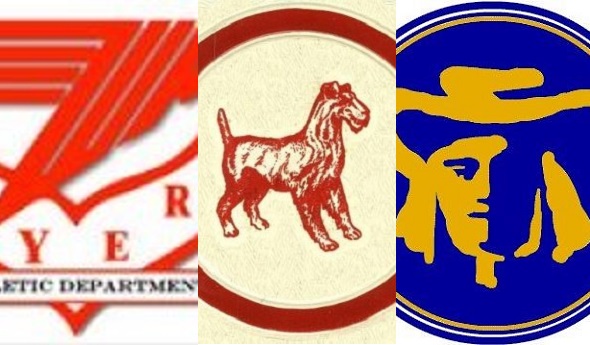
PHOTOS: (Top) Logos which have come, and sometimes gone along with those MHSAA schools through the years. (2) Kalkaska High School – from a postcard postmarked 1908. (3) Old Pontiac High School, built in 1913-14, became known as Pontiac Central once Pontiac Northern opened in 1958. (4) Ypsilanti Willow Run’s Flyers logo. (5) The logo used by Lansing Eastern’s Quakers. (6) Litchfield’s Terrier, as it appeared on the cover of the 1963 yearbook. (7) The logo for St. Helen Charlton Heston Academy’s Patriots. (Images collected by Ron Pesch.)