


Classes Still Create Hoosier Hysteria
July 27, 2017
By Rob Kaminski
MHSAA benchmarks editor
This is the fourth part in a series on MHSAA tournament classification, past and present, that will be published over the next two weeks. This series originally ran in this spring's edition of MHSAA benchmarks.
Twenty years ago, Bloomington North High School won the Indiana High School Athletic Association boys basketball championship, defeating Delta 75-54 at the RCA Dome in Indianapolis.
The date, March 22, 1997, is at the same time revered and disdained by traditionalists in the state who saw it as the last schoolboy championship game the state would ever host.
That’s how devout the game of basketball, particularly interscholastic basketball, had become in the Hoosier state during the 87 years a state champion – one state champion, to be precise – was crowned.
Following that 1997 season, the IHSAA moved to a four-class system for its roundball tournaments, like so many of its state association counterparts had done years earlier.
It would be shocking to find more than a small percentage of current high school basketball players around the country unfamiliar with the iconic movie Hoosiers, even though the film is now more than 30 years old.
And, the storyline for that blockbuster unfolded more than 30 years prior to its release, when small-town, undermanned Milan High School defeated Muncie Central High School 32-30 in the 1954 IHSAA title game.
Perhaps it’s because of the David vs Goliath notion, or the fame of the movie that replaced Milan with the fictional Hickory and real-life star Bobby Plump with Hollywood hero Jimmy Chitwood, or the simple fact that Indiana had something other states didn’t.
Whatever the reason, plenty of opposition remains to this day to basketball classification in the state.
The fact is, the small rural schools were regularly being beaten handily by the much larger suburban and city schools as the tournament progressed each season.
Small schools also were closing at a rapid rate following the state’s School Reorganization Act in 1959, as students converged on larger, centralized county schools. From 1960 to 2000, the number of schools entering the tournament dropped from 694 to 381, and in 1997 a total of 382 schools and 4,584 athletes began competition at the Sectional level (the first level of the IHSAA Basketball Tournament).
It was at the entry level of the tournament where school administrators felt the pain of the new class system, but not necessarily for the same nostalgic reasons as the fans who either attended or boycotted the tournament.
At the Sectional round of the tournament, the IHSAA was culling just 2 percent of the revenue, with the participating schools splitting the balance. So, when Sectional attendance dropped by 14 percent in that first year of class basketball, many schools realized a financial loss. It was money they had grown to count on in prior years to help fund various aspects of the department.
Schools cumulatively received more than $900,000 from Sectional competition in 1998, but that total was down from more than $1 million in the last year of the single-class tournament.
Yet, the current format provides a great deal more opportunity and realistic chances at championship runs for schools of all enrollments.
To date, 60 additional teams have championship or runner-up trophies on display in school trophy cases around Indiana.
That was the mission in front of then-IHSAA commissioner Bob Gardner (now National Federation executive director) once the board made its decision: to give thousands more student-athletes the opportunity for once-in-a-lifetime experiences.
As any statistician knows, figures can be manipulated to tell any side of a story. Declining attendance in year one of class basketball is such a number.
The truth is tournament attendance had been on a steady downward spiral since its peak of just over 1.5 million in 1962. By the last single-class event in 1997, the total attendance was half that.
The challenge then and today, as it is for all state associations, is to find that delicate balance for those holding onto tradition, those holding onto trophies, and the number of trophies to hand out.
Editor’s Note: Stories from the Fort Wayne Journal Gazette in 1998 and from a 2007 issue of Indianapolis Monthly provided facts in this article.
Vicksburg's Offord Jr. Beginning 50th, Final Season Coaching Teams to Net Gains
By
Pam Shebest
Special for MHSAA.com
March 26, 2025
VICKSBURG — Warner Offord Jr.’s was hardly impressed the first time he played tennis.
 That was 55 years ago, when he was heading into his sophomore year at Paw Paw High School.
Still, he continued to play with neighbor boys all that summer, and figured it would end there – until the following spring sports season, when he joined the tennis team.
“I go, it’s not a bad sport after all,” he laughed.
Offord ended up at No. 1 singles his final three years at Paw Paw, graduating in 1973.
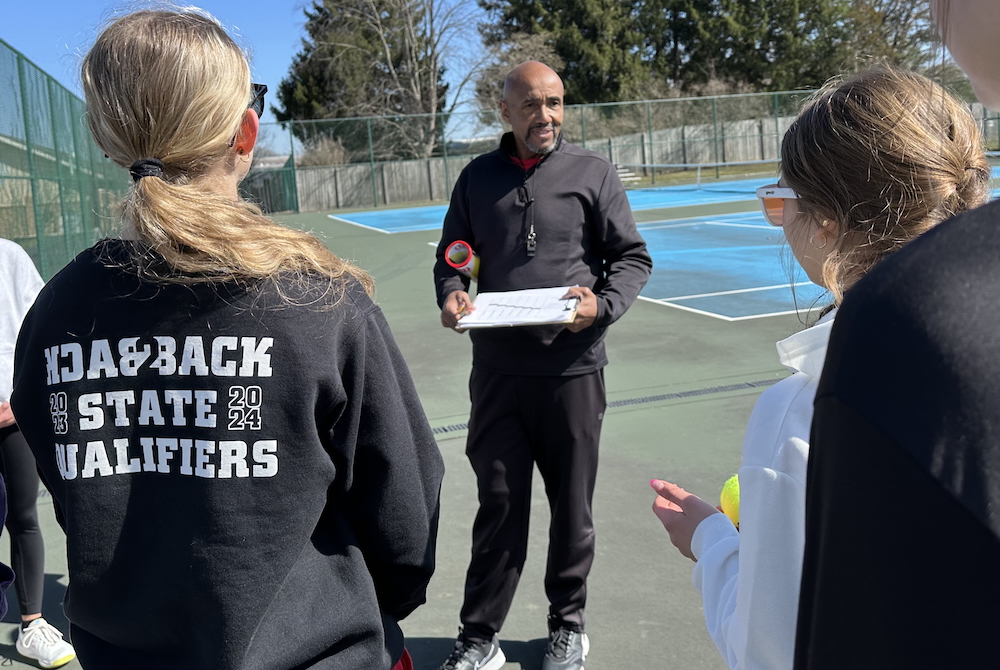
Now, at age 70, he is ready to retire at the end of the upcoming Vicksburg’s girls season after 50 years of coaching tennis.
After graduating from Paw Paw, Offord stayed in the area, helping the basketball team and coaching boys and girls tennis there. He coached at his alma mater 28 years, first as an assistant before taking over the tennis programs.
When he heard about a basketball coaching opening at Vicksburg 22 years ago, he applied for the job.
He did not get the head hoops gig, but athletic director Mike Roy offered him a job coaching the girls tennis team.
“I said I’ve got to talk to my wife (Linda Connor-Offord),” Offord said. “I don’t do nothing without talking to my wife, or I’ll be in the doghouse.”
Two days later, the boys tennis coach resigned and Roy offered Offord that job as well.
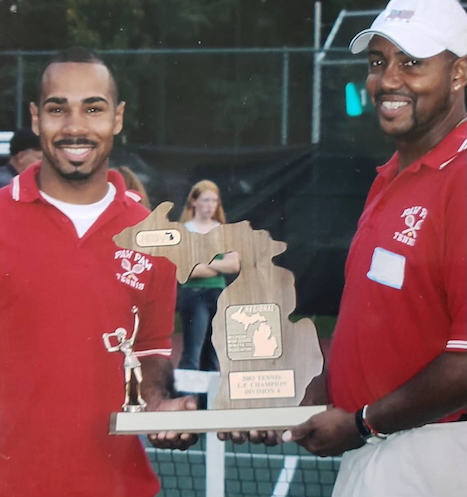 Once again he consulted his wife, who he gave him the thumbs up.
Offord soon discovered there is a bit of a difference between coaching boys and girls.
“Girls are feisty,” he said. “Girls listen to you. Boys, sometimes they want to do their own thing. When they do that, I say ‘end zone to end zone’ and then they get back to, ‘OK, we’re going to listen to our coach now.’”
He also has rules on the court.
“I believe in discipline. If you curse on the court, it’s an automatic two miles,” he said. “If you throw your racket, it’s an automatic two miles.
“No matter what, we’re going to run. I try to get the kids in shape for the third set.”
With the girls season just underway, Offord has some definite goals.
“We’re going to try to win (Wolverine) conference for the first time in school history,” he said. “The boys did it last year for the first time.
“Before I leave, I’d like to bring home that Regional trophy for the girls. It would be nice to bring home that trophy my last year.”
He is also challenging the girls not only to get back to the MHSAA Finals, but to improve on last year’s finish.
“Two years ago we finished 18th (in Lower Peninsula Division 3). Last year, I told the girls, let’s get up to 15th of 24 teams, and we got 14th.
“This year, if we go to state again, I’m going to tell then, let’s get down to 10.”
Game changer
Offord said today’s high school players are faster and stronger than when he picked up tennis because they use the weight room and do conditioning.
The equipment also has evolved.
“If I had the racket they have now and I could take that back in the ’70s, the racket is so big,” he said. “I had an Arthur Ashe (wooden) racket, I had a Wilson T3000 racket, I had a Kramer and I had a Davis.
“The technology now is unbelievable.”
Offord, who is affectionately called “Doctor O” or the abbreviated “Doc O” by the Vicksburg community, has changed with the times.
 “Dr. O’s unwavering passion and exceptional dedication have transformed the program,” Roy said. “His deep understanding of the game, paired with his ability to teach strategy at an elite level, sets him apart.
“Beyond his technical expertise, Dr. O instills a culture of excellence by holding athletes to high standards while maintaining fairness, consistency, and approachability – earning the trust and respect of his team.”
Roy noted that Offord has support around him.
“Since taking the reins, Dr. O has cultivated a winning culture, building on the foundation laid by coach Scott Wills, who continues to lead our summer youth programs,” Roy said.
“Recognizing the importance of strong leadership, Dr. O brought in Nick Foley, a former standout at Sturgis, as his assistant. Together these three men have ignited a culture shift, elevating the team to compete at an exceptional level. Their collective vision, tireless work ethic and commitment to growth has positioned the program for sustained success.”
Offord said he learned from the coaches he had growing up, who instilled not only a competitive spirit but confidence in playing and acceptable conduct on the court.
He mentioned retired Allegan tennis coach Gary Ellis as a mentor.
“Anytime I needed to know anything about tennis, I’d call him and he always had the answer,” Offord said. “I thought the world of him and what he did for that program. I’m trying to do the same thing at Vicksburg.”
Ellis said that Offord “definitely got the kids excited about playing tennis for Vicksburg and enjoying the sport. His kids get better and better during the season.”
The players at Vicksburg and Paw Paw are not the only ones who blossomed under Offord’s coaching.
His son, Warner Offord III, is an assistant to Matt Boven at Mattawan and has been a certified tennis pro for 20 years.
One final run
Offord Jr.’s decision to retire after half a century came at a perfect time, said senior Scarlett Hosner, the Bulldogs’ No. 1 singles player.
 “I feel it’s a good ending point because he coached my sister (Josephine, a 2016 grad), too, and he saw me growing up playing tennis,” Hosner said. “It’s like a full-circle moment because it’s my last year and his last year.
“He brings really positive energy. He’s such a nice, fun guy. He makes us enjoy the game, but he can also be serious at times. When we’re not doing what we’re supposed to be doing, he’s like getting on us.”
In retirement, Offord and his wife plan to do some traveling because “we want to enjoy life while we’re young,” he said.
“It’s been a wonderful 50 years coaching tennis, and it’s going to be sad. It hasn’t hit me yet for the boys, and once the girls season is over, then it will probably really hit me.
“I take great pride in seeing my players excel professionally, academically and as an athlete. I feel good knowing I played a part in that person’s success.”
 Pam Shebest served as a sportswriter at the Kalamazoo Gazette from 1985-2009 after 11 years part-time with the Gazette while teaching French and English at White Pigeon High School. She can be reached at [email protected] with story ideas for Calhoun, Kalamazoo and Van Buren counties.
PHOTOS (Top) Vicksburg girls tennis coach Warner Offord Jr. talks with his team at the start of this spring season. (2) Offord and son Warner Offord III hold up their Regional championship trophy won for Paw Paw in 2003. (3) Offord hits with his players during practice. (4) Scarlett Hosner headshot. (Current photos by Pam Shebest; 2003 photo courtesy of Warner Offord Jr.)