


Classes Still Create Hoosier Hysteria
July 27, 2017
By Rob Kaminski
MHSAA benchmarks editor
This is the fourth part in a series on MHSAA tournament classification, past and present, that will be published over the next two weeks. This series originally ran in this spring's edition of MHSAA benchmarks.
Twenty years ago, Bloomington North High School won the Indiana High School Athletic Association boys basketball championship, defeating Delta 75-54 at the RCA Dome in Indianapolis.
The date, March 22, 1997, is at the same time revered and disdained by traditionalists in the state who saw it as the last schoolboy championship game the state would ever host.
That’s how devout the game of basketball, particularly interscholastic basketball, had become in the Hoosier state during the 87 years a state champion – one state champion, to be precise – was crowned.
Following that 1997 season, the IHSAA moved to a four-class system for its roundball tournaments, like so many of its state association counterparts had done years earlier.
It would be shocking to find more than a small percentage of current high school basketball players around the country unfamiliar with the iconic movie Hoosiers, even though the film is now more than 30 years old.
And, the storyline for that blockbuster unfolded more than 30 years prior to its release, when small-town, undermanned Milan High School defeated Muncie Central High School 32-30 in the 1954 IHSAA title game.
Perhaps it’s because of the David vs Goliath notion, or the fame of the movie that replaced Milan with the fictional Hickory and real-life star Bobby Plump with Hollywood hero Jimmy Chitwood, or the simple fact that Indiana had something other states didn’t.
Whatever the reason, plenty of opposition remains to this day to basketball classification in the state.
The fact is, the small rural schools were regularly being beaten handily by the much larger suburban and city schools as the tournament progressed each season.
Small schools also were closing at a rapid rate following the state’s School Reorganization Act in 1959, as students converged on larger, centralized county schools. From 1960 to 2000, the number of schools entering the tournament dropped from 694 to 381, and in 1997 a total of 382 schools and 4,584 athletes began competition at the Sectional level (the first level of the IHSAA Basketball Tournament).
It was at the entry level of the tournament where school administrators felt the pain of the new class system, but not necessarily for the same nostalgic reasons as the fans who either attended or boycotted the tournament.
At the Sectional round of the tournament, the IHSAA was culling just 2 percent of the revenue, with the participating schools splitting the balance. So, when Sectional attendance dropped by 14 percent in that first year of class basketball, many schools realized a financial loss. It was money they had grown to count on in prior years to help fund various aspects of the department.
Schools cumulatively received more than $900,000 from Sectional competition in 1998, but that total was down from more than $1 million in the last year of the single-class tournament.
Yet, the current format provides a great deal more opportunity and realistic chances at championship runs for schools of all enrollments.
To date, 60 additional teams have championship or runner-up trophies on display in school trophy cases around Indiana.
That was the mission in front of then-IHSAA commissioner Bob Gardner (now National Federation executive director) once the board made its decision: to give thousands more student-athletes the opportunity for once-in-a-lifetime experiences.
As any statistician knows, figures can be manipulated to tell any side of a story. Declining attendance in year one of class basketball is such a number.
The truth is tournament attendance had been on a steady downward spiral since its peak of just over 1.5 million in 1962. By the last single-class event in 1997, the total attendance was half that.
The challenge then and today, as it is for all state associations, is to find that delicate balance for those holding onto tradition, those holding onto trophies, and the number of trophies to hand out.
Editor’s Note: Stories from the Fort Wayne Journal Gazette in 1998 and from a 2007 issue of Indianapolis Monthly provided facts in this article.
Engadine's Rock & Roll Relays Provide Runners with Interval Challenge
By
John Vrancic
Special for MHSAA.com
August 27, 2026
ENGADINE — This was not your ordinary cross country meet.
 Last week’s Engadine Rock & Roll Relays provide interval training for the runners, who do a mile on three occasions during the races and start and finish with music playing in the background.
“It went pretty good,” Engadine junior Ed Frankowiac said. “The breaks are nice, but you have to keep moving. It’s fun. We didn’t have this meet two years ago because it conflicted with a meet in Munising (Larissa Vartti Memorial Invitational), but we’re glad we had it last year. We’re trying to build this up.”
Frankowiak combined with junior Nate Stielstra for the first-place finish as they covered the six miles in 35 minutes, 17.18 seconds on a sunny and mild Aug. 20 day.
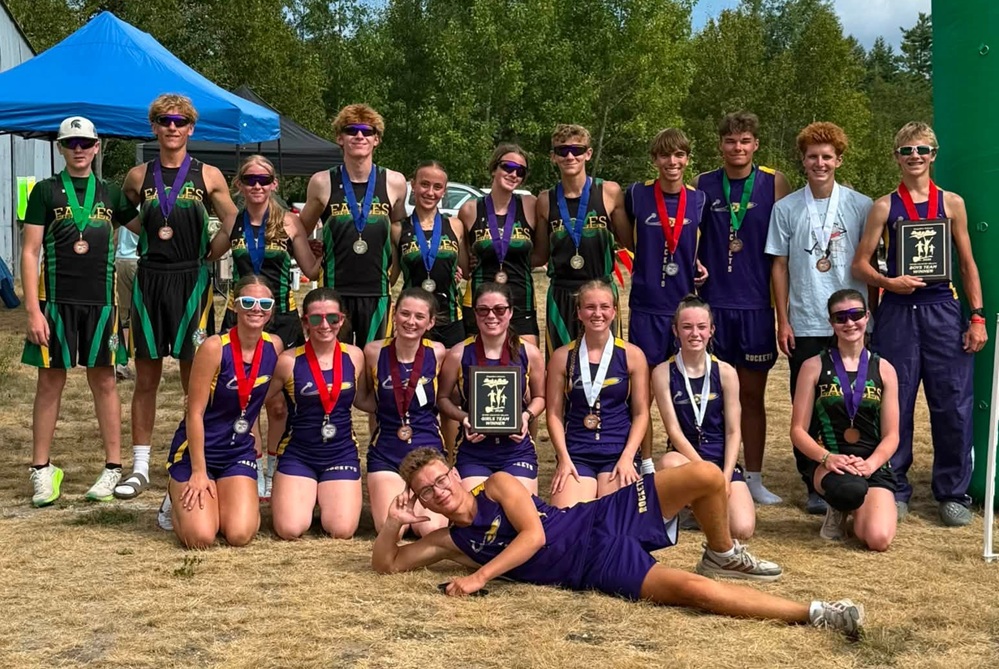
Rapid River, however, won the boys meet with five points. The host Eagles scored six and Manistique finished with 11.
The Rapid River girls retained their title by edging the Eagles 5-6.
“This is the second year we got the plaque,” Rockets’ sophomore Victoria Coppock said. “This is a nice boost for our team. Engadine has a couple real good runners.
“This is one of the meets I really look forward to. I think it’s more competitive. It’s also easier to look at placement and know where you are.”
Engadine sophomores Sarah Chapman and Fern Stielstra combined to win the girls race at 44:59.31. Rapid River juniors Kaylee Tyler and Julia Poma were runners-up (47:53.93) followed by Coppock and junior Ashlynn Thompson (49:02.42).
 “All my miles were under seven minutes,” Chapman said. “I’m very happy with my times and how I finished each time. It’s hard to stop and go, but it’s fun. It’s a great way to open the season. I think last year’s experience is helping me. It was nice out there. It wasn’t too hot and we had a nice breeze. I think it went well.”
Engadine junior Birch Bitely, who teamed with Oliver French for a fifth-place finish among the boys (41:08.53), also enjoys this meet.
“It’s a good course,” he said. “There’s one big hill toward the end and a few rolling hills before that. We had better conditions this time. Last year we had rain with temperatures in the 50s. The nice weather made it easier to keep your legs warm.”
Rapid River senior Jae Poma and sophomore Owen Truitt were boys runners-up at 35:40.63, followed by senior teammates Jeb Green and Jon Denkins (38:38.56).
“I really like it,” Poma said. “It’s something different. This helps our speed, and it’s kind of a tune-up for other races. It’s nice to get the break, but you have to keep moving to keep your legs warmed up for your next interval.”
Poma also has some personal and team goals in mind.
“I would like to get under 18 minutes,” he added. “I feel we have a shot at the U.P. (Division 3) title. There’s a lot of good teams out there, but if we work hard I think we have a chance.”
Rapid River senior Camden Holmio and Engadine’s Eli Frankowiak teamed for a sixth-place finish in 48:01.53.
“I was a little excited to run with a guy from another school,” Holmio said. “I think that made it more fun. Interval training is pretty helpful. The breaks are good, but it’s sometimes a little hard to get going after you stop.”
Sophomore Keira Hart, who represented the Manistique girls, ran on a boys team with fellow Emeralds Trent Mason and James King.
“I really wasn’t that nervous, but standing at the starting line alone was the hardest part mentally. It just felt weird because I wasn’t running with the other girls,” she said. “It was a good first meet. It was also kind of a learning experience.”
 John Vrancic has covered high school sports in the Upper Peninsula since joining the Escanaba Daily Press staff in 1985. He is known most prominently across the peninsula for his extensive coverage of cross country and track & field that frequently appears in newspapers from the Wisconsin border to Lake Huron. He received the James Trethewey Award for Distinguished Service in 2015 from the Upper Peninsula Sportswriters and Sportscasters Association.
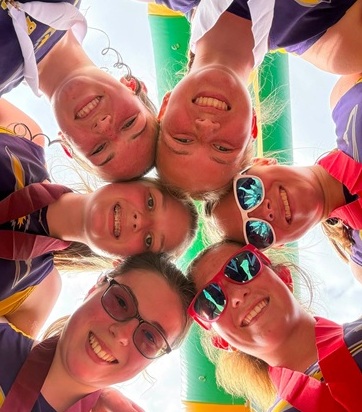
PHOTOS (Top) Rapid River and Engadine medal winners stand for a photo together after the Engadine Rock & Roll Relays. (Middle) The Rockets enjoy a moment together after their win. (Photos courtesy of the Rapid River cross country program.)