


Classes Still Create Hoosier Hysteria
July 27, 2017
By Rob Kaminski
MHSAA benchmarks editor
This is the fourth part in a series on MHSAA tournament classification, past and present, that will be published over the next two weeks. This series originally ran in this spring's edition of MHSAA benchmarks.
Twenty years ago, Bloomington North High School won the Indiana High School Athletic Association boys basketball championship, defeating Delta 75-54 at the RCA Dome in Indianapolis.
The date, March 22, 1997, is at the same time revered and disdained by traditionalists in the state who saw it as the last schoolboy championship game the state would ever host.
That’s how devout the game of basketball, particularly interscholastic basketball, had become in the Hoosier state during the 87 years a state champion – one state champion, to be precise – was crowned.
Following that 1997 season, the IHSAA moved to a four-class system for its roundball tournaments, like so many of its state association counterparts had done years earlier.
It would be shocking to find more than a small percentage of current high school basketball players around the country unfamiliar with the iconic movie Hoosiers, even though the film is now more than 30 years old.
And, the storyline for that blockbuster unfolded more than 30 years prior to its release, when small-town, undermanned Milan High School defeated Muncie Central High School 32-30 in the 1954 IHSAA title game.
Perhaps it’s because of the David vs Goliath notion, or the fame of the movie that replaced Milan with the fictional Hickory and real-life star Bobby Plump with Hollywood hero Jimmy Chitwood, or the simple fact that Indiana had something other states didn’t.
Whatever the reason, plenty of opposition remains to this day to basketball classification in the state.
The fact is, the small rural schools were regularly being beaten handily by the much larger suburban and city schools as the tournament progressed each season.
Small schools also were closing at a rapid rate following the state’s School Reorganization Act in 1959, as students converged on larger, centralized county schools. From 1960 to 2000, the number of schools entering the tournament dropped from 694 to 381, and in 1997 a total of 382 schools and 4,584 athletes began competition at the Sectional level (the first level of the IHSAA Basketball Tournament).
It was at the entry level of the tournament where school administrators felt the pain of the new class system, but not necessarily for the same nostalgic reasons as the fans who either attended or boycotted the tournament.
At the Sectional round of the tournament, the IHSAA was culling just 2 percent of the revenue, with the participating schools splitting the balance. So, when Sectional attendance dropped by 14 percent in that first year of class basketball, many schools realized a financial loss. It was money they had grown to count on in prior years to help fund various aspects of the department.
Schools cumulatively received more than $900,000 from Sectional competition in 1998, but that total was down from more than $1 million in the last year of the single-class tournament.
Yet, the current format provides a great deal more opportunity and realistic chances at championship runs for schools of all enrollments.
To date, 60 additional teams have championship or runner-up trophies on display in school trophy cases around Indiana.
That was the mission in front of then-IHSAA commissioner Bob Gardner (now National Federation executive director) once the board made its decision: to give thousands more student-athletes the opportunity for once-in-a-lifetime experiences.
As any statistician knows, figures can be manipulated to tell any side of a story. Declining attendance in year one of class basketball is such a number.
The truth is tournament attendance had been on a steady downward spiral since its peak of just over 1.5 million in 1962. By the last single-class event in 1997, the total attendance was half that.
The challenge then and today, as it is for all state associations, is to find that delicate balance for those holding onto tradition, those holding onto trophies, and the number of trophies to hand out.
Editor’s Note: Stories from the Fort Wayne Journal Gazette in 1998 and from a 2007 issue of Indianapolis Monthly provided facts in this article.
Growing Gobles Preparing for Future with Return to 11-Player Football
By
Pam Shebest
Special for MHSAA.com
August 25, 2026
GOBLES — For the last five years, Gobles saw success competing in 8-player football, making the MHSAA Playoffs four of those seasons.
 This year, coach Greg Eichler hopes to transition that success into 11-player in spite of grumbling from some fans.
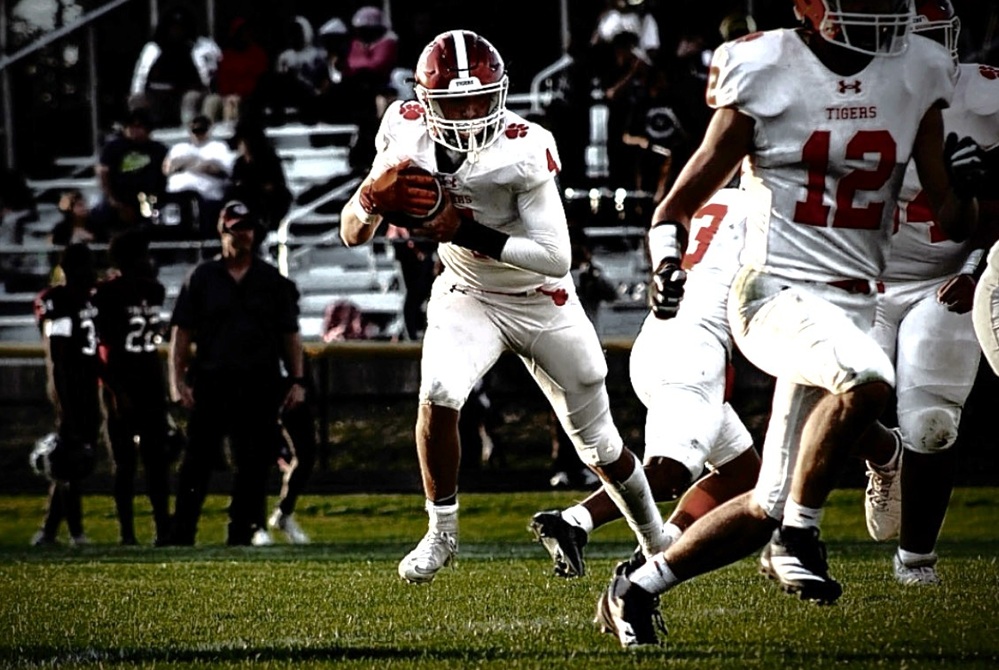
“We’re pretty doubted by the town right now,” sophomore tailback/free safety Case Lord said. “But I see what goes on at practice and in the weight room, and I see our work ethic and how strong we are. I think we can do something great.”
Eichler said numbers-wise, the Tigers could compete in 8-player, but “our district is growing, which is good, so when you look at the projected enrollments a couple years down the line, we’re going to be over that playoff limit for 8-player.
“We have a younger team, but we’ve got a diverse group from sophomores up to seniors in terms of their talents and abilities, and I think they can put together some good success right now and also build for the future.”
Gobles finished a combined 31-10 in 8-player over the last four seasons.
Moving back to 11-player, more athletes will have the opportunity to play big roles in the experience.
“It’s been good to have a JV and varsity consistently with no issue, but at the same time, we have a lot of extra kids on the sideline playing 8-player,” Eichler said. “With 11-player there are more opportunities for the kids.”
Discussing the move, the coach added, "When you’ve got three extra guys on the field, it changes how much space on the field you’ve got to cover and who you’re looking at, who you’re covering, who you’re keying on.”
Another change this fall will be playing several less familiar opponents as part of a combined league. Gobles is among a handful of Southwestern Athletic Conference schools playing football as part of the Southwest 10 Conference this fall.
"We’re playing a majority Southwest 10 schedule but will play Galesburg and Saugatuck from the SAC and everyone else is Southwest (10),” Eichler said. "Traditionally the SAC has been our league. You had to give that up, but you want to make sure you’re putting the kids in the best position.”
Eichler said the Southwest 10 has some great traditions and some solid football programs that will give the Tigers a run.
 “We love a new challenge, and we feel that’s what this is. It’s a new step in our program that’s going to challenge everybody, coaches and players alike,” he noted. “Southwest 10 teams are a little bit more our size. They’re still mostly bigger than us, but I think competitively they’re probably the better teams to put on our schedule.”
Senior outside linebacker/wing back Hunter Piper said playing in both conferences is a plus “because we’re playing more schools that I know. We go to those schools for other sports, so it’s nice to play new competition.”
Eichler said one advantage for the Division 8 Tigers this year is that in 11-player “you get bonuses for playing bigger schools and most of the time, we’re the smaller school.
“We have several Division 7 schools on our schedule, so those are like little bonus incentives. That’s win or lose.”
They got their first taste of 11-player in a while last Thursday in a scrimmage against Coloma. Gobles will kick off the “real” season at home Thursday against Niles Brandywine.
“We had a competitive scrimmage, and a lot of our young players got some really good experience,” Eichler said. “I would say the following day’s film session was even more important, as our team learned a lot in order to prepare for our Week 1 matchup versus Niles Brandywine.”
Their second game is a big one for the town: The Tiger Tribute game versus Hartford on Sept. 3.
“It’s the military and first responder appreciation game (which will feature) flyovers, vehicles,” Eichler said.
Honorary captain this year is Navy Lieutenant Commander Ian Weston, a 2010 Gobles alum. The tribute will include a parade and the school choir singing the national anthem.
Sophomore & senior expectations
Eichler said Lord was the first freshman he moved up to varsity over his six years coaching.
“He took some lumps early but really grew as the year went on,” the coach said. “He’s going to bring some varsity experience even as a sophomore.
"I think that’s really good for that sophomore group. He understands what varsity football looks like, even though it was 8-player. We played some really good teams.”
Lord said playing varsity as a freshman was eye-opening.
“Out of the gate I wasn’t prepared for the speed, but I learned very fast that’s a big thing with a varsity game,” he said. “Now I understand what that is, and I can compete with others.
 “I’ve been looking forward to this year since last season ended.”
Lord is no stranger to 11-player football, starting the sport 12 years ago on a club team.
“My brother (Adam Vosburg), and my grandpa (Gerald Gravatt) both played football,” Lord said. “My brother had D-I (college) offers everywhere but went to Olivet to stay close to home after my grandpa passed. My brother basically lived through him, and I live through my brother.”
Eichler counts on seniors such as Piper in leadership roles.
“Hunter brings experience, some really good leadership and stability,” the coach said. “I think that’s going to be important because our bigger group right now is our sophomores. We have him and a handful of other seniors to help stabilize them.”
Part of Piper’s experience is from the 2024 team that went undefeated in the regular season before losing its Division 1 8-Player Regional Semifinal to Martin.
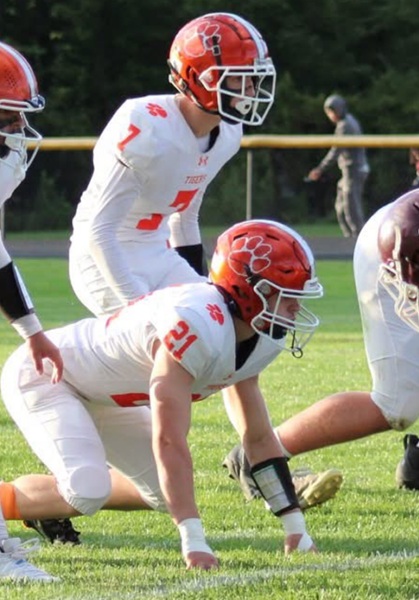
Jumping to 11-player is “a little funky with a couple more players, and the field is definitely a little bigger, but it’s still the same game,” Piper said. “I love the game, and I like to bring a lot of leadership. I like to help out the younger kids.”
Piper, who is also on the wrestling team, said that helps him in football.
“I like the testosterone sports,” he said. “I like to go out there and fly around and hit. The energy is beautiful.”
In spite of hearing some of the town’s naysayers, Piper said, “There’s moments in practice where I think this is a great team. People don’t see what we see, and they’re definitely underestimating us.
“Our strength is the bond we have. We have a very strong connection between all of us.”
 Pam Shebest served as a sportswriter at the Kalamazoo Gazette from 1985-2009 after 11 years part-time with the Gazette while teaching French and English at White Pigeon High School. She can be reached at [email protected] with story ideas for Calhoun, Kalamazoo and Van Buren counties.
PHOTOS (Top) Gobles’ Case Lord follows his blockers during a carry last season. (Middle) From left: Tigers coach Greg Eichler, Hunter Piper and Case Lord. (Below) Piper (7) lines up on defense last fall. (Action photos courtesy of the Gobles football program. Head shots by Pam Shebest.)