


Classes Still Create Hoosier Hysteria
July 27, 2017
By Rob Kaminski
MHSAA benchmarks editor
This is the fourth part in a series on MHSAA tournament classification, past and present, that will be published over the next two weeks. This series originally ran in this spring's edition of MHSAA benchmarks.
Twenty years ago, Bloomington North High School won the Indiana High School Athletic Association boys basketball championship, defeating Delta 75-54 at the RCA Dome in Indianapolis.
The date, March 22, 1997, is at the same time revered and disdained by traditionalists in the state who saw it as the last schoolboy championship game the state would ever host.
That’s how devout the game of basketball, particularly interscholastic basketball, had become in the Hoosier state during the 87 years a state champion – one state champion, to be precise – was crowned.
Following that 1997 season, the IHSAA moved to a four-class system for its roundball tournaments, like so many of its state association counterparts had done years earlier.
It would be shocking to find more than a small percentage of current high school basketball players around the country unfamiliar with the iconic movie Hoosiers, even though the film is now more than 30 years old.
And, the storyline for that blockbuster unfolded more than 30 years prior to its release, when small-town, undermanned Milan High School defeated Muncie Central High School 32-30 in the 1954 IHSAA title game.
Perhaps it’s because of the David vs Goliath notion, or the fame of the movie that replaced Milan with the fictional Hickory and real-life star Bobby Plump with Hollywood hero Jimmy Chitwood, or the simple fact that Indiana had something other states didn’t.
Whatever the reason, plenty of opposition remains to this day to basketball classification in the state.
The fact is, the small rural schools were regularly being beaten handily by the much larger suburban and city schools as the tournament progressed each season.
Small schools also were closing at a rapid rate following the state’s School Reorganization Act in 1959, as students converged on larger, centralized county schools. From 1960 to 2000, the number of schools entering the tournament dropped from 694 to 381, and in 1997 a total of 382 schools and 4,584 athletes began competition at the Sectional level (the first level of the IHSAA Basketball Tournament).
It was at the entry level of the tournament where school administrators felt the pain of the new class system, but not necessarily for the same nostalgic reasons as the fans who either attended or boycotted the tournament.
At the Sectional round of the tournament, the IHSAA was culling just 2 percent of the revenue, with the participating schools splitting the balance. So, when Sectional attendance dropped by 14 percent in that first year of class basketball, many schools realized a financial loss. It was money they had grown to count on in prior years to help fund various aspects of the department.
Schools cumulatively received more than $900,000 from Sectional competition in 1998, but that total was down from more than $1 million in the last year of the single-class tournament.
Yet, the current format provides a great deal more opportunity and realistic chances at championship runs for schools of all enrollments.
To date, 60 additional teams have championship or runner-up trophies on display in school trophy cases around Indiana.
That was the mission in front of then-IHSAA commissioner Bob Gardner (now National Federation executive director) once the board made its decision: to give thousands more student-athletes the opportunity for once-in-a-lifetime experiences.
As any statistician knows, figures can be manipulated to tell any side of a story. Declining attendance in year one of class basketball is such a number.
The truth is tournament attendance had been on a steady downward spiral since its peak of just over 1.5 million in 1962. By the last single-class event in 1997, the total attendance was half that.
The challenge then and today, as it is for all state associations, is to find that delicate balance for those holding onto tradition, those holding onto trophies, and the number of trophies to hand out.
Editor’s Note: Stories from the Fort Wayne Journal Gazette in 1998 and from a 2007 issue of Indianapolis Monthly provided facts in this article.
Usually Called On to Contain Buzz, Rockafellow Ready to Make More Noise as Perry's Top Target
By
Geoff Kimmerly
MHSAA.com senior editor
August 21, 2026
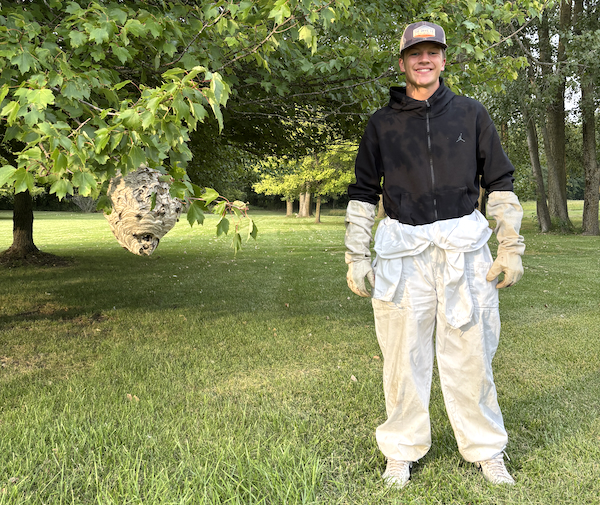
PERRY – Two nests already were packed away in the back of his vehicle when Alex Rockafellow rolled up at 9:45 p.m. under an impressive find – a basketball-sized sphere hanging from a single thin branch over a driveway and filled with black and white-lined bald-faced hornets.
 While most of us surely would have considered removing the nest daunting, the Perry senior saw an easy task compared to his usual searching around in the dark for a nest of insects he doesn’t want to startle. With the nest out in the open, all he had to do was snap the branch, drop the nest and its hundreds or hornets into an open pillowcase, and move on to the next collection.
Rockafellow spent five or six nights a week this summer driving around mid-Michigan working for the family business, Rock’s Free Yellow Jacket & Hornet Removal, which contains and takes away yellow jacket and hornet nests for free and sends the insects off to laboratories in Washington and Idaho where their venom is extracted to create immunotherapies to treat allergy patients.
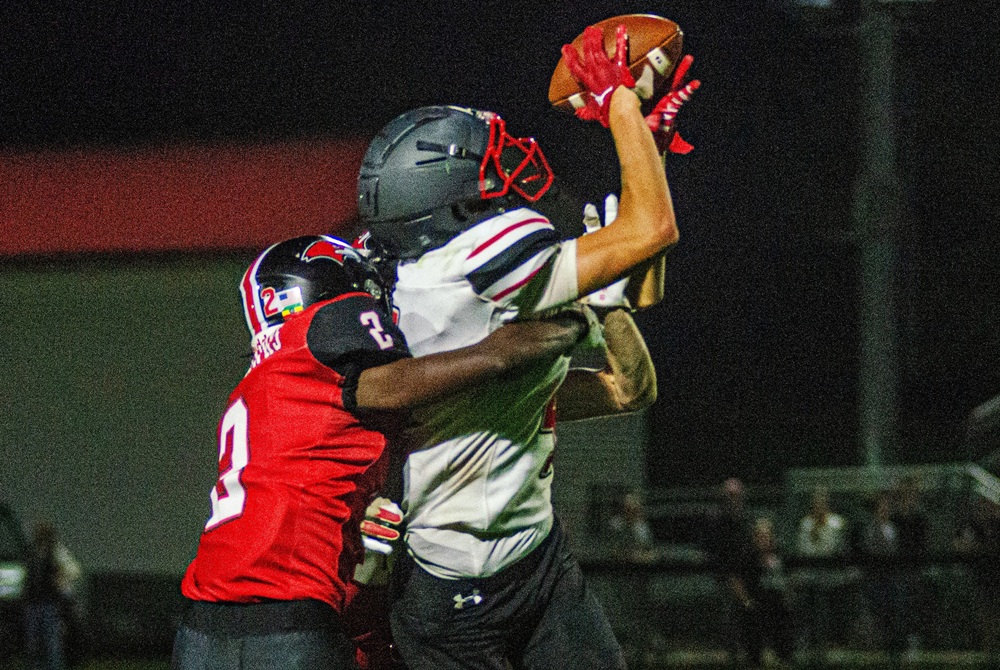
That’s obviously not the typical high schooler summer job – and surely it’s unique among all-state football receivers and MHSAA record-holders. But he enters this season as all three, having earned all-state honorable mention from the Detroit News last fall and after tying the record for longest reception with a 99-yarder from teammate Zach Miller.
“I’ve taken some of my teammates on a few (nest) runs before. They think it’s a great time, and it’s really great getting to know each other,” said Rockafellow, a 6-foot-1, 170-pound pass catcher who reeled in 47 total for 882 yards and seven touchdowns as a junior. “Just looking for the nests, it’s really fun, (and) it’s cool to have two people looking for it. One time I took my buddy Miles, and he was the one who found the nest, and he was pretty surprised. He was like two feet from the nest when he found it.”
Opening night is a week away for 600 football teams across Michigan, and preseason practice the last few weeks has allowed Rockafellow to step away from his nighttime insect runs. Tales from his summer vacation are fascinating on their own, but the story of his climb the last five years from being uninterested in football to becoming a college prospect has its share of riveting details as well.
 Rockafellow was an eighth grader during the fall of 2022, a quiet kid mostly hanging out at home “probably solving Rubik’s Cubes or reading books” and not nearly physically active enough for his dad Travis’ liking.
Alex had no interest in playing football, but Travis – who with wife Amy teaches in the Perry district – decided to reach out to a past student who was now serving as a middle school football coach. The middle school team at the time had 11 players – seventh and eighth graders combined – so Alex joined, giving the Ramblers 12 and some of his teammates a chance to take a breath.
He enjoyed that season enough to play again, entering high school a notable 6-foot tall but also just 123 pounds. He liked catching passes, didn’t love tackling, and so football remained just something to do during the fall – until the end of his sophomore season, when he moved up to varsity, and it was like he’d been stung (in a good way).
“I got a little taste of what it was like to play varsity, and I loved it,” Rockafellow recalled. “After that … (I) was just wanting more of it.
“(Football is) like an art. It’s just beautiful to watch it and see the plays unfold. Just understanding how to run routes against different defenders, where they are, and utilizing their leverage, how to attack that off the ball and how I’m going to break down.”
Intensely pursuing his role as artist, Rockafellow became a tireless worker, often found on Perry’s football field during the offseasons running routes by himself, even during breaks in winter weather. Despite suffering a broken collarbone at the end of that sophomore season, and then a busted wrist during basketball that winter, Rockafellow dedicated himself. It was during one of those football field training sessions before last spring when football coach Steve Bentley – also the school’s longtime and successful track & field coach – proposed Rockafellow give that sport a try. Over April and May, Rockafellow cut nearly two seconds off his 200 time, added four inches to his high jump and ran on the Ramblers’ 800 relay.
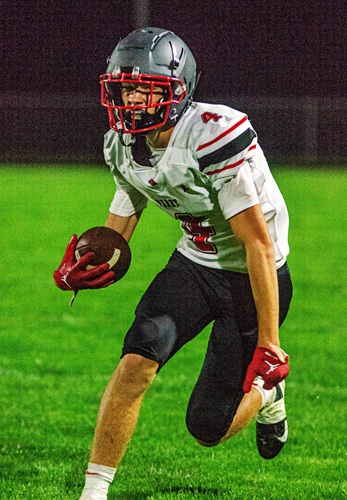
He’s hoping the improvements he picked up in running mechanics pay off on the football field. Another bonus: His big numbers from last fall – piled up almost entirely against double teams – came mostly on passes from now-senior quarterback Tyger Whitbeck.
They are two of only 16 players on the Perry varsity. But there are 25 players on the Ramblers’ JV, and Rockafellow’s commitment provides an example that may continue to pay off after he’s moved on.
 “He’s the sort of kid who is setting the foundation. He doesn’t care about any of the individual stuff or whatever. The only time he cares about that is when it can help him get to the next level,” Bentley said.
Rockafellow has been generating interest among Division II football programs and been offered 2027 roster spots by four Division III teams. “Courtney (Hawkins) is a friend of mine, at Michigan State, and we went and did some hand-to-hand stuff off the line of scrimmage with him, and (Alex) absorbs everything,” Bentley noted. “It’s almost to the point where it looks like he’s not paying attention to you, and he’s thinking of five different things on how he can apply what you just told him.”
Rockafellow also carries a 3.9 grade-point average, so maybe entomology is in his future?
Actually, he’s hoping to follow in the footsteps of his dad, a physical education teacher at Perry’s upper elementary school who Alex has watched impact students in a way he’d like to continue – like when Travis secured a grant to purchase mountain bikes and taught kids how to ride them.
“We’ve never been those parents to say ‘you’re going to do this, we want you to do this.’ He’s gone above and beyond what we’ve expected from him,” Travis Rockafellow said. “The best way to describe Alex is he gets himself in the right place in the right time. He puts himself out there. I was never that confident and outgoing, but to watch him make the transformation from a shy kid to this, he’s exceeded my expectations, and I’m really proud of him.”
Alex said his future could also include permanently adding a third generation to Rock's removal service. As a sweat bee darted around his helmet Monday, he didn’t seem to notice. He’s been helping out his dad and grandfather since he was 5, and the eight or so stings he received this year haven’t hurt like they used to when he was younger.
Rockafellow also will leave his mark as one of the all-time top receivers at Perry, but would love to be remembered in a less measurable way. Despite being few in numbers, the Ramblers this season are a close-knit group, and he’s plenty confident they’ll improve on their one win from a year ago.
“I would love to be just a different kind of team, one that hates losing more than they love winning,” Rockafellow said. “Just trying to be our best and fighting for everything we can get.”
 Geoff Kimmerly joined the MHSAA in Sept. 2011 after 12 years as Prep Sports Editor of the Lansing State Journal. He is a senior editor of MHSAA.com's editorial content and has served as MHSAA Communications Director since January 2021. Contact him at [email protected] with story ideas for the Barry, Eaton, Ingham, Livingston, Ionia, Clinton, Shiawassee, Gratiot, Isabella, Clare and Montcalm counties.
PHOTOS (Top) Perry’s Alex Rockafellow hauls in a pass last season while closely covered. (Middle) Rockafellow prepares to collect a nest Friday, despite nearly being stung. (Below) Rockafellow makes a move up field, also last season. (Photos courtesy of the Rockafellow family.)