


Classes Still Create Hoosier Hysteria
July 27, 2017
By Rob Kaminski
MHSAA benchmarks editor
This is the fourth part in a series on MHSAA tournament classification, past and present, that will be published over the next two weeks. This series originally ran in this spring's edition of MHSAA benchmarks.
Twenty years ago, Bloomington North High School won the Indiana High School Athletic Association boys basketball championship, defeating Delta 75-54 at the RCA Dome in Indianapolis.
The date, March 22, 1997, is at the same time revered and disdained by traditionalists in the state who saw it as the last schoolboy championship game the state would ever host.
That’s how devout the game of basketball, particularly interscholastic basketball, had become in the Hoosier state during the 87 years a state champion – one state champion, to be precise – was crowned.
Following that 1997 season, the IHSAA moved to a four-class system for its roundball tournaments, like so many of its state association counterparts had done years earlier.
It would be shocking to find more than a small percentage of current high school basketball players around the country unfamiliar with the iconic movie Hoosiers, even though the film is now more than 30 years old.
And, the storyline for that blockbuster unfolded more than 30 years prior to its release, when small-town, undermanned Milan High School defeated Muncie Central High School 32-30 in the 1954 IHSAA title game.
Perhaps it’s because of the David vs Goliath notion, or the fame of the movie that replaced Milan with the fictional Hickory and real-life star Bobby Plump with Hollywood hero Jimmy Chitwood, or the simple fact that Indiana had something other states didn’t.
Whatever the reason, plenty of opposition remains to this day to basketball classification in the state.
The fact is, the small rural schools were regularly being beaten handily by the much larger suburban and city schools as the tournament progressed each season.
Small schools also were closing at a rapid rate following the state’s School Reorganization Act in 1959, as students converged on larger, centralized county schools. From 1960 to 2000, the number of schools entering the tournament dropped from 694 to 381, and in 1997 a total of 382 schools and 4,584 athletes began competition at the Sectional level (the first level of the IHSAA Basketball Tournament).
It was at the entry level of the tournament where school administrators felt the pain of the new class system, but not necessarily for the same nostalgic reasons as the fans who either attended or boycotted the tournament.
At the Sectional round of the tournament, the IHSAA was culling just 2 percent of the revenue, with the participating schools splitting the balance. So, when Sectional attendance dropped by 14 percent in that first year of class basketball, many schools realized a financial loss. It was money they had grown to count on in prior years to help fund various aspects of the department.
Schools cumulatively received more than $900,000 from Sectional competition in 1998, but that total was down from more than $1 million in the last year of the single-class tournament.
Yet, the current format provides a great deal more opportunity and realistic chances at championship runs for schools of all enrollments.
To date, 60 additional teams have championship or runner-up trophies on display in school trophy cases around Indiana.
That was the mission in front of then-IHSAA commissioner Bob Gardner (now National Federation executive director) once the board made its decision: to give thousands more student-athletes the opportunity for once-in-a-lifetime experiences.
As any statistician knows, figures can be manipulated to tell any side of a story. Declining attendance in year one of class basketball is such a number.
The truth is tournament attendance had been on a steady downward spiral since its peak of just over 1.5 million in 1962. By the last single-class event in 1997, the total attendance was half that.
The challenge then and today, as it is for all state associations, is to find that delicate balance for those holding onto tradition, those holding onto trophies, and the number of trophies to hand out.
Editor’s Note: Stories from the Fort Wayne Journal Gazette in 1998 and from a 2007 issue of Indianapolis Monthly provided facts in this article.
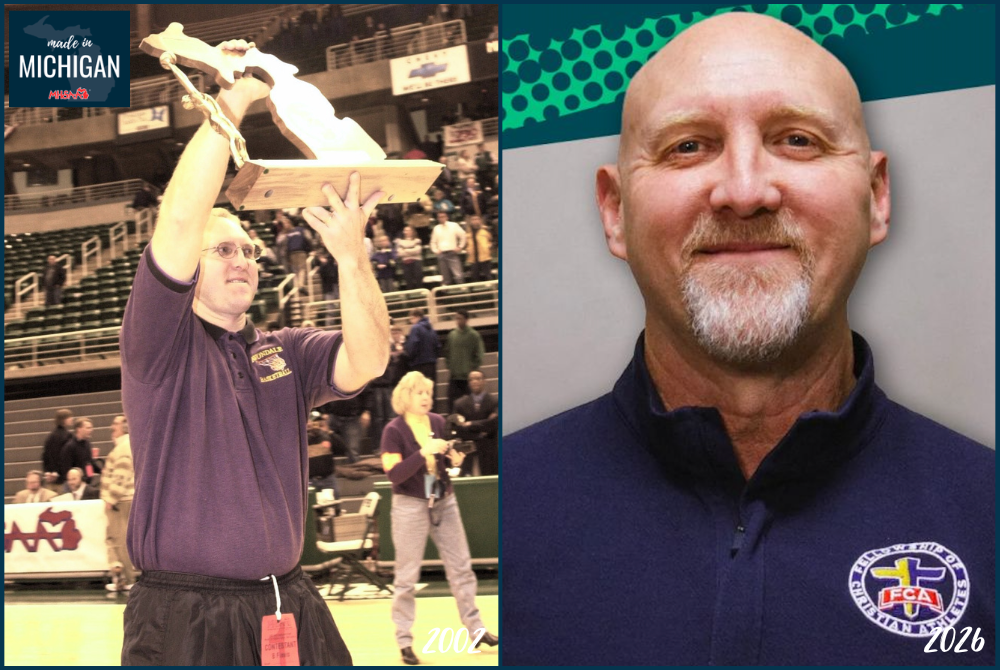
Nearly 25 Years After Leading Unexpected Run, Morton Directing Life-Changing Mission
By
Keith Dunlap
Special for MHSAA.com
August 11, 2026
Nearly a quarter century after presiding over arguably one of the most improbable boys basketball state championships in Michigan history, the same fight and underdog mentality still exists for Tim Morton.
 Back in 2002, Morton was the head boys basketball head coach at Auburn Hills Avondale, which produced a Hollywood-type run during that season’s Class B tournament.
Unranked and without a future Division I college player in the lineup, a Yellow Jackets team headlined by seven seniors went on a quest that stunned many statewide observers.
Avondale avenged the disappointment of not getting out of the District round the previous year and then recorded a stunning upset of a highly-ranked Flint Southwestern team in their Regional Final, winning in double overtime. But after squeaking out a six-point win over a solid Williamston team in a Quarterfinal and earning an 11-point win over Comstock Park in the Semifinals, surely midnight was going to strike for Cinderella in the championship game. After all, Avondale was up against a powerful Grand Rapids South Christian team which had multiple future Division I college players on its roster.
It didn’t matter as Avondale, led by tough-as-nails captains Mike Lewis and Wes Whiteside, senior Dionte Miller and sophomore Dave Holston, completed its stunning run with a 70-65 win to capture what still stands as the program’s only Finals basketball championship.
Morton said he thought his team the previous year that couldn’t make it out of Districts was more talented, but there were intangibles the 2001-02 team possessed that couldn’t be matched.
“I think that nobody really thought that they’d have a shot,” Morton said of his team. “I think that is why we were unranked, because of what had left. But you’ve got to have something to fight for, and I think the reason was the year before. We were motivated. I think playing that underdog role, we just loved it. We won games in so many different ways and got on that roll.”
This past March, Morton and other alumni of the Avondale team certainly were thrilled to see this year’s squad advance to the Semifinals for the first time since their 2001-02 team did so. This time, the Yellow Jackets suffered a three-point Semifinal loss to eventual Class A champion Rockford.
Today, Morton is also heading another team that has an underdog mentality but is motivated to fight for each other and surrounding communities.
Morton is the multi-area director for the Southeast Michigan chapter of the Fellowship of Christian Athletes, which aims to serve kids, coaches and communities by promoting through activities faith, self-esteem, serving others and being the best version of yourself.
The organization has roughly 50 student-led “huddles” that meet at high schools or middle schools, where students can have a safe haven to talk about problems, promote successes, go over scripture and bond during a challenging time of life.
Through volunteers and other staff members, the organization also conducts camps throughout the state for coaches, athletes and others to learn from each other and grow as leaders.
The chapter will have its annual golf outing Sept. 28 at Oakland University’s Sharf Golf Course.
“We just want to be really good at cultivating those relationships, making sure that we’re following up with people, and sharing what the Lord is doing so people feel like they can be connected to something bigger than themselves.”
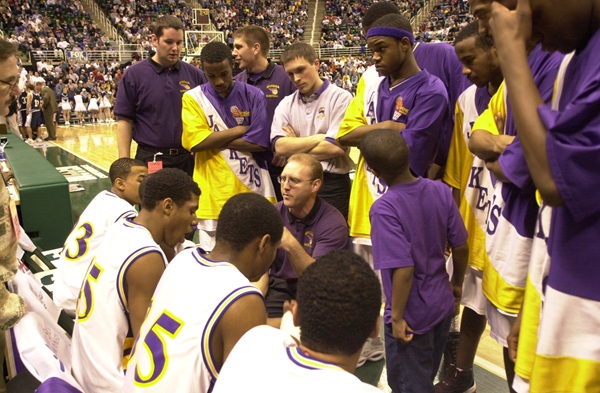 Playing for something bigger than themselves certainly worked for the 2002 team, and Morton said there is a 25th anniversary reunion in the works for next spring.
But while he nor anyone else in the Avondale community will forget that run in 2002, these days Morton is spearheading a team he said is playing for an even greater purpose, one he tried to describe to a group of youth football coaches in Flint during a recent gathering.
“I had only about 15 to 20 minutes to share with these guys,” Morton said. “I shared that we won a state title in 2002 and I was driven to be the best coach I could possibly be. A lot of great things happened, and the state championship happened. I’m on my way home from the state championship and we’re watching the video, and it’s crazy because this fear came over me. How are we going to do this again?
“Every coach that puts his or her full identity in the performance of the team, that’s scary and that’s not good. I got out six years later because of that fear. The most important relationships of my life were not good because I had to be validated by the performance of my team. That conversation kind of led into, “Why are you coaching? Why are you doing what you are doing? I wanted them to be motivated to be the best versions of themselves, for those kids, their wives and children. That’s why I’m in FCA. That’s my cause to fight for.”
2026 Made In Michigan
Aug. 7: Significance of Historic Run, Relationships Formed Live On for 1973 Unity Champs - Report
Aug. 4: Work Ethic Continues to Drive Van Dyk's Endeavors as Co-Owner of Family Farm - Report
July 24: Hackett Mentor's Care Sparked Lifetime in Hoops for BCAM President White - Report
July 24: Mackey Leaving Court with 500+ College Hoops Wins, Many More Lessons Shared - Report
July 16: Country Day Two-Time Champ Moore Building Perennial Winner at Harvard - Report
July 9: Multi-Sport Career at TC West Helps Gillis Thrive as Pro in Game She Once Left Behind - Report
July 2: Inspired by Home, Eager to Give Back, Spencer Hosts Hoop City Alumni Games - Report
PHOTOS At left, Tim Morton raises the Class B championship trophy in 2002. At right, Morton now a director for Fellowship of Christian Athletes. (Middle) Morton, kneeling, speaks to his team during the championship win at Breslin Center. (MHSAA archives)