


Classes Still Create Hoosier Hysteria
July 27, 2017
By Rob Kaminski
MHSAA benchmarks editor
This is the fourth part in a series on MHSAA tournament classification, past and present, that will be published over the next two weeks. This series originally ran in this spring's edition of MHSAA benchmarks.
Twenty years ago, Bloomington North High School won the Indiana High School Athletic Association boys basketball championship, defeating Delta 75-54 at the RCA Dome in Indianapolis.
The date, March 22, 1997, is at the same time revered and disdained by traditionalists in the state who saw it as the last schoolboy championship game the state would ever host.
That’s how devout the game of basketball, particularly interscholastic basketball, had become in the Hoosier state during the 87 years a state champion – one state champion, to be precise – was crowned.
Following that 1997 season, the IHSAA moved to a four-class system for its roundball tournaments, like so many of its state association counterparts had done years earlier.
It would be shocking to find more than a small percentage of current high school basketball players around the country unfamiliar with the iconic movie Hoosiers, even though the film is now more than 30 years old.
And, the storyline for that blockbuster unfolded more than 30 years prior to its release, when small-town, undermanned Milan High School defeated Muncie Central High School 32-30 in the 1954 IHSAA title game.
Perhaps it’s because of the David vs Goliath notion, or the fame of the movie that replaced Milan with the fictional Hickory and real-life star Bobby Plump with Hollywood hero Jimmy Chitwood, or the simple fact that Indiana had something other states didn’t.
Whatever the reason, plenty of opposition remains to this day to basketball classification in the state.
The fact is, the small rural schools were regularly being beaten handily by the much larger suburban and city schools as the tournament progressed each season.
Small schools also were closing at a rapid rate following the state’s School Reorganization Act in 1959, as students converged on larger, centralized county schools. From 1960 to 2000, the number of schools entering the tournament dropped from 694 to 381, and in 1997 a total of 382 schools and 4,584 athletes began competition at the Sectional level (the first level of the IHSAA Basketball Tournament).
It was at the entry level of the tournament where school administrators felt the pain of the new class system, but not necessarily for the same nostalgic reasons as the fans who either attended or boycotted the tournament.
At the Sectional round of the tournament, the IHSAA was culling just 2 percent of the revenue, with the participating schools splitting the balance. So, when Sectional attendance dropped by 14 percent in that first year of class basketball, many schools realized a financial loss. It was money they had grown to count on in prior years to help fund various aspects of the department.
Schools cumulatively received more than $900,000 from Sectional competition in 1998, but that total was down from more than $1 million in the last year of the single-class tournament.
Yet, the current format provides a great deal more opportunity and realistic chances at championship runs for schools of all enrollments.
To date, 60 additional teams have championship or runner-up trophies on display in school trophy cases around Indiana.
That was the mission in front of then-IHSAA commissioner Bob Gardner (now National Federation executive director) once the board made its decision: to give thousands more student-athletes the opportunity for once-in-a-lifetime experiences.
As any statistician knows, figures can be manipulated to tell any side of a story. Declining attendance in year one of class basketball is such a number.
The truth is tournament attendance had been on a steady downward spiral since its peak of just over 1.5 million in 1962. By the last single-class event in 1997, the total attendance was half that.
The challenge then and today, as it is for all state associations, is to find that delicate balance for those holding onto tradition, those holding onto trophies, and the number of trophies to hand out.
Editor’s Note: Stories from the Fort Wayne Journal Gazette in 1998 and from a 2007 issue of Indianapolis Monthly provided facts in this article.
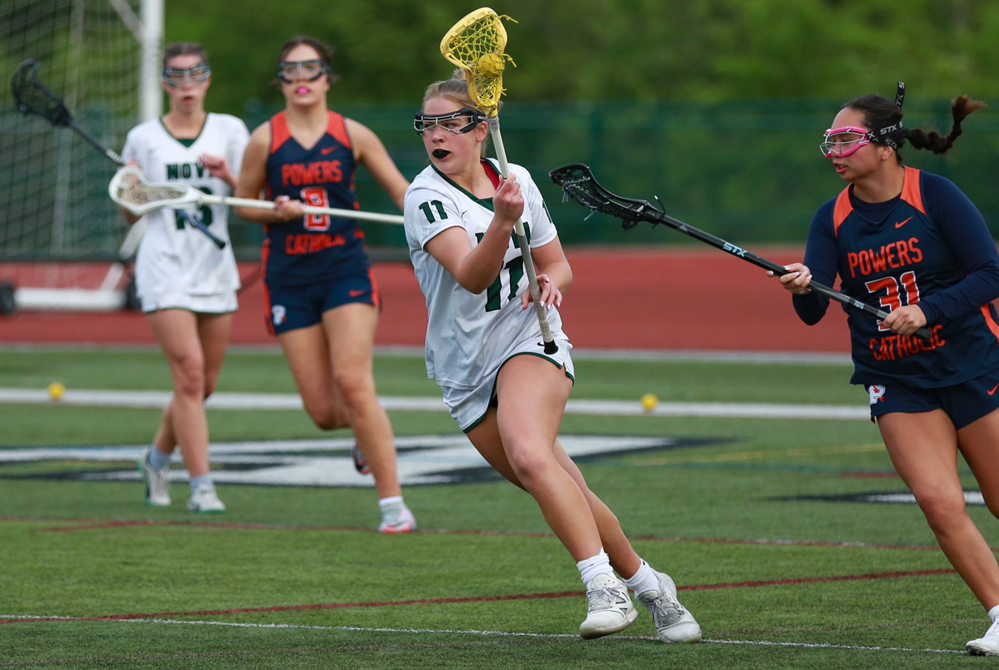
Performance of the Week: Novi's Ally Katinas
May 16, 2024
 Ally Katinas ♦ Novi
Senior ♦ Lacrosse
Katinas scored four goals in Novi’s 16-6 win over Flint Powers Catholic on May 10, including her 100th goal this season and the 200th over her career. Entering this spring only 20 players in MHSAA lacrosse history had scored 100 goals in a season, and only 20 had reached 200 career goals.
Novi is 13-5 after Monday’s 15-3 win over Canton, an improvement over last year’s 8-9 finish. Beginning with the summer before her junior year, Katinas fractured both ankles – and one ankle twice – but she returned for the second half of Novi’s season as her team won four of its last five games. The Wildcats have won 10 of their last 11 games this spring and are No. 6 in the Division 1 Michigan Power Ratings (MPR). Katinas will continue playing next season at Detroit Mercy and plans to study pre-law.
@mhsaasports 🥍POW: Ally Katinas #lacrosse #novi #letsgo #100goals #part1 #highschoolsports #tiktalk #interview #performanceoftheweek #mistudentaid #fyp #MHSAA ♬ original sound - MHSAA
@mhsaasports 🥍POW: Ally Katinas #tiktalk #questiontime #part2 #starbucks #chipotle #suits #dog #pilates #performanceoftheweek #mistudentaid #fyp #MHSAA ♬ original sound - MHSAA
Follow the MHSAA on TikTok.
MHSAA.com's "Performance of the Week" features are powered by MI Student Aid, a division within the Department of Lifelong Education, Advancement, and Potential (MiLEAP). MI Student Aid encourages students to pursue postsecondary education by providing access to student financial resources and information. MI Student Aid administers the state’s 529 college savings programs (MET/MESP), as well as scholarship and grant programs that help make college Accessible, Affordable and Attainable for you. Connect with MI Student Aid at www.michigan.gov/mistudentaid and find more information on Facebook and Twitter @mistudentaid.
Past 2023-24 Honorees
May 9: Peter Roehl, Rochester Adams golf - Report
May 2: Lilah Smith, Richland Gull Lake soccer - Report
April 25: Mason Mayne, Lawton track & field - Report
April 18: Alli Wright, Jenison softball - Report
April 11: Chloe Wishart, Trenton soccer - Report
March 28: Jenna Maki, Ishpeming basketball - Report
March 22: Jaremiah Palmer, Niles Brandywine basketball - Report
March 15: Leah Hodge, North Farmington gymnastics - Report
March 8: Darius Marines, Detroit Catholic Central wrestling - Report
March 1: Rylee Smith, Zeeland West bowling - Report
Feb. 22: Caleb Lewandowski, Traverse City West skiing - Report
Feb. 15: Jadin Mix, Onaway basketball - Report
Feb. 8: Onalee Wallis, Cadillac skiing - Report
Feb. 1: Abbey DeGraw, Rochester Hills Stoney Creek competitive cheer - Report
Jan. 25: Ewan Todd, Riverview swimming - Report
Jan. 18: Ashley Weller, Jackson Northwest basketball - Report
Jan. 11: Michael Baldwin, Saginaw Arthur Hill wrestling - Report
Dec. 15: Jena Fijolek, Fenton bowling - Report
Dec. 8: Sophia Wagner, Escanaba gymnastics - Report
Dec. 1: Isaiah Marshall, Southfield Arts & Technology football - Report
Nov. 24: Sarah Bradley, Clarkston Everest Collegiate volleyball - Report
Nov. 17: Kalieb Osborne, Waterford Mott football - Report
Nov. 10: Tekalegn Vlasma, Muskegon Western Michigan Christian soccer - Report
Nov. 3: Colton Kinnie, Birmingham Seaholm football - Report
Oct. 27: Lauren Timpf, Macomb Lutheran North golf - Report
Oct. 20: Alena Li, Okemos golf - Report
Oct. 13: Seth Norder, Grand Haven cross country - Report
Oct. 5: Paige Anderson, Muskegon Reeths-Puffer golf - Report
Sept. 29: MacKenzie Bisballe, Lake City volleyball - Report
Sept. 22: Jhace Massey, Gladwin football - Report
Sept. 15: Kaylee Draper, Sturgis swimming - Report
Sept. 8: Owen Jackson, Traverse City St. Francis tennis - Report
Sept. 1: Rachel Forsyth, Ann Arbor Pioneer cross country - Report
(Action photo courtesy of Chris Mucke.)