


Classes Still Create Hoosier Hysteria
July 27, 2017
By Rob Kaminski
MHSAA benchmarks editor
This is the fourth part in a series on MHSAA tournament classification, past and present, that will be published over the next two weeks. This series originally ran in this spring's edition of MHSAA benchmarks.
Twenty years ago, Bloomington North High School won the Indiana High School Athletic Association boys basketball championship, defeating Delta 75-54 at the RCA Dome in Indianapolis.
The date, March 22, 1997, is at the same time revered and disdained by traditionalists in the state who saw it as the last schoolboy championship game the state would ever host.
That’s how devout the game of basketball, particularly interscholastic basketball, had become in the Hoosier state during the 87 years a state champion – one state champion, to be precise – was crowned.
Following that 1997 season, the IHSAA moved to a four-class system for its roundball tournaments, like so many of its state association counterparts had done years earlier.
It would be shocking to find more than a small percentage of current high school basketball players around the country unfamiliar with the iconic movie Hoosiers, even though the film is now more than 30 years old.
And, the storyline for that blockbuster unfolded more than 30 years prior to its release, when small-town, undermanned Milan High School defeated Muncie Central High School 32-30 in the 1954 IHSAA title game.
Perhaps it’s because of the David vs Goliath notion, or the fame of the movie that replaced Milan with the fictional Hickory and real-life star Bobby Plump with Hollywood hero Jimmy Chitwood, or the simple fact that Indiana had something other states didn’t.
Whatever the reason, plenty of opposition remains to this day to basketball classification in the state.
The fact is, the small rural schools were regularly being beaten handily by the much larger suburban and city schools as the tournament progressed each season.
Small schools also were closing at a rapid rate following the state’s School Reorganization Act in 1959, as students converged on larger, centralized county schools. From 1960 to 2000, the number of schools entering the tournament dropped from 694 to 381, and in 1997 a total of 382 schools and 4,584 athletes began competition at the Sectional level (the first level of the IHSAA Basketball Tournament).
It was at the entry level of the tournament where school administrators felt the pain of the new class system, but not necessarily for the same nostalgic reasons as the fans who either attended or boycotted the tournament.
At the Sectional round of the tournament, the IHSAA was culling just 2 percent of the revenue, with the participating schools splitting the balance. So, when Sectional attendance dropped by 14 percent in that first year of class basketball, many schools realized a financial loss. It was money they had grown to count on in prior years to help fund various aspects of the department.
Schools cumulatively received more than $900,000 from Sectional competition in 1998, but that total was down from more than $1 million in the last year of the single-class tournament.
Yet, the current format provides a great deal more opportunity and realistic chances at championship runs for schools of all enrollments.
To date, 60 additional teams have championship or runner-up trophies on display in school trophy cases around Indiana.
That was the mission in front of then-IHSAA commissioner Bob Gardner (now National Federation executive director) once the board made its decision: to give thousands more student-athletes the opportunity for once-in-a-lifetime experiences.
As any statistician knows, figures can be manipulated to tell any side of a story. Declining attendance in year one of class basketball is such a number.
The truth is tournament attendance had been on a steady downward spiral since its peak of just over 1.5 million in 1962. By the last single-class event in 1997, the total attendance was half that.
The challenge then and today, as it is for all state associations, is to find that delicate balance for those holding onto tradition, those holding onto trophies, and the number of trophies to hand out.
Editor’s Note: Stories from the Fort Wayne Journal Gazette in 1998 and from a 2007 issue of Indianapolis Monthly provided facts in this article.
Opsal Overcomes Potential Season-Ending Injury to End Season as Champion
By
Steve Vedder
Special for MHSAA.com
March 24, 2026
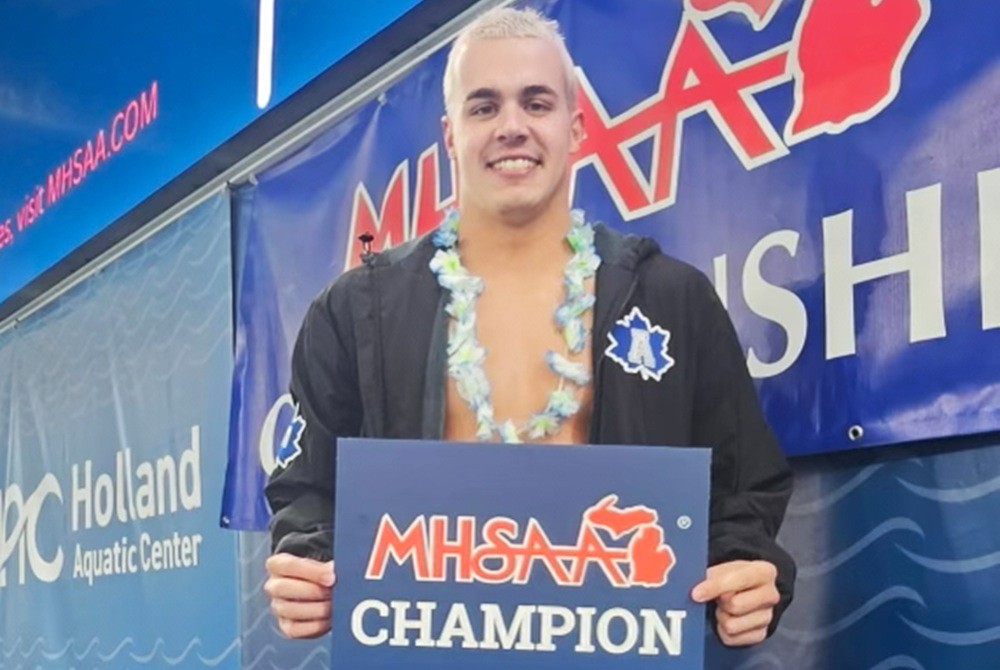
You couldn't blame Kade Opsal for being a little teary-eyed as he stood quietly on the medal stand at the Lower Peninsula Division 3 Swimming & Diving Finals earlier this month at Holland Aquatics Center.
By rights, you could easily make the case he shouldn't have been there.
It wasn't through a lack of talent for the Adrian senior, who was undefeated in four years of conference championship meets in the 50-yard freestyle and 100 backstroke while taking second in Division 3 in the 100 backstroke as a junior. Talent wasn't the problem.
The problem was the freak accident Opsal had suffered six months ago which doctors feared could cost him his final year of swimming.
So as Opsal waited anxiously on the stand for a medal to be hung around his neck, he found himself fighting a flood of emotion.
"My coach handed out the medal, and I heard my name over the public address system," he said. "I leaned down and my coach said, 'You really did it.' I got a little emotional, I cried a little. I was so full of emotion. I was glad I had finished my career how I did."
Opsal's dream for his final year of high school swimming was simple: win a Finals championship. But that goal seemed potentially unattainable after an accident on the soccer field in early September.
After having been convinced by friends to go out for soccer when Adrian needed a goalkeeper, Opsal stepped up to fill the void. But during a practice session, Opsal faced shot from a teammate less than a dozen feet away. He stuck his hand in front of his face to shield himself from the shot, but the ball crashed into Opsal's wrist, causing a fracture of the scaphoid bone near where his wrist and thumb meet.
It was the second time Opsal had broken the bone. The first was during the swim Finals as a freshman when he slammed his hand into the end of the pool at the end of a race. He spent 16 weeks in a cast.
 But while Opsal dodged surgery three years ago, this time doctors diagnosed a displaced fracture which resulted in surgery, screws inserted in the wrist and a bone graft. Qualifying for the Finals and fulfilling a lifelong dream at that point seemed miles away, Opsal admitted.
"I went into a spiral," he said. "I thought I was going to miss the whole season. It was terrible."
Doctors weren't exactly in disagreement with that prognosis. After surgery Oct. 12, doctors encased his hand in a nine-pound cast, basically a club, Opsal said. He spent two weeks in the cast, had a checkup, spent four more weeks in a cast, then was placed in a removeable cast. By now it was the second week of December, this season’s Finals were three months away, and Opsal had yet to enter the water. By Jan. 9, Opsal was finally pronounced ready to swim by doctors, but he was seriously behind in his attempt to simply qualify for the Division 3 championship meet, let alone be in the hunt to win a race there.
Still, Opsal wasn't ready to toss in his goggles.
"I knew I could do something with the little time I had left," he said. "I knew I had put in a lot of work over the summer and had gained like 30 pounds of muscle. But I didn't know how all that would translate in the final two months of the season. I did know that every practice and meet had to count."
By the MISCA meet in early February, there was a ray of light. Opsal swam a 21.2 in the 50 free and a 50.4 in the 100 backstroke. Suddenly there was hope that he still had a shot at his dream.
Opsal continued to pick up the pace until the Division 3 Finals prelims March 13. He wound up seeded first in the 100 backstroke with a time of 50.1 and was third in the 50 free.
There was, Opsal told himself, hope.
One day later, he began his Finals by helping Adrian's 200 medley relay to a ninth-place finish. Then, in his first attempt at a title, he finished runner-up in the 50 free with a time of 20.87.
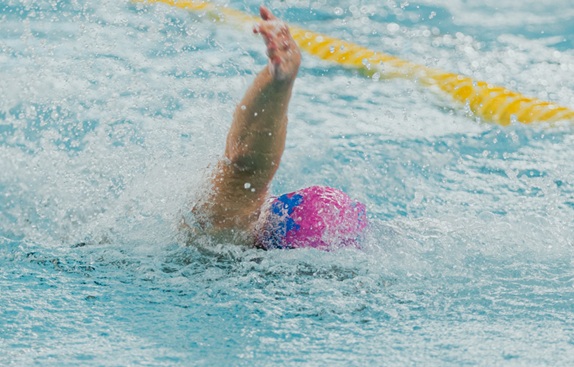
Opsal's championship dream had come down to the 100 backstroke. He finally turned that dream into reality when he outdistanced Spring Lake's Dane Trask to win the event, swimming a lifetime-best time of 49.20 to nudge the 50.46 by Trask.
Tears aside on the medals stand, all Opsal could think about was advice he received from family members.
"I thought about my grandfather who always reminded me about that Vince Lombardi quote that winning wasn't everything, it was the only thing," he said. "I had thought I had a shot at it and I kept telling myself this was my senior year and I wanted to go out with a bang."
Considering his two broken hands and a fractured patella he suffered as a youngster, Opsal can now laugh at the obstacles he's had to overcome.
"My mom has definitely made comments that they need to bubble wrap me," he said. "I've been around the block in getting hurt."
PHOTOS (Top) Adrian’s Kade Opsal stands on the medal podium after winning the 100-yard backstroke at the Lower Peninsula Division 3 Finals in Holland. (Middle) Opsal swims to his championship. (Action photo by High School Sports Scene.)