


Classes Still Create Hoosier Hysteria
July 27, 2017
By Rob Kaminski
MHSAA benchmarks editor
This is the fourth part in a series on MHSAA tournament classification, past and present, that will be published over the next two weeks. This series originally ran in this spring's edition of MHSAA benchmarks.
Twenty years ago, Bloomington North High School won the Indiana High School Athletic Association boys basketball championship, defeating Delta 75-54 at the RCA Dome in Indianapolis.
The date, March 22, 1997, is at the same time revered and disdained by traditionalists in the state who saw it as the last schoolboy championship game the state would ever host.
That’s how devout the game of basketball, particularly interscholastic basketball, had become in the Hoosier state during the 87 years a state champion – one state champion, to be precise – was crowned.
Following that 1997 season, the IHSAA moved to a four-class system for its roundball tournaments, like so many of its state association counterparts had done years earlier.
It would be shocking to find more than a small percentage of current high school basketball players around the country unfamiliar with the iconic movie Hoosiers, even though the film is now more than 30 years old.
And, the storyline for that blockbuster unfolded more than 30 years prior to its release, when small-town, undermanned Milan High School defeated Muncie Central High School 32-30 in the 1954 IHSAA title game.
Perhaps it’s because of the David vs Goliath notion, or the fame of the movie that replaced Milan with the fictional Hickory and real-life star Bobby Plump with Hollywood hero Jimmy Chitwood, or the simple fact that Indiana had something other states didn’t.
Whatever the reason, plenty of opposition remains to this day to basketball classification in the state.
The fact is, the small rural schools were regularly being beaten handily by the much larger suburban and city schools as the tournament progressed each season.
Small schools also were closing at a rapid rate following the state’s School Reorganization Act in 1959, as students converged on larger, centralized county schools. From 1960 to 2000, the number of schools entering the tournament dropped from 694 to 381, and in 1997 a total of 382 schools and 4,584 athletes began competition at the Sectional level (the first level of the IHSAA Basketball Tournament).
It was at the entry level of the tournament where school administrators felt the pain of the new class system, but not necessarily for the same nostalgic reasons as the fans who either attended or boycotted the tournament.
At the Sectional round of the tournament, the IHSAA was culling just 2 percent of the revenue, with the participating schools splitting the balance. So, when Sectional attendance dropped by 14 percent in that first year of class basketball, many schools realized a financial loss. It was money they had grown to count on in prior years to help fund various aspects of the department.
Schools cumulatively received more than $900,000 from Sectional competition in 1998, but that total was down from more than $1 million in the last year of the single-class tournament.
Yet, the current format provides a great deal more opportunity and realistic chances at championship runs for schools of all enrollments.
To date, 60 additional teams have championship or runner-up trophies on display in school trophy cases around Indiana.
That was the mission in front of then-IHSAA commissioner Bob Gardner (now National Federation executive director) once the board made its decision: to give thousands more student-athletes the opportunity for once-in-a-lifetime experiences.
As any statistician knows, figures can be manipulated to tell any side of a story. Declining attendance in year one of class basketball is such a number.
The truth is tournament attendance had been on a steady downward spiral since its peak of just over 1.5 million in 1962. By the last single-class event in 1997, the total attendance was half that.
The challenge then and today, as it is for all state associations, is to find that delicate balance for those holding onto tradition, those holding onto trophies, and the number of trophies to hand out.
Editor’s Note: Stories from the Fort Wayne Journal Gazette in 1998 and from a 2007 issue of Indianapolis Monthly provided facts in this article.
MHSAA, NFHS Learning Center Team Up to Provide Online Student Leadership Series
By
Geoff Kimmerly
MHSAA.com senior editor
August 10, 2023
Leadership always has been one of the most valuable and applicable life skills developed by student-athletes participating in educational athletics. To assist in that development, the Michigan High School Athletic Association (MHSAA) and National Federation of State High School Associations (NFHS) have partnered to produce an online Student Leadership series designed to provide the latest research-based instruction to high schoolers throughout the United States.
The Student Leadership series is provided as part of the web-based NFHS Learning Center and includes two free courses focused on students – “Becoming a Leader” and “Leading Others” – with a third installment for coaches currently in production. All three are inspired by the latest research on how youth-aged athletes learn to lead.
This latest work builds on the MHSAA-produced “Captains Course” developed in 2015 with Michigan State University’s Institute for the Study of Youth Sports (ISYS). The “Captains Course” has been taken more than 100,000 times and is based on in-person “Captains Clinics” that MHSAA staff and ISYS conduct with thousands of students across Michigan each year.
Each student-focused segment of the new Student Leadership series takes 30-45 minutes to complete and includes frequent and quick activities designed to help students understand how they would apply leadership skills in real-life scenarios. Course instruction was created primarily in coordination with the MHSAA by a pair of nationally-recognized authorities on the subject: Jed Blanton, an assistant professor in kinesiology, recreation and sport studies at the University of Tennessee; and Scott Pierce, an associate professor in kinesiology and recreation at Illinois State University.
Both Blanton and Pierce have vast experience with youth athletics; both also formerly worked for the Institute for the Study of Youth Sports and served as graduate assistants at the MHSAA during their time at MSU, playing large roles in more than a decade of research conducted through coordination with the MHSAA’s 16-member Student Advisory Council. High school administrators, student leaders, and other researchers and mental performance consultants also contributed to the lessons taught in these courses. The NFHS produced the content, including all of the visuals and digital features, and the student-focused courses went live on the NFHS Learn website in mid-summer.
“We’ve taken a good program, and made it even better,” said MHSAA Assistant Director Andy Frushour, who coordinates the Association’s student services programs. “This is a program we do in person in Michigan, but our reach now is across the country – and these courses are free, hopefully allowing us to contribute to the development of even more student leaders.”
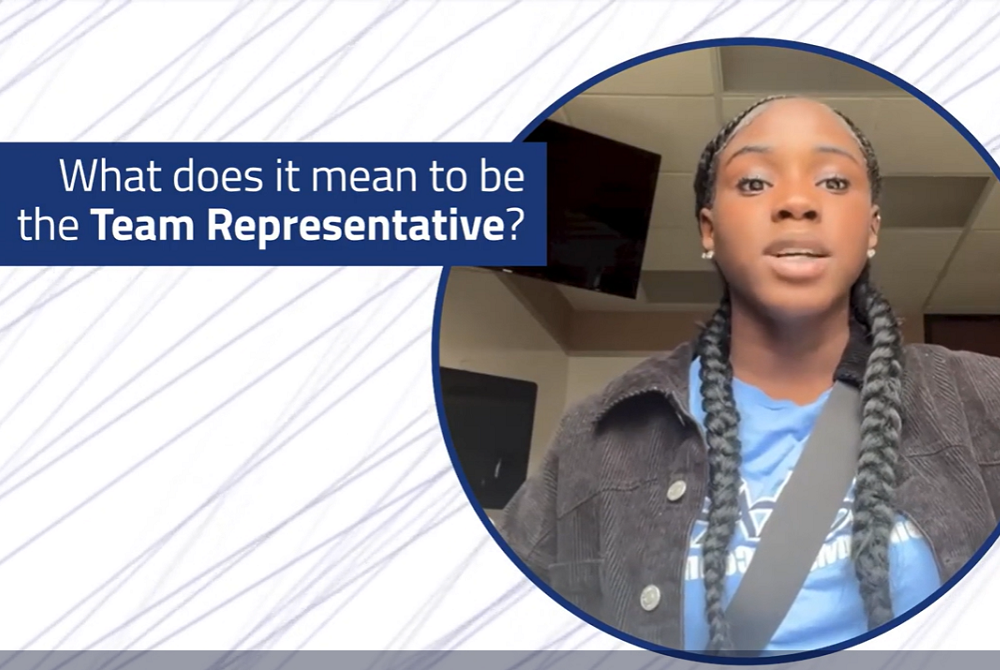
The “Becoming a Leader” course defines leadership styles and builds skills to help students consider themselves as leaders. “Leading Others” details how leaders put those skills into practice including during challenging situations. Blanton and Pierce worked closely with student advisory groups from various states to make the research content relatable to school sports participants. All voices heard in the courses belong to high school students – including athletes from Michigan, Illinois and Washington who provided 30 testimonials that describe leadership in action.
The “Coaches Course” will provide the same information as presented to high school students, but in a way that explains how coaches can use these tools to personalize leadership training among their athletes as they seek to recognize which types of leaders they have on a team, and which types are missing and need to be developed.
“The NFHS is grateful for the opportunity to work with the MHSAA as well as Dr. Blanton and Dr. Pierce,” said Dan Schuster, the NFHS’ director of educational services. “We believe these student leadership courses will provide valuable information across the country and will contribute to the improvement of the interscholastic experience for young people.”
Video previews provide additional information on both Student Leadership courses.Click for direct links to “Becoming a Leader" and “Leading Others.”