


Classes Still Create Hoosier Hysteria
July 27, 2017
By Rob Kaminski
MHSAA benchmarks editor
This is the fourth part in a series on MHSAA tournament classification, past and present, that will be published over the next two weeks. This series originally ran in this spring's edition of MHSAA benchmarks.
Twenty years ago, Bloomington North High School won the Indiana High School Athletic Association boys basketball championship, defeating Delta 75-54 at the RCA Dome in Indianapolis.
The date, March 22, 1997, is at the same time revered and disdained by traditionalists in the state who saw it as the last schoolboy championship game the state would ever host.
That’s how devout the game of basketball, particularly interscholastic basketball, had become in the Hoosier state during the 87 years a state champion – one state champion, to be precise – was crowned.
Following that 1997 season, the IHSAA moved to a four-class system for its roundball tournaments, like so many of its state association counterparts had done years earlier.
It would be shocking to find more than a small percentage of current high school basketball players around the country unfamiliar with the iconic movie Hoosiers, even though the film is now more than 30 years old.
And, the storyline for that blockbuster unfolded more than 30 years prior to its release, when small-town, undermanned Milan High School defeated Muncie Central High School 32-30 in the 1954 IHSAA title game.
Perhaps it’s because of the David vs Goliath notion, or the fame of the movie that replaced Milan with the fictional Hickory and real-life star Bobby Plump with Hollywood hero Jimmy Chitwood, or the simple fact that Indiana had something other states didn’t.
Whatever the reason, plenty of opposition remains to this day to basketball classification in the state.
The fact is, the small rural schools were regularly being beaten handily by the much larger suburban and city schools as the tournament progressed each season.
Small schools also were closing at a rapid rate following the state’s School Reorganization Act in 1959, as students converged on larger, centralized county schools. From 1960 to 2000, the number of schools entering the tournament dropped from 694 to 381, and in 1997 a total of 382 schools and 4,584 athletes began competition at the Sectional level (the first level of the IHSAA Basketball Tournament).
It was at the entry level of the tournament where school administrators felt the pain of the new class system, but not necessarily for the same nostalgic reasons as the fans who either attended or boycotted the tournament.
At the Sectional round of the tournament, the IHSAA was culling just 2 percent of the revenue, with the participating schools splitting the balance. So, when Sectional attendance dropped by 14 percent in that first year of class basketball, many schools realized a financial loss. It was money they had grown to count on in prior years to help fund various aspects of the department.
Schools cumulatively received more than $900,000 from Sectional competition in 1998, but that total was down from more than $1 million in the last year of the single-class tournament.
Yet, the current format provides a great deal more opportunity and realistic chances at championship runs for schools of all enrollments.
To date, 60 additional teams have championship or runner-up trophies on display in school trophy cases around Indiana.
That was the mission in front of then-IHSAA commissioner Bob Gardner (now National Federation executive director) once the board made its decision: to give thousands more student-athletes the opportunity for once-in-a-lifetime experiences.
As any statistician knows, figures can be manipulated to tell any side of a story. Declining attendance in year one of class basketball is such a number.
The truth is tournament attendance had been on a steady downward spiral since its peak of just over 1.5 million in 1962. By the last single-class event in 1997, the total attendance was half that.
The challenge then and today, as it is for all state associations, is to find that delicate balance for those holding onto tradition, those holding onto trophies, and the number of trophies to hand out.
Editor’s Note: Stories from the Fort Wayne Journal Gazette in 1998 and from a 2007 issue of Indianapolis Monthly provided facts in this article.
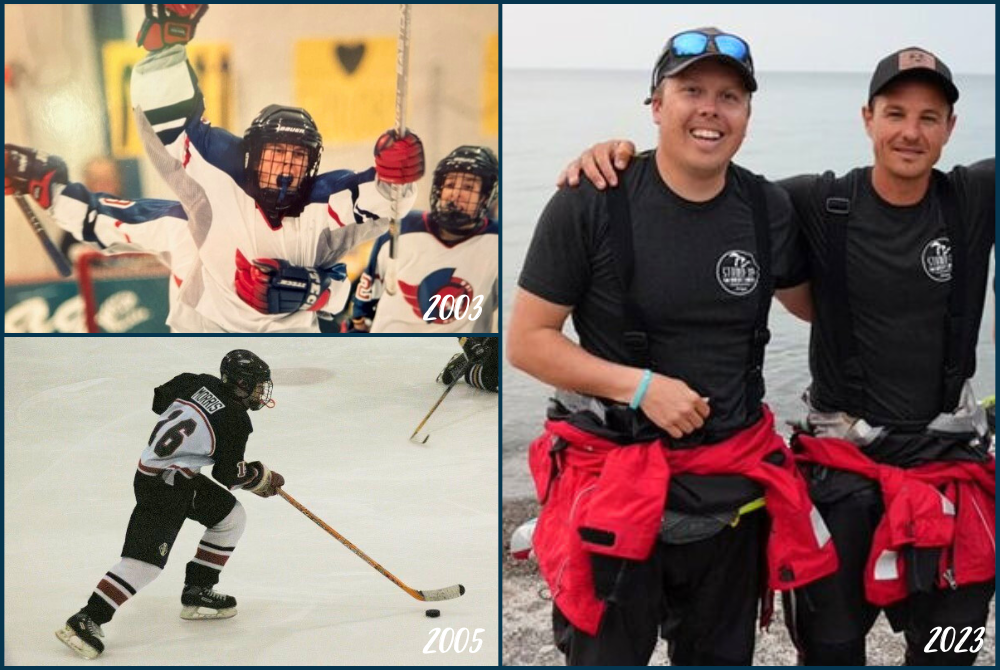
Traverse Bay Reps Teammates Unite to Take on Great Lakes Paddle Board Pursuit
By
Tom Spencer
Special for MHSAA.com
August 3, 2023
Twenty years ago, Kwin Morris and Jeff Guy were teammates on an MHSAA Quarterfinal-qualifying hockey team.
 Guy even scored the winning goal in the Regional Final for Bay Area Reps, which topped Traverse City West 2-1.
This summer’s accomplishment, though, will go deeper in the history books.
Guy and Morris teamed up with Joe Lorenz to complete a dream that started a decade ago. They crossed all five of the Great Lakes on paddle boards while raising awareness and funds for water quality.
They put their balance, endurance and stick-handling skills together for the cause.
‘After 10 years and over one hundred grand raised for the lakes, it feels amazing,” Morris said. “I think the best part is knowing my kids will grow up knowing their old man did something cool for the environment in a unique way.”
It all started at a December social event in Traverse City. Guy, a financial adviser, and Morris, a middle school science teacher, had just gotten into paddle boarding when they began to wonder if they could cross Lake Michigan.
Lorenz, a personal trainer, promptly gave assurances they could — and joined them — even though he had never been on a paddle board prior to the holiday gathering.
Morris, Guy and Lorenz successfully crossed Lake Michigan in 2015, pausing in the cold of the night to look at the Northern Lights. They finished the nearly 100-kilometer journey in just under 25 hours. That accomplishment convinced them to launch Stand Up for Great Lakes, a non-profit organization to raise money and awareness for the protection of the lakes.
The trio also is supporting the Cooperative Institute for Great Lakes Research, a non-profit housed at the University of Michigan.
“It feels amazing to have finished crossing all five lakes and complete a lifelong goal,” Guy acknowledged. “The dollars and awareness we have raised is incredible, and hopefully it continues to grow.”
Lake Huron was the toughest to cross by far, the former Reps noted. The 90-mile, 29-hour paddle brought seven hours of rain and high waves.
“Plus Joe knocked me in and Jeff fell in after catching a fish,” Morris observed.
Ontario was the team’s second-hardest challenge and the shortest paddle. Huge waves from the side all day took quite a toll on the paddlers, who were accompanied by safety boats on each crossing.
Lake Superior featured glassy water, a spectacular sunset and the paddlers pausing to conduct a ceremony over the Edmund Fitzgerald shipwreck. The northernmost Great Lake ranks as the group’s favorite.
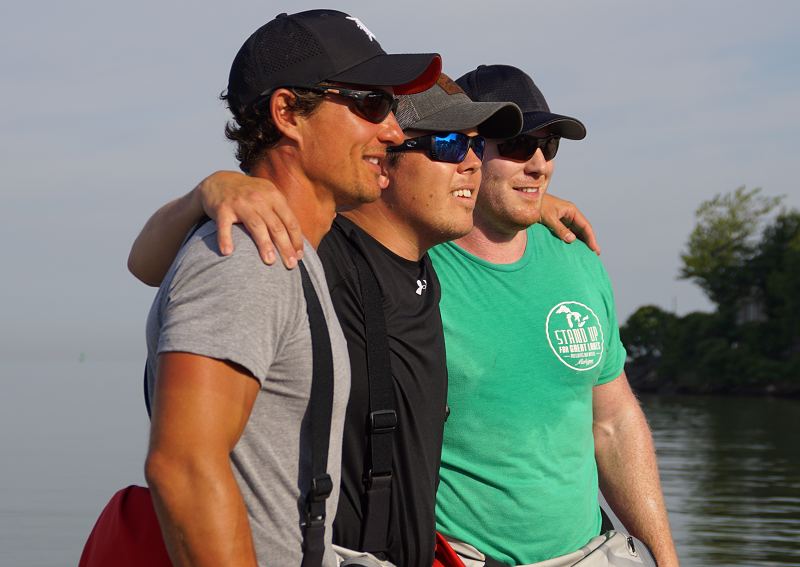 Guy graduated from Kalkaska High School in 2003 and went on to play hockey at Hope College. He also played football, baseball and golf for the Blazers. He and his wife, Melissa, have a daughter, Emma.
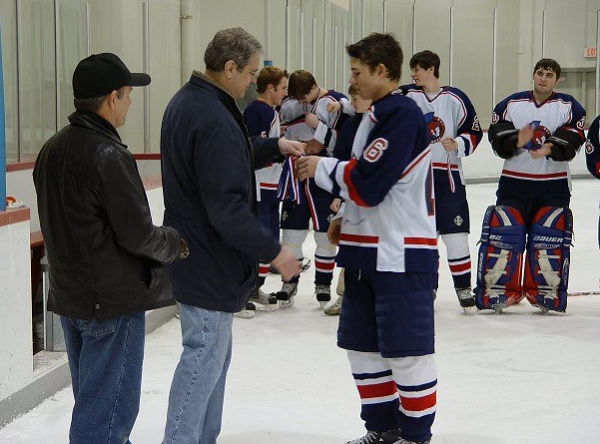
Morris graduated in 2005 from Elk Rapids High School, where he also played baseball. He went on to get a teaching degree from Western Michigan University. He and his wife, Megan, have two children, Fitz and Knox. He now works for his former school district, teaching science.
The pair played for the Reps through a co-op hosted by Traverse City St. Francis that included athletes from Charlevoix, Elk Rapids, Kalkaska, Kingsley, Lake Leelanau St Mary, Mancelona and Suttons Bay. The Reps’ first coach was Michigan High School Hockey Coaches Association Hall of Fame inductee Rex Luxton. He coached through 2008.
Morris and Guy look back at their high school playing days and coach with fondness.
“We had some great teams, and I think I still have the career goal record there,” Guy recalled. “Also, our coach on the Reps Rex Luxton was highly motivational to me while playing for him and later in life.”
Morris echoed Guy.
“I loved the whole experience,” Morris said. “Playing for my high school … Friday night games … school rivalries … playing for Rex Luxton … amazing friends and teammates — almost surreal that it will have been 20 years.”
The former coaching staff of the Reps are not at all surprised Morris and Guy challenged themselves to make a difference for the Great Lakes.
The coaching staff remembers Guy as a natural scorer coming through with big goals, and Morris as a strong two-way player who scored five goals in one period in Sault Ste. Marie. The past coaches also remember all the traveling the two did for practice and games because of the geographic nature of the squad.
“I had no idea they had any interest in the water kind of stuff,” Luxton said of his former players’ feat. “When I started following their bid to raise awareness, it didn’t surprise me they would attempt something like this.
 “I think it illustrates how much determination they have and how much hard work they were willing to put in,” he continued. “It is just outstanding, particularly with the cold weather in the Great Lakes.”
Cody Inglis, a senior assistant director for the MHSAA, was an assistant coach for the Reps during all of Morris and Guy’s time with the co-op. He finds himself beaming with pride and happiness knowing these former players are giving back and making it a better world.
“What Jeff and Kwin have done physically and mentally to cross all of the Great Lakes on stand-up paddle boards is remarkable in itself,” Inglis pointed out. “When you add in the fact that they have put in charitable causes and the preservation of the Great Lakes as a reason for doing it – it makes it even more special.
“It’s not surprising given my recollection and remembrances of Jeff and Kwin, as they were really good hockey players and better people.”
High school hockey is where Morris and Guy’ friendship blossomed. Spending 24 or more hours together — and with Lorenz — has forged a greater lifetime bond that already had included being a part of each other’s weddings.
But they admit they had no inkling of this type of accomplishment back in high school.
“Sports were the most important thing in my life in high school,” Guy revealed. “Working really hard to win as many games as possible was the main goal – along with getting good grades and trying to get into a good college.”
But teamwork, learned on the ice and through other high school sports, can make anything possible.
“Any sport where you have to work as a team helps push yourself out of your comfort zone,” Morris concluded. “That's where the best things in life happen.”
2023 Made In Michigan
August 1: Vast Experience Shapes Retired MLB-er Gates Into 3-Time Finals-Winning Coach - Read
July 25: After All-American Career, Rockford's Bennett Making Impact as Mat Mentor - Read
July 20: Oakridge 3-Sport Star Potts Applying Lessons to 'Second Chapter' in Sales - Read
July 18: Frankfort Hoops Staff Bolstered by Past Stars Giving Back in Banktson, Kreski - Read
July 12: Championship Memories, High School Tennis' Impact Stick with Hackett Pair - Read
July 6: Brother Rice Finals Hero Aiming to Ace Family Life, Financial World - Read
July 5: Lapeer West 4-Time Finals Winner Set to Build Champions at Oklahoma - Read
PHOTOS (Top) Clockwise from top left: Jeff Guy celebrates a goal while playing for Traverse Bay Reps with Kwin Morris to his left, Guy (left) and Morris (right) take a photo after one of their paddle board trips, and Morris bringing the puck up the ice for the Reps. (Middle) Guy, Morris and Joe Lorenz take a photo together on the lake shore. (Below) Morris accepts a medal during the 2004-05 season. (Photos courtesy of Jeff Guy, Kwin and Jo Morris.)