


Classes Still Create Hoosier Hysteria
July 27, 2017
By Rob Kaminski
MHSAA benchmarks editor
This is the fourth part in a series on MHSAA tournament classification, past and present, that will be published over the next two weeks. This series originally ran in this spring's edition of MHSAA benchmarks.
Twenty years ago, Bloomington North High School won the Indiana High School Athletic Association boys basketball championship, defeating Delta 75-54 at the RCA Dome in Indianapolis.
The date, March 22, 1997, is at the same time revered and disdained by traditionalists in the state who saw it as the last schoolboy championship game the state would ever host.
That’s how devout the game of basketball, particularly interscholastic basketball, had become in the Hoosier state during the 87 years a state champion – one state champion, to be precise – was crowned.
Following that 1997 season, the IHSAA moved to a four-class system for its roundball tournaments, like so many of its state association counterparts had done years earlier.
It would be shocking to find more than a small percentage of current high school basketball players around the country unfamiliar with the iconic movie Hoosiers, even though the film is now more than 30 years old.
And, the storyline for that blockbuster unfolded more than 30 years prior to its release, when small-town, undermanned Milan High School defeated Muncie Central High School 32-30 in the 1954 IHSAA title game.
Perhaps it’s because of the David vs Goliath notion, or the fame of the movie that replaced Milan with the fictional Hickory and real-life star Bobby Plump with Hollywood hero Jimmy Chitwood, or the simple fact that Indiana had something other states didn’t.
Whatever the reason, plenty of opposition remains to this day to basketball classification in the state.
The fact is, the small rural schools were regularly being beaten handily by the much larger suburban and city schools as the tournament progressed each season.
Small schools also were closing at a rapid rate following the state’s School Reorganization Act in 1959, as students converged on larger, centralized county schools. From 1960 to 2000, the number of schools entering the tournament dropped from 694 to 381, and in 1997 a total of 382 schools and 4,584 athletes began competition at the Sectional level (the first level of the IHSAA Basketball Tournament).
It was at the entry level of the tournament where school administrators felt the pain of the new class system, but not necessarily for the same nostalgic reasons as the fans who either attended or boycotted the tournament.
At the Sectional round of the tournament, the IHSAA was culling just 2 percent of the revenue, with the participating schools splitting the balance. So, when Sectional attendance dropped by 14 percent in that first year of class basketball, many schools realized a financial loss. It was money they had grown to count on in prior years to help fund various aspects of the department.
Schools cumulatively received more than $900,000 from Sectional competition in 1998, but that total was down from more than $1 million in the last year of the single-class tournament.
Yet, the current format provides a great deal more opportunity and realistic chances at championship runs for schools of all enrollments.
To date, 60 additional teams have championship or runner-up trophies on display in school trophy cases around Indiana.
That was the mission in front of then-IHSAA commissioner Bob Gardner (now National Federation executive director) once the board made its decision: to give thousands more student-athletes the opportunity for once-in-a-lifetime experiences.
As any statistician knows, figures can be manipulated to tell any side of a story. Declining attendance in year one of class basketball is such a number.
The truth is tournament attendance had been on a steady downward spiral since its peak of just over 1.5 million in 1962. By the last single-class event in 1997, the total attendance was half that.
The challenge then and today, as it is for all state associations, is to find that delicate balance for those holding onto tradition, those holding onto trophies, and the number of trophies to hand out.
Editor’s Note: Stories from the Fort Wayne Journal Gazette in 1998 and from a 2007 issue of Indianapolis Monthly provided facts in this article.
Brighton Names Baseball Field for Program Builder, Longtime Leader
By
Tim Robinson
Special for MHSAA.com
May 4, 2023
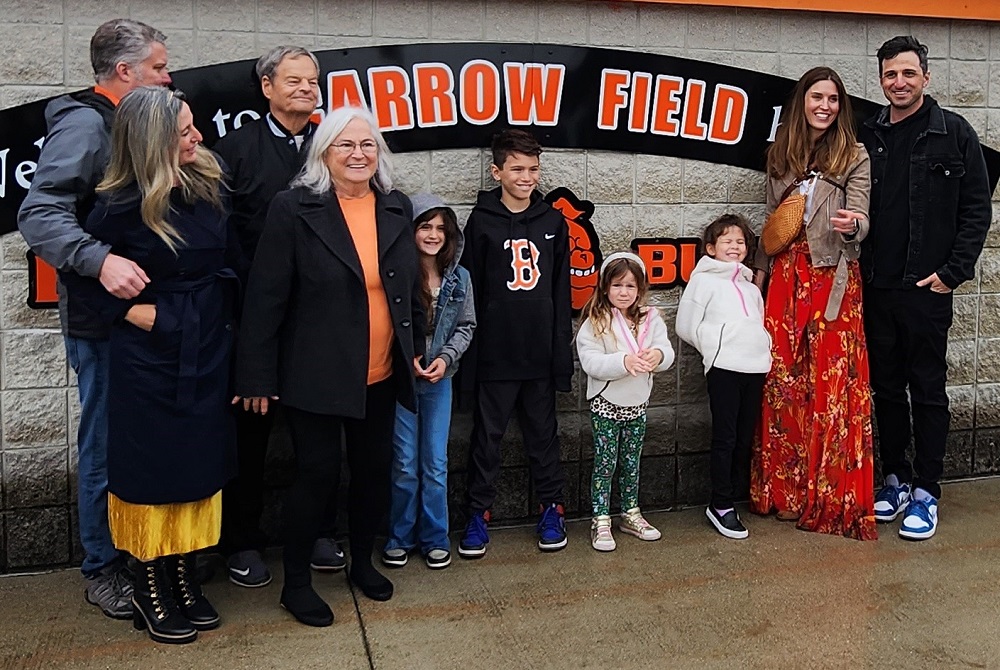
BRIGHTON — Mark Carrow didn’t know what to expect April 22 when he arrived at Brighton High School’s baseball field, where he was the guest of honor for a ceremony officially naming it Carrow Field.
 “I remember back in October, when they announced this would happen, I told my wife, Mary, that there will be probably 60-70 people here, because there are 18 players on each team and their parents,” he recalled. “We pulled up here and there were all these people, and these young men who look older now.”
Dozens of Brighton alumni, some of whom Carrow hadn’t seen since their high school days nearly a half-century ago, were in attendance for the ceremony held before a doubleheader with Ypsilanti Lincoln.
Carrow retired in 2006 after 34 seasons as Brighton’s baseball coach, recording 823 wins, now eighth on the state’s all-time list. He also was an assistant football coach and coached both boys and girls middle school basketball.
He came to Brighton a year after graduating from the University of Michigan, where he played baseball for the Wolverines, starring at third base.
“My dream was to coach baseball at Ann Arbor High,” Carrow said of his high school alma mater, now Ann Arbor Pioneer. “That was my dream.”
But he had applied to Brighton Area Schools as well, and after a year teaching in Grand Rapids, he and Mary both were offered teaching positions.
“Wouldn’t you know it? We were in school for two days and Ann Arbor calls me up,” Carrow said. “They had a phys ed job open. I’d have been the JV football coach, and I knew the baseball coach was on his way out. It was everything I wanted, and I went to (administrator) Bob Scranton and said, ‘Here’s what’s happening.’ He told me to think about it over the weekend and come back Monday.
“My wife and I talked it over, and we were so grateful to Brighton for giving us a chance to be near our hometown that we felt we owed them a year,” Carrow said. “In November, we bought a house that we lived in for 22 years.”
Brighton’s sports teams weren’t the dominant squads of today. The football team had had two winning seasons in 20 years, and the year Carrow arrived went 0-9.
“We played in six homecoming games, including our own,” he said. “Everyone wanted to play us.”
The baseball team wasn’t much better, having gone decades without a winning season.
But the Bulldogs were 12-12 that first spring under Carrow’s leadership, and never finished below .500 during the rest of his tenure.
 The Bulldogs joined the Southeastern Conference the next year and got off to a 7-0 start before losing at Lincoln.
“The kids were crying on the bus ride home,” Carrow said, “and I knew right then that Brighton had turned a corner, that it meant something to win and losing wasn’t acceptable anymore.”
Brighton took off, winning 20 games or more in all of his last 23 years as a coach, and a total of 13 league titles, 12 District titles, three Regional crowns and while making two trips to the Semifinals.
The talent was there, too, including 16 all-state players and two Mr. Baseball Award winners in Ron Hollis and Drew Henson.
Carrow earned national and Michigan Coach of the Year honors three times apiece and was inducted into the Michigan High School Baseball Coaches Hall of Fame in 1992.
The field was renamed in his honor after the Brighton school board changed its policy to allow the renaming of facilities to honor living persons less than two years ago.
But Carrow is quick to cite the reasons for his success.
“The players are the ones who made this possible,” he said. “I mean that from the bottom of my heart. I never threw a pitch or hit the baseball. I got 800 wins, but it was because of them.
Carrow has a photographic memory, which came in handy while chatting with former players.
“It was funny, because with each kid I remembered an incident about them,” he said. “Jeff Bogos, who I hadn’t seen since he graduated in 1979, came out and I said, ‘Do you remember when we were at Milan and your knee went out (of place) in the middle of the field?’ It happened twice. He said, ‘How do you remember that?’ And I said, ‘How could I not?’”
Carrow moved to Florida after his retirement, where he and his longtime assistant, George Reck, meet up a couple of times a week. He makes frequent trips north to watch U-M football and to visit his son, Chris, who lives in Chicago.
Baseball is firmly in his past.
“I think I’ve been to one high school game since I went down there,” Carrow said. “I hated the way the coach was coaching, and Mary did, too. She said, ‘We don’t have to watch any more high school baseball,’ and I said, ‘You’re right.’”
When he retired, Carrow said he would likely be forgotten in a few years.
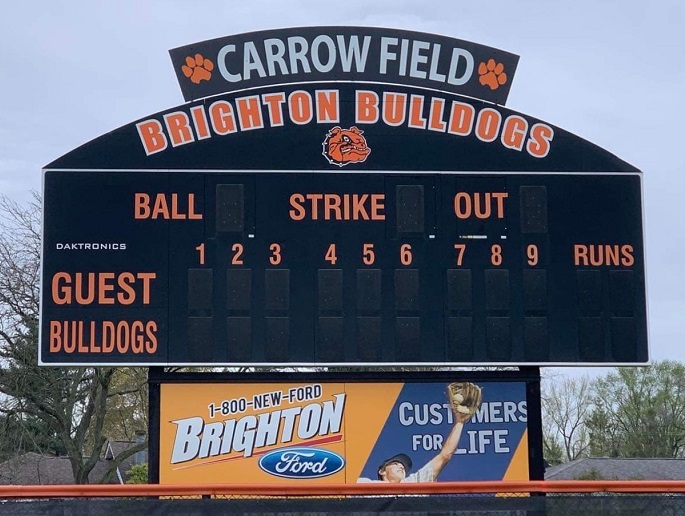
Seventeen years later, his legacy is assured and his memory will be invoked any time one looks at the scoreboard in left-center field that has a “Carrow Field” sign on top of it.
Not bad for a coach who was in the right place at the right time.
“My dream was fulfilled, and rightly so,” Carrow said. “And, believe me, I made the right decision. I couldn't have had better kids to teach or lived in a better community. It couldn't have worked out any better.”
PHOTOS (Top) The Carrow family stands together in front of the welcome sign to Carrow Field – including daughter Tiffany (front left), Mark and Mary (second from left, front and back) and son Chris (far right). (Middle) The Carrow name stands tall atop the scoreboard at the field named for the longtime coach. (Family photo by Daniel Collins.)