


Classes Still Create Hoosier Hysteria
July 27, 2017
By Rob Kaminski
MHSAA benchmarks editor
This is the fourth part in a series on MHSAA tournament classification, past and present, that will be published over the next two weeks. This series originally ran in this spring's edition of MHSAA benchmarks.
Twenty years ago, Bloomington North High School won the Indiana High School Athletic Association boys basketball championship, defeating Delta 75-54 at the RCA Dome in Indianapolis.
The date, March 22, 1997, is at the same time revered and disdained by traditionalists in the state who saw it as the last schoolboy championship game the state would ever host.
That’s how devout the game of basketball, particularly interscholastic basketball, had become in the Hoosier state during the 87 years a state champion – one state champion, to be precise – was crowned.
Following that 1997 season, the IHSAA moved to a four-class system for its roundball tournaments, like so many of its state association counterparts had done years earlier.
It would be shocking to find more than a small percentage of current high school basketball players around the country unfamiliar with the iconic movie Hoosiers, even though the film is now more than 30 years old.
And, the storyline for that blockbuster unfolded more than 30 years prior to its release, when small-town, undermanned Milan High School defeated Muncie Central High School 32-30 in the 1954 IHSAA title game.
Perhaps it’s because of the David vs Goliath notion, or the fame of the movie that replaced Milan with the fictional Hickory and real-life star Bobby Plump with Hollywood hero Jimmy Chitwood, or the simple fact that Indiana had something other states didn’t.
Whatever the reason, plenty of opposition remains to this day to basketball classification in the state.
The fact is, the small rural schools were regularly being beaten handily by the much larger suburban and city schools as the tournament progressed each season.
Small schools also were closing at a rapid rate following the state’s School Reorganization Act in 1959, as students converged on larger, centralized county schools. From 1960 to 2000, the number of schools entering the tournament dropped from 694 to 381, and in 1997 a total of 382 schools and 4,584 athletes began competition at the Sectional level (the first level of the IHSAA Basketball Tournament).
It was at the entry level of the tournament where school administrators felt the pain of the new class system, but not necessarily for the same nostalgic reasons as the fans who either attended or boycotted the tournament.
At the Sectional round of the tournament, the IHSAA was culling just 2 percent of the revenue, with the participating schools splitting the balance. So, when Sectional attendance dropped by 14 percent in that first year of class basketball, many schools realized a financial loss. It was money they had grown to count on in prior years to help fund various aspects of the department.
Schools cumulatively received more than $900,000 from Sectional competition in 1998, but that total was down from more than $1 million in the last year of the single-class tournament.
Yet, the current format provides a great deal more opportunity and realistic chances at championship runs for schools of all enrollments.
To date, 60 additional teams have championship or runner-up trophies on display in school trophy cases around Indiana.
That was the mission in front of then-IHSAA commissioner Bob Gardner (now National Federation executive director) once the board made its decision: to give thousands more student-athletes the opportunity for once-in-a-lifetime experiences.
As any statistician knows, figures can be manipulated to tell any side of a story. Declining attendance in year one of class basketball is such a number.
The truth is tournament attendance had been on a steady downward spiral since its peak of just over 1.5 million in 1962. By the last single-class event in 1997, the total attendance was half that.
The challenge then and today, as it is for all state associations, is to find that delicate balance for those holding onto tradition, those holding onto trophies, and the number of trophies to hand out.
Editor’s Note: Stories from the Fort Wayne Journal Gazette in 1998 and from a 2007 issue of Indianapolis Monthly provided facts in this article.
Lawton's Rueff Caps Career Among State's All-Time Leading Rushers, Scorers
By
Geoff Kimmerly
MHSAA.com senior editor
April 28, 2023
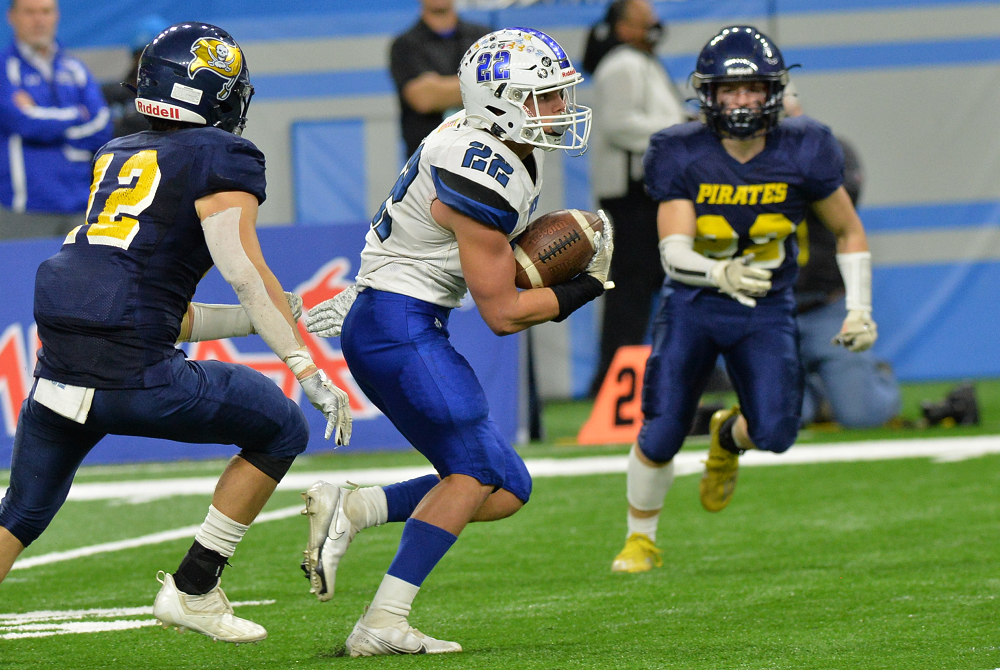
Lawton’s run to the 2021 Division 7 championship game frequently came on the legs of then-senior Jake Rueff, who posted some of the top performances in MHSAA football history.
He scored 298 points – fifth-most in 11-player history – with his 49 total touchdowns ranking fourth and his 46 rushing touchdowns third. He also made records lists with 2,370 rushing yards, 71 career touchdowns and 430 career points.
Lawton as a team scored 92 touchdowns, tying the record with 10 in one game, gained 5,662 yards of total offense and ran for 4,725 yards over 14 games.
Rueff plays at Michigan Tech.
See below for more recent additions to the 11-player football record book:
Football
Aiden Brunin stacked up many contributions on both sides of the field for Cedar Springs in 2021. But his less frequently-mentioned punting earned the senior a spot in the record book as he booted an 83-yard punt during a Nov. 6 playoff win over Muskegon that ranks as the fourth-longest in state history. The kick flew 62 yards in the air before taking a series of bounces and rolls. Brunin currently is a freshman baseball player at Spring Arbor.
Sturgis’ Jacob Thompson became the 10th to return two kickoffs for touchdowns in one game as a junior in 2021, scoring from 97 and 83 yards out against Paw Paw. Thompson also was added to the records for six rushing touchdowns in a Sept. 9, 2022, win over Plainwell – and he also threw for a score in the 55-34 victory.
Twenty years later, Coleman’s Joshua Moore has been added for a pair of interception returns for touchdowns Oct. 11, 2002, against Mount Pleasant Sacred Heart. Moore was a senior that season and scored off those turnovers during the third and fourth quarters.
Nearly a decade later, Cheboygan’s Ben Pearson also was added to the record book for a 99-yard rushing touchdown that tied the record for longest run. Pearson took the handoff deep in his own end zone and scored against Gaylord on Aug. 29, 2013. Pearson, a senior that season, went on to play at Northwood.
A trio of past Grand Ledge standouts have been entered for their achievements going back decades. Mitch Gulker made the record book for 1,002 receiving yards as a senior in 1976. Nick Kissane was added for his 170 completions, 297 pass attempts, 2,452 yards and 29 touchdowns through the air in 2008. Corey Arnouts made the tackles for loss list with 28 as a senior in 2011. Grand Ledge’s Division 1 championship run in 2000 came in part on the arm of Matt Bohnet, and he’s been added for his 2,052 yards passing that season. He went on to play at Iowa and Eastern Michigan. Arnouts went on to play at Ferris State, and Kissane went on to play baseball at Aquinas College.
Justin Brown had multiple returns for touchdowns as a junior at East Lansing in 2018, including a 99-yarder on Sept. 14. That kickoff return tied the record for longest on a list that now stands at 20 players.
Carson Roose earned his 10th record book listing when he threw for five touchdowns during the first half of Grosse Pointe Woods University Liggett’s 58-22 win over New Haven on Oct. 22, 2021. Roose graduated last spring.
Frankenmuth’s run to the Division 6 championship game in the fall saw the Eagles make team record book lists with 544 points and 72 touchdowns over 14 games, featuring as well a kicker who will bring an impressive extra point streak into the upcoming season. Junior Will Soulliere made 69 of 70 extra-point tries and has connected on 61 straight as he prepares for his senior season. Additionally, the Eagles’ defense was added after not allowing a first down during its Semifinal win over Detroit Country Day. Sam Barger was added for a 98-yard kickoff return in 2021, and Ryan Brenner was added for 45 extra points during the abbreviated 2020 season. Barger also is a senior this school year.
West Bloomfield’s run to the 2021 Regional Final was fueled in part by a tough defense, including a pair of pass rushers who rank among the all-time leaders in single-season sacks. Michael Williams II recorded 24 that fall, tied for fourth-most for one season, while Brandon Davis-Swain tied for 12th with 18. Williams, a senior that fall, plays for South Florida, while Davis-Swain is finishing his junior year at West Bloomfield.
PHOTO Lawton’s Jake Rueff (22) breaks into the open during his team’s Division 7 Final matchup with Pewamo-Westphalia in 2021.