


Classes Still Create Hoosier Hysteria
July 27, 2017
By Rob Kaminski
MHSAA benchmarks editor
This is the fourth part in a series on MHSAA tournament classification, past and present, that will be published over the next two weeks. This series originally ran in this spring's edition of MHSAA benchmarks.
Twenty years ago, Bloomington North High School won the Indiana High School Athletic Association boys basketball championship, defeating Delta 75-54 at the RCA Dome in Indianapolis.
The date, March 22, 1997, is at the same time revered and disdained by traditionalists in the state who saw it as the last schoolboy championship game the state would ever host.
That’s how devout the game of basketball, particularly interscholastic basketball, had become in the Hoosier state during the 87 years a state champion – one state champion, to be precise – was crowned.
Following that 1997 season, the IHSAA moved to a four-class system for its roundball tournaments, like so many of its state association counterparts had done years earlier.
It would be shocking to find more than a small percentage of current high school basketball players around the country unfamiliar with the iconic movie Hoosiers, even though the film is now more than 30 years old.
And, the storyline for that blockbuster unfolded more than 30 years prior to its release, when small-town, undermanned Milan High School defeated Muncie Central High School 32-30 in the 1954 IHSAA title game.
Perhaps it’s because of the David vs Goliath notion, or the fame of the movie that replaced Milan with the fictional Hickory and real-life star Bobby Plump with Hollywood hero Jimmy Chitwood, or the simple fact that Indiana had something other states didn’t.
Whatever the reason, plenty of opposition remains to this day to basketball classification in the state.
The fact is, the small rural schools were regularly being beaten handily by the much larger suburban and city schools as the tournament progressed each season.
Small schools also were closing at a rapid rate following the state’s School Reorganization Act in 1959, as students converged on larger, centralized county schools. From 1960 to 2000, the number of schools entering the tournament dropped from 694 to 381, and in 1997 a total of 382 schools and 4,584 athletes began competition at the Sectional level (the first level of the IHSAA Basketball Tournament).
It was at the entry level of the tournament where school administrators felt the pain of the new class system, but not necessarily for the same nostalgic reasons as the fans who either attended or boycotted the tournament.
At the Sectional round of the tournament, the IHSAA was culling just 2 percent of the revenue, with the participating schools splitting the balance. So, when Sectional attendance dropped by 14 percent in that first year of class basketball, many schools realized a financial loss. It was money they had grown to count on in prior years to help fund various aspects of the department.
Schools cumulatively received more than $900,000 from Sectional competition in 1998, but that total was down from more than $1 million in the last year of the single-class tournament.
Yet, the current format provides a great deal more opportunity and realistic chances at championship runs for schools of all enrollments.
To date, 60 additional teams have championship or runner-up trophies on display in school trophy cases around Indiana.
That was the mission in front of then-IHSAA commissioner Bob Gardner (now National Federation executive director) once the board made its decision: to give thousands more student-athletes the opportunity for once-in-a-lifetime experiences.
As any statistician knows, figures can be manipulated to tell any side of a story. Declining attendance in year one of class basketball is such a number.
The truth is tournament attendance had been on a steady downward spiral since its peak of just over 1.5 million in 1962. By the last single-class event in 1997, the total attendance was half that.
The challenge then and today, as it is for all state associations, is to find that delicate balance for those holding onto tradition, those holding onto trophies, and the number of trophies to hand out.
Editor’s Note: Stories from the Fort Wayne Journal Gazette in 1998 and from a 2007 issue of Indianapolis Monthly provided facts in this article.
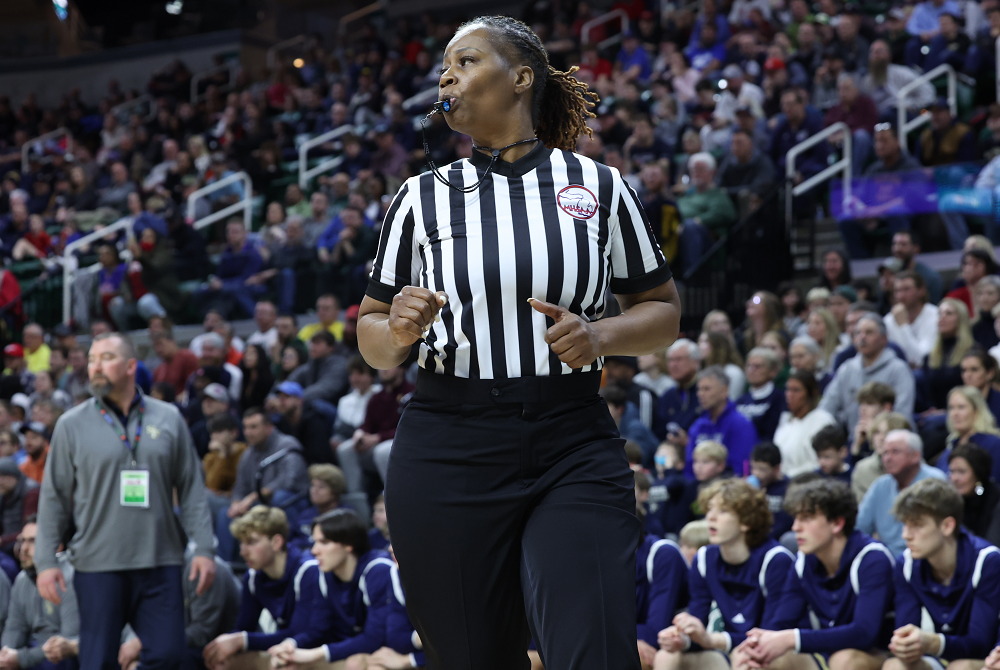
Little Provides Major Stride as 1st Woman to Officiate Boys Hoops Final since 1995
By
Keith Dunlap
Special for MHSAA.com
April 13, 2023
Delonda Little was already a trailblazer to many before this year’s MHSAA Boys Basketball Finals.
 But what happened last month at Breslin Center made her even more of one on a statewide level.
A referee and assigner for 20 years in the Detroit area, Little is a female boys and girls basketball official who mentors both male and female referees – no matter the gender or level, as she officiates high school and college games.
Officials often go to Little for guidance, direction and assignments, which has made her respected for years throughout Metro Detroit in the prep basketball community. Then, her status as a trailblazer grew even more.
Little was assigned as an official for the Division 3 Boys Basketball Final between Flint Beecher and Traverse City St. Francis, and she became the first female referee to officiate an MHSAA Boys Basketball Final since Traverse City’s Barb Beckett 1995.
“It was a very good feeling to know I was the one selected,” said Little, who officiated the Final with Matt Olson and Zach Porritt.
In fact, while attending a Semifinal game the Friday before the Final, Little received a phone call from an area code she didn’t recognize.
She answered, and it was Beckett.
“At first I didn’t know the name,” Little said. “I said, ‘No, I don’t know you, but that’s fine.’”
Beckett then explained she was the first female referee to be assigned a Boys Basketball Final, and just wanted to offer support to Little.
At that point, Little became excited and thankful she answered the call.
“It was very nice to hear from her because she wanted to reach out and if not pass the torch, to congratulate me,” Little said.
Little, 51, said she found out she was going to be refereeing the Division 3 boys championship game just before the start of the postseason when she received an email from the MHSAA.
“I’m looking at the email and I’m like, boys?” Little said. “I was shocked.”
But she was shocked in a good way, and obviously excited for the honor.
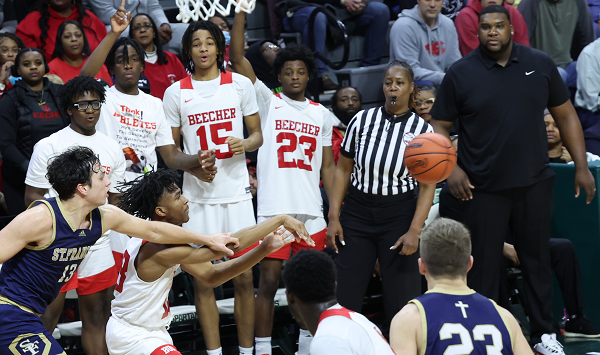 Little didn’t find out until a couple of days before the St. Francis/Beecher contest that she would be officiating that specific championship game, but the Monday of boys championship week was when she really started to receive congratulations from friends and colleagues.
That’s when an article came out in the Detroit News detailing her selection, which led to countless calls, texts and congratulatory messages on social media.
“I couldn’t even (keep up with the comments),” she said. “That’s how overwhelming the actual tags were. It came from all across the state with officials, men and women, because I do women’s college (games). Some of the college ladies were reaching out. I was getting all the hoopla before the game.”
Little said she normally doesn’t get nervous for games, but not having some nerves became a bit harder once so many people knew of her achievement.
However, she settled into a normal routine quickly once the game started.
“I wanted to get it done, get it over with and do well,” she said.
Little did do well, which is no surprise to everyone who knew her before she officiated on the boys championship stage.
It was just another feather in the cap for Little, who in 2016 became the first woman to officiate a boys Detroit Public School League championship game.
“Delonda is one of the top officials in the Detroit area, and our staff doesn’t look at Delonda as a female working a boys game – we see one of the top officials in Detroit working a basketball game,” MHSAA Executive Director Mark Uyl said. “There are females officiating in the NBA and female officials in the NCAA Men’s Basketball Tournament. The aspect that made Delonda’s selection for this MHSAA championship game nearly unique will soon be the norm at all levels of athletics.”
Little graduated from Detroit Osborn in 1989 and starred on the basketball court at Wayne State, earning induction into WSU’s Athletic Hall of Fame in 2005.
Her day job is as an officer for the Michigan Department of Corrections, but her passion is officiating. She’s been an MHSAA-registered official for basketball for two decades and also was registered for volleyball for four years. This past fall she registered for football for the first time.
“I get something from it because it keeps me in shape, I love the people I work with and I like the kids,” Little said. “You are always teaching, and I like training the newer officials. I just enjoy it. I don’t know what I’d be doing if I wasn’t refereeing.”
Going forward, Little hopes her championship game assignment will now be an inspiration for other female referees.
“There aren’t very many women who would like to work boys basketball or feel comfortable,” Little said. “If that’s something they desire, I’m hoping more women are selected to work the games if they feel comfortable.”
 Keith Dunlap has served in Detroit-area sports media for more than two decades, including as a sportswriter at the Oakland Press from 2001-16 primarily covering high school sports but also college and professional teams. His bylines also have appeared in USA Today, the Washington Post, the Detroit Free Press, the Houston Chronicle and the Boston Globe. He served as the administrator for the Oakland Activities Association’s website from 2017-2020. Contact him at [email protected] with story ideas for Oakland, Macomb and Wayne counties
PHOTOS (Top) Delonda Little takes her position on the court during the Division 3 Boys Basketball Final on March 25 at Breslin Center. (Middle) Little monitors the action between Flint Beecher and Traverse City St. Francis.