


Classes Still Create Hoosier Hysteria
July 27, 2017
By Rob Kaminski
MHSAA benchmarks editor
This is the fourth part in a series on MHSAA tournament classification, past and present, that will be published over the next two weeks. This series originally ran in this spring's edition of MHSAA benchmarks.
Twenty years ago, Bloomington North High School won the Indiana High School Athletic Association boys basketball championship, defeating Delta 75-54 at the RCA Dome in Indianapolis.
The date, March 22, 1997, is at the same time revered and disdained by traditionalists in the state who saw it as the last schoolboy championship game the state would ever host.
That’s how devout the game of basketball, particularly interscholastic basketball, had become in the Hoosier state during the 87 years a state champion – one state champion, to be precise – was crowned.
Following that 1997 season, the IHSAA moved to a four-class system for its roundball tournaments, like so many of its state association counterparts had done years earlier.
It would be shocking to find more than a small percentage of current high school basketball players around the country unfamiliar with the iconic movie Hoosiers, even though the film is now more than 30 years old.
And, the storyline for that blockbuster unfolded more than 30 years prior to its release, when small-town, undermanned Milan High School defeated Muncie Central High School 32-30 in the 1954 IHSAA title game.
Perhaps it’s because of the David vs Goliath notion, or the fame of the movie that replaced Milan with the fictional Hickory and real-life star Bobby Plump with Hollywood hero Jimmy Chitwood, or the simple fact that Indiana had something other states didn’t.
Whatever the reason, plenty of opposition remains to this day to basketball classification in the state.
The fact is, the small rural schools were regularly being beaten handily by the much larger suburban and city schools as the tournament progressed each season.
Small schools also were closing at a rapid rate following the state’s School Reorganization Act in 1959, as students converged on larger, centralized county schools. From 1960 to 2000, the number of schools entering the tournament dropped from 694 to 381, and in 1997 a total of 382 schools and 4,584 athletes began competition at the Sectional level (the first level of the IHSAA Basketball Tournament).
It was at the entry level of the tournament where school administrators felt the pain of the new class system, but not necessarily for the same nostalgic reasons as the fans who either attended or boycotted the tournament.
At the Sectional round of the tournament, the IHSAA was culling just 2 percent of the revenue, with the participating schools splitting the balance. So, when Sectional attendance dropped by 14 percent in that first year of class basketball, many schools realized a financial loss. It was money they had grown to count on in prior years to help fund various aspects of the department.
Schools cumulatively received more than $900,000 from Sectional competition in 1998, but that total was down from more than $1 million in the last year of the single-class tournament.
Yet, the current format provides a great deal more opportunity and realistic chances at championship runs for schools of all enrollments.
To date, 60 additional teams have championship or runner-up trophies on display in school trophy cases around Indiana.
That was the mission in front of then-IHSAA commissioner Bob Gardner (now National Federation executive director) once the board made its decision: to give thousands more student-athletes the opportunity for once-in-a-lifetime experiences.
As any statistician knows, figures can be manipulated to tell any side of a story. Declining attendance in year one of class basketball is such a number.
The truth is tournament attendance had been on a steady downward spiral since its peak of just over 1.5 million in 1962. By the last single-class event in 1997, the total attendance was half that.
The challenge then and today, as it is for all state associations, is to find that delicate balance for those holding onto tradition, those holding onto trophies, and the number of trophies to hand out.
Editor’s Note: Stories from the Fort Wayne Journal Gazette in 1998 and from a 2007 issue of Indianapolis Monthly provided facts in this article.
1975 Class D Football Film Finds Way Back to MHSAA for All to Enjoy Again
By
John Johnson
MHSAA Communications Director emeritus
April 11, 2023
Chasing history was one of the most enjoyable parts of serving at the MHSAA for nearly 34 years. Researching information, but especially what I considered for a long time to be talking to the “old guys” (now I’m one of them) and soaking up their verbal histories of our games.
It also involved chasing down old photos, broadcasts and game films – especially those which preceded our more modern video era beginning in the 1990s.
When I arrived at the MHSAA in 1987, there was a shelf of old 16mm film canisters of an assortment of Boys Basketball Finals from the 1950s to the 70s – certainly not a complete set. The Association would shoot some game action from each quarter and the trophy presentations. They’d be sent out to the participating schools to show to the students (I remember watching a Mt. Pleasant Sacred Heart game in 1967 when I was in fifth grade). Some would find their way back to the office – most would not.
Will Robinson, the legendary Detroit Public School League coach who led Pershing High School to the league’s first MHSAA titles (in 1967 and 1970) after a district-imposed hiatus from 1931-61 from statewide tournaments, would pull my chain every time we saw each other about those games featuring Spencer Haywood and Ralph Simpson, among others. We never found them.
So it became a project to try and track down as many old game films of state championships as we could.
Any conversation with someone with a history tone always included a question about the whereabouts of a game film or video. One of those recently bore fruit.
When Crystal Falls Forest Park played in the 8-Player Football Finals at the Superior Dome in Marquette back in 2017, I spent a lot of time talking with living legend Bill Santilli, who led the Trojans to the Class D crown in the very first year of the tournament in 1975, and who would later coach the school to a second state title (2007) and serve as athletic director. He said he had a box on his desk collecting dust that he didn’t know what to do with – that box contained an old video tape from that game.
I uttered four little words – “Send It To Me.”
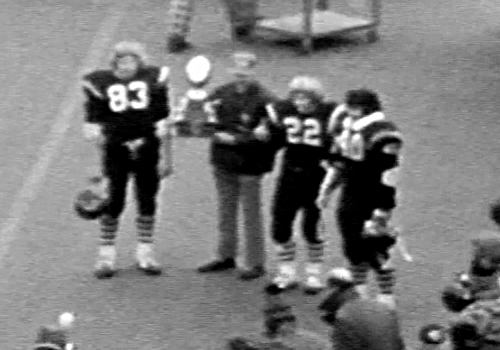 After a while the tape arrived in East Lansing, and I got our video production friends at When We Were Young Productions/Rush Media in Wisconsin on it. This winter, they found someone who could convert it and sent me a file that was recently posted to the MHSAASPORTS Channel on YouTube. You can watch the Trojans play Flint Holy Rosary by Clicking Here or watching above.
There are all kinds of old game films/videos and artifacts in attics, closets, garages, etc., in every town. Two of our Muskegon historians – Ron Pesch, the MHSAA’s history guy; and the old broadcaster, Jim Moyes, who called games on the radio for years in the Port City – can tell stories of their own about discoveries they have made. Moyes found all kinds of mementos while working on his book on the history of high school track & field in Michigan, and sitting with Ron at this year’s Girls Basketball Finals, he told a story of finding the mother lode of photographs from one of his other historical passions – silent film star Buster Keaton – who spent ten summers in the Actor’s Colony in Muskegon.
Pesch found a listing for Eleanor Keaton, Buster’s widow, using a telephone book (remember those?), made a phone call and shortly thereafter, on a vacation to California, was in her living room where he was loaned a photo album and family scrapbook containing all kinds of images from their time in Muskegon. Many of those images appear in a soon-to-be-released documentary, while the album and scrapbook now reside in the Academy of Motion Picture Arts and Sciences library in Beverly Hills, Calif. You can preview the film by Clicking Here.
So if you think you have something of a state championship that could be utilized on a bigger platform and enjoyed by everyone, drop a note to [email protected]. If something needs to be converted to a more modern format, you’ll get a copy back, and the footage will be eventually viewable on the MHSAA’s YouTube channel.
To help guide your search, think in the following terms:
► Just about anything before 1990. But there are gaps during the 90s that need to be filled as well.
► Only Championship games and Semifinal games, unless something momentous occurred (like Richie Jordan’s 60-point game for Fennville against Bridgman in a Regional Semifinal in 1965, which is still an all-time tournament single-game record for boys basketball).
► For a list of what’s in the MHSAA archives prior to 2000 – Click Here. A long-term project is to get all of the games on the list and up to about 2010 uploaded to the YouTube channel. Most games from 2013-14 on can be viewed on the NFHS Network, and some games between 2010 and 2013 are available for purchase as DVDs from PrepFilms.com.
PHOTO Posing with the championship trophy after the 1975 Class D Football Final are (left to right): Forest Park tight end Bryan LaChapelle, quarterback Richard Mettlach, head coach Dick Mettlach and running back Bill Santilli.