


Classes Still Create Hoosier Hysteria
July 27, 2017
By Rob Kaminski
MHSAA benchmarks editor
This is the fourth part in a series on MHSAA tournament classification, past and present, that will be published over the next two weeks. This series originally ran in this spring's edition of MHSAA benchmarks.
Twenty years ago, Bloomington North High School won the Indiana High School Athletic Association boys basketball championship, defeating Delta 75-54 at the RCA Dome in Indianapolis.
The date, March 22, 1997, is at the same time revered and disdained by traditionalists in the state who saw it as the last schoolboy championship game the state would ever host.
That’s how devout the game of basketball, particularly interscholastic basketball, had become in the Hoosier state during the 87 years a state champion – one state champion, to be precise – was crowned.
Following that 1997 season, the IHSAA moved to a four-class system for its roundball tournaments, like so many of its state association counterparts had done years earlier.
It would be shocking to find more than a small percentage of current high school basketball players around the country unfamiliar with the iconic movie Hoosiers, even though the film is now more than 30 years old.
And, the storyline for that blockbuster unfolded more than 30 years prior to its release, when small-town, undermanned Milan High School defeated Muncie Central High School 32-30 in the 1954 IHSAA title game.
Perhaps it’s because of the David vs Goliath notion, or the fame of the movie that replaced Milan with the fictional Hickory and real-life star Bobby Plump with Hollywood hero Jimmy Chitwood, or the simple fact that Indiana had something other states didn’t.
Whatever the reason, plenty of opposition remains to this day to basketball classification in the state.
The fact is, the small rural schools were regularly being beaten handily by the much larger suburban and city schools as the tournament progressed each season.
Small schools also were closing at a rapid rate following the state’s School Reorganization Act in 1959, as students converged on larger, centralized county schools. From 1960 to 2000, the number of schools entering the tournament dropped from 694 to 381, and in 1997 a total of 382 schools and 4,584 athletes began competition at the Sectional level (the first level of the IHSAA Basketball Tournament).
It was at the entry level of the tournament where school administrators felt the pain of the new class system, but not necessarily for the same nostalgic reasons as the fans who either attended or boycotted the tournament.
At the Sectional round of the tournament, the IHSAA was culling just 2 percent of the revenue, with the participating schools splitting the balance. So, when Sectional attendance dropped by 14 percent in that first year of class basketball, many schools realized a financial loss. It was money they had grown to count on in prior years to help fund various aspects of the department.
Schools cumulatively received more than $900,000 from Sectional competition in 1998, but that total was down from more than $1 million in the last year of the single-class tournament.
Yet, the current format provides a great deal more opportunity and realistic chances at championship runs for schools of all enrollments.
To date, 60 additional teams have championship or runner-up trophies on display in school trophy cases around Indiana.
That was the mission in front of then-IHSAA commissioner Bob Gardner (now National Federation executive director) once the board made its decision: to give thousands more student-athletes the opportunity for once-in-a-lifetime experiences.
As any statistician knows, figures can be manipulated to tell any side of a story. Declining attendance in year one of class basketball is such a number.
The truth is tournament attendance had been on a steady downward spiral since its peak of just over 1.5 million in 1962. By the last single-class event in 1997, the total attendance was half that.
The challenge then and today, as it is for all state associations, is to find that delicate balance for those holding onto tradition, those holding onto trophies, and the number of trophies to hand out.
Editor’s Note: Stories from the Fort Wayne Journal Gazette in 1998 and from a 2007 issue of Indianapolis Monthly provided facts in this article.

Moggach Honored Nationally for 25 Years of 'Sticking In, Doing Good'
By
Tim Robinson
Special for MHSAA.com
March 17, 2023
When Paul Moggach began his tenure as Brighton’s hockey coach, the program was at its nadir.
“When we got into high school hockey, it wasn't very good,” he said recently. “Our league wasn't very good. Our team wasn't very good. We started with character to try to build something different, you know, a different mousetrap.”
Over the next quarter of a century, Moggach and his assistants, primarily Rick Bourbonais (whom Moggach succeeded as coach) and current coach Kurt Kivisto helped lift the program into one of the most respected, and successful, in the state.
Moggach (pronounced MUG-uhth), along with former Detroit Catholic Central coach Gordon St. John, in February was named a co-recipient of the John Mariucci Award by the American Hockey Coaches Association.
They, along with Andy Weidenbach of Bloomfield Hills Cranbrook Kingswood, are the only Michigan coaches to have received the award, named after the longtime hockey coach at Michigan Tech.
“He brought in people that he knew could do things he may have had limitations at,” said Kivisto, who played for Moggach at Brighton two decades ago and was an assistant for 10 years before taking over as head coach in 2020. “He did a good job surrounding himself with people he trusted and knew would be good for the program while he steered the ship in the direction he wanted. And he was very good at that.”
Moggach calls the honor “very humbling.
“I got into hockey because there was a need,” he added, “then I ended up with Rick at the high school for those years. When you look back at it, I grew a lot. I grew a lot personally and from a coaching perspective I grew. I had to change things, and so I think it's not so much the reward as at least a recognition that I stuck it out. My grandmother used to always tell me, ‘Stick in and do good.’ She would say that when I was on the way out the door. That was her message to me, and I think (the award) just emphasizes that I did, I did stick in.”
“You can’t be happier for a guy than for a guy like Paul,” said Bourbonais, who coached with Moggach at Brighton for a total of 30 years, the last 20 as an assistant. “He took a hockey team and made it into a hockey program that is a top-five contender every year. Guys come out of the program with championships, but they also come out with life lessons and some idea of what it takes to be a great citizen and a great student as well as what it takes to be a great athlete.”
At first, though, there were trials. The Bulldogs struggled in his first two seasons, and the program itself was in jeopardy for a short while after a bench-clearing brawl.
Once that crisis passed, Moggach and his staff, which for many years consisted of Bourbonais, Mike Brown and Jason Valente, worked to rebuild the Bulldogs from a team known for its physicality to one with a more wide-open passing style of play.
When hockey trends went to a more defensive style, where the defense sparked the offense, Moggach adapted.
During the first decade of his tenure, as the Bulldogs had more success and built their reputation, teams that had shunned scheduling them in the past began adding Brighton to their schedules.
He kept looking for ways to improve his team, both on and off the ice.
Brighton was the first team to schedule a game with those in the Keweenaw Peninsula, both for the keen competition, but also as a team-bonding exercise.
The bus rides, about 11 hours each way, helped players who in many cases didn’t know each other outside the rink to bond. So did activities outside of hockey including team dinners and curling, and the experience of being together as a team for four days.
Other teams took notice, and team bonding trips, including those far shorter than the 550 miles from Brighton to Houghton, are commonplace.
 Soon after, he introduced a skating coach and stricter team nutrition to the program.
“It’s not something that we had done when I was in high school," said Kivisto, who graduated in 2003. “It was something that some of the families and players weren’t overly excited about, but he knew it was good for the team and he was always looking ahead and finding ways to give his team an advantage.”
Brighton grew to dominate its league, and winning gave Moggach the authority to introduce concepts new to players and families who grew up in travel hockey.
“I'm sure we weren't pleasing everybody,” he said, “But we thought we would do with character and live the kind of model that we would hope that the players would follow, that their families would follow. And as we did that it changed and we got in front of some things with our league, and had a good run in our league.”
Brighton won its first Division 1 championship in 2006. That was followed by back-to-back Division 1 titles in 2012 and 2013, and then 2017 and 2018, a stretch that saw the Bulldogs reach the Finals in six out of seven seasons.
“Some of that is when you learn how to win, you win, even sometimes when you shouldn't,” he said. “I'm not saying that you know when we got to the Finals that we didn't deserve to win. We had a good recipe there that got us those five wins, but once we got it rolling, that momentum kept us going sometimes then maybe it shouldn't have.”
As the program’s success and reputation grew, players who had been in travel hockey started opting to play for the Bulldogs.
“There are some kids on (this year’s Brighton) team who came from Triple A who are tired of that commitment, because of the travel, the time, the money,” he said. “And they found that high school hockey is different. I mean just look at the crowds. They don't get that kind of a reward for the work that they put in.
“I think it's developed to that point now for us and we get players like that and it's made a difference, I think, and not just for our team but for all of high school hockey, " Moggach continued. “The coaches association has done a great job in promoting now and so it is a great destination for so many good reasons for kids to spend that time and grow up with their friends who are in their neighborhoods and in their community.”
Moggach is still a fixture at Brighton games, still in close touch with Kivisto when not driving to see his grandsons play or his stepson, Damon Whitten, who coaches at Lake Superior State.
His impact will be felt in Brighton hockey for years to come.
“He left no stone unturned to try and be the best he thought we could be,” Brighton athletic director John Thompson said. “He’s one of those people who was genuinely invested in young people, and he always, always put the program first. He was a good manager of young men and developed some pretty good coaches, too.”
Moggach finished with a record of 467-172-43. St. John, who won six state titles at Catholic Central and another at Cranbrook, had a record of 229-29-18 in 10 seasons at Catholic Central.
“I was excited for (Moggach) when I heard the news,” Kivisto said, “seeing him put at a level of the guys who have won the award and the contributions they made to high school hockey. It’s neat to see him recognized at that level.”
Both men will receive their awards sometime this spring.
“I can be recognized,” Moggach said, “and I think kids are and their families are always looking for that. But I think before you do that you have to build the program, the program has to be something that's respectful and respected and competitive, and I think we accomplished that.”
***
Gordon St. John led Detroit Catholic Central and Bloomfield Hills Cranbrook Kingswood to a combined eight Finals championships over 16 seasons, the last seven with the Shamrocks including five straight in Class A or Division 1 from 1999-2003.
 DCC’s Class A championship in 1994 was the first of now 17 Finals titles, which rank second-most in MHSAA history. He built a 222-29-18 record (.859 winning percentage) over 10 seasons leading the Shamrocks through 2003-04, the last two seasons as co-head coach before then staying with the program as an assistant and helping the team to another Division 1 championship in 2005.
St. John’s championship at Cranbrook came in 1988 in Class B-C-D.
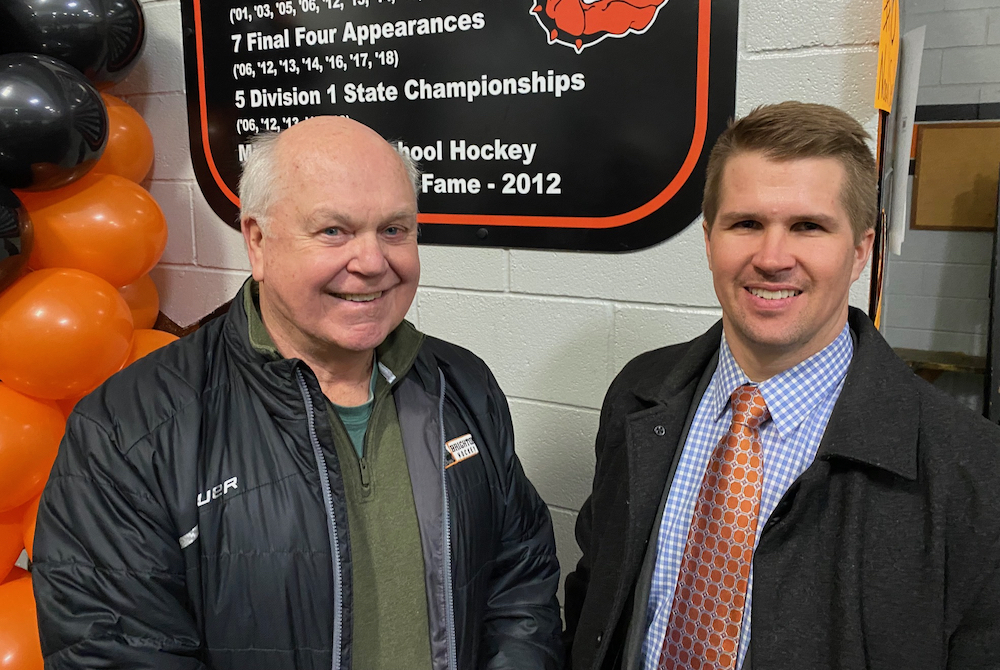
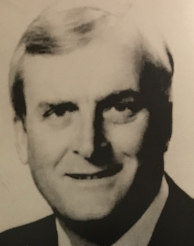
PHOTOS (Top) Retired Brighton hockey coach Paul Moggach, far right, stands alongside his players as they await to receive their medals after winning the 2018 Division 1 championship (Middle) Moggach stands with his former assistant and current Brighton head coach Kurt Kivisto. (Middle photo by Tim Robinson; St. John photo courtesy of the American Hockey Coaches Association.)