


Classes Still Create Hoosier Hysteria
July 27, 2017
By Rob Kaminski
MHSAA benchmarks editor
This is the fourth part in a series on MHSAA tournament classification, past and present, that will be published over the next two weeks. This series originally ran in this spring's edition of MHSAA benchmarks.
Twenty years ago, Bloomington North High School won the Indiana High School Athletic Association boys basketball championship, defeating Delta 75-54 at the RCA Dome in Indianapolis.
The date, March 22, 1997, is at the same time revered and disdained by traditionalists in the state who saw it as the last schoolboy championship game the state would ever host.
That’s how devout the game of basketball, particularly interscholastic basketball, had become in the Hoosier state during the 87 years a state champion – one state champion, to be precise – was crowned.
Following that 1997 season, the IHSAA moved to a four-class system for its roundball tournaments, like so many of its state association counterparts had done years earlier.
It would be shocking to find more than a small percentage of current high school basketball players around the country unfamiliar with the iconic movie Hoosiers, even though the film is now more than 30 years old.
And, the storyline for that blockbuster unfolded more than 30 years prior to its release, when small-town, undermanned Milan High School defeated Muncie Central High School 32-30 in the 1954 IHSAA title game.
Perhaps it’s because of the David vs Goliath notion, or the fame of the movie that replaced Milan with the fictional Hickory and real-life star Bobby Plump with Hollywood hero Jimmy Chitwood, or the simple fact that Indiana had something other states didn’t.
Whatever the reason, plenty of opposition remains to this day to basketball classification in the state.
The fact is, the small rural schools were regularly being beaten handily by the much larger suburban and city schools as the tournament progressed each season.
Small schools also were closing at a rapid rate following the state’s School Reorganization Act in 1959, as students converged on larger, centralized county schools. From 1960 to 2000, the number of schools entering the tournament dropped from 694 to 381, and in 1997 a total of 382 schools and 4,584 athletes began competition at the Sectional level (the first level of the IHSAA Basketball Tournament).
It was at the entry level of the tournament where school administrators felt the pain of the new class system, but not necessarily for the same nostalgic reasons as the fans who either attended or boycotted the tournament.
At the Sectional round of the tournament, the IHSAA was culling just 2 percent of the revenue, with the participating schools splitting the balance. So, when Sectional attendance dropped by 14 percent in that first year of class basketball, many schools realized a financial loss. It was money they had grown to count on in prior years to help fund various aspects of the department.
Schools cumulatively received more than $900,000 from Sectional competition in 1998, but that total was down from more than $1 million in the last year of the single-class tournament.
Yet, the current format provides a great deal more opportunity and realistic chances at championship runs for schools of all enrollments.
To date, 60 additional teams have championship or runner-up trophies on display in school trophy cases around Indiana.
That was the mission in front of then-IHSAA commissioner Bob Gardner (now National Federation executive director) once the board made its decision: to give thousands more student-athletes the opportunity for once-in-a-lifetime experiences.
As any statistician knows, figures can be manipulated to tell any side of a story. Declining attendance in year one of class basketball is such a number.
The truth is tournament attendance had been on a steady downward spiral since its peak of just over 1.5 million in 1962. By the last single-class event in 1997, the total attendance was half that.
The challenge then and today, as it is for all state associations, is to find that delicate balance for those holding onto tradition, those holding onto trophies, and the number of trophies to hand out.
Editor’s Note: Stories from the Fort Wayne Journal Gazette in 1998 and from a 2007 issue of Indianapolis Monthly provided facts in this article.
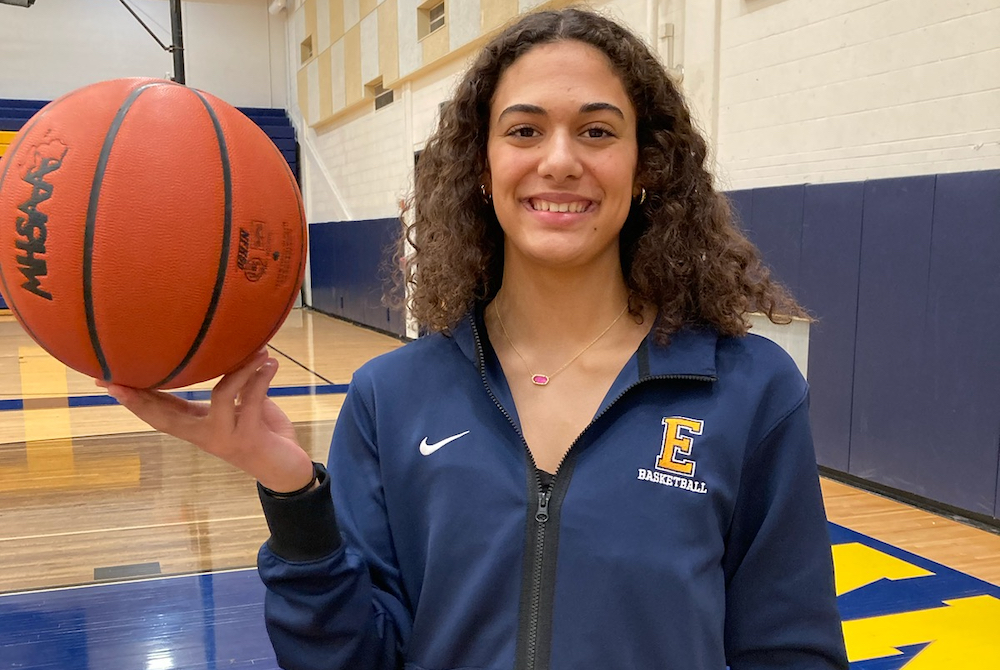
Step by Step, EGR's Brown Climbs to Miss Basketball Award, College Future
By
Steve Vedder
Special for MHSAA.com
March 16, 2023
EAST GRAND RAPIDS – Macy Brown remembers spending her Saturday mornings with her older sisters scrambling around gymnasiums when she was no older than a first grader.
The long and winding journey from those early days to a sterling career at East Grand Rapids is one chronicled by overcoming the gangly body of a middle schooler, surrendering interest in two other sports in favor of basketball, countless hours of AAU, critical advice from two older sisters, a misfortunate accident to a teammate as a junior that necessitated a position switch and eventually to sorting through scholarship offers from a handful of elite college programs.
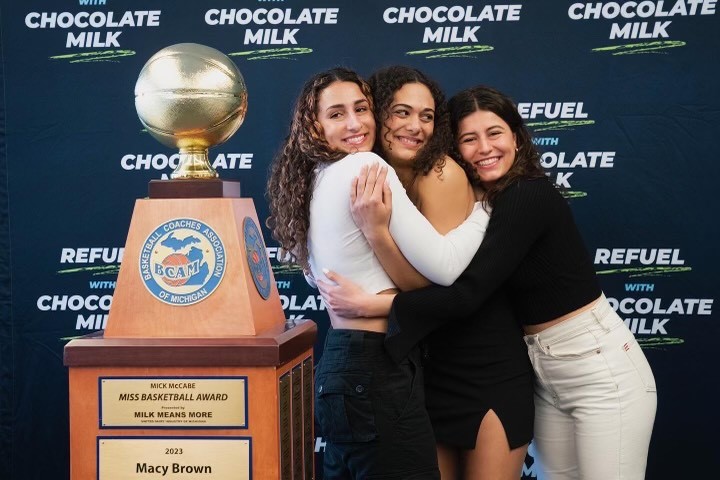
It's a path that concluded this week with the Pioneers’ point guard not only becoming one of just 1.3 percent of high school players to accept a Division I scholarship, but also being named winner of the prestigious Miss Basketball Award as the state's top senior player.
It's a long way from those weekend mornings to becoming the school's all-time leading scorer, a four-year starter, all-stater and Miss Basketball winner – and a story that Brown says exceeds anything she could have imagined.
"It's been amazing, magical at times," Brown said. "You don't realize how you've spent your time until it's over. There were a lot of sacrifices, but you also gain so much with the relationships you've had through basketball."
The journey started at the East Hills center in Grand Rapids with older sisters Oliva and Jillian, both of whom are currently playing Division I college basketball, and their mother Noelle, who ran an AAU program. It was the first time Macy Brown recalls taking an interest in the sport and began taking stock of what it would take to play basketball at the high school or possibly even college level.
By the time Brown entered middle school, she was all of 5-foot-9 with skills that while encouraging, were far from a guarantee that a long basketball bloodline would be extended by one more daughter. In fact, it was the first time Brown was spotted by EGR coach Troy Hammond, who recalls her as anything but the player who would become the program’s all-time leading scorer with 1,537 points while starting all 86 of the team's games over four varsity seasons.
"She was a tall, lanky kid who was just figuring her body out," Hammond said, "She was a tag-along with her sisters. She was always smiling, a happy-go-lucky kid who loved being in the gym. But I would be lying if I said she would be as good or better than the experiences I had with her sisters. That was no foregone conclusion."
Still, Brown stuck it out and slowly made progress, both mentally and physically. Boosted by advice from her sisters, Brown's on-court talent began to take shape. She also grew about three inches and began hitting the weight room to gain strength. As she entered middle school, she elected to give up lacrosse and soccer to spend more time playing basketball. Armed by having additional time for basketball, she threw herself into even more AAU ball. College coaches who constantly mine the AAU circuit for emerging talent began to notice Brown, who received her first scholarship offer from Loyola of Chicago following her eighth-grade season.
 Despite the interest, however, Brown knew she had to become a better player.
"I was pretty good, but you don't realize how big of a leap it is from middle school to high school," said Brown, who had no second thoughts about becoming a single-sport athlete. "I grew up around basketball, it was always my first sport. I couldn't see playing lacrosse or soccer past high school."
Brown was good enough to make EGR's varsity as a freshman, She averaged 11.7 points per game in her inaugural season and gained additional attention from playing on a 22-1 team that would have been in contention for a Division 1 title if the season hadn't been cancelled because of COVID-19.
Brown continued to hone her game, averaging 13.5 points as a sophomore. She made all-conference for a second time and also made her college choice: she would become a Michigan Wolverine.
"When you know, you know," she said. "I knew I would wind up at Michigan because when I went other places, I would always compare them to Michigan. It just felt like home."
Brown said she relied on her sisters to know what required her utmost attention during the recruitment period. Olivia started at St. Bonaventure and now plays at Valparaiso, while Jillian is at Northwestern. Both offered crucial advice on how to pick a school.
"It definitely helped playing against them. I would get beat on, but it helped me," Macy said. "It was all for the best because it helped me become a better player."
It was after picking her college that Brown's career took another significant step forward. The Pioneers' senior point guard, Ally Carlson, who now plays at Western Michigan, suffered a season-ending ACL injury before senior-year practice began. The injury meant Brown, who had been a shooting guard her first two seasons, would have to move to point. She had to transition from becoming the team's second or even third offensive option to someone counted on to score points. She responded by averaging 22.4 as a junior and tossing in 25 points per game this season.
"I watched her develop into a leader, both as a person and on the court," Hammond said. "To see that development as a coach, it was wonderful."
Brown's improvement as a player included serious self-reflection. She admits to being the kind of athlete who maps out goals and then isn't satisfied until she reaches them.
"Every year was a checkpoint for me," she said. "I worked hard every offseason, and I would always notice what it took to play the game."
While the book on her high school career closes with the Miss Basketball Award, another door is opened in Ann Arbor. Brown said if she were to speak to a room full of young basketball wannabes, her advice would be simple. Brown was once in their position, and better than anyone else knows what it takes to conquer the next step in moving up the basketball ladder.
"It's definitely step by step, and you have to learn from your experiences," she said. "You make sacrifices, but you can gain so much."
PHOTOS (Top) Macy Brown is this season's Miss Basketball Award winner. (Middle) Brown and her sisters celebrate her award this week. (Top photo by Steve Vedder. Middle photo courtesy of the East Grand Rapids athletic department.)