


Classes Still Create Hoosier Hysteria
July 27, 2017
By Rob Kaminski
MHSAA benchmarks editor
This is the fourth part in a series on MHSAA tournament classification, past and present, that will be published over the next two weeks. This series originally ran in this spring's edition of MHSAA benchmarks.
Twenty years ago, Bloomington North High School won the Indiana High School Athletic Association boys basketball championship, defeating Delta 75-54 at the RCA Dome in Indianapolis.
The date, March 22, 1997, is at the same time revered and disdained by traditionalists in the state who saw it as the last schoolboy championship game the state would ever host.
That’s how devout the game of basketball, particularly interscholastic basketball, had become in the Hoosier state during the 87 years a state champion – one state champion, to be precise – was crowned.
Following that 1997 season, the IHSAA moved to a four-class system for its roundball tournaments, like so many of its state association counterparts had done years earlier.
It would be shocking to find more than a small percentage of current high school basketball players around the country unfamiliar with the iconic movie Hoosiers, even though the film is now more than 30 years old.
And, the storyline for that blockbuster unfolded more than 30 years prior to its release, when small-town, undermanned Milan High School defeated Muncie Central High School 32-30 in the 1954 IHSAA title game.
Perhaps it’s because of the David vs Goliath notion, or the fame of the movie that replaced Milan with the fictional Hickory and real-life star Bobby Plump with Hollywood hero Jimmy Chitwood, or the simple fact that Indiana had something other states didn’t.
Whatever the reason, plenty of opposition remains to this day to basketball classification in the state.
The fact is, the small rural schools were regularly being beaten handily by the much larger suburban and city schools as the tournament progressed each season.
Small schools also were closing at a rapid rate following the state’s School Reorganization Act in 1959, as students converged on larger, centralized county schools. From 1960 to 2000, the number of schools entering the tournament dropped from 694 to 381, and in 1997 a total of 382 schools and 4,584 athletes began competition at the Sectional level (the first level of the IHSAA Basketball Tournament).
It was at the entry level of the tournament where school administrators felt the pain of the new class system, but not necessarily for the same nostalgic reasons as the fans who either attended or boycotted the tournament.
At the Sectional round of the tournament, the IHSAA was culling just 2 percent of the revenue, with the participating schools splitting the balance. So, when Sectional attendance dropped by 14 percent in that first year of class basketball, many schools realized a financial loss. It was money they had grown to count on in prior years to help fund various aspects of the department.
Schools cumulatively received more than $900,000 from Sectional competition in 1998, but that total was down from more than $1 million in the last year of the single-class tournament.
Yet, the current format provides a great deal more opportunity and realistic chances at championship runs for schools of all enrollments.
To date, 60 additional teams have championship or runner-up trophies on display in school trophy cases around Indiana.
That was the mission in front of then-IHSAA commissioner Bob Gardner (now National Federation executive director) once the board made its decision: to give thousands more student-athletes the opportunity for once-in-a-lifetime experiences.
As any statistician knows, figures can be manipulated to tell any side of a story. Declining attendance in year one of class basketball is such a number.
The truth is tournament attendance had been on a steady downward spiral since its peak of just over 1.5 million in 1962. By the last single-class event in 1997, the total attendance was half that.
The challenge then and today, as it is for all state associations, is to find that delicate balance for those holding onto tradition, those holding onto trophies, and the number of trophies to hand out.
Editor’s Note: Stories from the Fort Wayne Journal Gazette in 1998 and from a 2007 issue of Indianapolis Monthly provided facts in this article.
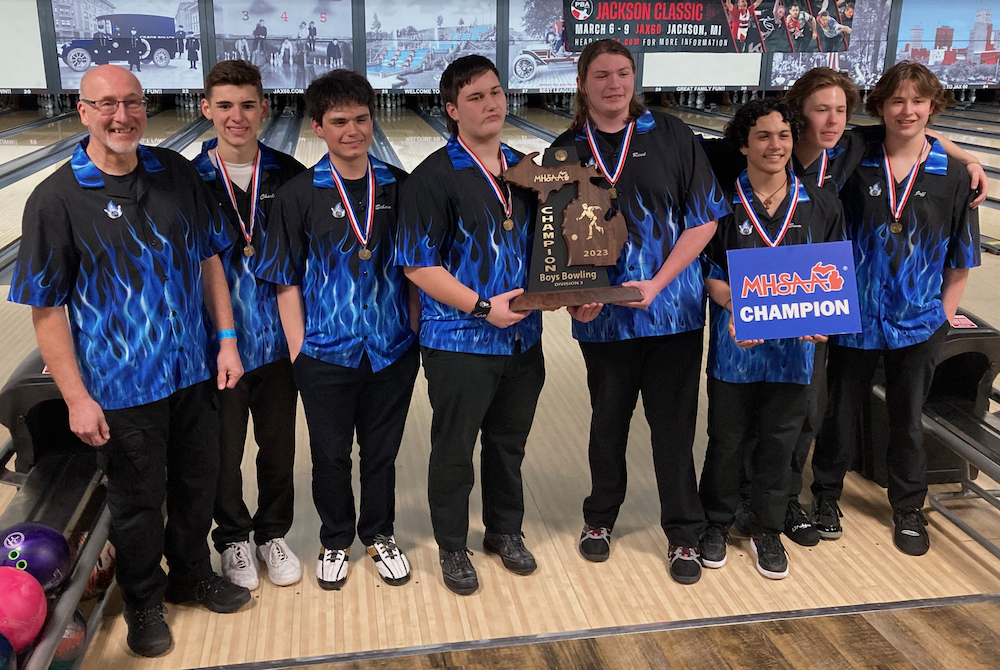
Senior Twins Power Lansing Catholic Surge, Junior Star Paces Flint Powers Title Run
By
Jeff Bleiler
Special for MHSAA.com
March 3, 2023
Jeff Wheeler said he has a “built-in best friend for life” in his twin brother, James.
At the urging of their mother a decade ago, they learned how to bowl. They endured unspeakable loss in 2018 when Melissa Wheeler died of cancer. And they persevered through a challenging six months in 2020 when Jeff developed and beat stage 4 Burkitt lymphoma.
On Friday, for their mother, they celebrated and cried together after leading Lansing Catholic to the Division 3 boys bowling Finals championship at Jax 60 in thrilling fashion.
After staking a 39-pin lead after two Baker games against Ogemaw Heights in the Final, the Cougars shook off a sluggish start to the team game just in time to snatch away the championship by a 1,239-1,216 margin.
“We’ve been through a lot in our life, a lot of rough times and we just always try to get through it, so doing this just means the entire world to us,” James Wheeler said. “It feels great.”
The senior twin brothers provided huge strikes when Lansing Catholic needed them most, which proved to be in the 10th frame of the championship. Trailing by about 80 pins entering the final frame, James Wheeler and Jeff Wheeler both doubled, Jeff’s first strike sealing the title and sending the Cougars faithful into a frenzy.
“I knew I needed the first shot just to get me hype and the team hype,” Jeff Wheeler said. “Our mom got us into it, and we finished our senior year strong. We did it for Mom.”
Jeff Wheeler’s 199 game with seven strikes led all scorers in the final game. After five opens in the first seven frames, James Wheeler changed balls and threw four straight strikes for 164. Charlie Gates delivered 179, Ethan Wolcott struck out in the 10th for 171 and Jack Hernly’s 158 rounded out the Cougars in the final.
Danny Gassman had 198 and Derek Malone 197 for Ogemaw Heights. Colin Matheson shot 178.
Cougars coach Doug Moore lauded his team’s resilience after it missed qualifying for the Finals last year by seven pins. They advanced out of their Regional by four pins last weekend and took advantage of the opportunity by qualifying third for Friday’s match play. They won their quarterfinal handily over Yale, and then squeaked out a 23-pin victory over 2022 champion Gladwin in the semifinal.
“All day we just said, ‘This is our time,’” Moore said. “Don’t worry about them, just bowl one frame at a time and do your game. This is awesome. I think we’re all going to start bawling.”
Ogemaw Heights qualified fifth, beat Napoleon in the quarterfinals and topped eighth-seeded Chesaning in the semifinals. Chesaning pulled off the upset of the day by ousting top seed and 2021 champion Armada in the quarterfinals by 15.
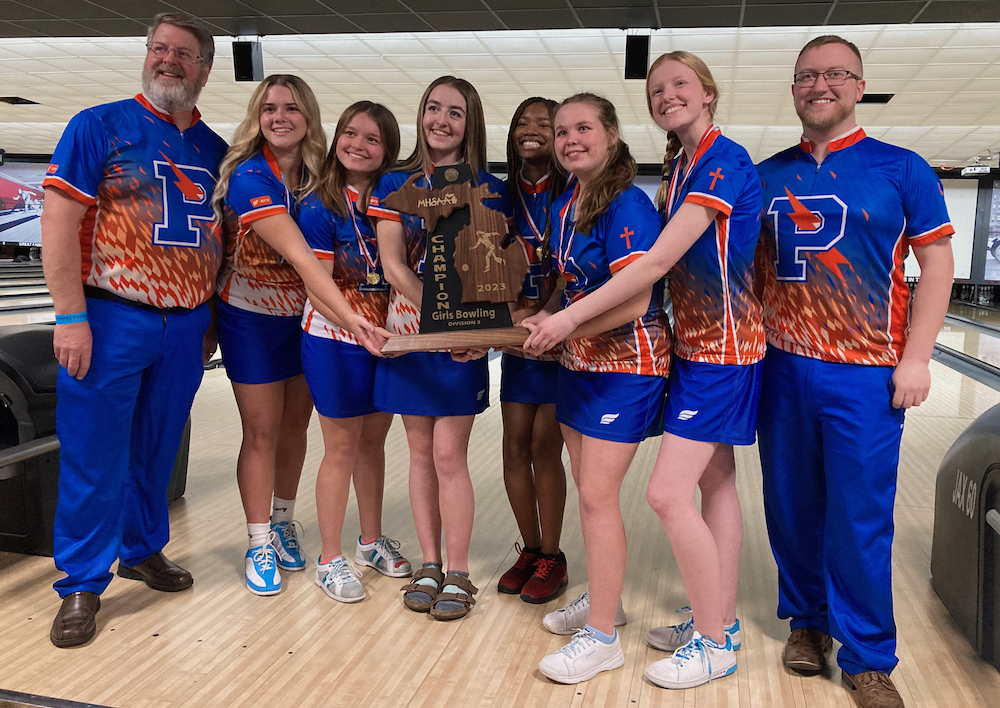
On the girls side, Flint Powers Catholic earned a narrow but fulfilling victory over Ishpeming Westwood, 1,024-1,007. Junior Elizabeth Teuber delivered a clutch strike in the ninth frame of the team game to complete a three-bagger.
Four years ago, the Chargers’ lineup was only four strong — and current seniors Lauren Harrold, Libby Hagan and Olivia Tremaine were three of them. Two years ago they added Teuber and Lillee-Ann Jacobs as freshmen, and the seeds for success were planted.
That’s only partially true, actually. Coach Matthew Wheeler, a graduate of high school bowling powerhouse Flint Kearsley, cultivated those seeds when he took over at Powers five years ago.
“Everything I learned about coaching, I learned from (Kearsley coach) Rob Ploof, who calls himself the Bill Belichick of high school bowling, and I don’t argue that point at all,” Wheeler said. “My aspiration was to build a program behind his theories and drive, and it’s nice to see it rewarded. These girls worked hard.”
Flint Powers reached the Finals last year, bowing out in the semifinals. They qualified fifth this year, defeated Midland Bullock Creek in the quarterfinals, 1,024-906, and earned a spot in the championship by beating top seed Napoleon, 1,176-1,115.
In the championship, Ishpeming took a 13-pin lead after the Baker games but had no answer for Teuber, who shot 221. Jacobs added 164 and Harrold had 147.
For Teuber, it was another highlight in a bowling career already full of them. She won the Division 3 Singles Final as a freshman and was runner-up last year. She will compete for another individual title Saturday after winning her Regional, but this team title was something special.
“This is what I’ve always wanted for my team, and now that we have it, it’s an amazing feeling,” she said. “With my win freshman year, I didn’t understand it. Now that I’m a junior and I understand how big a deal it is, it is incredible that they get to experience it, too.”
Kylie Junak shot 188 and Elise Ketola had 175 for Westwood, which earned the second seed in qualifying. The Patriots defeated Boyne City and Shepherd to reach the championship.