


Classes Still Create Hoosier Hysteria
July 27, 2017
By Rob Kaminski
MHSAA benchmarks editor
This is the fourth part in a series on MHSAA tournament classification, past and present, that will be published over the next two weeks. This series originally ran in this spring's edition of MHSAA benchmarks.
Twenty years ago, Bloomington North High School won the Indiana High School Athletic Association boys basketball championship, defeating Delta 75-54 at the RCA Dome in Indianapolis.
The date, March 22, 1997, is at the same time revered and disdained by traditionalists in the state who saw it as the last schoolboy championship game the state would ever host.
That’s how devout the game of basketball, particularly interscholastic basketball, had become in the Hoosier state during the 87 years a state champion – one state champion, to be precise – was crowned.
Following that 1997 season, the IHSAA moved to a four-class system for its roundball tournaments, like so many of its state association counterparts had done years earlier.
It would be shocking to find more than a small percentage of current high school basketball players around the country unfamiliar with the iconic movie Hoosiers, even though the film is now more than 30 years old.
And, the storyline for that blockbuster unfolded more than 30 years prior to its release, when small-town, undermanned Milan High School defeated Muncie Central High School 32-30 in the 1954 IHSAA title game.
Perhaps it’s because of the David vs Goliath notion, or the fame of the movie that replaced Milan with the fictional Hickory and real-life star Bobby Plump with Hollywood hero Jimmy Chitwood, or the simple fact that Indiana had something other states didn’t.
Whatever the reason, plenty of opposition remains to this day to basketball classification in the state.
The fact is, the small rural schools were regularly being beaten handily by the much larger suburban and city schools as the tournament progressed each season.
Small schools also were closing at a rapid rate following the state’s School Reorganization Act in 1959, as students converged on larger, centralized county schools. From 1960 to 2000, the number of schools entering the tournament dropped from 694 to 381, and in 1997 a total of 382 schools and 4,584 athletes began competition at the Sectional level (the first level of the IHSAA Basketball Tournament).
It was at the entry level of the tournament where school administrators felt the pain of the new class system, but not necessarily for the same nostalgic reasons as the fans who either attended or boycotted the tournament.
At the Sectional round of the tournament, the IHSAA was culling just 2 percent of the revenue, with the participating schools splitting the balance. So, when Sectional attendance dropped by 14 percent in that first year of class basketball, many schools realized a financial loss. It was money they had grown to count on in prior years to help fund various aspects of the department.
Schools cumulatively received more than $900,000 from Sectional competition in 1998, but that total was down from more than $1 million in the last year of the single-class tournament.
Yet, the current format provides a great deal more opportunity and realistic chances at championship runs for schools of all enrollments.
To date, 60 additional teams have championship or runner-up trophies on display in school trophy cases around Indiana.
That was the mission in front of then-IHSAA commissioner Bob Gardner (now National Federation executive director) once the board made its decision: to give thousands more student-athletes the opportunity for once-in-a-lifetime experiences.
As any statistician knows, figures can be manipulated to tell any side of a story. Declining attendance in year one of class basketball is such a number.
The truth is tournament attendance had been on a steady downward spiral since its peak of just over 1.5 million in 1962. By the last single-class event in 1997, the total attendance was half that.
The challenge then and today, as it is for all state associations, is to find that delicate balance for those holding onto tradition, those holding onto trophies, and the number of trophies to hand out.
Editor’s Note: Stories from the Fort Wayne Journal Gazette in 1998 and from a 2007 issue of Indianapolis Monthly provided facts in this article.
'3rd-Quarter Team' West Catholic Shows Why in Record-Setting Triumph
By
Paul Costanzo
Special for MHSAA.com
November 25, 2022
DETROIT – When Negaunee senior Phil Nelson returned the opening kickoff of the second half Friday and tied the Division 6 championship game at 14, it woke something up inside Ford Field.
Unfortunately for Negaunee, that something was Timmy Kloska.
“I just saw that kick return, and it really fired me up,” the Grand Rapids West Catholic senior running back said. “Our o-line got going, the holes were opening and we just got going.”
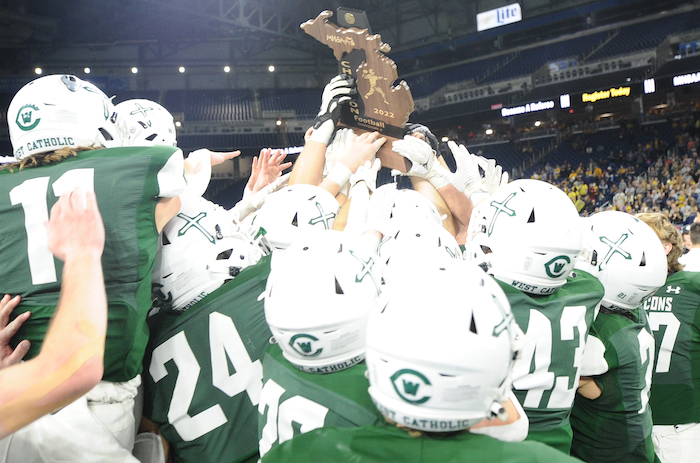
Kloska dominated the rest of the game, rushing for 172 yards and four touchdowns during the second half, leading West Catholic to a 59-14 victory. It was the sixth Finals title for West Catholic, and first since 2017.
The Falcons’ 59 points set the record for an 11-player Final, breaking the mark set by both Flint Powers Catholic and Saginaw Nouvel in 2011.
“It’s great,” said Kloska, who finished with 241 yards rushing for the game. “Me and all my friends, and all the players on the team, we’ve worked really hard for this. This has been a dream since we were in seventh grade, watching all those state championships. It’s a great feeling because we’ve worked so hard.”
 West Catholic put on an offensive display, gaining 520 yards of total offense and averaging 14.9 yards per play. That number sat at 16.8 yards per play entering the fourth quarter.
The Falcons had five touchdowns of longer than 30 yards, and three longer than 60. They were also remarkably balanced, as they gained 295 yards on the ground and 225 through the air on the arm of quarterback Bernie Varnesdeel.
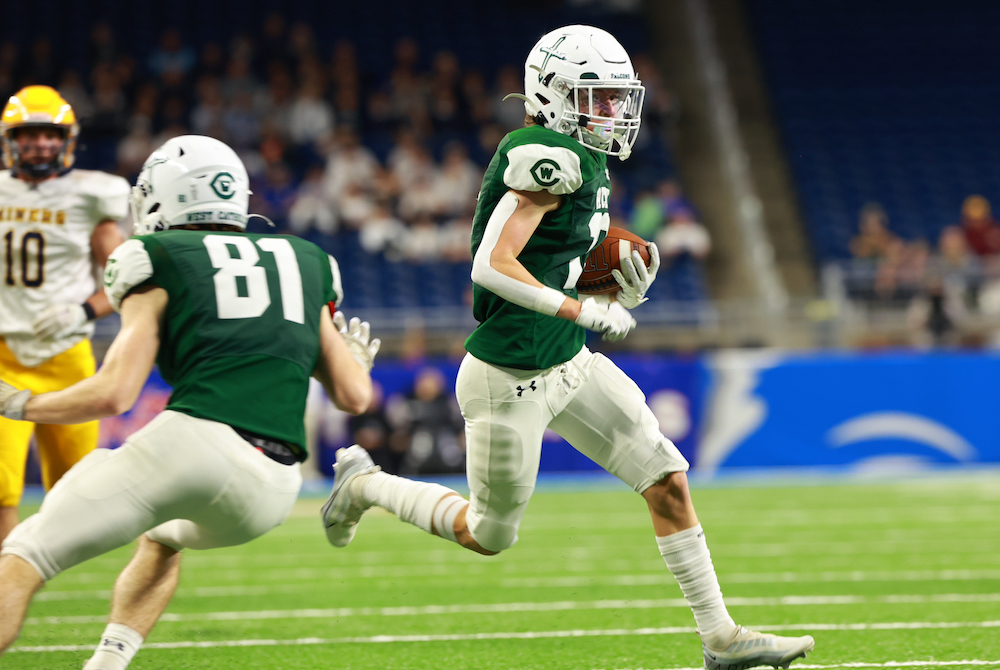
“Our coaches, all week, have put us in good positions,” said junior receiver Carter Perry, who had touchdown receptions of 72 and 32 yards in the first half. “When you get put in that position, it’s almost easy to make the plays and execute them.”
It started right away, too, as Perry’s 72-yard score came on the first play from scrimmage.
“I knew right before the game he was going to be wide open,” Varnesdeel said. “We were working on that play all week at practice, and he’s been open most of the time. He was the main option right there, so I just hit him and executed.”
Despite the big-play success, West Catholic (13-1) wasn’t able to pull away from Negaunee because it barely had the ball during the first half.
Negaunee (13-1) had a 20:03-3:57 edge in time of possession, and ran 37 plays to West Catholic’s 13. But it took until the final play of the half for the Miners to get on the scoreboard. They scored on a 6-yard pass from Ty Jacobson to Nelson on 4th-and-goal to make it 14-7 at halftime. The scoring toss was set up by a 32-yard pass on a reverse flea flicker from Jacobson to Eli VanBuren on a third down near midfield.
“Our gameplan was really similar from the first half to the second half, but you have to give Negaunee a lot of credit,” West Catholic coach Landon Grove said. “They did a really good job. They slowed the game down. They ate up a lot of clock. That’s credit to them. They got us out of rhythm, and they kind of forced our hand a little bit by not letting us have the football.”
When Nelson ran the kick back to start the second half and tie the game at 14, it seemed as if Negaunee’s strategy was working perfectly.
 But West Catholic’s 45 unanswered points to end the game negated all of that.
“We ran out of gas,” Negaunee coach Paul Jacobson said. “We played toe-to-toe with them for a half, Phil had a great return to start the second half. I don’t know if we woke a sleeping giant. It was a combination of that, and we kind of ran out of gas. Then they rolled that second half on us.”
The Falcons scored 31 points in the third quarter, and didn’t take up a lot of time in doing so.
Kloska had touchdown runs of 61, 16 and 3 yards, and Varnesdeel threw his third touchdown pass of the game, a 68-yarder to Andrew McAlary. Carson Beekman added a 31-yard field goal.
Those five drives lasted a total of 4:35.
The difference between the third quarter and the first half, however, was that the West Catholic defense was getting the Negaunee offense off the field.
“Kind of our M.O. this year has been third quarters,” Grove said. “Kind of coming out with our hair on fire and taking over games. That’s what we did again today. That’s a testament to our defensive staff for making those adjustments they needed to make. Then our kids buying into those adjustments and believing in the process.”
Kloska added a 13-yard touchdown run in the fourth quarter, while Elliot Zainea had a 26-yard touchdown run for the Falcons.
Varnesdeel was 5-of-10 passing on the night for his 225 yards and three scores. McAlary had three catches for 121 yards, and Perry had his two for 104.
Charlie DeBruyn led the West Catholic defense with 10 tackles, including 3.5 for loss, and forced a fumble.
Kai Lacar led Negaunee with 45 yards rushing, and Ty Jacobson was 7-of-12 passing for 78 yards.
“I’m just proud of these guys, the way they battled adversity,” Paul Jacobson said. “They battled a ton of different stuff this year. Just the ups and downs, they were able to stick together. We really preach a family mentality, and they stuck together through and through. I’m proud of these guys.”
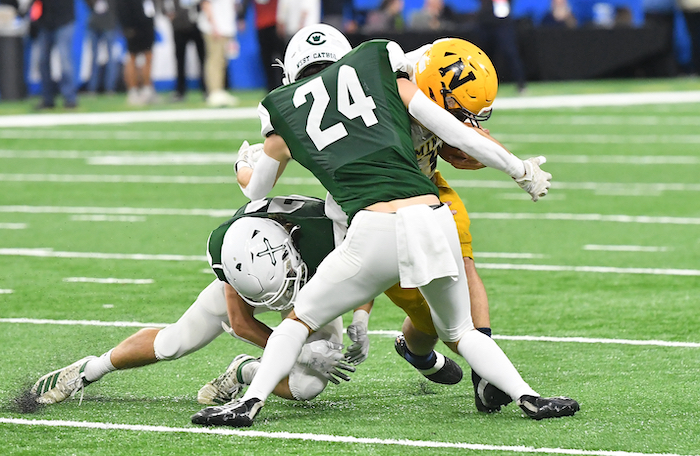
PHOTOS (Top) West Catholic’s Carter Perry (13) gets upfield during his team’s Division 6 championship win. (Middle) The Falcons’ Danny Groskiewicz (24) and Joe Debski bring down a Negaunee ball carrier. (Below) West Catholic players celebrate Friday’s win. (Click for more from Hockey Weekly Action Photos.)