


Classes Still Create Hoosier Hysteria
July 27, 2017
By Rob Kaminski
MHSAA benchmarks editor
This is the fourth part in a series on MHSAA tournament classification, past and present, that will be published over the next two weeks. This series originally ran in this spring's edition of MHSAA benchmarks.
Twenty years ago, Bloomington North High School won the Indiana High School Athletic Association boys basketball championship, defeating Delta 75-54 at the RCA Dome in Indianapolis.
The date, March 22, 1997, is at the same time revered and disdained by traditionalists in the state who saw it as the last schoolboy championship game the state would ever host.
That’s how devout the game of basketball, particularly interscholastic basketball, had become in the Hoosier state during the 87 years a state champion – one state champion, to be precise – was crowned.
Following that 1997 season, the IHSAA moved to a four-class system for its roundball tournaments, like so many of its state association counterparts had done years earlier.
It would be shocking to find more than a small percentage of current high school basketball players around the country unfamiliar with the iconic movie Hoosiers, even though the film is now more than 30 years old.
And, the storyline for that blockbuster unfolded more than 30 years prior to its release, when small-town, undermanned Milan High School defeated Muncie Central High School 32-30 in the 1954 IHSAA title game.
Perhaps it’s because of the David vs Goliath notion, or the fame of the movie that replaced Milan with the fictional Hickory and real-life star Bobby Plump with Hollywood hero Jimmy Chitwood, or the simple fact that Indiana had something other states didn’t.
Whatever the reason, plenty of opposition remains to this day to basketball classification in the state.
The fact is, the small rural schools were regularly being beaten handily by the much larger suburban and city schools as the tournament progressed each season.
Small schools also were closing at a rapid rate following the state’s School Reorganization Act in 1959, as students converged on larger, centralized county schools. From 1960 to 2000, the number of schools entering the tournament dropped from 694 to 381, and in 1997 a total of 382 schools and 4,584 athletes began competition at the Sectional level (the first level of the IHSAA Basketball Tournament).
It was at the entry level of the tournament where school administrators felt the pain of the new class system, but not necessarily for the same nostalgic reasons as the fans who either attended or boycotted the tournament.
At the Sectional round of the tournament, the IHSAA was culling just 2 percent of the revenue, with the participating schools splitting the balance. So, when Sectional attendance dropped by 14 percent in that first year of class basketball, many schools realized a financial loss. It was money they had grown to count on in prior years to help fund various aspects of the department.
Schools cumulatively received more than $900,000 from Sectional competition in 1998, but that total was down from more than $1 million in the last year of the single-class tournament.
Yet, the current format provides a great deal more opportunity and realistic chances at championship runs for schools of all enrollments.
To date, 60 additional teams have championship or runner-up trophies on display in school trophy cases around Indiana.
That was the mission in front of then-IHSAA commissioner Bob Gardner (now National Federation executive director) once the board made its decision: to give thousands more student-athletes the opportunity for once-in-a-lifetime experiences.
As any statistician knows, figures can be manipulated to tell any side of a story. Declining attendance in year one of class basketball is such a number.
The truth is tournament attendance had been on a steady downward spiral since its peak of just over 1.5 million in 1962. By the last single-class event in 1997, the total attendance was half that.
The challenge then and today, as it is for all state associations, is to find that delicate balance for those holding onto tradition, those holding onto trophies, and the number of trophies to hand out.
Editor’s Note: Stories from the Fort Wayne Journal Gazette in 1998 and from a 2007 issue of Indianapolis Monthly provided facts in this article.
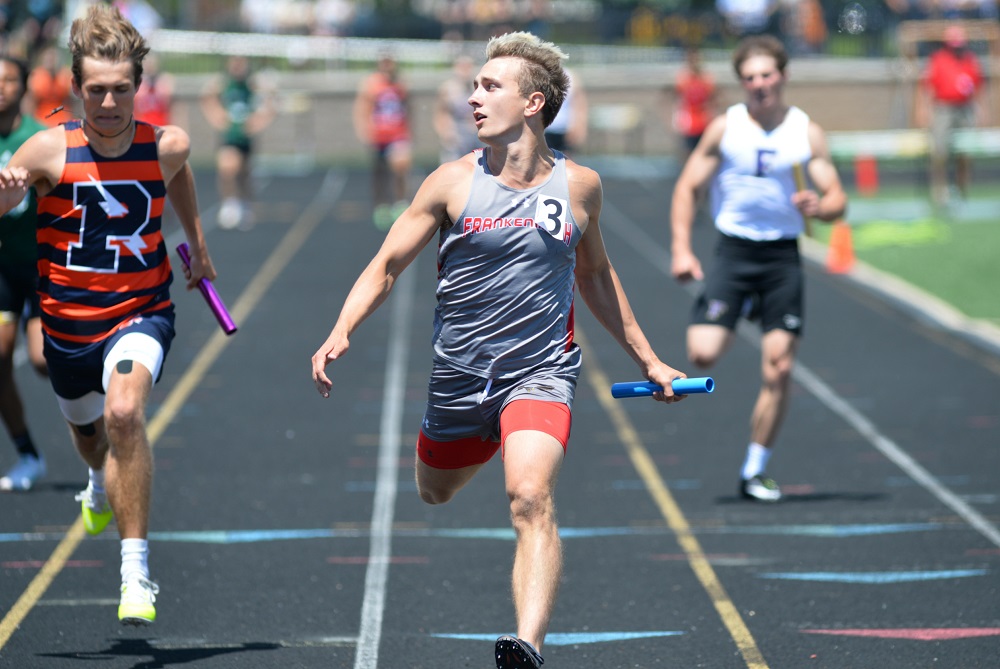
Frankenmuth Takes Championship Surge Through Final Race
June 5, 2021
ZEELAND – The Frankenmuth boys track & field team knew it had a chance Saturday to win its first MHSAA Finals championship since 2011 – but only if everything went right.
Not everything did – but plenty went better than planned as the Eagles won for the first time in Lower Peninsula Division 2, outpacing runner-up Flint Powers Catholic by 3¾ points to add a third championship to those won in Division 3 in 2005 and 2011.
Frankenmuth’s power in relays paid off in the final event, as the Eagles finished second in the 1,600 relay to Yale, scoring eight points while Powers came in eighth to add only one point to its team total.
That runner-up finish matched another in the 800 relay, and Frankenmuth also won the 400 relay with senior Daniel Barger joining junior Ian Stephens and sophomores Sam Barger and Andrew Braman. Those four ran the 800 together as well, with senior Ryan Brenner and junior Seth Malmo joining Sam Barger and Stephens on the 1,600.
 “We knew it came down to the mile relay, and I was pretty easy going the entire time – and then the mile relay hits and we knew Powers had to do something and we knew we had to do something, and I had to be alone for a little while,” Frankenmuth coach Luke Sheppard said. “I just had to sit and soak it all in, but it was a lot of fun – it’s a lot of fun to watch these kids run. They always compete. They always do what they’re supposed to.”
The Eagles’ lone win came in the 400 relay, but they picked up other points throughout the day in the 100 and 200 dashes, 300 hurdles, high jump and discus.
Powers, meanwhile, got a first in the 100 and third in the 200 from junior Austin Hamlin and placed in all four relays among a variety of scoring performances.
Powers had entered seeded first in the 400 relay and Frankenmuth third based on Regional times, but the Eagles crossed the finish line 41 hundredths of a second faster than the runner-up Chargers.
“We always know coming into meets we’ve got to up-seed – be better than what we’re seeded, be better than what we’ve been doing,” said Brenner, who in addition to his 1,600 relay leg contributed a sixth place in the 300 hurdles and seventh in high jump. “That was our mindset through this whole meet, knowing we had to perform at the best of our capabilities to do what we just did.”
Motivation was not in short supply anywhere this weekend, or throughout the season, after COVID-19 led to 2020 spring sports being canceled.
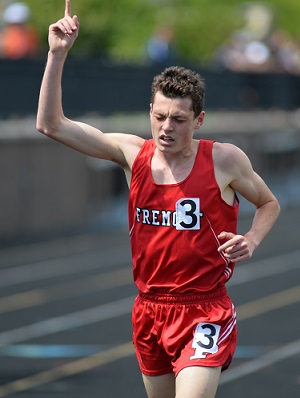
Fremont senior Nathan Walker capped his senior year Saturday by adding wins in the 1,600 (4:16.12) and 3,200 (9:34.30) to the cross country championship he earned in the fall. Edwardsburg junior Luke Stowasser also was a double champion in Division 2, claiming the long jump in 21-10 and high jump in 6-6 after also winning the former two years ago as a freshman.
 Hudsonville junior Ryan Shinabery edged Monroe Jefferson junior Alex Mansfield by 15 inches to win the discus with a toss of 163-7, but Mansfield won the shot put by more than eight feet ahead of the field with a toss of 59-2½. Allendale junior Cam Battjes rounded out the field event champions with a pole vault of 14-4.
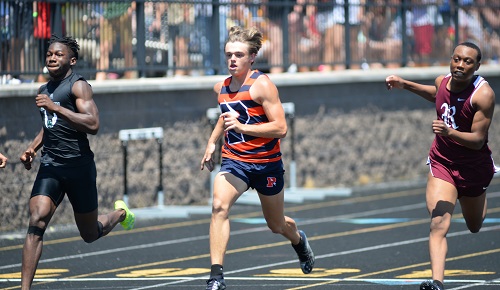
Romulus junior Troy Cranford won the 200 in 22.84, pacing a race where the top three finishers were separated by a tenth of a second – after he was third and Berrien Springs junior Jamal Hailey second to Hamlin in a 100 decided by less than two hundredths of a second between those three. Orchard Lake St. Mary’s senior Edward Watkins won the 400 in 49.1 seconds, and Marysville senior Evan Woodard won the 800 in 1:55.25. Allendale junior Patrick Adams won the 110 hurdles in 15.19 seconds, then finished second in the 300 as Vicksburg senior Levi Thomas edged him in 40.10.
Fruitport won the 800 relay in 1:29.64, while Yale won the 1,600 in 3:25.85 and Holland Christian won the 3,200 relay by less than a second, in 8:01.26.
PHOTOS: (Top) Frankenmuth’s Daniel Barger, middle, crosses first in a close 400 relay finish Saturday. (Middle) Fremont’s Nathan Walker finishes one of his two championship runs. (Below) Flint Powers Catholic’s Austin Hamlin, middle, edges Jamal Hailey of Berrien Springs (far left) and Romulus’ Troy Cranford in the 100. (Photos by Dave McCauley/RunMichigan.com.)