


Classes Still Create Hoosier Hysteria
July 27, 2017
By Rob Kaminski
MHSAA benchmarks editor
This is the fourth part in a series on MHSAA tournament classification, past and present, that will be published over the next two weeks. This series originally ran in this spring's edition of MHSAA benchmarks.
Twenty years ago, Bloomington North High School won the Indiana High School Athletic Association boys basketball championship, defeating Delta 75-54 at the RCA Dome in Indianapolis.
The date, March 22, 1997, is at the same time revered and disdained by traditionalists in the state who saw it as the last schoolboy championship game the state would ever host.
That’s how devout the game of basketball, particularly interscholastic basketball, had become in the Hoosier state during the 87 years a state champion – one state champion, to be precise – was crowned.
Following that 1997 season, the IHSAA moved to a four-class system for its roundball tournaments, like so many of its state association counterparts had done years earlier.
It would be shocking to find more than a small percentage of current high school basketball players around the country unfamiliar with the iconic movie Hoosiers, even though the film is now more than 30 years old.
And, the storyline for that blockbuster unfolded more than 30 years prior to its release, when small-town, undermanned Milan High School defeated Muncie Central High School 32-30 in the 1954 IHSAA title game.
Perhaps it’s because of the David vs Goliath notion, or the fame of the movie that replaced Milan with the fictional Hickory and real-life star Bobby Plump with Hollywood hero Jimmy Chitwood, or the simple fact that Indiana had something other states didn’t.
Whatever the reason, plenty of opposition remains to this day to basketball classification in the state.
The fact is, the small rural schools were regularly being beaten handily by the much larger suburban and city schools as the tournament progressed each season.
Small schools also were closing at a rapid rate following the state’s School Reorganization Act in 1959, as students converged on larger, centralized county schools. From 1960 to 2000, the number of schools entering the tournament dropped from 694 to 381, and in 1997 a total of 382 schools and 4,584 athletes began competition at the Sectional level (the first level of the IHSAA Basketball Tournament).
It was at the entry level of the tournament where school administrators felt the pain of the new class system, but not necessarily for the same nostalgic reasons as the fans who either attended or boycotted the tournament.
At the Sectional round of the tournament, the IHSAA was culling just 2 percent of the revenue, with the participating schools splitting the balance. So, when Sectional attendance dropped by 14 percent in that first year of class basketball, many schools realized a financial loss. It was money they had grown to count on in prior years to help fund various aspects of the department.
Schools cumulatively received more than $900,000 from Sectional competition in 1998, but that total was down from more than $1 million in the last year of the single-class tournament.
Yet, the current format provides a great deal more opportunity and realistic chances at championship runs for schools of all enrollments.
To date, 60 additional teams have championship or runner-up trophies on display in school trophy cases around Indiana.
That was the mission in front of then-IHSAA commissioner Bob Gardner (now National Federation executive director) once the board made its decision: to give thousands more student-athletes the opportunity for once-in-a-lifetime experiences.
As any statistician knows, figures can be manipulated to tell any side of a story. Declining attendance in year one of class basketball is such a number.
The truth is tournament attendance had been on a steady downward spiral since its peak of just over 1.5 million in 1962. By the last single-class event in 1997, the total attendance was half that.
The challenge then and today, as it is for all state associations, is to find that delicate balance for those holding onto tradition, those holding onto trophies, and the number of trophies to hand out.
Editor’s Note: Stories from the Fort Wayne Journal Gazette in 1998 and from a 2007 issue of Indianapolis Monthly provided facts in this article.
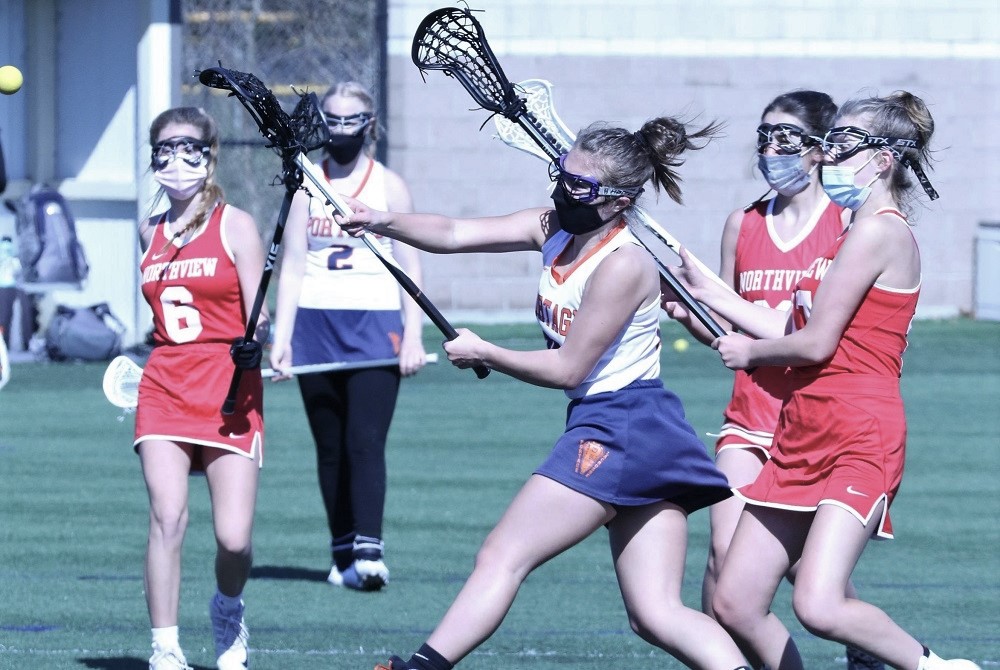
Portage Unites 'Frenemies' Into Lacrosse Force
By
Pam Shebest
Special for MHSAA.com
May 11, 2021
PORTAGE — On the basketball court, Brooke Hoag and Grace Cheatham were “frenemies.”
 But now that spring sports are here, that has changed.
The two seniors from rival schools are teammates.
Hoag, from Northern, and Cheatham, from Central, are both members of the Portage girls lacrosse team, a co-op composed of players from both schools.
When playing against each other, “you have to be focused on your team,” Hoag said. “When you come to lacrosse, it’s almost like you flip a switch because they’re your team now.
“Playing against them is just fun. You look at them and you know how they play in different sports, so it’s fun because you can kind of pick on them. It’s also a competition, and you definitely learn how to separate the two sports.”
After being shut down last year because of COVID-19 restrictions, the lacrosse team is having one of its best seasons ever.
Portage is 12-2 so far and currently ranked No. 8 in Division I, according to LaxNumbers.com
“For our returners, I think (the year off) has given them more motivation to want to play,” said Kate Twichell, in her seventh year as head coach. “There’s a fire lit, especially under my seniors.
 “They’re playing so hard. They understand every opportunity is another opportunity they weren’t going to get.”
This season is different from any other, with mandated masks and rapid testing. Adapting to cool weather and then hot makes masking up a little more challenging, Hoag said, but worth it to have a chance to play. Twichell said Portage schools provide a mask that is easier to wear. “None of them will claim they love it,” she added. “The second we say they can take them off, they will 100 percent take them off.”
But in spite of the drawbacks, “This year, our varsity team is playing together the best I think it’s ever played together,” Twichell said. “The team chemistry is just phenomenal.
“That’s really all them. They’ve really taken extra time to make sure that they are putting in the work to come together.”
For the first time, Portage is hosting an MHSAA Division 1 Regional, facing Zeeland East on May 20. Finals are June 12 at Novi High School.
Other Northern varsity players are seniors Mairin Boshoven and Karly Turchan, junior Annie Galin and freshman Avery Kelly.
Central players include seniors Kyla Meyle, Jenna Camp, Calista Richmond and Lauren DeHaan; juniors Ryan Knauer, Olivia Jensenius and Lauren King; and sophomores Sam Swafford and Lexie Springman. Casey Hendrixson coaches the junior varsity team.
Learning Fast
Neither Hoag nor Cheatham grew up playing lacrosse, but that is not a problem, Twichell said.
“My varsity players are all returning, so I have six returning starters on varsity right now,” she said. “My JV team, of the 15 of them, 10 are new to the sport this year.
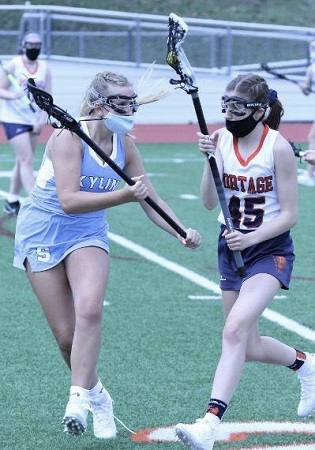 “They’ve never touched a stick before. MHSAA gave us some small practices so we had a few in earlier, but most of them are brand new within the last 12 months.”
Learning that the stick is actually an extension of their hand is one of the hardest adjustments for new players, she said.
“I always tell the kids the first week is going to be the hardest – the frustration of dropping the ball and not being able to figure out the mechanics of it is always going to be the most difficult,” she said.
Hoag first played the sport when she was in eighth grade and took to it immediately.
“The only downside is the bruises you can get from it, but I like to say they’re like trophies showing you’re an aggressive player and it’s just something that you almost want to show that you play,” the midfielder said.
She kept in shape during the shutdown by working out at home.
“I have a net and a rebounder in my backyard, so I would practice shooting and my stick skills by myself,” she said.
Losing last season was especially difficult for the midfielder.
Not only is the junior season a big year for college recruitment but “my sister (Ashleigh) was a senior and I got my last chance to play with her taken away.”
Cheatham also has played lacrosse for five years, with her interest piqued by her father and brother.
Family helped her hone her skills during the shutdown.
“I live super close to Portage Central High School, so me and my brother (Andrew, a freshman who plays lacrosse at Central) used to go and play a lot of wall ball against The Stable. We did a lot of shooting drills on our own, just to keep busy.”
Both Hoag and Cheatham also played on summer and fall travel teams, which helped keep them in shape.
One unexpected moment for the two happened May 1 at the Matt Thrasher Memorial Games when each received a $500 scholarship, awarded each year to two players from the girls team and a player from each school’s boys team.
Thrasher played lacrosse and, while a freshman at Northern, died in a boating accident in 2004.
Cheatham echoed Hoag in saying it was an honor to receive the award.
“The fact that his family still does this is really amazing,” she said.
Hoag is headed to Trine University and will play lacrosse there, while Cheatham will attend Kent State in the nursing program and hopes to continue to play the sport, possibly at the club level.
Ultimate goal
While the ultimate goal is to one day have enough players to field a girls team at each school, the co-op team is under the umbrella of Portage Northern.
 That poses one of the few problems for Twichell, who teaches Spanish at Hackett Catholic Prep.
“For me, honestly, the biggest thing is recruiting, getting into both schools equally to get enough kids to field a team,” she said. “Trying to get in the schools as one person from outside the school is pretty difficult.
“Likewise, especially during the offseason, getting enough practice time at both facilities so that each player gets their home facility or their home games or home practices, that can be a challenge.”
Next year that could be a bit easier. Twichell’s husband, Kurt, was recently named Northern’s head football coach after longtime coach Pete Schermerhorn retired. The past seven years, he was on the Portage Central football staff.
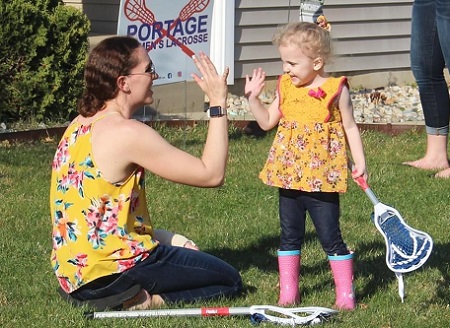
One future recruit for the girls team should be a shoo-in. The couple’s 2½-year-old twins – daughter Aubrey and son Griffin – already have lacrosse sticks.
 Pam Shebest served as a sportswriter at the Kalamazoo Gazette from 1985-2009 after 11 years part-time with the Gazette while teaching French and English at White Pigeon High School. She can be reached at [email protected] with story ideas for Calhoun, Kalamazoo and Van Buren counties.
PHOTOS: (Top) Portage’s Brooke Hoag fires a shot against Grand Rapids Northview this spring. (2) From left: Portage coach Kate Twichell, Grace Cheatham and Brooke Hoag. (3) Grace Cheatham (45) advances the ball against Ann Arbor Skyline. (4) Twichell and daughter Aubrey enjoy a moment with lacrosse stick in hand. (Action photos by Chris Boot. Head shots by Pam Shebest. Twichell photo courtesy of the Twichell family.)